
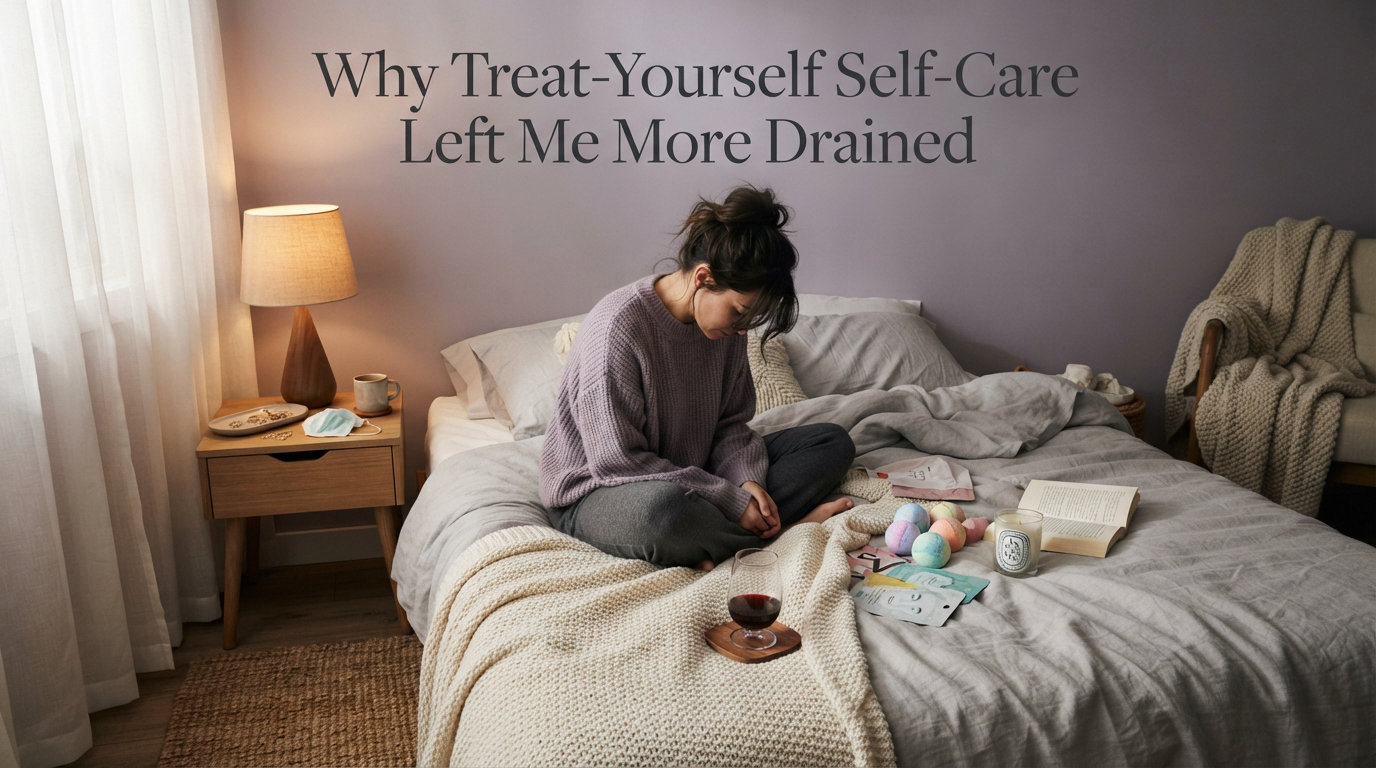
I bought the bath bomb. I booked the massage. I lit the candle that cost more than my dinner. And when it was all over, I felt worse than before I started — not refreshed, not glowing, just hollow and oddly guilty.
If you have ever wondered why treat-yourself self-care left you more drained, you are not broken and you are not ungrateful. You are experiencing something therapists and researchers now recognize as a real, documented phenomenon called self-care fatigue. And it is far more common than the wellness industry wants to admit.
I spent years chasing the version of self-care I saw everywhere online. The face masks. The expensive yoga retreats. The “you deserve it” mentality that turned every weekend into a recovery project. Each attempt left me emptier, not fuller. The more I treated myself, the more exhausted I became.
Here is what I learned the hard way: the problem was never me. The problem was the entire framework of treat-yourself culture. When self-care becomes another performance, another expense, another item on your already-overloaded to-do list, it stops being care at all. It becomes one more thing draining the energy it promised to restore.
In this article, I will walk you through why self-care that drains energy happens, what is going on in your brain and body when treating yourself backfires, and how to build a version of rest that actually recharges you. No expensive products required. No guilt attached.
Let us get into why that bubble bath left you feeling worse — and what genuinely helps instead.
Table of Contents
What Is Self-Care Fatigue?
Self-care fatigue is the exhaustion and frustration that builds when messages about self-care keep coming but your underlying reality never changes. Dr. Lourival Baptista-Neto of Columbia University describes it plainly: self-care fatigue occurs when “these messages about self-care keep coming, but our reality is not changing around us.”
Think of it this way. If your life is a house with a leaking roof, a scented candle will not fix the water damage. Yet we are told to just light the candle, breathe deeply, and feel grateful.
Self-care fatigue shows up as emotional exhaustion, cynicism toward wellness advice, and a strange guilt that you cannot seem to self-care your way out of burnout. It is not laziness. It is your mind and body rejecting a solution that was never designed to address the actual problem.
This phenomenon is distinct from clinical burnout, though the two often overlap. Burnout is the fire. Self-care fatigue is what happens when someone hands you a tiny water bottle and tells you the inferno is your personal responsibility to extinguish.
When I first encountered the term self-care burnout, something clicked immediately. I was not failing at wellness. I was exhausted by a version of self-care that demanded more energy than it ever returned.
Why Treat-Yourself Self-Care Left Me More Drained
Treat-yourself self-care left me more drained because it functioned as another obligation dressed up as a reward. Every “you deserve this” activity carried hidden costs: planning, spending, performing, and then evaluating whether it worked. The framework itself was exhausting.
Self-Care Became Another Task on My List
The moment I turned rest into a scheduled activity, it stopped being restful. I would block out Sunday afternoon for self-care, then spend the morning anxious about doing it correctly. By the time I sat down with my face mask and herbal tea, I was already running a mental checklist. Did I relax hard enough? Was this worth the money? Should I feel better by now?
That is not rest. That is a performance review for your weekend.
The self-care paradox is that the more effort you put into planning and executing rest, the less restorative it becomes. Your brain treats it as work because the structure feels like work — deadlines, expectations, and a pass-fail outcome.
The Dopamine Trap of Reward-Based Rest
Treating yourself activates your brain’s reward system, which sounds wonderful until you understand the crash. Each purchase, each treat, each “you earned this” moment releases a spike of dopamine — the same neurotransmitter involved in addiction cycles. The high fades fast, leaving you lower than where you started.
This is why that shopping spree felt amazing for two hours and terrible by evening. It is why the spa day did not fix the Sunday Scaries. Reward-based self-care creates a mini cycle of dependence: you need the next treat to feel okay again, and each treat works a little less than the last.
I noticed this pattern in my own life. The first time I bought myself flowers, it felt special. By the tenth time, it felt like a routine I was going through to feel something. The reward had lost its power, but I kept chasing it because the wellness world told me this was how I was supposed to recharge.
Decision Fatigue and the Mental Cost of Choosing
Decision fatigue is real, and it is one of the biggest reasons self-care that drains energy catches us off guard. By the time you have researched the best yoga class, compared prices, read reviews, booked the slot, and arranged childcare, your mental energy is already spent.
Psychologists call this ego depletion — the concept that willpower and decision-making draw from a limited pool of mental resources. When that pool is empty, no amount of lavender oil will refill it. You arrive at your self-care activity already depleted, then blame yourself for not feeling restored.
I used to spend thirty minutes choosing which meditation app to try, then feel too tired to actually meditate. The choosing was the drain. The practice never had a chance.
Your Nervous System Cannot Tell the Difference
Your body cannot tell the difference between “exciting treat” and “stressful event.” A weekend shopping trip, a crowded fitness class, or a high-energy social outing all activate your sympathetic nervous system — your fight-or-flight response. Your cortisol spikes. Your heart rate goes up. Your body prepares for action, not rest.
When your baseline is already chronic stress, layering stimulating activities on top does not create calm. It creates more arousal. You end the day wired, anxious, and confused about why your “relaxing” plans left you feeling like you ran a marathon.
I used to think I was bad at relaxing. Turns out, I was choosing stimulating activities and calling them rest. Once I understood cortisol dysregulation, the mystery solved itself. My body was doing exactly what bodies do when they get excited signals — preparing for threat, not settling into safety.
Signs You Are Caught in the Self-Care Paradox
You might be stuck in the self-care paradox if your attempts to rest leave you more depleted than before. Here are the signs I recognized in myself — see if any of them feel familiar.
You feel guilty during and after self-care activities, as though you should be doing something productive instead. The guilt turns rest into stress.
Self-care feels like another chore you have to schedule, plan, and execute correctly. It has a pass-fail quality that makes it feel like work.
You spend more time researching and buying self-care products than actually resting. The shopping is the activity, and the crash follows.
After a treat-yourself day, you feel emptier, not fuller. Sometimes you feel sad without being able to explain why.
You have started rolling your eyes at wellness content because it feels tone-deaf to your actual reality and constraints.
Your self-care requires spending money that you later stress about, which creates a fresh source of anxiety.
You perform self-care for others — on social media, in conversations — to prove that you are handling things. The performance replaces the rest.
If you nodded along to three or more of these signs, you are not failing at wellness. You are experiencing treat yourself guilt and performative self-care — and recognizing the pattern is the first step toward something that actually helps.
The Guilt-Shame Loop of Failed Self-Care
The cruelest part of self-care fatigue is the guilt it generates. When treating yourself does not work, you do not just feel tired. You feel like you have failed at something that was supposed to be effortless.
I would finish a self-care Sunday and think, “I did everything right. Why don’t I feel better? What is wrong with me?” That internal voice is not harmless. It feeds a shame loop: the self-care fails, you blame yourself, the blame drains more energy, and suddenly you need rest even more desperately than before.
For people-pleasers and caregivers, this loop is especially vicious. You have spent your life pouring energy into other people, and now the culture tells you to fill your own cup. But the cup has a hole in it — created by the same obligations, expectations, and lack of boundaries that drained you in the first place. Pouring water into a leaky cup and blaming yourself for the spill is not a strategy. It is a setup.
The guilt comes from a false premise: that rest is something you earn through correct behavior. You did not earn the right to sleep. You did not deserve a bath because you were productive enough. Rest is a biological need, not a reward for performance. The moment I internalized that, the guilt began to loosen its grip.
Why a Bubble Bath Will Not Fix Burnout
A bubble bath will not fix burnout because burnout is a systemic problem, not a personal hygiene issue. Neither will a massage, a gratitude journal, or a forty-dollar candle. These things might feel nice for thirty minutes. They will not address the root cause.
Burnout stems from chronic overwork, lack of control over your time, insufficient support, and a fundamental misalignment between your values and your environment. These are structural issues that no amount of self-care products can touch.
When I was deep in burnout, I tried every self-care strategy I could find. Nothing shifted the exhaustion until I changed the conditions creating it — not the activities I used to cope with it. That meant fewer commitments, honest conversations about my capacity, and walking away from situations that were actively harming me.
Research backs this up. Studies on chronic stress consistently show that individual coping strategies, while helpful for short-term relief, cannot override ongoing exposure to stressors. If your job demands sixty hours a week, no amount of meditation will make that sustainable. If your caregiving load is impossible, no face mask will make it manageable.
This does not mean self-care is useless. It means we have been sold a lie: that burnout is a personal failure fixable with personal solutions. Sometimes the most effective form of self-care is saying no, drawing a hard boundary, or walking away from something that is depleting you. Forum discussions across Reddit capture this frustration perfectly. Hundreds of people describe running on fumes, trying every wellness trend, and feeling worse because their reality has not changed — and neither has the advice they keep receiving.
From Self-Care to Self-Nurturing
The shift that changed everything for me was moving from self-care to self-nurturing. A Psychology Today framework helped me understand the difference, and it is worth breaking down because it reframes everything.
Self-care, as marketed to us, is performative. It is a face mask for Instagram. It is a checklist of wellness tasks. It almost always centers consumption — buying things to feel better about systems that are grinding you down.
Self-nurturing is internal. It is about meeting your actual needs rather than performing wellness for an audience. It means asking yourself what you genuinely require in this specific moment — which might be sleep, a difficult conversation, a good cry, or simply sitting in silence without a single obligation pressing on you.
Self-nurturing includes the basics that get overlooked when we chase trendy self-care: consistent sleep, real nourishment, meaningful connection with people who actually see you, movement that feels good rather than punishing, and space to feel authentic emotions without immediately judging them or trying to fix them.
The distinction matters because self-nurturing cannot be bought. It cannot be squeezed into a forty-five-minute window between meetings. It is an ongoing relationship with yourself built on self-compassion rather than performance metrics.
When I stopped trying to earn rest and started meeting my needs as they arose, the exhaustion began to lift. Not because I found a better candle. Because I stopped treating myself like a project to optimize and started treating myself like a person who deserved care.
Sustainable Self-Care Strategies That Actually Recharge You
Sustainable self-care works because it removes the performance, the spending, and the pressure. These strategies cost nothing, require no scheduling, and address energy at the source. Here is what actually helped me recover from self-care burnout in 2026.
1. Audit Your Energy Drains Before Adding Activities
Before adding any new self-care practice, identify what is draining you. I spent one week tracking what left me depleted versus what gave me energy. The results surprised me — my biggest drain was not a lack of bubble baths. It was endless notifications, saying yes to requests I wanted to decline, and carrying mental load for people who never asked how I was doing.
Fix the leak before you try to fill the cup. Adding self-care on top of unchecked drains is like bailing water without plugging the hole.
2. Practice Guilt-Free Micro-Rest
Guilt-free rest means resting without needing to justify it to yourself or anyone else. Try two minutes of silence between meetings. Stare out a window for sixty seconds. Sit in your car for five minutes before walking into the house. These micro-rests require nothing, and they train your nervous system that stillness is safe rather than wasteful.
The key word is guilt-free. If you spend the two minutes mentally drafting emails, you are not resting. Give yourself permission to do nothing — literally nothing — and mean it.
3. Set Boundaries Instead of Buying Products
The most effective self-care I practiced had nothing to do with products. It was learning to say “I cannot take that on right now” without attaching a three-paragraph apology. Boundaries protect your energy at the source, which means less need for recovery later.
Start small. Decline one meeting that could have been an email. Turn off notifications after a specific hour. Each boundary you set is energy you keep rather than spend on someone else’s urgency.
4. Move Your Body Without Punishment
Joyful movement means exercising because it feels good, not to earn food or compensate for a stressful day. A walk without your phone. Stretching while listening to music you love. Dancing in your kitchen at full volume. Movement releases tension and regulates your nervous system — but only when it is not another obligation on the list.
If your workout feels like punishment, it is not self-care. It is self-criticism with a fitness tracker attached.
5. Connect With People Who Do Not Require Performance
Social connection is one of the most evidence-based protections against burnout. But only authentic connection counts. Spend time with people you do not have to perform for — people who let you be tired, quiet, or messy without asking what is wrong or offering unsolicited advice.
One honest conversation with a safe friend did more for my energy in 2026 than six months of solo wellness routines. We are not built to recharge in isolation.
6. Redefine Rest as Your Default, Not Your Reward
Rest is not something you earn through productivity. It is your baseline state, temporarily interrupted by effort and obligation. When I stopped treating rest as a prize for surviving the week, I stopped dreading Mondays. I built rest into my days in small, consistent amounts rather than stockpiling exhaustion for a weekend crash that never actually restored me.
7. Seek Professional Support When Needed
Sometimes self-care fatigue points to something deeper — depression, ADHD, chronic anxiety, or unresolved trauma. There is no shame in therapy or medical support. Recognizing that individual strategies are not enough is a sign of self-awareness, not weakness.
If you have lost interest in taking care of yourself entirely, that is worth exploring with a professional. It is not a personal failing. It is information your mind and body are trying to give you.
FAQs
Why is taking care of yourself so draining?
Taking care of yourself becomes draining when self-care transforms from genuine rest into another task you have to plan, perform, and evaluate. If your underlying stressors remain unchanged, layering wellness activities on top adds to your load rather than reducing it. Your nervous system also cannot distinguish between exciting treats and stressful events, so stimulating self-care can keep you in fight-or-flight mode instead of allowing true recovery.
What is toxic self-care?
Toxic self-care is any wellness practice that creates more stress than relief. It includes self-care that requires spending money you cannot afford, activities performed for social media rather than personal need, and advice that dismisses real constraints like time, money, and systemic barriers. Toxic self-care blames you for feeling exhausted instead of examining what is draining you.
Why have I lost interest in taking care of myself?
Losing interest in self-care often signals burnout, depression, or emotional exhaustion rather than laziness. When your reserves are deeply depleted, even basic self-maintenance can feel overwhelming. This response can also stem from the shame loop of repeated self-care attempts that failed to help. If this feeling persists, consider speaking with a mental health professional to explore what is underneath it.
How to recharge after being emotionally drained?
Start by reducing stimulation rather than adding activities. Prioritize sleep, spend time in low-demand environments, connect with one person who does not require performance, and give yourself permission to do nothing without guilt. Avoid reward-based self-care like shopping or intense outings, which can overstimulate an already drained nervous system. Sustainable recovery comes from addressing the source of depletion, not from treating the symptoms.
Is struggling with self-care an ADHD thing?
Yes, people with ADHD often find traditional self-care especially difficult. Executive dysfunction can make planning and initiating rest activities feel overwhelming, while dopamine-seeking tendencies can turn treat-yourself culture into a compulsive cycle. Many people with ADHD report that structured, low-effort rest works better than elaborate self-care routines that demand planning and decision-making energy they do not have.
Conclusion
Understanding why treat-yourself self-care left me more drained changed how I approach rest entirely. The problem was never that I was bad at relaxing. It was that I was trying to fix systemic exhaustion with consumer products and scheduled joy — two things that were never designed to address what was actually wrong.
You do not need another face mask. You do not need to optimize your weekend. You need permission to rest without performing it, boundaries that protect your energy at the source, and the self-compassion to meet your real needs instead of the needs wellness culture invented to sell you things.
If you take one thing from this article, let it be this: rest is not a reward you earn through productivity. It is a need you meet because you are human. And meeting real needs — not performed ones — is the only kind of care that leaves you more energized, not more drained.