
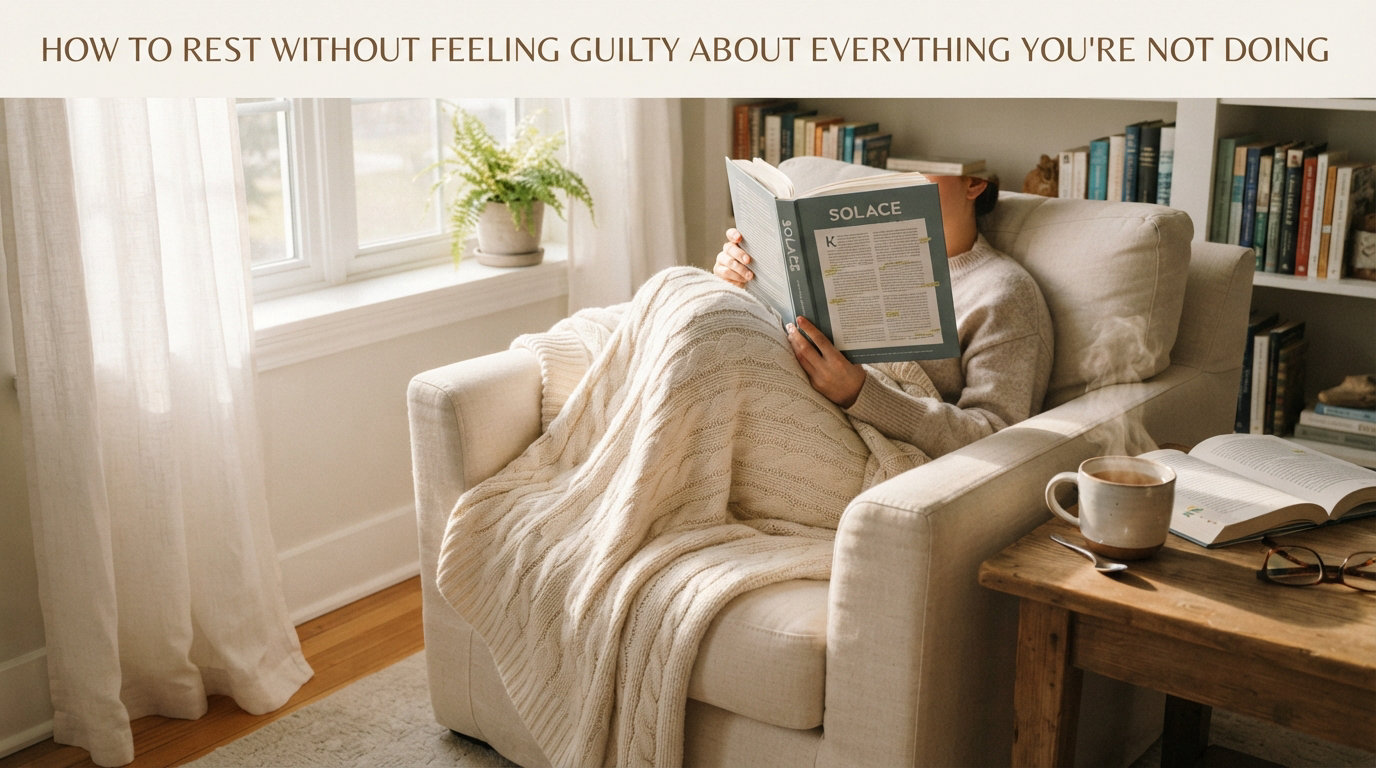
You know the feeling. You finally sit down on the couch after a long day, and within thirty seconds your brain starts its favorite playlist: “You should be answering those emails. The laundry is not going to fold itself. That project deadline is creeping up. Why are you being so lazy?”
If you want to learn how to rest without feeling guilty about everything you’re not doing, you are in the right place. This is one of the most common struggles I hear from clients in my coaching practice. I have wrestled with it myself for years.
Here is what I want you to know right now: rest guilt is not a personality flaw. It is a learned response with deep psychological and cultural roots. And like anything learned, it can be unlearned.
In this guide, I will walk you through why rest guilt happens, what science says about why your brain and body actually need rest, and seven practical strategies you can start using today.
I will also share something most articles miss entirely. The idea that rest is a radical act of self-trust. Because when you allow yourself to rest, you are telling yourself something powerful: you are enough, exactly as you are.
Table of Contents
Why We Feel Guilty About Rest
Your rest guilt has specific, identifiable causes. Understanding them is the first step toward loosening their grip on your life.
Contingent Self-Worth
Psychologists use the term “contingent self-worth” to describe what happens when your sense of value depends on what you produce or achieve. When self-worth is tied to productivity, doing nothing feels dangerous, like your worth is actively draining away.
This is not a character weakness. It is conditioning, often built up over years of reinforcement. The good news is that recognizing it begins to break the pattern.
One Reddit user described it perfectly: “Whenever I try to rest, even when I know I need it, I feel this weird guilt creeping in, like I’m wasting time or falling behind.” If that sounds familiar, you are experiencing contingent self-worth in action.
Cultural Programming Around Busyness
We live in a culture that treats exhaustion like a badge of honor. Ask someone how they are doing and there is a good chance the answer includes “busy.” We have absorbed the message that constant activity means you matter.
Productivity guilt is the tax we pay for living in a society that never stops celebrating busyness. The first step toward overcoming it is recognizing that “busy” and “important” are not the same thing.
In 2026, we are more connected and more exhausted than any generation before us. Rest guilt is a natural response to that pressure, but it does not have to be your permanent state.
Childhood Roots and Perfectionism
For many people, the roots go deeper. Maybe you were praised only for achievements growing up. Maybe love and approval felt conditional on performance: good grades, clean rooms, helpful behavior.
Perfectionism often grows from this soil. When perfectionism takes hold, rest feels like falling short of impossible standards, even when those standards exist only in your own head. Understanding where your rest guilt comes from does not erase it overnight, but it gives you something concrete to work with.
What Science Says About Rest
Your brain is not designed for nonstop output. It runs on cycles of focus and recovery, and the research on why rest matters is clear and compelling.
The Default Mode Network
When you stop actively focusing on a task, your brain activates the default mode network (DMN). This is not “doing nothing.” The DMN is where your brain processes emotions, consolidates memories, makes creative connections, and works through problems in the background.
That moment in the shower when you suddenly solve a problem you had been stuck on all day? That is your DMN at work.
Rest is not the opposite of productivity. It is a different kind of productivity your brain needs.
Your brain’s default mode network is most active during rest. Research shows it plays a key role in creativity, self-awareness, and emotional processing. Skipping rest means skipping this essential brain function entirely.
Cortisol and Stress Recovery
When you are constantly in motion, your cortisol levels stay elevated. Chronic high cortisol is linked to anxiety, weight gain, weakened immunity, and cardiovascular problems.
Genuine rest activates your parasympathetic nervous system, the body’s natural recovery mode. This lowers cortisol, reduces inflammation, and allows physical healing. Without regular rest, stress compounds day after day.
Ultradian Rhythms
Your body operates on 90-to-120-minute energy cycles called ultradian rhythms. After each period of focused work, your brain needs 15 to 20 minutes of recovery.
Pushing through these natural breaks leads to cognitive fatigue, more mistakes, and diminishing returns on your effort. Honoring them keeps you sharp and sustainable over the long haul.
Rest is not optional maintenance. It is how your brain and body are designed to function.
How to Rest Without Feeling Guilty
These are seven strategies I use myself and share with coaching clients. Pick one or two that resonate and start there. You do not need to overhaul your entire life overnight.
1. Reframe Rest as an Investment, Not a Reward
The biggest shift is this: rest is not something you earn by finishing everything first. It is something you need in order to function well.
Think of it like breathing. You do not earn the right to exhale by inhaling enough first.
Both are essential parts of the same cycle, and when you treat rest as an investment in your energy and focus, it stops feeling like wasted time.
2. Challenge Your Inner Critic
When guilt shows up during rest, do not just accept it. Talk back.
Ask whose voice it sounds like. Often it echoes someone from your past who valued productivity above all else.
Then ask yourself: “Is this thought true? Is it helpful?” Most of the time, the honest answer is no. You do not have to obey every thought that crosses your mind, especially the ones that make you feel worse for no good reason.
3. Practice Self-Compassion
Self-compassion means treating yourself the way you would treat a good friend. If your best friend said she was exhausted and needed to rest, you would not call her lazy. You would tell her to take care of herself.
Research shows self-compassion is linked to higher motivation and resilience, not less. Being hard on yourself does not make you more productive. It just makes you miserable while you work.
4. Set Clear Boundaries Around Work and Rest
Rest guilt thrives in ambiguity. When work time and personal time blur together, your brain never fully clocks out.
Create a clear boundary by picking a specific time when the workday ends. Close the laptop and put the phone in another room.
Build a simple shutdown ritual to signal that work is over. Write tomorrow’s top three priorities, turn off notifications, or take a short walk.
5. Choose Active Rest Over Passive Scrolling
Not all rest is equal. Scrolling through social media might feel like downtime, but it keeps your brain stimulated and often increases anxiety. It is fake rest.
Real rest includes walking, gentle stretching, reading, gardening, or sitting quietly with a cup of tea. These activities activate your parasympathetic nervous system and allow genuine cognitive recovery. You will feel the difference within minutes.
6. Accept That Your To-Do List Will Never Be Finished
Here is a truth that took me years to accept: there will always be more to do. The to-do list is endless by nature.
If you wait until everything is done to rest, you will never rest. The goal is not to finish everything. It is to do what matters most and then let yourself recover so you can do it again tomorrow.
One Reddit user put it well: “After checking off everything on my to-do list, I don’t feel like I’ve accomplished something significant.” That feeling of “not enough” never goes away through more productivity. It changes when you change the rule itself.
7. Give Yourself Explicit Permission
This sounds almost too simple, but it works. Say it out loud: “I give myself permission to rest right now.”
Many of us carry an unspoken rule that rest must be justified, earned, or made productive somehow. Explicitly giving yourself permission short-circuits that rule.
It feels awkward at first, but keep doing it until it starts to feel natural.
Try writing yourself a literal rest permission slip: a small note that says “You have permission to rest today.” Put it where you will see it. Sometimes seeing permission in writing makes it feel more real.
Rest as a Radical Act of Self-Trust
Here is the angle that most articles miss completely. Rest is not just self-care. It is an act of self-trust.
When you rest without guilt, you are making a quiet but powerful statement. You are saying: “I trust that I am enough even when I am not producing. I trust that things will be okay if I step away. I trust myself to come back and handle what needs handling.”
Rest guilt is, at its core, a failure of self-trust. It is the fear that if you stop, everything will fall apart. The fear that you will fall behind, lose your edge, or discover you were never enough to begin with.
But here is the paradox: people who rest well often perform better over time. They make sharper decisions, think more creatively, and sustain their energy instead of burning bright and flaming out.
Chronic busyness does not lead to excellence. It leads to burnout.
Self-trust grows through practice. Every time you let yourself rest, truly rest without one eye on your phone, you strengthen the belief that you are safe and enough exactly as you are. This is the work I do with coaching clients every day, and it changes everything.
Quick Rest Techniques for Busy People
You do not need a full day off to experience genuine rest. These micro-rest practices take five minutes or less and fit into any schedule.
The five-minute reset. Set a timer, close your eyes, and focus on your breathing. When thoughts about tasks pop up, and they will, gently bring your attention back.
This is not about emptying your mind. It is about practicing the act of letting go.
The outdoor pause. Step outside for three minutes. Notice three things you can see, two you can hear, and one you can feel. This simple grounding technique pulls you into the present moment and interrupts the productivity loop in your brain.
The body scan. Start from your head and move down to your toes, noticing where you are holding tension. Deliberately relax those areas. Most people do not realize how much tension they carry until they consciously release it.
Phone-free fifteen. Put your phone in another room for fifteen minutes. Do something with your hands: wash dishes, stretch, doodle. The absence of constant input is itself a form of rest your brain craves.
Signs You Need More Rest Than You’re Getting
Sometimes rest guilt is so loud that you cannot hear what your body is actually telling you. Here are the warning signs that you need more genuine rest.
You feel tired even after a full night’s sleep
Small tasks feel overwhelming or irritating
You are forgetful, scattered, or making silly mistakes
You feel emotionally flat or unusually sensitive
You get sick more often than usual
You carry tension in your jaw, shoulders, or chest
You cannot remember the last time you felt genuinely bored
If you recognize yourself in three or more of these signs, your body is not asking for another coffee. It is asking for rest.
Chronic rest deprivation is linked to burnout, anxiety, depression, and weakened immune function. If you are experiencing physical symptoms like chest pain, persistent headaches, or chronic fatigue, please talk to a healthcare professional.
FAQs
How to actually rest without feeling guilty?
Start by reframing rest as an investment in your well-being rather than a reward you must earn. Challenge your inner critic when guilt appears, practice self-compassion, and set clear boundaries between work and personal time. Choose active rest like walking or reading over passive scrolling, accept that your to-do list will never be fully done, and give yourself explicit permission to pause. Rest guilt is learned, and it can be unlearned with consistent practice.
Why do I feel guilty when I am not doing anything?
You feel guilty because of contingent self-worth, the psychological pattern where your sense of value is tied to productivity and achievement. Cultural messaging that equates busyness with importance reinforces this pattern. Your brain has learned to interpret stillness as a threat to your self-worth. This is a learned response, not a personal failing, and understanding its roots is the first step toward changing it.
How to stop feeling guilty for something you didn’t do?
Recognize that guilt about not doing something is often misplaced anxiety, not a signal that you did something wrong. Ask yourself whether the guilt is proportional to the situation, challenge the belief that you must always be productive, and practice self-compassion. Remind yourself that you are a person with limits, not a productivity machine.
How to enjoy life without guilt?
Start by separating your worth from your output. Practice being fully present during enjoyable activities rather than mentally listing tasks. Set boundaries around work time, choose rest that genuinely restores you, and give yourself explicit permission to enjoy your life. Joy and rest are essential parts of being human, not rewards you must earn through productivity.
Permission to Rest
Learning how to rest without feeling guilty is a practice, not a one-time fix. It takes time to unlearn years of conditioning that told you your worth depends on constant productivity.
But every time you choose rest, and choose to be okay with it, you are building self-trust. You are telling yourself that you matter beyond what you produce.
Start small. Pick one strategy from this guide and try it this week. Give yourself permission to rest, and see what happens when you finally let yourself breathe.
Make 2026 the year you stop earning your rest and start claiming it. You are enough. You always were.