
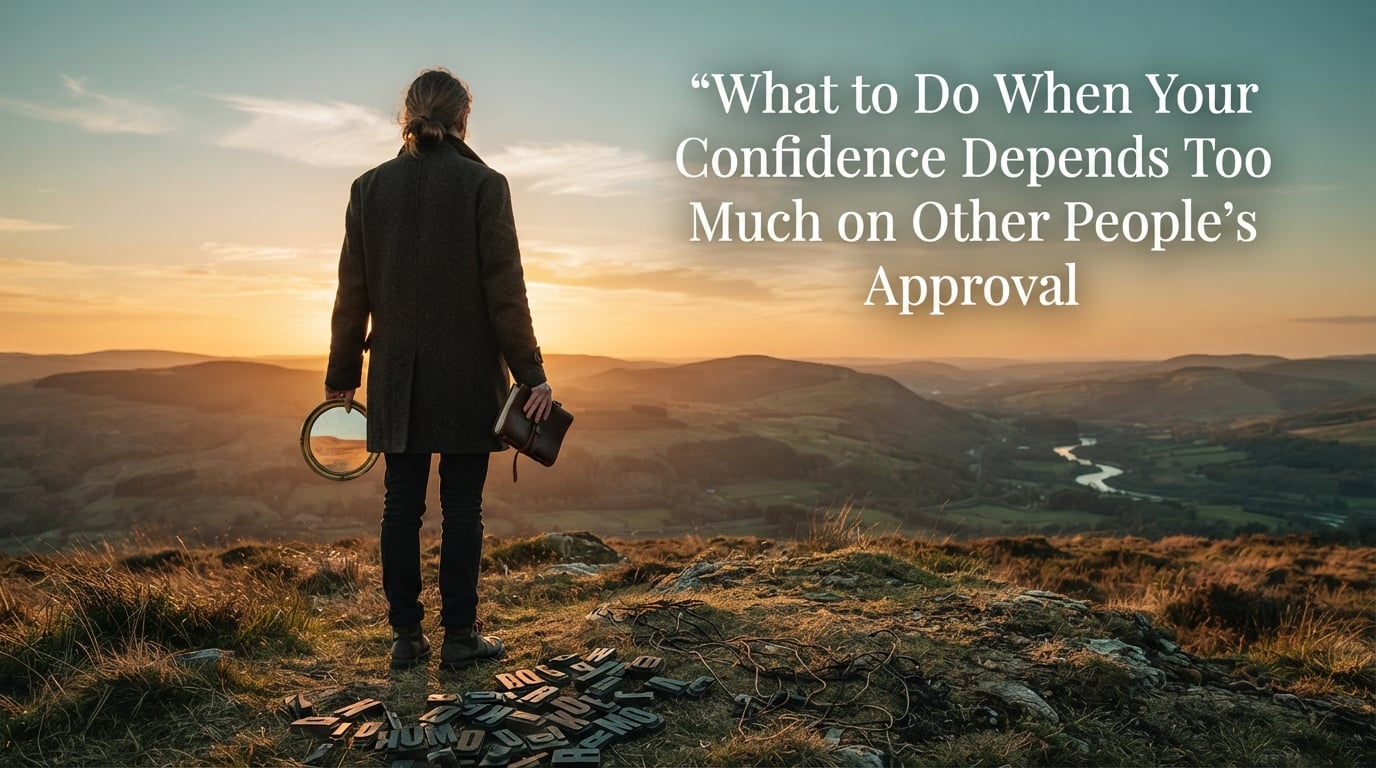
You aced the presentation, but one colleague barely nodded. Suddenly that accomplishment feels hollow. You posted something personal, and the silence from friends made you question whether you should have shared it at all. Sound familiar?
When your confidence depends too much on other people’s approval, your sense of self-worth swings with every reaction, comment, or lack thereof. You become a passenger in your own emotional life, waiting for someone else to hand you permission to feel good about yourself.
As a life coach, I have worked with countless people who feel trapped in this exact cycle. The good news is that approval-seeking behavior is not a fixed personality trait. It is a learned pattern, and anything learned can be unlearned. In this guide, I will walk you through why this happens, how to recognize it, and seven practical strategies to build confidence that comes from within.
Table of Contents
What Approval-Seeking Behavior Really Looks Like
Approval-seeking behavior is the pattern of basing your self-worth, decisions, and emotional state on validation, praise, or acceptance from other people. Instead of trusting your own assessment of yourself, you outsource it.
Psychologists call this contingent self-esteem, meaning your confidence is conditional. It rises when you receive praise and crumbles when you face criticism or indifference. Your internal thermostat for self-worth is installed in someone else’s house.
This differs from the normal human desire for connection. We all enjoy being appreciated. The problem arises when you cannot feel okay without it. When external validation becomes the primary fuel for your confidence, you lose touch with your authentic self.
People who struggle with this often describe feeling like a puppet with strings, constantly performing for an audience. You shape your opinions, appearance, and choices around what will earn approval rather than what feels true to you.
Signs Your Confidence Depends Too Much on Other People’s Approval
Not sure if this applies to you? I have found that most people underestimate how deeply approval-seeking shapes their daily choices. See how many of these signs resonate:
You replay conversations for hours. After a social interaction, you obsess over what you said and whether people approved of you.
You struggle to make decisions alone. Even small choices send you texting three friends for opinions before you commit.
Criticism devastates you. Constructive feedback feels like a personal attack, and one negative comment can ruin your entire day.
You change yourself to fit the room. Your personality, opinions, or even style shifts depending on who you are with.
Achievements feel meaningless without recognition. You did great work, but if nobody acknowledged it, you question whether it mattered at all.
You say yes when you mean no. People-pleasing overrides your own needs because disappointing someone feels unbearable.
Silence from others feels like rejection. A friend not texting back or a colleague not replying to your email triggers anxiety about whether they are upset with you.
You avoid taking risks. Fear of judgment or failure keeps you playing small rather than pursuing what you actually want.
If you recognized yourself in four or more of these signs, your confidence has likely become over-reliant on external validation. That awareness is the first step toward changing it.
Why We Seek External Validation
Understanding why you seek approval helps you respond to yourself with compassion rather than frustration. This pattern did not appear out of nowhere.
The Childhood Roots
Many people who struggle with approval-seeking developed this pattern early in life. If you grew up receiving praise only when you met certain expectations, you learned that love and worth were conditional. Children adapt to their environment. If approval felt scarce or unpredictable, you may have learned to constantly scan for signs of acceptance.
This is sometimes called an approval-seeking schema, a deeply held belief that you must earn your worth through pleasing others. It often forms when a child’s emotional needs were inconsistently met or when love felt transactional.
The Evolutionary Pull
There is also a biological reason we crave approval. For our ancestors, being accepted by the group meant survival. Being rejected meant danger. Your brain still carries that ancient wiring, treating social disapproval as a threat.
This is why a critical comment can trigger a genuine stress response. Your nervous system interprets it as a survival issue, even though logically you know you will be fine.
Modern Amplifiers
Social media has turned approval-seeking into a constant, measurable game. Likes, comments, and follower counts provide instant hits of external validation. When you rely on those metrics to feel good about yourself, the dependence deepens.
Forum discussions I have reviewed reveal how people feel their achievements are never valid without an external stamp of approval. One person described it as feeling unreal because they kept making themselves fake to earn validation from others.
The Real Cost of Approval-Dependent Confidence
Living at the mercy of other people’s opinions takes a serious toll. Your emotional state becomes a rollercoaster you cannot control. When approval flows in, you feel great. When it dries up, anxiety and self-doubt flood in.
Decision-making suffers enormously. If every choice requires external confirmation, you move slowly, second-guess constantly, and often abandon what you actually want. Over time, this erodes your sense of identity. You lose track of who you are without others’ opinions to define you.
Relationships also suffer. When you people-please to earn approval, you build connections on a false version of yourself. The person others see is not really you, which creates a lonely paradox. You can be surrounded by people and still feel unknown.
How to Stop Seeking Other People’s Approval: 7 Practical Strategies
Breaking free from approval-seeking takes practice, but these strategies work. I have seen clients transform their confidence using exactly these approaches.
1. Catch the pattern in real time. The moment you notice yourself adjusting your behavior for approval, pause. Name what is happening. Awareness disrupts the automatic cycle. Simply saying to yourself, “I am seeking approval right now,” creates space to choose differently.
2. Define your core values. When you know what matters to you, other people’s opinions carry less weight. Write down five values that define who you want to be. Use those as your decision-making compass instead of polling everyone around you.
3. Practice making small decisions alone. Start with low-stakes choices. Pick a restaurant without asking anyone. Choose a movie without reading reviews first. Build the muscle of trusting your own judgment in safe situations before tackling bigger decisions.
4. Set boundaries and hold them. Saying no is one of the most powerful confidence-building actions you can take. Start with small boundaries and work up. Each time you honor your own needs over someone else’s expectations, you reinforce that your approval of yourself matters most.
5. Track your own wins. Keep a daily record of things you did well, decisions you made independently, and moments you showed up authentically. This builds the habit of self-validation instead of waiting for someone else to notice.
6. Limit social media validation loops. Turn off notifications for likes and comments. Post without checking engagement for at least an hour. Gradually reduce how often you look at metrics. Breaking the feedback loop weakens the dependence on digital approval.
7. Reframe criticism as information, not identity. When someone criticizes you, separate the feedback from your worth as a person. Ask yourself: Is this feedback useful? What can I learn from it? Then decide whether to act on it. Criticism becomes data, not a verdict on your value.
How to Build Internal Self-Worth That Lasts
Stopping approval-seeking is only half the equation. You also need to replace it with something stronger: a source of confidence that comes from within.
Practice Self-Validation Daily
Self-validation means acknowledging your own feelings, efforts, and accomplishments without needing someone else to confirm them. After completing something, tell yourself what you did well. After a hard day, acknowledge that your effort mattered even if no one saw it.
This feels awkward at first. Most people are unaccustomed to approving of themselves. But like any skill, it strengthens with repetition.
Develop Self-Compassion
Treating yourself with kindness, especially when you fall short, builds emotional resilience. Instead of harsh self-criticism when you make a mistake, try speaking to yourself the way you would speak to a friend. Research consistently shows that self-compassion is more effective than self-criticism for motivation and growth.
When setbacks happen, try saying: “This is a hard moment, and I am still worthy.” Simple phrases like this rewire how you relate to yourself over time.
Connect With Your Authentic Self
Spend time exploring what you genuinely enjoy, believe, and want, separate from anyone else’s expectations. Journal about what matters to you. Try activities you have always been curious about but never pursued because you worried what others would think. Authentic confidence grows from self-knowledge.
Approval-Seeking at Work and in Relationships
In the Workplace
Approval-seeking at work often shows up as overworking to impress your boss, avoiding necessary conflict, or staying quiet in meetings. To shift this, focus on your professional standards rather than your manager’s reactions. Set clear criteria for your own work quality. Seek feedback as a growth tool, not as permission to feel good about yourself.
In Personal Relationships
If your confidence depends on your partner’s approval, the dynamic becomes emotionally exhausting for both of you. Practice expressing your real opinions, even small ones, without checking their reaction first. Healthy relationships thrive on authenticity, not performance. The right people will value the real you, not the version shaped to please them.
Handling Setbacks Without Losing Your Progress
Changing deeply ingrained patterns is not a straight line. You will have days where you slip back into people-pleasing or feel crushed by a critical comment. That is normal, not failure.
Treat setbacks as data, not evidence that you cannot change. Notice what triggered the old pattern, learn from it, and try again. Progress is measured over months, not days. Be patient with yourself.
If you find that approval-seeking is deeply tied to past trauma or significantly impacts your daily life, working with a therapist can provide the deeper support that self-help strategies alone may not offer.
FAQs
How to stop seeking other people’s approval?
To stop seeking approval, start by noticing when the pattern happens, defining your core values, and practicing small decisions on your own. Set boundaries, track your own accomplishments without waiting for recognition, and reframe criticism as information rather than a judgment of your worth. Building internal self-worth through self-validation and self-compassion replaces the need for constant external approval.
Why do I feel the need for other people’s approval?
The need for approval often stems from childhood experiences where love or validation felt conditional, creating a belief that you must earn your worth. It also has evolutionary roots, since group acceptance historically meant survival. Social media and past relationships can amplify this pattern by making external validation feel essential to feeling okay about yourself.
What is it called when I feel like my worth depends on others’ opinions?
This pattern is known in psychology as contingent self-esteem, meaning your confidence rises and falls based on external feedback. It is also described as an approval-seeking schema, a deeply held belief that your value depends on earning acceptance from others rather than coming from within.
Is seeking validation a mental illness?
Seeking validation is not itself a mental illness. It is a common psychological pattern that many people experience. However, when approval-seeking is severe, tied to past trauma, or significantly disrupts your daily life and relationships, it may be connected to conditions like anxiety or low self-esteem. In those cases, working with a therapist can help address the underlying causes.
How to heal approval-seeking schema?
Healing an approval-seeking schema involves becoming aware of the pattern, understanding its roots in childhood or past relationships, and gradually building internal sources of validation. Practical steps include identifying your core values, practicing self-compassion, setting boundaries, and making decisions independently. Schema therapy with a trained professional can provide structured support for deeper healing.
What are some examples of approval-seeking behavior?
Common examples include changing your opinions to match whoever you are with, overworking to impress a boss, replaying conversations to check if people approved of you, saying yes when you want to say no, avoiding risks for fear of judgment, and feeling like your accomplishments do not count unless someone else acknowledges them.
Moving Forward: Your Confidence Belongs to You
Learning what to do when your confidence depends too much on other people’s approval is one of the most valuable investments you can make in yourself. The strategies in this guide are not quick fixes. They are a framework for rewiring how you relate to your own worth.
Start with one strategy. Practice catching the approval-seeking pattern in real time. Build from there. Each time you choose your own judgment over someone else’s reaction, you strengthen authentic confidence that no one can take away.
Remember that wanting connection and appreciation is human. The goal is not to stop caring about others entirely. It is to stop making their approval the foundation of your self-worth. When you can appreciate external validation without depending on it, you become free to live, decide, and relate as your genuine self.
If you found this guide helpful and want more support building unshakeable confidence, explore the coaching resources at Kim Life Coach. You do not need anyone’s permission to start becoming the person you want to be. That permission has been yours all along.