
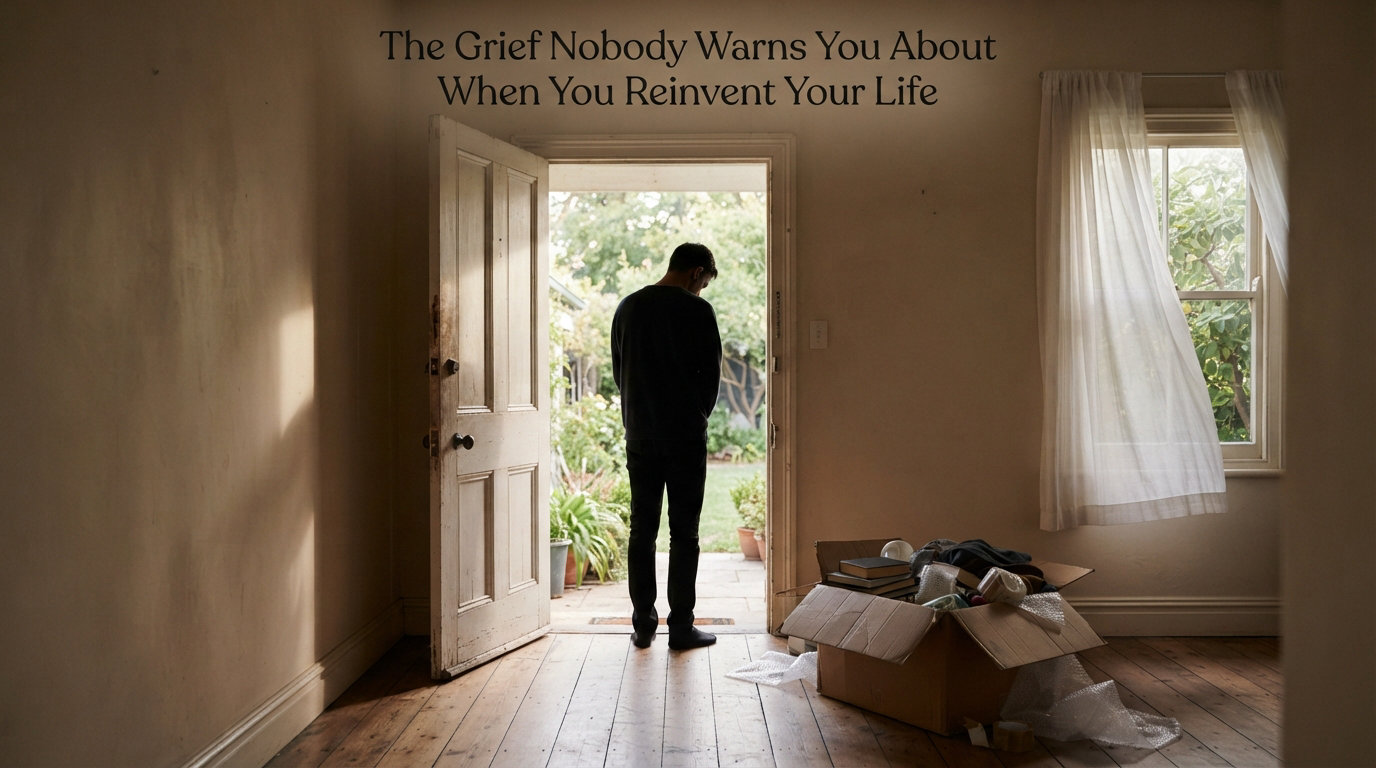
You finally left the job. You moved across the country. You ended the relationship.
You made the brave, intentional choice to reinvent your life, and from the outside, everything looks like progress.
So why do you feel so heavy?
Why do you cry in the car for no reason at all? Why do you miss people who hurt you? Why does the new life you have worked so hard to build feel strangely empty on certain mornings?
This is the grief nobody warns you about when you reinvent your life. It is real. It is valid. And it does not mean you made the wrong choice.
I have worked with hundreds of people through major life transitions, and I can tell you: the sadness you feel while your life is getting better is one of the most disorienting experiences humans have.
We talk openly about grief after a death. We have rituals for it. We send cards. We bring casseroles. But grief that shows up in the middle of a life you are actively building? That grief gets no casserole. No card. No permission.
This article is your permission slip to feel it all.
Table of Contents
Reinvention grief is the grief you feel when becoming someone new
Reinvention grief is the emotional response you have when your identity, routines, relationships, and sense of self get rearranged by a major life change, even one you chose and wanted.
Psychologists often call this transitional grief. It shows up during career changes, divorces, moves, sobriety, retirement, spiritual awakenings, and any moment when the old version of you falls away.
Unlike bereavement grief, no one sends a card. Unlike the grief after a sudden loss, no one checks on you. You are supposed to be celebrating.
So when the heaviness arrives, you tend to question yourself in quiet shame: Why am I sad when my life is improving?
The short answer: because your old self just died a little. Even when you wanted that to happen, something inside you still needs to mourn it.
You can be proud of who you are becoming and still grieve who you used to be. Both can be true at the same moment. That dual experience is what makes reinvention grief so confusing.
Your nervous system treats every reinvention as a loss
Your brain does not really distinguish between losses you chose and losses that happened to you. The same neural pathways that fire when you lose a loved one also fire when you lose a familiar version of yourself.
When you reinvent your life, your nervous system has to reorganize everything: your routines, your relationships, your daily identity, even the way you walk into a room.
That reorganization takes enormous psychological energy. It is, in a real sense, a form of death and rebirth happening inside your body.
Here is what makes reinvention grief harder than other kinds of grief: you chose it. That means you cannot blame anyone. You cannot rage at a circumstance. You cannot point to a villain.
You carry a quiet, complicated grief that often feels shameful because, from the outside, your life is objectively improving.
Psychodynamic therapists often point out that transitions stir the unconscious. Old wounds you did not have time to feel can suddenly surface.
A move across the country can resurrect a childhood feeling of abandonment. A divorce can wake up a grief you never processed from years ago. A career change can echo a long-ago identity you had to abandon.
Your reinvention is not just changing your future. It is asking you to revisit your past.
Here are 8 truths nobody warns you about when you reinvent your life
These are the things I wish someone had said to me during my own reinvention. I share them with clients. I share them with friends. I share them now with you.
Keep this list somewhere close. Return to it on the hard days.
1. Change for the better still causes grief
Even wanted, chosen, long-awaited change costs you something. Your brain expects loss when things end badly. It does not know what to do when things end well.
That confusion produces grief. The cultural script only gives you permission to mourn what was taken. It rarely gives you permission to mourn what you gave up willingly, even when giving it up was the right call.
2. You will lose friends, and that loss is real
When you change, some of your old people no longer fit. Drinking buddies drift away when you get sober. Colleagues fade when you leave the industry. Family members struggle with how different you have become.
People who once knew your schedule, your jokes, your wounds, your secrets, can slowly become strangers.
This is one of the loneliest parts of reinvention. The grief of losing friendships you did not expect to lose can feel sharper than the grief of the change itself. You will mourn those people. Let yourself.
3. People will misjudge you, and you will misjudge yourself
Others will label you as ungrateful, dramatic, lost, selfish, or unmoored. You might label yourself the same way in the quiet hours.
Neither judgment is true. You are simply mid-transformation, and transformations are confusing to watch from the outside.
Most people around you do not have a framework for someone choosing a brave reinvention and feeling sad in the middle of it. So they will reach for the only story they know: either you are happy or you are struggling. They will miss the third option, which is that you are both.
4. People keep expecting you to be who you were
Old friends will reference the old you as if she still exists. Family will keep telling stories about a version of you that no longer fits. Coworkers will joke about the old you at parties.
You will find yourself grieving the way people used to know you, even when that version felt smaller than the one you are becoming.
There is a particular grief in being unseen. You feel like you are shouting into a canyon, becoming someone new, and yet everyone keeps asking the old you to come out and play.
5. You will feel out of control for a while
Even when you chose the change, reinvention disorients your nervous system. You may feel untethered, anxious, or strangely flat.
Decisions that used to feel easy now feel impossible. Your sleep may change. Your appetite may change. Your sense of time may warp.
This is not a sign you chose wrong. It is a sign you are still catching up to your own life. Your old self had a map. Your new self does not yet. Living without a map feels like falling for a while. That is the normal experience of becoming.
6. You will sometimes miss the ‘before-you’
This is the part that makes you feel crazy. You chose to leave. You wanted this. And still, you miss the old version of yourself.
You miss her predictability. You miss her certainties, even the painful ones. You miss the way she knew how to suffer in a way she understood.
Missing her does not mean you should go back. It means she was real, and real things deserve to be mourned. You can love her and still leave her behind.
7. You will know who you are not before you know who you are
Identity reorganization is slow. For a long stretch, the only thing you will know for sure is what you are no longer.
You are no longer the corporate lawyer. You are no longer the dutiful daughter. You are no longer the woman who stayed. The negative space will be clearer than the new shape for a while.
This in-between space can feel formless and lonely. Trust it. The new shape will come, but only if you let it arrive in its own time.
8. You will feel things in a different order than you expected
Grief is not linear. You might feel relief on Monday, deep sadness on Wednesday, and anger on Friday.
Sometimes the grief hits a year after the change. Sometimes it hits in the middle of a celebration. None of this means you are doing it wrong.
It means you are doing it honestly. The messy emotional weather is not a sign of failure. It is a sign that you are letting the process be real instead of performing a tidy transformation for other people.
These are the signs you are experiencing reinvention grief
Sometimes reinvention grief hides behind other labels. You might think you are depressed, burned out, having a midlife crisis, or simply ungrateful.
Often, you are just grieving. Look for these signs.
Crying unexpectedly, especially when something good happens
Feeling disoriented in your new life, even when you wanted it
Missing people or places you consciously chose to leave
Feeling emotionally flat or numb during exciting milestones
Physical heaviness: tight chest, fatigue, disrupted sleep, low appetite
Wanting to talk about the old life even though you should be “over it”
A sense of identity confusion: not recognizing yourself in the mirror or in old stories
Irritability when others expect you to be happy for them
A persistent sense of loneliness even when you are not alone
Difficulty making small decisions that used to be easy
If several of these resonate, you are not failing at reinvention. You are doing the hard, quiet, invisible work of becoming someone new. That work is rarely celebrated, but it is sacred.
The hardest part is the lonely space between who you were and who you are becoming
Few people write about the loneliness of in-between. You are no longer the old self, but you are not yet fully the new self. You do not fit neatly into any category anymore.
Old friends do not quite get your new life. New friends do not know your history. You float between worlds, belonging fully to neither.
This in-between space is where reinvention grief lives longest. It is also where the most growth happens, if you can stand to stay there without rushing to define yourself.
The temptation to grab a label, a relationship, a new identity, anything to feel solid again, will be strong. Resist it for as long as you can.
On Reddit, people describe this in raw terms. One person wrote: “I feel this grief knowing I never lived the life I should have lived. A loss of nothing but myself.” Another said: “I feel like I am just existing.”
These words reflect a grief that does not have a tidy name in our culture, even though millions of people carry it at any given moment.
You are not alone in this in-between. You are also not stuck. The identity confusion is part of the process, not a sign you have to abandon.
The discomfort is the price of becoming someone who is actually yours.
You can move through reinvention grief without skipping it
Well-meaning friends will tell you to focus on the future. To celebrate the new life. To stop looking back.
I understand why they say it. Skipping grief feels efficient. It looks like strength. It fits the cultural story of reinvention as a triumphant upward climb.
It also backfires. Skipped grief tends to come back later as anxiety, depression, unexplained heaviness, or sudden emotional breakdowns at strange moments.
The body keeps the score during transitions, and unprocessed loss does not disappear. It waits in your shoulders. It waits in your sleep. It waits until something cracks you open.
Here are healthy ways to move through reinvention grief without skipping it.
Allow the full range of emotions
You can feel grief and relief in the same hour. You can be proud of your choice and sad about what it cost.
You can love your new life and miss your old one in the same breath. These are not contradictions. They are the texture of a meaningful life.
Stop trying to feel just one thing.
Find ways to express it
Write letters to the version of you that is gone. Talk out loud in your car. Journal at night. Tell a trusted friend the parts you have been hiding.
Make art that does not have to be good. Grief needs movement, not just thought. It needs to leave your body, not just swirl in your mind.
Create a ritual to honor what you left behind
Burn a list of the old roles you no longer play. Frame a photo from the old life. Take one last walk through the old neighborhood.
Cook the meal your grandmother taught you. Plant something in honor of the chapter that ended.
Rituals give the psyche permission to mark an ending. Without them, endings stay half-finished inside you, draining energy for years.
Connect with others who are mid-transition
Find people who understand the strange, specific grief of becoming. Online forums, support groups, coaching communities, and certain friendships can hold the parts of you that your old circle no longer recognizes.
You do not need a hundred people. You need a few who can sit with your mixed emotions without flinching.
Be patient with the timeline
Some people feel integrated in six months. Some need three years. There is no correct speed for becoming yourself.
The non-linear nature of this grief means you may feel fine for weeks, then suddenly collapse on a random Tuesday. That is normal. Stop measuring yourself against other people’s highlight reels.
Know when to seek professional support
If your grief feels bottomless, if you cannot stop replaying the past, if daily functioning has become hard, or if you find yourself numbing out with substances, work, or screens, please reach out to a therapist or coach trained in life transitions.
Asking for help is not weakness. It is how reinvention actually completes itself.
A good coach or therapist will not push you to “get over it.” They will hold space for both the grief and the growth, which is exactly what reinvention needs.
FAQs
Why am I sad when my life is improving?
You are sad because reinvention involves real loss. Even positive changes ask you to leave behind a familiar version of yourself, your routines, and your relationships. Your brain processes that loss as grief, regardless of whether you wanted the change. The sadness and the progress can coexist.
Can positive changes cause grief?
Yes. Positive changes can cause grief because your nervous system experiences any major shift in identity as a loss. Leaving a job, ending a relationship, moving, becoming a parent, or starting sobriety all require you to say goodbye to who you used to be, and that goodbye hurts even when the new life is objectively better.
What is transitional grief?
Transitional grief is the grief that surfaces during major life transitions, such as career changes, divorce, sobriety, retirement, or spiritual awakening. It is the mourning of an old identity, role, or chapter, even when the change is wanted. It is often invisible because no one has died, yet something inside you has.
How long does identity grief last?
Identity grief is not linear, so there is no set timeline. Some people feel more integrated in a few months. Others need a year or more, especially if the transition touches older wounds. What matters is that you stop measuring yourself against a deadline and start letting the grief move through you rather than around you.
How do I cope with identity loss after a major life change?
You cope with identity loss by letting yourself feel it, expressing it through writing or conversation, creating rituals to honor the old self, connecting with others in transition, and seeking professional support when the grief becomes heavy enough to interfere with daily life. Avoidance usually makes it louder over time.
Is it normal to grieve during a positive life transition?
Yes. It is completely normal to grieve during a positive life transition. Choosing a change does not cancel the loss of what came before. In fact, chosen losses often carry a quieter, more complicated grief because there is no one to blame and no clear permission to mourn.
You are not wrong for grieving a life you chose to leave
The grief nobody warns you about when you reinvent your life is one of the most quietly painful experiences I have ever witnessed, and I have witnessed it hundreds of times.
People rebuilding after divorce. Founders walking away from businesses they poured years into. Mothers reclaiming their identities after decades of caregiving.
People in early sobriety. People who finally moved to the place they always dreamed of. People who finally left the relationship that was dimming them.
Each of them, at some point in the process, wondered if something was wrong with them for feeling so heavy while their life was objectively getting better.
Nothing is wrong with you. You are doing one of the bravest things a human can do: choosing to become.
Grief during reinvention is not a sign you made the wrong choice. It is a sign you are human. It is a sign that what you left behind mattered.
It is a sign that you are capable of holding two truths at once: the new life is right, and the old one is still worth mourning.
If you are in the middle of this right now, please hear me: you do not have to rush. You do not have to perform happiness. You do not have to explain your sadness to anyone who wants you to be grateful and nothing else.
You do not have to pretend the grief is finished before it is. You do not have to choose between honoring your past and embracing your future.
You are allowed to take the time your reinvention needs. You are allowed to grieve. You are allowed to be proud and sad in the same hour.
And you are allowed to believe that on the other side of this grief is a version of you who feels more at home in her own life than she ever has before.
That version of you is worth every tear you are shedding right now. She is being built by the very grief you are trying to skip.
If you want support moving through this, I work with people during major reinventions, and you can learn more about how I help at kimlifecoach.com.
You do not have to walk the in-between alone. Reaching out is not weakness. It is how reinvention actually becomes you, instead of just something you are doing.