
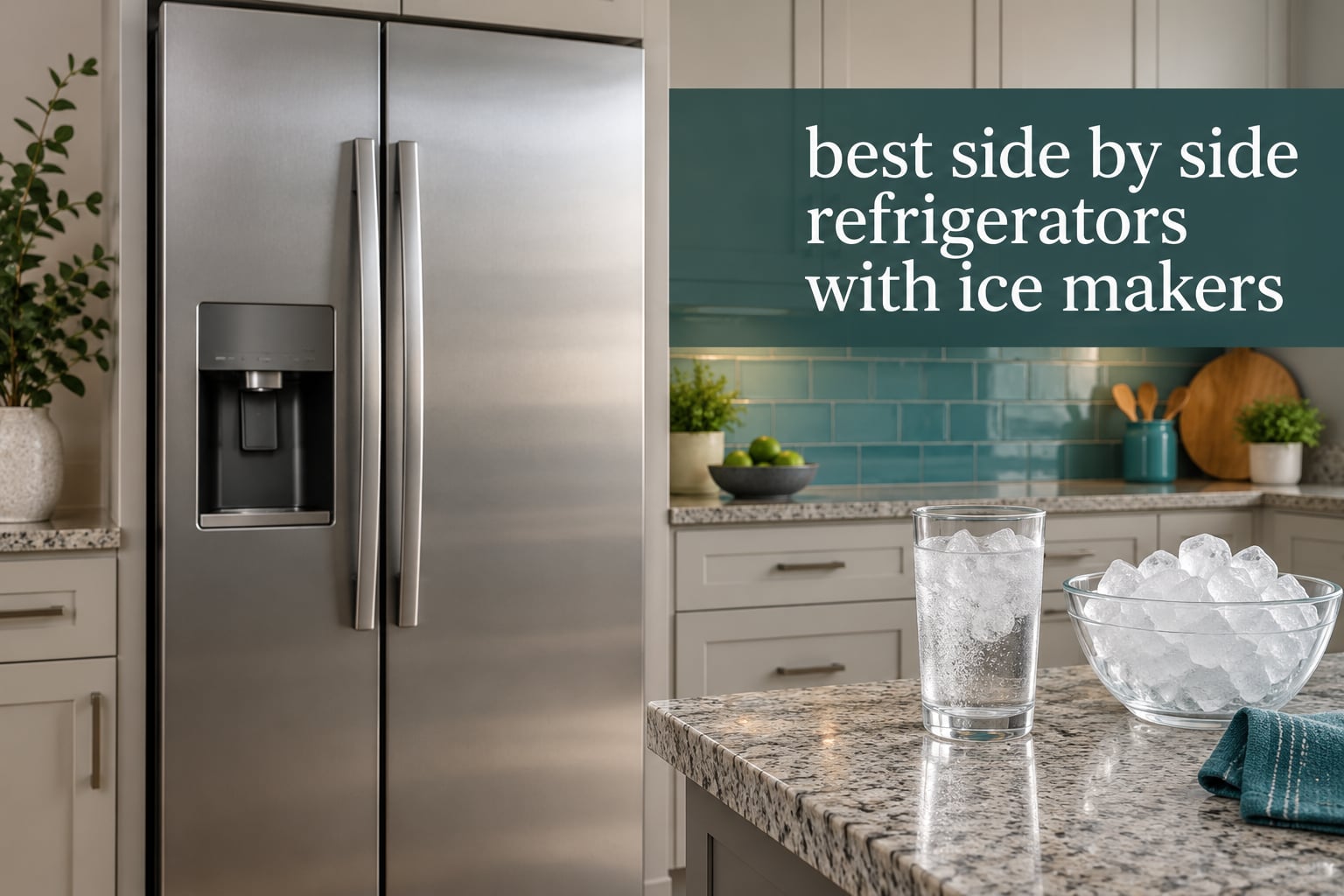
Shopping for the best side by side refrigerators with ice makers is mostly a question of ice. Every model on this list makes ice automatically, but they do it in very different ways, and that difference decides how much shelf space you lose, how much noise you get at 2 a.m., and how likely you are to be calling a repair technician in year four. I went through the six strongest options currently on the market and pulled apart the specs, the warranty language, and the owner complaints behind each one.
My top pick is the LG LS27T3230S, a 27 cu. ft. standard-depth side-by-side that hides a slim in-door ice maker behind the freezer door and adds Wi-Fi for temperature checks. It has the most owner feedback of any refrigerator in this group at 11 ratings holding a 4.4 star average, which gives it the best evidence base of anything I looked at. If you want the largest interior, the Kenmore 4651845 is 29 cu. ft. and the only model here with a published ice output figure of up to 3 lbs per day.
For the record, a side-by-side refrigerator with an ice maker is a fridge split vertically into a fresh-food compartment and a freezer, where one of those sections contains an automatic ice system. That system is either an in-door bin that drops ice into a bucket you scoop from, or a through-the-door dispenser that augers ice out to the outside of the door when you press a pad. Everything else in this guide, including capacity sizing, delivery measurements, and what tends to fail, is built around choosing between those two setups. If you want to compare built-in ice against a freestanding one, I covered those in our guide to the best countertop ice makers.
Table of Contents
Our Top 3 Picks for Best Side by Side Refrigerators with Ice Makers in 2026

LG LS27T3230S 27 cu. ft. Side-by-Side
- 27 cu. ft. capacity
- Slim in-door ice and water dispenser
- Wi-Fi enabled

Samsung RS27T5561SR 26.7 cu. ft.
- 26.7 cu. ft. capacity
- Family Hub touch screen
- High-capacity indoor icemaker

Forno Salerno 20 cu. ft. 36-inch
- 20 cu. ft. in a 36-inch body
- Cubed and crushed ice
- 2 year parts and labor
The LG takes the overall spot because its in-door ice maker leaves more shelf space than an external dispenser would, and its 4.4 star average across 11 ratings is the most meaningful owner sample here. The Samsung wins on capacity per dollar of feature and carries the longest compressor warranty in the group at ten years parts and five years labor. The Forno is the one to look at if you want an external dispenser with cubed and crushed ice on a body that measures 35.9 inches wide.
Best Side by Side Refrigerators with Ice Makers (October 2026)
| Product | Specifications | Action |
|---|---|---|
| LG LS27T3230S 27 cu. ft. Side-by-Side |
|
Check Latest Price |
 Amana ASI2575GRS 24.6 cu. ft. Side-by-Side Amana ASI2575GRS 24.6 cu. ft. Side-by-Side |
|
Check Latest Price |
 Electactic FF2-695 18.1 cu. ft. Side-by-Side Electactic FF2-695 18.1 cu. ft. Side-by-Side |
|
Check Latest Price |
| Forno Salerno 20 cu. ft. 36-inch Side-by-Side |
|
Check Latest Price |
| Samsung RS27T5561SR 26.7 cu. ft. Side-by-Side |
|
Check Latest Price |
 Kenmore 4651845 29 cu. ft. Side-by-Side Kenmore 4651845 29 cu. ft. Side-by-Side |
|
Check Latest Price |
Two things jump out of that table. First, capacity ranges from 18.1 to 29 cu. ft., which is a big enough spread that household size matters more than any feature. Second, five of the six run on R-600A refrigerant and four use an inverter or rotary compressor, so the energy numbers in the spec sheets are broadly comparable.
1. LG LS27T3230S – Best Overall With An In-Door Ice Maker
LG 27 cu. ft. Side-by-Side Standard Depth Slim in Door Ice and Water Dispenser in PrintProof Stainless Steel Wi-Fi Enabled LS27T3230S
27 cu. ft. capacity
16.2 cu. ft. fresh food
Slim in-door ice and water dispenser
Wi-Fi enabled
Pros
- In-door ice maker frees up shelf space
- Simple two-door layout with no screen in daily use
- Spacious interior for the body size
- Wi-Fi enabled for remote temperature checks
Cons
- In-door ice maker is louder and slower than competing models
- One verified reviewer reported the ice maker inlet freezing up almost daily
- Small touch target for switching between water and ice
The LS27T3230S is the refrigerator I kept coming back to while I was building this list. At 27 cu. ft. it splits into 16.2 cu. ft. of fresh food and the balance as freezer, and it measures 35 inches wide by 73 inches deep by 35 inches high, which is a standard-depth body rather than a counter-depth one. The doors are PrintProof stainless steel and the whole thing weighs 267 pounds, so plan your delivery path accordingly.
What makes it interesting is the ice maker. LG put it inside the freezer door rather than building an external dispenser recess into the refrigerator door. That single design decision frees up roughly a foot of door width that a through-the-door unit would consume, so the refrigerator side keeps its full interior depth. You still get filtered water and ice from the exterior pad, you just get them from a slimmer housing.
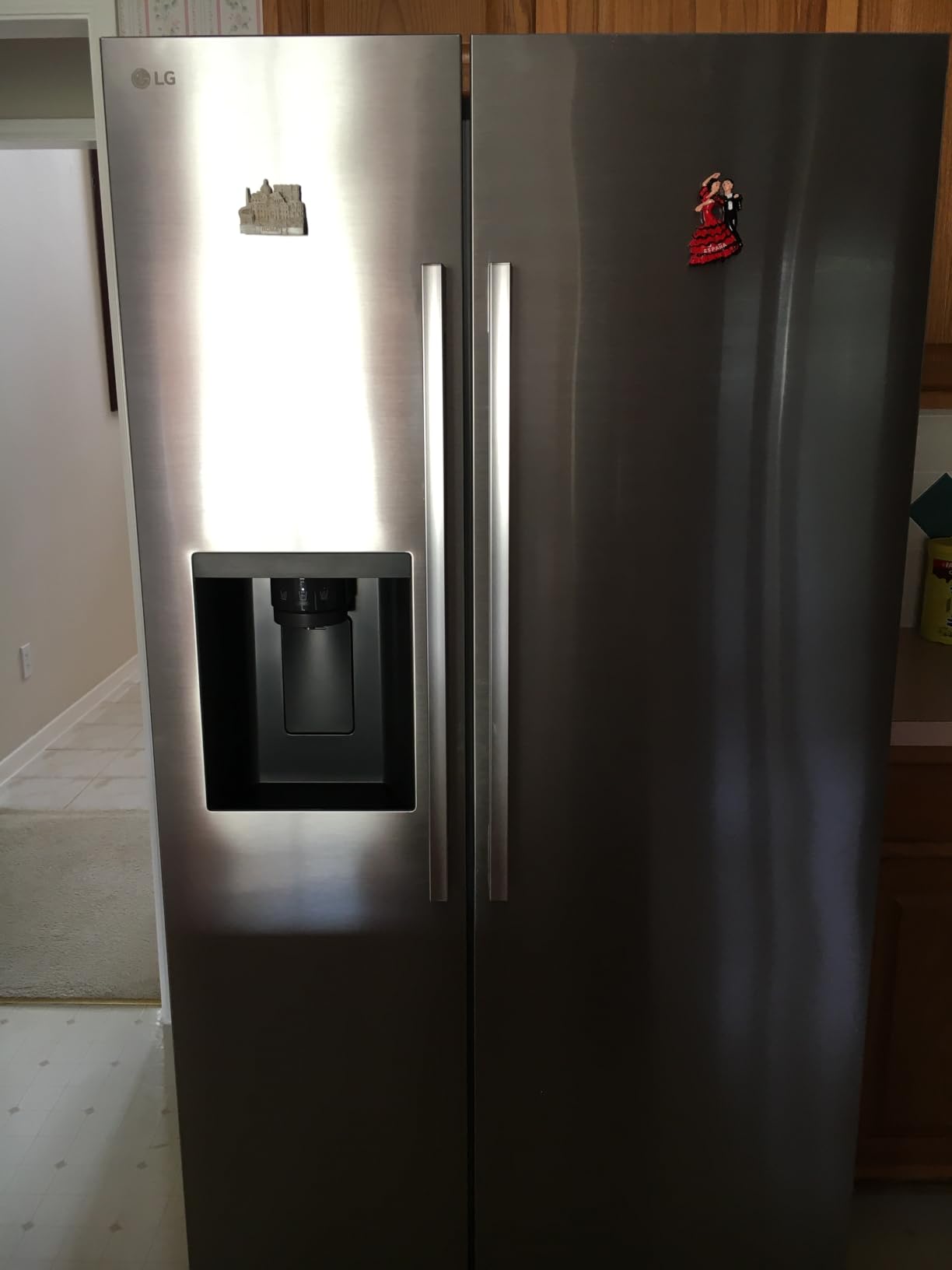
The owner feedback is the strongest evidence I found anywhere in this roundup. Across 11 ratings the average is 4.4 stars, with 71 percent at five stars and 17 percent at four. Reviewers consistently praise the straightforward layout, the space the in-door ice maker gives back, and the fact that there is no screen to interact with when you just want cold milk. Wi-Fi is there for temperature checks, but nothing about daily use requires you to touch a phone.
The complaint to know about is the ice maker inlet freezing up. One verified reviewer reported having to unplug the refrigerator almost daily to thaw it, which is not a small inconvenience. The same reviewers also describe the in-door maker as louder and slower than external dispensers, and several mention how expensive out-of-warranty service calls turned out to be. The warranty on the appliance itself is one year, so year two onward is when that risk starts to matter.
What to check before you commit
Make sure you have a plumbed water line within reach of the refrigerator, because a slim in-door maker still needs water supplied to the back of the unit. The included components are listed simply as tools, so confirm with the retailer what the install kit actually includes before the delivery crew arrives.
Also think hard about how you feel about a touch-only control. The pad for switching between water and ice is small, and there is no tactile button to confirm you hit it. If you have any hand strength or dexterity concerns in the household, that is a real friction point rather than a minor one.
Where it falls short
There is no external crushed ice option, so if you want blended ice for a blender, you are crushing it yourself. And at 73 inches deep, this is one of the deeper bodies in the group, so a galley kitchen or a tight alcove will not accept it without a measurement first.
Owner-reported service cost is the other caution. The freezer in-door ice maker design is shared across several LG models, and buyers on this one specifically describe expensive out-of-warranty repairs. If you already have a history of appliances that needed service calls, the two year Forno coverage may interest you more.
2. Samsung RS27T5561SR – Most Versatile With Family Hub
Samsung 26.7 Cu. Ft. Large Capacity Side-By-Side Refrigerator with Family Hub, Stainless Steel, RS27T5561SR/AA
26.7 cu. ft. capacity
17.2 cu. ft. fresh food
Family Hub touch screen
Indoor high-capacity icemaker
Pros
- Largest fresh food compartment per cubic foot in the group
- Family Hub screen with Alexa built in and app control
- Multivent airflow for even cooling
- Ten year parts and five year labor compressor warranty
Cons
- Family Hub screen adds cost and a learning curve
- Heaviest model here at 306 pounds
- Some 1-star reviews report delivery or damage issues
This Samsung brings 26.7 cu. ft. to the table, divided into 17.2 cu. ft. of fresh food and 9.5 cu. ft. of freezer. That fresh food figure is the second largest of the six, and combined with flat panel doors and recessed handles it gives the unit a built-in look that the other budget models in this list do not manage. The body measures 35.88 inches wide, 33.5 inches deep, and 70.06 inches tall.
Like the LG, Samsung built the ice maker inside the freezer door rather than recessing an external dispenser. They call it the indoor high-capacity icemaker, and owners credit it with freeing up shelf space that would otherwise be occupied by a traditional top-shelf ice bucket. Multivent even-cooling technology circulates air through multiple vents so no single shelf runs warm.
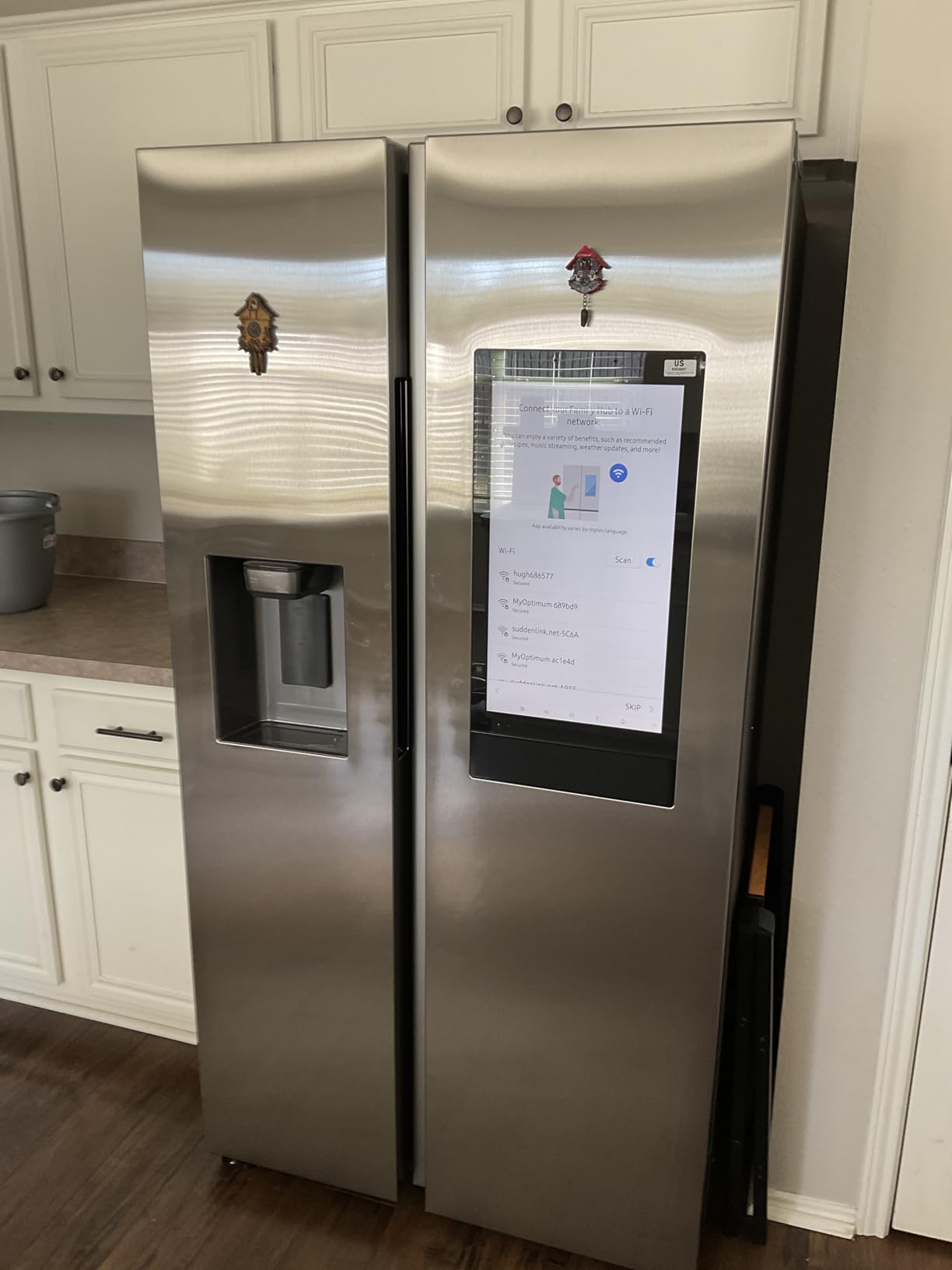
Smart features are where this model separates itself. The Family Hub touch screen is the centerpiece, and Alexa is built in, so you can ask for the refrigerator status without opening an app. The listed annual energy consumption is 691 kWh, which sits in the middle of this group, between the Forno at 560 and the Kenmore at 731.
Across 10 ratings holding a 4.1 star average, reviewers like the redesigned interior, which Samsung claims fits about 10 percent more groceries than the prior generation, and they like the even cooling. Smart feature feedback is genuinely mixed, which tracks with what we see in most appliance reviews of this type. About 17 percent of ratings are one star, and those reviews cluster around delivery damage rather than function.
What to check before you commit
At 306 pounds, this is the heaviest model in the roundup, and that has consequences beyond the appliance itself. Residential floors and older homes can be a real constraint, and the delivery crew needs a straight path. Measure your stairwell and doorway width before the unit arrives rather than after.
Warranty is the strongest in the group and the main thing separating this from the LG. You get five years parts and labor on the sealed refrigeration system, and ten years parts with five years labor on the digital inverter compressor. That is a meaningful difference if you intend to keep the refrigerator past year five.
Where it falls short
The Family Hub screen is the single most polarizing feature here. It adds cost to the purchase and introduces a learning curve for anyone in the household who does not want to deal with it, and it gives you a large panel on the exterior that can show the contents of your refrigerator to anyone standing in your kitchen.
It also draws more power than most of the alternatives, and the 1-star reviews that exist are concentrated on units arriving damaged. If you live in a building where deliveries are handled by concierge staff rather than the manufacturer, that risk profile changes.
3. Forno Salerno – Best Value In A 36-Inch Body
Forno Salerno 36-inch Side-by-Side 20 cu.ft Refrigerator in Stainless Steel with Ice & Water Dispenser
20 cu. ft. in a 36-inch body
13.48 cu. ft. fresh food
Cubed and crushed ice
2 year parts and labor
Pros
- External touchscreen dispenser with cubed and crushed ice
- Two year parts and labor warranty is the second longest here
- Inverter compressor with frost-free multi-air cooling
- Sabbath mode and temperature memory
Cons
- Lowest average rating in the group at 3.7 stars
- Smallest fresh food compartment here at 13.48 cu. ft.
- About a quarter of ratings are one star
The Salerno is the one to consider when you want a genuine external dispenser but do not want to give up counter-depth-style slimness. It fits 20 cu. ft., split into 13.48 cu. ft. fresh food and 6.53 cu. ft. freezer, inside a body that measures 35.9 inches wide and only 29.76 inches deep without the doors open. For comparison, the Samsung and Kenmore both run past 33 inches deep before you open anything.
That shallow depth is the whole point. Manufacturers quote a maximum depth with the door open, and this one is listed at 45.74 inches, which is tighter than the 51.31 inches on the Samsung and 51 inches on the Kenmore. If your counter run is shallow or you have an island close by, that difference decides whether the appliance fits at all.
The dispenser is a touch panel that switches between filtered water, cubed ice, and crushed ice. It is the only model in this roundup that offers all three. Owners also like the four adjustable spill-proof glass shelves, the produce drawers, and the three freezer shelves with bins. The inverter compressor drives frost-free multi-air flow cooling, and the exterior is described as resistant to fingerprints, scratches, and dents.
What to check before you commit
Twenty cubic feet is genuinely compact by side-by-side standards, and 13.48 cu. ft. of fresh food is the smallest here. For a household of one or two it is comfortable. For a family of four doing a weekly shop, you will notice the difference, and the compact shelled storage is what you will feel first.
There is no ice production rate published for this model, which is a real gap. If you entertain often and need a lot of ice quickly, you are guessing here. Our guide to the best countertop nugget ice makers covers the standalone options for that specific need.
Where it falls short
The 3.7 star average is the lowest of the six, and roughly 24 percent of the seven ratings sit at one star. That is too small a sample to diagnose a specific defect pattern, but it is enough to tell you that the experience is inconsistent, with 59 percent at five stars and the remainder split down.
Two year parts and labor is the second longest warranty here, behind only the Samsung compressor coverage, which is a genuine point in its favor. But the freight and logistics of a value-tier appliance can be less predictable, and the brand does not have the service network density that the major manufacturers do.
4. Kenmore 4651845 – Best For Ice Output At 3 lbs Per Day
Kenmore 29 cu. ft. 36″ Wide Side-by-Side Refrigerator – FPR Stainless Steel
29 cu. ft. capacity
18.6 cu. ft. fresh food
Up to 3 lbs of ice per day
NSF-certified filter
Pros
- Largest capacity in the roundup at 29 cu. ft.
- Only model with a published ice output of 3 lbs per day
- Eighteen gallon-size door bins and edge-to-edge glass shelves
- Accela Chill and Accela Freeze rapid cooling modes
Cons
- Highest energy consumption here at 731 kWh per year
- Shortest warranty at one year on the appliance
- Smallest review base with only 4 ratings
The Kenmore is the largest refrigerator on this list at 29 cu. ft., with 18.6 cu. ft. of fresh food and 10.4 cu. ft. of freezer. It still fits inside a standard 36-inch width at 35.75 inches across, 69.96 inches tall, and 36.02 inches deep. That combination of full width and top capacity is unusual and it is the reason to look at this model if your household shops in bulk.
What sets it apart for this particular roundup is the ice. The freezer door carries a space-saving ice maker that produces up to 3 lbs of ice per day according to the manufacturer technical data, and no other model in this group publishes an output figure. For anyone who fills coolers, hosts a lot of gatherings, or simply does not want to refill an ice bucket twice a day, that is the headline number.
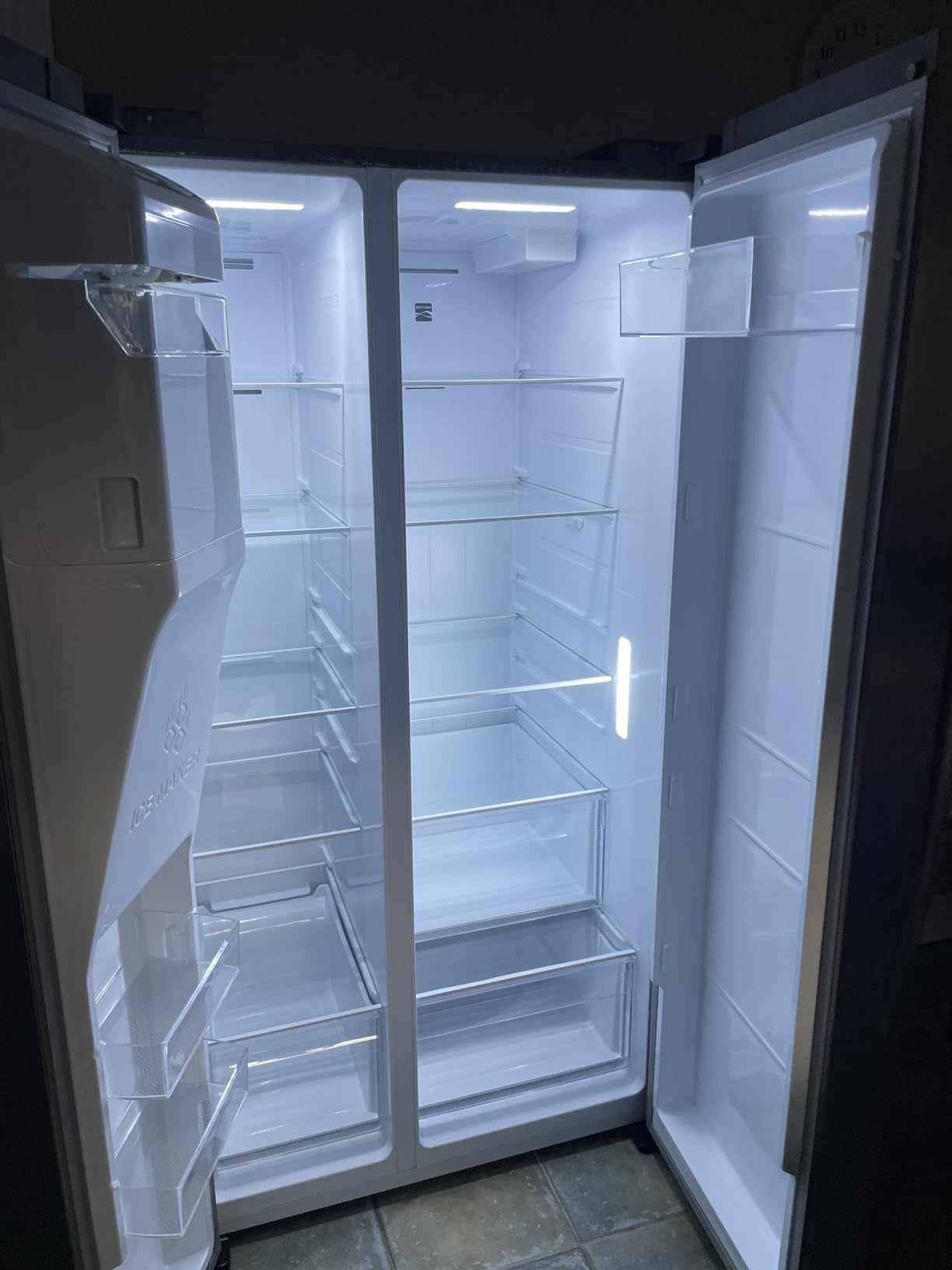
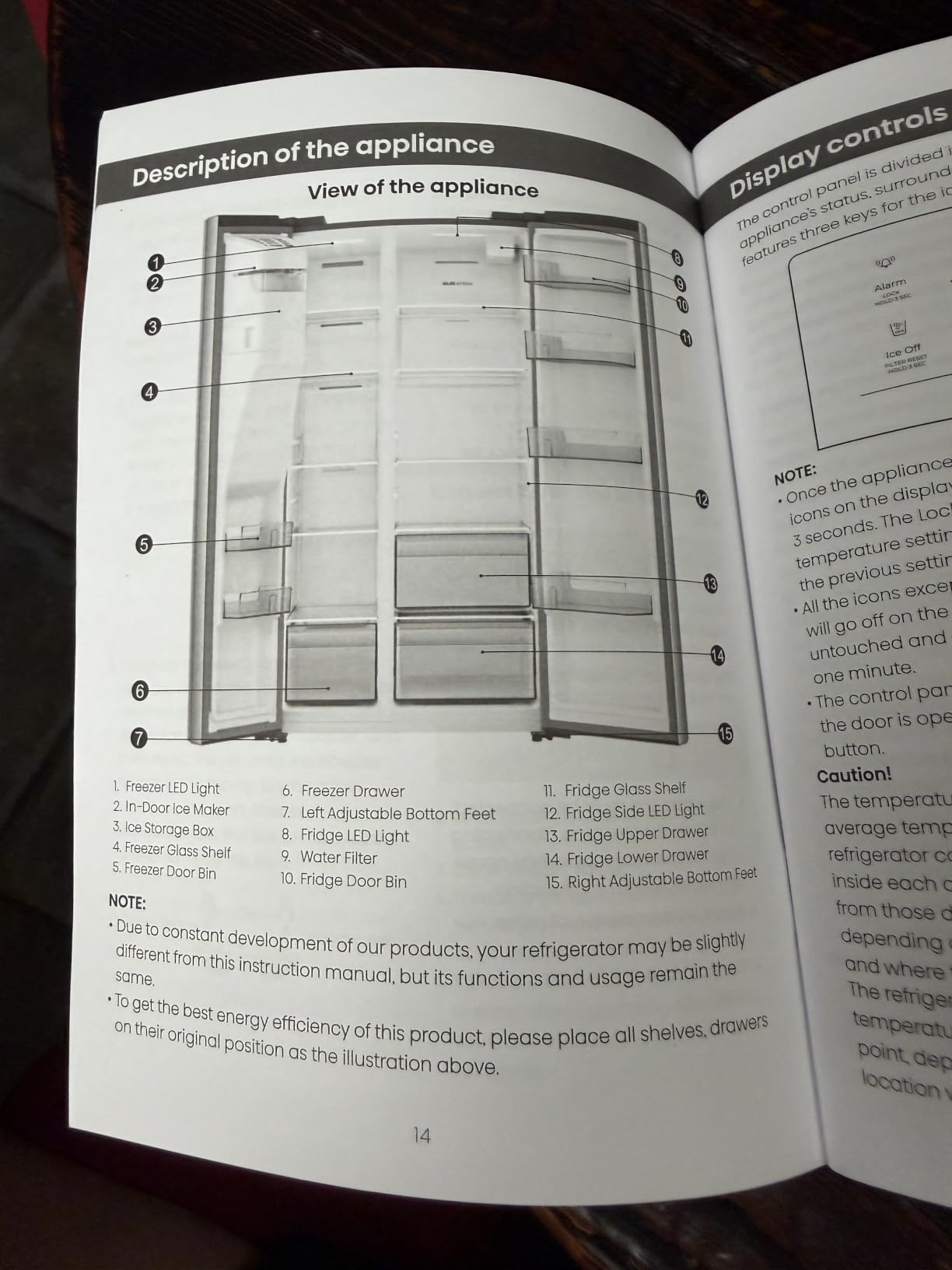
The external dispenser runs NSF-certified filtration, meaning both the water and the ice coming out of it are filtered. Storage is well organized with edge-to-edge glass shelves, four gallon-size door bins, and crisper drawers, and the Accela Chill and Accela Freeze functions let you drop the temperature quickly after a large grocery run. The doors are fingerprint-resistant stainless steel.
At 4.7 stars across 4 ratings, this model has the highest average rating of the group. That is worth saying plainly and also worth tempering: four ratings is a very small sample, with 74 percent at five stars and 26 percent at four, and no one-star reviews at all. Small samples skew high.
What to check before you commit
At 36.02 inches deep, this is a full standard-depth body, and the maximum depth with the door open is listed at 51 inches. That is the largest door clearance requirement of the six models here, so measure your alcove depth plus the space you need to stand in front of the open door, not just the cabinet depth.
The published 3 lbs per day assumes a specific ambient temperature and a full water supply. Cold garage temperatures and a warm kitchen both slow ice production, and the Kenmore is also the least energy efficient model here at 731 kWh per year, which is a running cost you pay every month rather than a one-time cost.
Where it falls short
The warranty is one year on the appliance, the shortest of the six. On a machine with a compressor, an ice maker, a water valve, and a dispenser motor, one year is thin coverage for exactly the components most likely to fail.
It also carries the highest energy draw in this roundup, and with only four ratings behind it you have almost no long-term owner data. If reliability is your primary concern rather than capacity, the Samsung’s ten year compressor coverage is the safer structure even though it costs more.
5. Electactic FF2-695 – Best For Small Kitchens And Quiet Operation
Electactic 18.1 Cu. Ft. Side by Side Refrigerator with Freezer, 2-Door Refrigerator with Built-in Ice Maker, Water Dispenser, Garage Ready Freezer with Digital Temperature Control, White
18.1 cu. ft. total
12.1 cu. ft. fridge and 6.0 cu. ft. freezer
Cubed and crushed ice
45dB inverter
Pros
- Quietest operation in the roundup at 45dB
- Shallowest body here at 26.38 inches deep
- Cubed and crushed ice from the exterior dispenser
- Child lock and door-open alarm included
Cons
- Smallest capacity in the roundup at 18.1 cu. ft.
- Only one customer review so long-term reliability is undocumented
- Highest energy draw per cubic foot at 624 kWh per year
The Electactic is the odd one out in this list, and that is precisely why it is here. It is the smallest at 18.1 cu. ft., split into 12.1 cu. ft. fresh food and 6 cu. ft. freezer, and the shallowest body at 26.38 inches deep by 35.83 inches wide and 69.69 inches tall. It weighs 202.8 pounds, which is also the lightest here and the easiest to get into a tight space.
Despite the small footprint, it still gives you an external dispenser that serves chilled water plus both cubed and crushed ice. The cooling system is Total No Frost with glass shelves, an inverter compressor rated at 45 dB, and digital temperature control with a door-open alarm that triggers after 60 seconds and a 3-second child lock. An ice storage box is included in the box.
The single owner rating is 5 stars and praises the ice and water dispensing, the quiet inverter compressor, and the frost-free performance. One review is not a track record, and I would not treat it as one. What it does tell us is that the feature set is at least implemented well on the unit that shipped.
What to check before you commit
Eighteen cubic feet is a genuine constraint. It works for one or two people, for a couple who eats out often, or as a second refrigerator in a garage or basement. It is tight for a family of four, and the 12.1 cu. ft. fresh food side is where you would feel that first.
Annual energy consumption is listed at 624 kWh, which is high for the capacity. That is partly a function of a small compressor cycling more often, and it partly reflects that the figure is a rated estimate rather than a measured average. Either way, budget for it as a real line item rather than assuming small means cheap to run.
Where it falls short
There is no published ice production rate, and with one review there is no community data to supplement it. If a dispenser jams or the ice tray fails, you are diagnosing from scratch with no owner history to lean on, and service for a lesser-known brand can mean a longer wait.
The listed warranty is one year. If you want the shallowest body and the quietest compressor on this list, this is the clear answer, but pair it with a realistic expectation that the warranty will not cover an ice maker failure in year three.
6. Amana ASI2575GRS – Best For A First Place With A Dual Pad Dispenser
Amana 24.6 CU. FT. Side BY Side Refrigerator with Dual PAD External ICE and Water Dispenser in Stainless Steel ASI2575GRS
24.57 cu. ft. total
15.46 cu. ft. fresh food
Dual pad external dispenser
Hot gas defrost
270 lb
Pros
- Dual pad external ice and water dispenser
- 15.46 cu. ft. of fresh food space in a 34-inch body
- Electronic lock for a shared or rental kitchen
- R-600A refrigerant and electronic touch controls
Cons
- Only one customer rating on record
- Not ENERGY STAR certified
- No warranty length stated in the product data
The Amana is listed as 24.57 cu. ft. with 15.46 cu. ft. of fresh food, inside a body that measures 34.12 inches deep by 35.87 inches wide and 69.25 inches tall at 270 pounds. That fresh food figure is the third highest here and it is packed into one of the narrower widths in the group, which is where the value of this model actually sits.
The dispenser is the dual pad external ice and water unit, with one pad for water and one for ice, which is simpler to operate than a single pad with a mode switch. The doors are stainless steel, defrost is handled by hot gas, and the refrigerant is R-600A. There is also an electronic lock, a feature you rarely see at this level and one that matters in a shared apartment or rental kitchen.
Worth flagging plainly: the product data lists this model as not ENERGY STAR certified. If you are choosing on running cost over five or ten years, that rating is part of the calculation and it does not favor this appliance.
What to check before you commit
Confirm the water line situation. A dual pad external dispenser needs a plumbed supply, and in a rental or older building the cost of getting a water line to the kitchen can exceed the appliance price. Verify that before you commit to anything else.
Also ask the retailer to confirm warranty terms in writing. The product data for this model shows no stated warranty description, and buying a major appliance without a known warranty length is a bigger gamble than it looks.
Where it falls short
There is a single customer rating at 4 stars, which is not enough to draw any conclusion about durability, noise, or ice production over time. Treat this as a spec-driven purchase rather than one backed by owner evidence.
The wire shelf construction is also worth noting against the glass shelves on the other models here. Wire shelves are cheaper and can flex under heavy weight, and the three shelves plus four racks layout is less flexible than the four adjustable spill-proof glass shelves on the Forno. If you decant a lot of containers, glass is easier to clean around.
How to Choose a Side by Side Refrigerator With an Ice Maker
Start with ice layout, because it drives everything else. An in-door ice maker sits inside the freezer compartment and keeps its ice in a bin you reach into. It takes up no door width, it adds no dispenser recess, and it has far fewer moving parts between the tray and your glass because there is no auger and no crusher. A through-the-door dispenser feeds ice out through a chute driven by an auger motor, which is what gives you crushed ice and a hands-free experience, and it is also what adds jam points, leak points, and noise.
The trade-off is real and buyers routinely regret getting it backwards. A forum thread on r/Appliances put it plainly: through-the-door dispensers are widely reported as the most common refrigerator failure point, and several people in that thread said they deliberately chose a freezer with a built-in ice maker and no external dispenser as a reliability trade-off. If you do not care about crushed ice, the in-door route is the lower-risk one.
Ice format is the second decision. Cubed ice is what most models make. Crushed ice needs a crusher mechanism inside the door, which is another motor to fail. Craft or nugget ice, the slow-melting kind you see on higher-end models, is made in a separate mold and is a genuine differentiator, though none of the six models here lists it.
Capacity comes next, and the numbers here tell the story. Eighteen cubic feet suits one or two people. Twenty to twenty-five handles a couple or a small family. Twenty-six and up is where a four-person household with a weekly shop gets comfortable. The fresh food figure matters more than the total, because that is the space you will actually run out of first.
Counter-depth versus standard-depth is the last structural choice. Counter-depth units sit nearly flush with your cabinets, which looks built-in and preserves walkway clearance, but you give up capacity. Standard-depth bodies cost the same money and hold noticeably more. If you are replacing an existing appliance in the same alcove, matching the old depth is usually the right call.
Smart features are a nice-to-have rather than a differentiator in this group. The Samsung’s Family Hub with Alexa built in is the most capable, and the LG’s Wi-Fi connection is enough for remote temperature checks and door alerts. We covered the smaller-capacity options in our guide to the best compact refrigerators if the 18 cu. ft. class is where you are shopping.
Ice Maker Reliability: What Actually Breaks And When
The through-the-door dispenser is the most failure-prone part of any refrigerator, and the reason is mechanical complexity. The path from the ice tray to your glass runs through a release mechanism, an auger motor, and on crushed-ice models a crusher. Forum reports on r/appliancerepair describe the common failures precisely: clumped or frozen ice in the chute, a damaged drive coupler, a jammed crusher mechanism, and a weak auger motor that spins without moving ice to the front.
Timing matters as much as the failure. Multiple owners report ice makers breaking in years three and four, which is exactly when a one year warranty has expired and the labor component of a longer warranty has usually run out. That is the single most useful thing to know before buying, and it is why warranty length belongs in the ice maker decision rather than in a general spec comparison.
Comparing the six models here: the Samsung carries five years parts and labor on the sealed refrigeration system and ten years parts with five years labor on the digital inverter compressor. The Forno covers two years parts and labor. The LG, Electactic, and Kenmore all list one year on the appliance, and the Amana lists no warranty length in the product data at all.
You can extend the life of any of these ice makers with a few habits. Replace the water filter on the manufacturer’s schedule rather than when taste changes, because taste is a late signal. Flush the water line when you change filters. Clean the ice tray and the ice bin regularly, since a thin layer of ice buildup around the tray edges is what causes the slow trickle failures owners describe. And if you go on long vacations, turn the ice maker off rather than leaving it cycling in an empty freezer.
One more forum pattern worth knowing: budget-conscious buyers with a fixed spending ceiling often choose a no-dispenser model specifically to avoid ice maker risk. That is not a failure of the product, it is a rational allocation of risk. Paying the same money for more interior space and dropping the dispenser entirely is a defensible strategy, and our countertop ice maker guide covers the standalone alternative.
Sizing: Counter-Depth vs Standard-Depth And Measuring Your Kitchen
Measure three things before you order: the width of the alcove, the depth from the wall to whatever is in front of it, and the delivery path from where the appliance enters the building to the kitchen. Width is usually the easy one, since most of these models measure between 34 and 36 inches across, but depth is where people get caught.
Use the maximum depth with the door open, not the cabinet depth, and allow room to stand in front of the open door. The Forno lists 45.74 inches with the door open, the Samsung lists 51.31 inches, and the Kenmore lists 51 inches. A 5 inch spread in required clearance is the difference between a smooth install and a fridge that cannot have its doors opened in a tight kitchen.
The delivery path deserves its own measurement. The Kenmore’s ice maker and dispenser recess add weight to the front of the door, which is the hardest moment to control. The Samsung at 306 pounds is the heaviest of the six, and the Electactic at 202.8 pounds is the lightest and by far the easiest to maneuver through a narrow hall or around a corner.
Measure every doorway, stairwell, and turn between the truck and the kitchen, and note the diagonal width of any tight corner you have to navigate. A 36-inch side-by-side will fit through a standard residential doorway, but a 36-inch body plus packaging plus the hands of two delivery workers is a much larger number than 36 inches.
On accessibility, worth raising because it rarely gets discussed. A side-by-side puts both the fridge and the freezer at roughly the same height, which means nobody in the household has to squat or reach overhead to find a frozen item. That is a genuine advantage over French door models, where the freezer contents sit at knee level and the top shelves are out of reach for anyone with shoulder or back problems.
Side by Side vs French Door vs Bottom Freezer
Side-by-side splits the appliance vertically. Both compartments are full height, both are at eye level, and the doors are narrow enough for tight kitchens and galley layouts where a wide French door would hit the opposite counter. The cost is that each compartment is half as wide, so a pizza box or a sheet pan needs to sit at an angle, and the freezer shelf space is narrower than a full-width bottom freezer.
French door puts a wide refrigerator on top and a wide pull-out freezer drawer at the bottom. It gives you the widest fresh food shelf of any layout and the easiest access to frozen goods, at the cost of the lowest and highest shelves both being less convenient. The dispenser recess, when present, also eats into that width.
Bottom freezer keeps the same wide fresh food compartment as a French door with a hinged freezer door instead of a drawer. It costs less, and the freezer requires bending rather than crouching. None of these three layouts has an in-door ice maker that works as well as a side-by-side’s freezer door, because the side-by-side’s narrow freezer column is where that kind of ice bin actually fits.
If your household uses the fridge far more than the freezer, a French door or bottom freezer gives you more usable fresh food width. If you split usage evenly or the kitchen is tight, the side-by-side wins on reach and footprint.
Frequently Asked Questions
Which brand of refrigerator has the most reliable ice maker?
There is no single brand winner, but the design matters more than the badge. Models with an in-door ice bin and no through-the-door auger have fewer failure points than external dispensers, because there is no crusher or drive motor in the path. Among the six models here, the Samsung RS27T5561SR pairs an indoor icemaker with the longest warranty at five years on the sealed system and ten years parts on the compressor.
What brand side-by-side refrigerator is most reliable?
Reliability in this category tracks warranty length and ice maker layout more than brand reputation. The Samsung RS27T5561SR offers the longest coverage in our group, with five years parts and labor on the sealed refrigeration system and ten years parts with five years labor on the digital inverter compressor. The LG LS27T3230S is a close second on owner evidence, with 11 ratings averaging 4.4 stars.
What brand of refrigerator has the least problems?
Owners most often report issues concentrated in one component category: the through-the-door ice and water dispenser. Reported failures include frozen or clumped ice in the chute, a damaged drive coupler, a jammed crusher, and a weak auger motor that runs without dispensing. A model that keeps its ice maker inside the freezer compartment avoids most of these failure points entirely.
What is the average lifespan of a refrigerator ice maker?
Owner reports commonly place ice maker failures in years three to four, which is when most appliance warranties have already expired. Life expectancy improves with basic maintenance, which means replacing the water filter on schedule, flushing the line at each filter change, cleaning the ice tray and bin to prevent buildup, and turning the ice maker off during long absences.
Is a side-by-side refrigerator better than a French door?
A side-by-side is better when the kitchen is tight, the household uses fridge and freezer equally, or accessibility matters, because both compartments sit at eye level and the narrow doors need less swing clearance. A French door is better when fresh food width is the priority, since the wide upper compartment fits sheet pans and pizza boxes flat. Budget buyers often prefer a top-freezer or no-dispenser model to avoid ice maker risk.
The Bottom Line on Side by Side Refrigerators With Ice Makers
After working through six models, the LG LS27T3230S is the best side by side refrigerator with an ice maker for most households, thanks to a 27 cu. ft. interior, a slim in-door ice maker that gives back shelf space, and the largest owner feedback base in the group at 4.4 stars across 11 ratings. Buy the Samsung RS27T5561SR if the ten year compressor warranty matters more to you than the sticker price, and the Kenmore 4651845 if ice output is your priority at up to 3 lbs per day inside a 29 cu. ft. body.
The single most important thing to get right is the ice maker layout. Choose in-door if you want fewer failure points and more usable space, and choose through-the-door if you want crushed ice and hands-free filling and accept more mechanical complexity. Measure your door swing before you order, because the difference between 45 inches and 51 inches of required clearance decides whether the appliance fits your kitchen at all.