
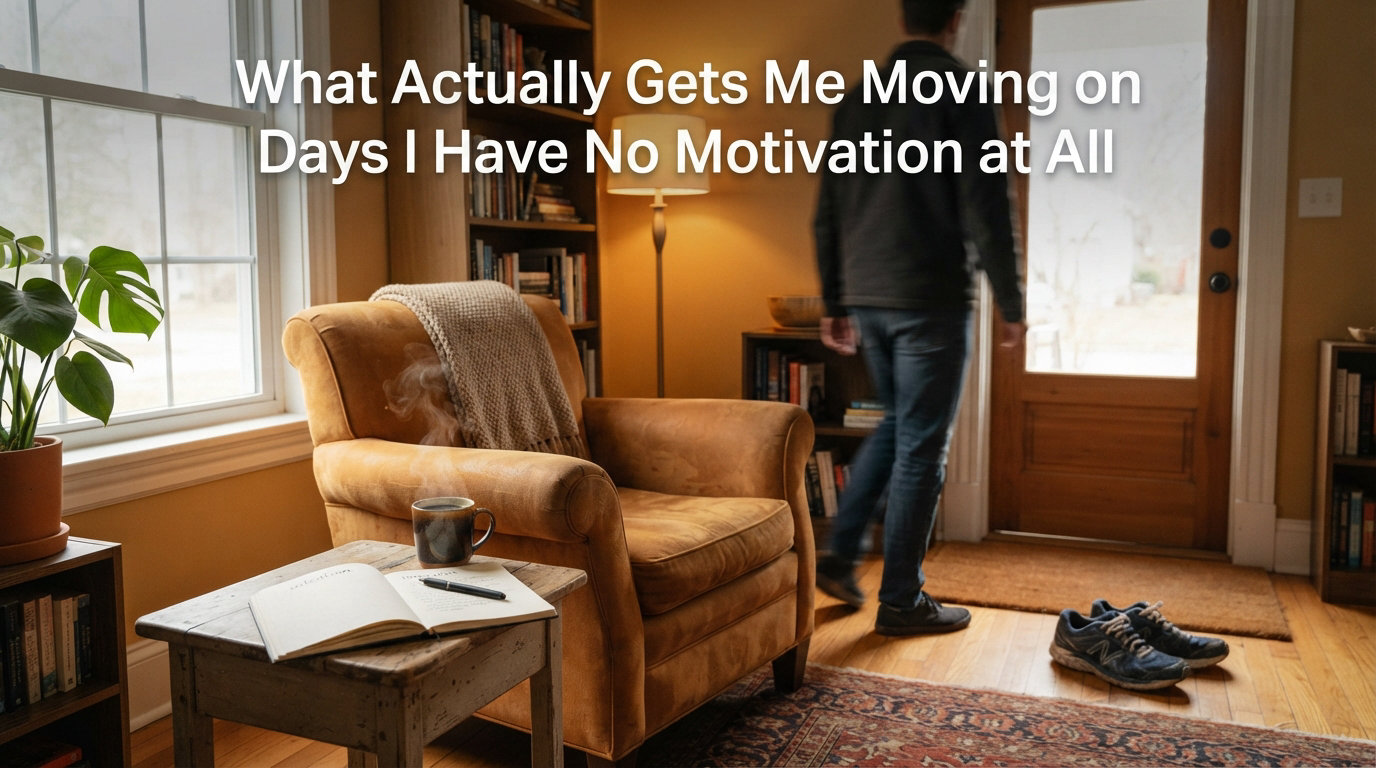
Some mornings the alarm goes off and you already know. The list stares back at you, the coffee tastes like nothing, and the weight in your chest has a name: zero motivation.
If that is you right now, I want to say something before we go any further. You are not lazy. You are not broken. You are not failing at adulthood. Something in your life has drained the tank, and what you need is not a louder pep talk. You need a different approach.
I know because I have lived it. I know because I have sat across from clients who showed up on Zoom looking like they had been dragged there by their own hair, and who eventually told me that the five-minute rule, of all things, was what cracked their cycle. I know because I have coached people who went from not being able to brush their teeth to rebuilding businesses and friendships and routines they actually wanted.
I am Kim, a life coach, and I work with people who feel exactly this way. Not people in crisis, just regular humans who look at a Tuesday and cannot find a single reason to move. In this article I want to share what actually gets me moving on days I have no motivation at all, and what I have seen work for the clients I have walked beside for years. No shame, no hustle culture, no toxic positivity. Just honest, practical things that meet you where you are.
Here is the short version, in case you are reading this from bed and need the headline first. Motivation is not a feeling you wait for. It is a feeling you create by starting. The fastest way to start when you have nothing left is to make the start absurdly small, give yourself permission to stop after five minutes, and stack tiny wins until your nervous system believes it is safe to try again. That is the whole article, in three sentences. The rest of this is the how, and the why it actually works.
Table of Contents
Why You Can’t Force Yourself to Start (The Motivation Lie)
Here is the lie we have all been sold: you should feel motivated first, and then you will act. We wait for inspiration to strike, for the mood to shift, for some invisible switch to flip. And then we wait another day.
The lie is so embedded that we blame ourselves when it does not work. We tell ourselves we are undisciplined, we download productivity apps, we buy planners we never open. None of it sticks, because none of it was the actual problem.
Motivation does not work that way. In my experience, both in my own life and across hundreds of coaching conversations, motivation is what shows up after you move, not before. The action creates the feeling. The feeling does not create the action.
Think about the last time you finally cleaned the kitchen. You did not feel like doing it. You probably started with a sigh. By the end, you were scrubbing the stovetop like your life depended on it. Where did that energy come from? It came from starting.
Your brain is wired to conserve energy. When you are tired, depleted, or overwhelmed, starting feels expensive. The resistance is real, and it is physiological. Beating yourself up for feeling it only makes the resistance louder.
The way out is not to feel ready. The way out is to make starting so small that your brain agrees. Once it agrees, the rest is just momentum, and momentum is a thing your body already knows how to do.
What Your Lack of Motivation Is Actually Telling You
Low motivation is not a character flaw. It is information. Something in your life is out of sync, and your energy is the messenger.
Here are the most common messages I see when someone tells me they have no motivation. I will keep the descriptions short, because most of us recognize ourselves before we finish the second sentence anyway.
You Are Burned Out
Burnout is what happens when you have been running on fumes for too long. Decision fatigue, sleep debt, emotional overload, constant context switching. Your nervous system pulls the brake because it knows what is coming if you keep going.
If you have been saying yes to everything, sleeping poorly, and treating weekends like recovery rooms for Monday, burnout is the most likely culprit. The fix is not more discipline. The fix is a longer runway, fewer commitments, and a serious look at the pace you have been running.
Your Daily Life Is Out of Sync With Your Values
This is the quiet one. You can technically do everything you are supposed to do and still feel dead inside, because none of it lines up with what actually matters to you.
I have coached people in good jobs, with good families, doing everything right on paper, who cannot find a single reason to get out of bed. The job is not bad. The life is just not theirs.
Values misalignment does not announce itself. It just slowly drains the color out of your days until you wonder why you are so tired for a life that looks fine from the outside.
It Might Be Depression or ADHD
I want to be careful and honest here. Sometimes low motivation is the early signal of depression. Sometimes it is executive dysfunction from ADHD that has never been diagnosed. Sometimes it is anxiety so loud it freezes you in place.
Coaching is a great fit for low motivation caused by burnout, values misalignment, and life transition. It is not a substitute for clinical care when something deeper is happening. I will come back to that distinction later in this article, because it matters.
If anything in this section felt uncomfortably familiar, take it seriously. Not as a diagnosis. Just as a reason to make a call you have been putting off.
The 5-Minute Start (The Strategy That Actually Works)
This is the strategy I lean on when my own tank is empty. I share it with every client in their first month. It sounds too simple to work, which is exactly why it does.
The rule is this. Commit to five minutes. That is it. Five minutes of the thing you are avoiding, and then you are allowed to stop.
I started using the five-minute rule during a season when my business was in a slump and I could not make myself write a single email. The thought of writing for two hours felt impossible. So I told myself I would write for five minutes. I wrote for ninety.
What happens in those five minutes is not magic. Your brain stops fighting the start, because the start is now small enough to be safe. The threat response quiets down and your prefrontal cortex finally gets a seat at the table.
Sometimes you stop at five minutes, and that is fine too. You kept the promise to yourself, and that matters more than you think. The point is not the size of the result. The point is the broken pattern of avoidance.
How to Make the 5-Minute Rule Actually Work
The five-minute rule fails when you treat it like a trick to force yourself to do more. It only works when you genuinely mean it. If you go in with a hidden agenda to keep going no matter what, your nervous system will know. The rule stops working the moment it becomes a lie.
Set a timer. When it goes off, stop or keep going, your choice. No guilt either way. Over time, your nervous system learns that starting is safe because it never has to mean a full task. That trust is what rebuilds motivation over weeks and months, not the heroic single day where you pushed through for three hours.
One of my clients used this rule to start running again after two years off. She told herself she only had to put on her shoes and step outside for five minutes. Some days she ran three miles. Some days she sat on her porch and came back in. She has run consistently for over a year now. None of that would have happened if the first step had been a five-mile run.
Another client used it for the dishes. Five minutes of dishes, then stop. Within a few weeks, the kitchen was clean most evenings. Within a few months, she realized the five-minute rule had spilled over into her work, her workouts, and her morning routine. The smallest unit of action had changed her relationship with starting.
Start Small, Win Tiny: Practical Strategies That Move You Forward
The five-minute rule is one tool in a larger kit. Here are the other moves I make and coach others to make when the tank is empty.
Break Tasks Down to Absurdly Small Steps
Your brain does not resist effort. It resists ambiguity. “Clean the house” is overwhelming. “Put three dishes in the sink” is not.
I keep a running list of absurdly small versions of hard tasks. Write one sentence. Open the document. Stand up. Walk to the door. Each of these is a complete win, and your brain starts to track a pattern of success instead of a pattern of avoidance.
The trick is to make the first step so small it feels almost silly. If the step is silly, your brain cannot justify resisting it. Silly actions are below the threshold of effort, and that is where the magic is.
Reduce Friction in Your Environment
Motivation is expensive. Friction is what makes it more expensive. Look at the things you are avoiding and ask, what is making this harder than it has to be?
Lay out your workout clothes the night before. Leave the laptop open to the document you need. Keep a water bottle on your desk. None of these moves are about willpower. They are about making the next action so easy that doing it is easier than not doing it.
Willpower is a finite resource. Friction design is a renewable one. Every small change you make to your environment pays you back in saved decisions for the rest of the day.
Build a Low-Motivation Morning Routine
A regular morning routine assumes you feel like doing it. A low-motivation morning routine assumes you do not.
Mine, on a zero day, looks like this. I sit up in bed for sixty seconds before I touch my phone. I drink a full glass of water. I open the blinds. That is the whole thing. Nothing heroic. Nothing Instagram-worthy. Just three small wins before the day starts trying to pull me in ten directions.
On the days I cannot even manage that, I do one of them. The point is not perfection. The point is contact with action. Each completed action is a tiny deposit back into your sense of agency, and agency is what motivation is built on.
Clients who build these routines tell me the same thing. The mornings start to feel survivable again. From survivable, you can usually get to functional, and you do not have to start at good.
Use Accountability Without Pressure
Most accountability systems fail when they add pressure. You do not need someone watching your numbers. You need someone who will check in and care.
Text a friend one sentence about what you are doing today. Ask a coworker to do the same. The act of saying it out loud, even in a text, gives your day a small witness. It also makes vague intentions into specific promises.
If you do not have someone to text, a coaching relationship can serve the same purpose. Coaches are not there to push. We are there to notice, reflect back what we see, and ask the question you have been avoiding. Sometimes that question is the action that breaks the freeze.
Match the Task to Your Real Energy
This is the strategy nobody talks about. Not every task belongs in every moment. There are hours when you can write a proposal and hours when you can only answer an email. Fighting against your actual energy level is one of the fastest ways to feel like you have no motivation.
I keep a rough mental map of my day. Mornings are for thinking. Afternoons are for meetings. Late afternoons are for admin. When I try to do admin at 9 a.m., I feel broken. When I do it at 4 p.m., I feel productive. Same task, different time, different person.
If you do not know your own rhythms, start tracking them for a week. Note your energy every two hours from one to ten. The pattern will show up by Wednesday.
Rest Is Not Laziness: Knowing When to Push and When to Pause
This is the conversation I have most often with new clients, and the one most often skipped in articles about motivation. We have been taught that rest is what happens when motivation fails. That is backwards.
Rest is what makes motivation possible. If you cannot tell the difference between rest and avoidance, you will keep punishing yourself for the wrong thing.
The Signals of Real Rest
Real rest feels quiet. Your shoulders drop. Your jaw unclenches. You might not be able to point to anything you accomplished, but something inside settles.
Real rest can be a nap, a long shower, a walk with no podcast, a slow morning with nowhere to be. It often looks like nothing from the outside. From the inside, it is repair.
The Signals of Avoidance
Avoidance feels buzzy. You tell yourself you are resting, but your chest is tight. You scroll until your eyes hurt. You sleep ten hours and wake up more tired than before. You are not resting. You are hiding.
I am not here to judge hiding. Sometimes it is the only thing that gets you through. But it is worth knowing the difference, because hiding does not refill the tank, it just lets you pretend the tank is empty.
How to Give Yourself Permission
If you were raised by people who valued productivity, rest feels morally dangerous. You have to consciously decide to give yourself permission, and it might not feel real at first. That does not mean it is not working.
Try this. On the next day you have nothing, take a thirty-minute window and do absolutely nothing on purpose. No phone. No plans. No “I should be doing.” When the guilt shows up, notice it. You do not have to obey it. You can let it sit next to you like an anxious dog and not follow where it leads.
Permission to rest is one of the hardest practices for driven people to build. It is also one of the most important. Without it, every off day becomes a failure instead of a refill, and you start to dread the very weekends and vacations you are supposed to enjoy.
When Low Motivation Needs More Than a Coach
I want to end this article with something I think is missing from most motivation advice. Sometimes the answer is not a strategy. Sometimes the answer is help.
Coaching is for people who are functional but want to grow. Therapy is for people who are hurting and need to heal. They are different. Both are valid. Sometimes you need both.
Signs to Reach Out to a Therapist
If your low motivation has lasted more than two weeks and is paired with any of the following, please reach out to a licensed mental health professional. Not a coach. Not a friend. A clinician.
You have lost interest in things you used to enjoy. Your sleep has changed dramatically, either sleeping too much or not at all. You cannot get out of bed most days. You are using food, alcohol, or screens to numb out. You have had thoughts of hurting yourself, even passively. You feel nothing, including nothing about feeling nothing.
None of those signs mean you are weak. They mean your brain needs support that goes beyond what I can offer in a coaching session. A good coach will tell you this and already have a list of therapists they trust to refer you to.
How Coaching and Therapy Work Together
Many of my best clients see a therapist and a coach. Therapy helps them process what is underneath the low motivation. Coaching helps them build the day-to-day structures that turn insight into action. Neither replaces the other, and the combination is often where the deepest change happens.
If you are unsure which you need, start by asking yourself this question. Do I mostly need to understand what is happening, or do I mostly need help doing something about it? If the answer is the first, look for a therapist. If it is the second, look for a coach. Many people end up in both, and that is normal.
FAQs
Why do I have no motivation to do anything?
Low motivation is usually a signal, not a flaw. The most common causes are burnout, decision fatigue, sleep debt, values misalignment, or something deeper like depression or ADHD. Start by naming what you are carrying. You cannot fix what you will not look at, but you also do not have to fix everything at once. If the lack of motivation has lasted more than two weeks and is changing your sleep, your appetite, or your interest in things you used to love, please reach out to a therapist for a proper assessment.
What actually gets you moving when you do not want to do anything?
The most reliable move is the five-minute start. Commit to only five minutes of the task. Set a timer. When it ends, you can stop or keep going. Starting is the only part your brain resists. Once you are in motion, momentum takes over more often than not. Pair this with reduced friction in your environment, one tiny win before anything bigger, and permission to stop without guilt. The point is the broken pattern of avoidance, not the size of the result.
How can I tell if it is laziness or something deeper?
Laziness feels neutral. You choose not to do something and you are at peace with it. Low motivation from burnout, depression, or ADHD feels heavy. You want to move but cannot. If the weight has lasted more than two weeks, is affecting sleep, appetite, or interest in things you used to love, or comes with numbness or hopelessness, that is something deeper. It is worth a conversation with a clinician who can give you a real answer instead of Google symptoms at 2 a.m.
How do I get motivated again after burnout?
Recovery from burnout happens in reverse order from how it built up. First, stop the leak. Cut one commitment, protect one hour of true rest each day, and lower the bar on what counts as a good day. Second, rebuild basics slowly. Sleep, water, movement, sunlight, one human connection. Third, only then look at your values and ask whether your current life lines up with what actually matters to you. Motivation returns last, not first, and trying to force it earlier is one of the fastest ways to burn out again.
Closing Thoughts for 2026
If I could leave you with one thing from this whole article, it would be this. You are not behind. You are not lazy. You are not failing some test nobody told you about.
You are a person whose tank is low, and there are real, repeatable things that refill it. Start with five minutes. Build one tiny win. Give yourself permission to rest on purpose. Reach out for help when the weight is too heavy to carry alone.
That is what actually gets me moving on days I have no motivation at all. It is not glamorous, but it works. And if you try it and it does not work, that is information too. Bring it to a coach, a therapist, or someone you trust, and let them help you sort out what is really going on underneath.
You have more options than you think. You are allowed to take the small one today.