
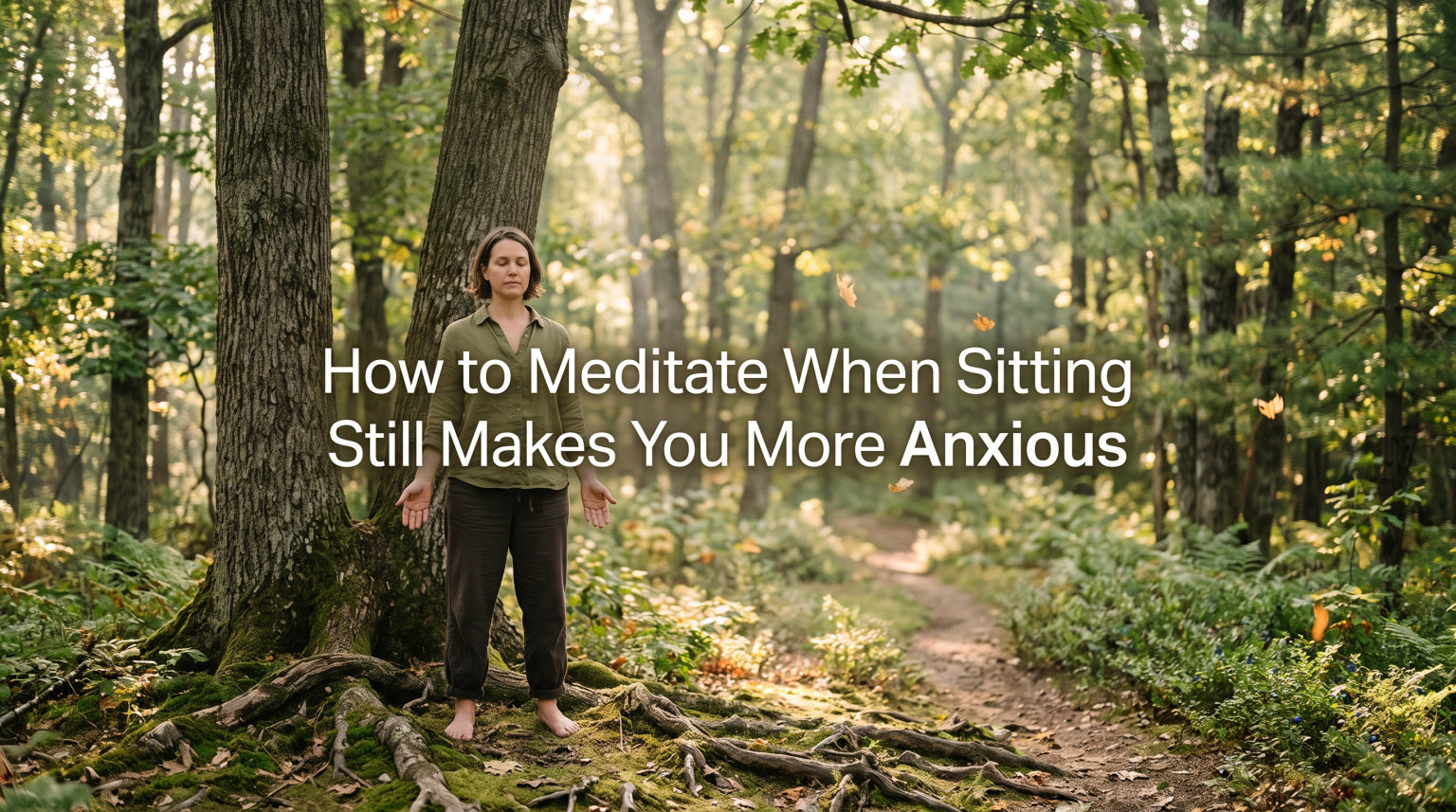
You sit down, close your eyes, and try to meditate. Within minutes your chest tightens, your mind races louder than before, and you feel more anxious than when you started. If this sounds familiar, you are far from alone. Learning how to meditate when sitting still makes you more anxious starts with one simple fact: this experience is incredibly common, and it does not mean you are doing anything wrong.
Thousands of people share this exact struggle on forums and in therapy offices every year. The breath you were told to focus on suddenly feels like the only thing keeping you alive. Your heartbeat grows louder. Stillness feels like being trapped rather than being at peace.
I want you to know that your reaction makes complete sense from a biological standpoint. There is nothing broken about your brain or your body. Once you understand why sitting still triggers these feelings, you can use alternative techniques that work with your nervous system instead of against it.
This guide walks through the science behind meditation-induced anxiety, the anxiety loop that keeps it going, and five practical alternatives you can start using today. You do not have to sit still to be mindful.
Table of Contents
Why Meditation Can Increase Anxiety
Meditation increases anxiety for many people because it turns up the volume on everything happening inside your body and mind. During a typical busy day, your brain filters out most internal signals so you can focus on tasks and conversations. When you sit still and go quiet, that filtering system gets dialed back.
Suddenly you notice your heartbeat, your pulse in your fingertips, the rhythm of your breathing, and every tiny physical sensation. For someone already living with anxiety, this surge of internal awareness can feel overwhelming and even frightening.
The Self-Awareness Spike
Meditation is built on self-awareness. That is the whole point of the practice. But when you have an anxiety disorder or high baseline anxiety, heightened self-awareness becomes a double-edged sword.
Instead of peacefully observing your thoughts, you become hyper-aware of physical anxiety symptoms. Your chest twitches. Your breath feels irregular and uncomfortable. You might feel tense in muscles you never noticed before. One Reddit user described it perfectly: focusing on the breath made them hyper-aware of it, feeling like they had to manually guide each breath in and out.
Beta Brain Waves and Why Stillness Backfires
Here is where the biology gets interesting. Most people assume meditation shifts your brain into calm, slow-wave states like alpha or theta. For some anxious meditators, the brain actually stays stuck in beta wave activity, which is the fast, active pattern associated with alertness and problem-solving.
Your brain interprets the sudden stillness and silence as a signal that something might be wrong. After all, when would humans normally go completely still and silent in nature? Usually when a predator is nearby. Your nervous system can mistake meditation for a threat response, flooding your body with the very sensations you are trying to calm.
Relaxation-Induced Anxiety
Researchers have actually documented a phenomenon called relaxation-induced anxiety. For some people, the act of trying to relax triggers anxiety instead of calming it. The contrast between your anxious state and the relaxation you are attempting can create cognitive dissonance.
Your body is used to running on adrenaline and tension. When you try to drop that tension quickly, your nervous system panics. It is like a car that has been revving at high RPM for years suddenly dropping to idle. The engine sputters and feels wrong.
This is why forcing yourself to sit still and calm down rarely works. Your system needs a gentler, more gradual approach that respects where it is at right now.
The Anxiety Loop Explained (and How to Break It)
The anxiety loop is the feedback cycle that keeps meditation-induced anxiety going. Understanding this loop is the first step to breaking it.
Here is how it works. You sit down to meditate, hoping to feel calmer. Within a few minutes you notice an uncomfortable physical sensation, maybe a tight chest or a racing heart. You think, why am I feeling this? Something must be wrong. That worried thought produces more anxiety, which produces stronger physical sensations, which produces more worried thoughts.
The loop spins faster with each cycle. Noticing anxiety creates more anxiety. Trying to suppress the anxiety creates resistance, which creates even more tension. Many people describe feeling worse after meditation than before they started.
Why Trying to Calm Down Makes It Worse
The paradox of the anxiety loop is that the harder you try to relax, the more anxious you become. Telling yourself to calm down activates the very monitoring system that is causing the problem. You start checking: am I calm yet? No? I must be failing. More anxiety follows.
Breaking the Loop With Curiosity
The way out is not to try harder to relax. It is to shift your relationship with the anxiety itself. Instead of treating sensations as threats to eliminate, approach them with curiosity.
Try this mental shift. When you notice your heart racing, instead of thinking oh no, not again, try thinking interesting, my heart is beating fast right now. Label what you feel without judging it. Observe it the way you might watch a weather pattern, knowing it will pass on its own.
Curiosity-based attention removes the fear that fuels the loop. Without fear, the physical sensations lose their grip and gradually settle on their own. You are not forcing calm. You are allowing what is already there.
How to Meditate When Sitting Still Makes You More Anxious: Practical Alternatives
You do not have to sit still with your eyes closed to practice mindfulness. Some of the most effective meditation for anxious minds happens while moving, engaging your senses, or doing everyday activities. Here are five alternatives that bypass the stillness trap entirely.
1. Walking Meditation
Walking meditation keeps your body in gentle motion, which gives your nervous system something to do rather than building tension. Walk slowly and deliberately, noticing the feeling of each foot touching the ground. Focus on the shift of weight from heel to toe.
You can practice this anywhere, a hallway in your home, a quiet sidewalk, or a park. Start with five minutes. The movement satisfies your body’s need for physical action while your mind stays present and grounded. Many people who cannot sit still find walking meditation immediately more comfortable.
2. Open-Eyes Meditation
Closing your eyes can trigger a claustrophobic feeling, like being boxed in with your anxious thoughts. Open-eyes meditation removes that trigger entirely.
Instead of closing your eyes, choose a soft, neutral point to gaze at. A spot on the wall, a candle flame, or a plant works well. Keep your gaze relaxed rather than staring intensely. With your eyes open, you stay connected to your environment rather than being pulled inward into hyper-awareness of your body.
This approach is especially helpful if you experience depersonalization or dissociation during traditional meditation. Visual connection to your surroundings keeps you anchored in reality.
3. Sensory Grounding (The 5-4-3-2-1 Technique)
When anxiety spikes, sensory grounding pulls your attention outward instead of inward. This technique engages all five senses and works well for people whose anxiety intensifies when they focus on their body.
Slowly identify five things you can see, four things you can feel, three things you can hear, two things you can smell, and one thing you can taste. Take your time with each sense. This is meditation in motion, keeping your mind occupied with external reality rather than internal sensations.
Sensory grounding works because it gives your busy, anxious mind a structured task. It is nearly impossible to spiral into anxious thoughts when you are actively cataloging your environment. This is one of the most effective meditation alternatives for anxiety sufferers.
4. Mini-Meditation: Ten Breaths at a Time
If longer sessions feel overwhelming, shrink the practice. A mini-meditation of just ten breaths is enough to build the mindfulness habit without giving anxiety time to build up.
Count each breath silently from one to ten. If you lose count, simply start over at one. There is no goal to reach, no state to achieve. When you finish ten breaths, you are done. You can do this standing, sitting, or even lying down.
Short sessions prevent the anxiety loop from gaining momentum. Over time, you can gradually extend to fifteen breaths, then twenty. The key is to stop before anxiety sets in, building positive associations with the practice rather than fearful ones.
5. Mantra and Counting Focus Instead of Breath
For many anxious meditators, focusing on the breath is the specific trigger. Becoming hyper-aware of breathing can make it feel manual and uncomfortable, like you have to remind yourself to breathe. If breath focus makes your anxiety worse, shift your attention elsewhere.
Repeating a simple word or phrase silently gives your mind an anchor that is not connected to your body. Try something neutral and calming, like peace, let go, or simply counting slowly. The repetition occupies your mind without directing attention toward physical sensations.
Mantra-based meditation has been practiced for thousands of years precisely because it quiets the mind through gentle repetition rather than inward observation. It sidesteps the body-awareness trigger entirely.
Quick Grounding Techniques for In-the-Moment Anxiety
Sometimes you need something faster than a full meditation session. These grounding techniques work in thirty seconds or less and can be used anywhere, including mid-meditation if anxiety suddenly spikes.
The 3-3-3 Rule for Anxiety
The 3-3-3 rule is a quick grounding exercise that interrupts anxious thought spirals. Name three things you can see around you. Then identify three sounds you can hear. Finally, move three parts of your body, such as your fingers, toes, and shoulders.
This technique forces your brain to shift from internal rumination to external awareness. It engages visual, auditory, and physical senses simultaneously, leaving less mental bandwidth for anxiety to maintain itself. Many therapists recommend it for panic attacks and acute anxiety moments.
Temperature Reset
Splashing cold water on your face or holding an ice cube activates the mammalian dive reflex, which naturally slows your heart rate and calms your nervous system. This is a biological reset button you can use in seconds when meditation triggers a spike.
Tips for Building a Practice Without Triggering Anxiety
Building a meditation practice when you have developed fear and resistance around it requires a different approach than standard meditation advice. Here is how to create a sustainable habit that does not backfire.
Release the Goal of Calming Down
The biggest trap is treating meditation as a tool to make anxiety disappear. When you sit down with the expectation that you should feel calm afterward, every anxious thought becomes evidence of failure. Drop the goal entirely.
Approach meditation with no agenda. You are not there to relax, to quiet your mind, or to feel peaceful. You are simply there to notice whatever happens, anxiety included. This attitude shift alone reduces the pressure that feeds the anxiety loop.
Address the Fear of Meditation Itself
If you have had negative experiences with meditation, you may have developed genuine fear around the practice. Your brain has learned to associate sitting down to meditate with feeling worse. That learned association is real and powerful.
Start by redefining what meditation looks like for you. If sitting still is the trigger, do walking meditation. If closing your eyes is the trigger, keep them open. If silence is the trigger, use gentle background sound. Change enough variables that your brain stops recognizing the activity as a threat.
Keep Sessions Short and Frequent
Five minutes daily is far more valuable than thirty minutes once a week. Short sessions prevent anxiety from building while still training your brain in mindfulness. You can always extend sessions later as your comfort grows.
Practice Self-Compassion
If a session goes badly, that is not a failure. It is information. Maybe a particular technique does not work for you, or maybe today is just a high-anxiety day. Speak to yourself the way you would speak to a friend going through the same thing.
Self-compassion is not just a nice idea. Research shows that self-criticism actively increases anxiety, while self-kindness reduces it. Being gentle with yourself is itself a form of meditation practice.
Track What Works
Keep a simple note on your phone tracking which techniques you tried and how you felt before and after. Over time, patterns will emerge. You will discover which alternatives work for your specific nervous system and build a personalized toolkit.
When to Seek Professional Help
Meditation-induced anxiety is common, but some experiences warrant support from a mental health professional. If you experience full panic attacks during meditation that do not subside, persistent depersonalization or derealization that lingers between sessions, or thoughts of self-harm, please reach out to a therapist.
Look specifically for therapists trained in trauma-sensitive mindfulness or anxiety treatment. They can help you develop a personalized approach to mindfulness that accounts for your history and nervous system. Some people also benefit from working with a meditation teacher who specializes in anxiety-sensitive instruction.
There is no shame in needing support. Meditation is a tool, not a test of willpower. Professional guidance can make the difference between struggling alone and building a practice that genuinely serves you.
Frequently Asked Questions
Why does sitting still make me anxious?
Sitting still removes external distractions and increases your awareness of internal physical sensations like your heartbeat and breathing. For people with anxiety, this sudden internal focus can trigger the nervous system’s threat response, making stillness feel dangerous rather than relaxing.
Why does meditation trigger my anxiety?
Meditation triggers anxiety through a feedback loop called the anxiety loop. When you become aware of anxious physical sensations during meditation, that awareness produces worried thoughts, which produce stronger sensations, which produce more worry. The loop spins faster with each cycle unless interrupted by curiosity-based attention.
How to meditate if you can’t sit still?
Try alternative techniques like walking meditation, open-eyes meditation, sensory grounding, mini-meditations of ten breaths, or mantra-based focus. These methods keep your body in motion or redirect attention away from internal sensations, bypassing the stillness trap entirely.
What is the 3 3 3 rule for anxiety?
The 3-3-3 rule is a quick grounding technique: name three things you can see, identify three sounds you can hear, and move three parts of your body. It forces your brain to shift from internal anxious rumination to external awareness, interrupting anxiety spirals in about thirty seconds.
You Can Practice Mindfulness Without Sitting Still
If sitting still to meditate makes you more anxious, the answer is not to push harder through the discomfort. The answer is to change the approach entirely. Your nervous system is responding exactly the way it was designed to, and it deserves techniques that work with it rather than against it.
Learning how to meditate when sitting still makes you more anxious opens up an entire world of alternatives. Walking meditation keeps you grounded through movement. Open-eyes meditation prevents the trapped feeling. Sensory grounding pulls you outward when inward focus gets overwhelming. Mini-meditations build the habit without triggering the anxiety loop. Mantra focus redirects attention away from the breath entirely.
Pick one technique from this guide and try it for five minutes today. Not thirty. Not an hour. Five minutes, with no expectation of feeling calm. Notice what happens without judging it. That is the entire practice.
Your relationship with meditation can change. It starts with letting go of the idea that there is one right way to be mindful and discovering the way that actually works for you.