
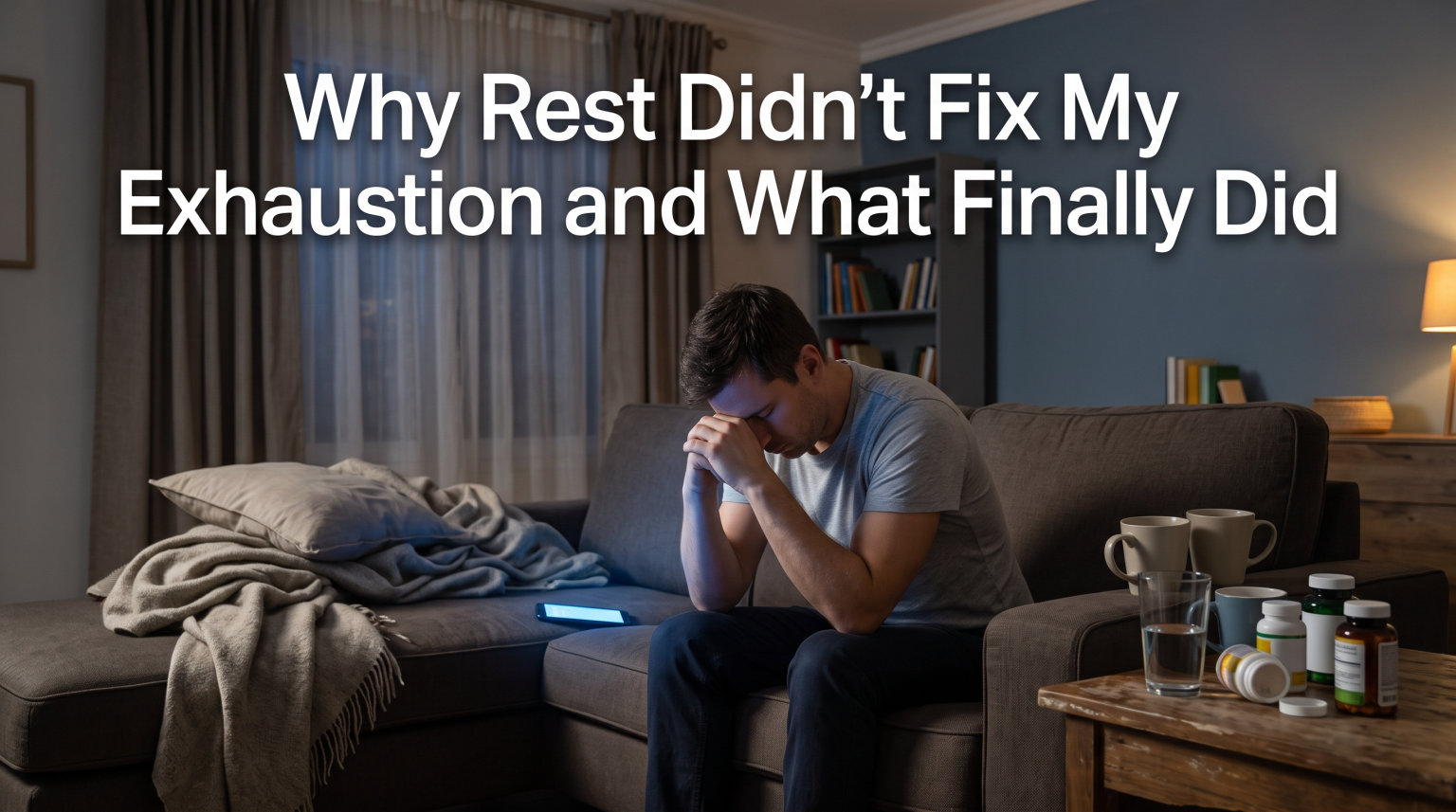
I slept nine hours straight and woke up feeling like I had run a marathon. I took a long weekend off, came home, and crashed harder than before I left. I said no to three social invitations, lit a candle, did a meditation app, took a hot bath. By Tuesday morning I was staring at the ceiling, exhausted again.
If you have ever asked yourself why rest didn’t fix my exhaustion, I want you to know something before we go further. You are not lazy. You are not broken. You are not failing at self-care. Something real is happening in your body, and it is not what you have been told.
This is the article I wish someone had handed me three years ago. I am going to share what I learned the hard way, and what finally helped me come back to myself. If you have tried everything and still wake up tired, please keep reading. The answer is closer than you think.
Table of Contents
Why Rest Didn’t Fix My Exhaustion (And What I Kept Missing)
Exhaustion that rest doesn’t fix is usually not about sleep at all. It is rooted in nervous system dysregulation and emotional fatigue, which is why your body can log eight hours in bed and still wake up feeling like the lights are dim.
When your nervous system has been on high alert for months or years, it loses the ability to downshift on command. Sleep becomes a shallow pause instead of a deep reset. Your brain is technically off, but your body never really believes the danger has passed.
I kept treating exhaustion like a fuel problem. If I could just add more rest, I thought, the tank would refill. What I learned is that the issue was not the amount of rest. The issue was that my system had forgotten how to receive rest. I was trying to pour calm into a nervous system that was still bracing.
That bracing is what most people miss. Rest alone cannot undo chronic alertness. The body needs to be taught, slowly, that it is safe to come down.
Burnout vs Tiredness: What’s Really Going On
Tiredness is a physical signal. Burnout is a nervous system condition. Knowing the difference changed everything for me.
Tiredness responds to a good night’s sleep, a slow morning, or a quiet weekend. It shows up after exertion and clears with recovery. Burnout does not follow that simple loop. It lingers after rest, gets worse when you try to push through, and often arrives without a clear trigger.
Here are the signs that your exhaustion is deeper than ordinary tiredness:
You wake up after 8 or 9 hours and still feel heavy
Vacation gives you a brief lift, then you crash within days of returning
Rest feels uncomfortable, agitating, or even guilty
Small tasks feel like they require enormous energy
You feel disconnected from your body, like you are operating on autopilot
You have a hard time feeling joy, even in moments that should bring it
When I read that list three years ago, I cried in my car. I had been blaming myself for years for not bouncing back after a vacation. I thought I was doing rest wrong. The truth was, I was not dealing with tiredness. I was dealing with burnout, and burnout needs a different kind of care.
Nervous System Dysregulation: The Hidden Reason Sleep Isn’t Enough
Nervous system dysregulation is what happens when your stress response gets stuck in the “on” position. Your body adapted to constant pressure, and now it treats ordinary life as a threat.
Think of it like a smoke detector that has become too sensitive. It goes off when you make toast. It goes off when a door closes. It will not stop, no matter how many times you press the button. Sleep is supposed to be the button. But when the system is dysregulated, the button does not work anymore.
This is what I now call chronic alertness. Your body learned that slowing down led to overwhelm or criticism, so it learned to stay braced. Even when nothing is wrong, it scans for what could go wrong. That constant scanning burns enormous energy, which is why you feel exhausted even when you have done very little.
I started noticing my own signs. A clenched jaw at red lights. Holding my breath during emails. A low hum of tension in my chest from the moment I opened my eyes. None of these were dramatic. All of them were costing me real energy, every single day.
Sleep cannot reach that hum. No vacation can turn it off. Resetting a dysregulated nervous system requires a different approach. It requires teaching your body, in small and repeated ways, that it is allowed to come down.
The Self-Abandonment Pattern That Keeps You Exhausted
The deepest layer of my exhaustion was not the stress itself. It was the pattern of overriding my own signals to keep everyone else comfortable.
I called it self-care, but most of what I was doing was self-abandonment dressed up as a routine. Saying yes when I meant no. Smiling when I felt wrong. Performing energy I did not have. Telling my body to quiet down so I could keep going. Each time I overrode a signal, my nervous system learned that my own needs were not safe to honor.
This is what I see in so many high-achieving people, especially the helpers and caretakers. We are taught that our value comes from how much we can hold. So we hold and hold and hold. The body eventually has to scream to be heard. Exhaustion is that scream.
Once I started noticing the pattern, I could not unsee it. I would push through a meeting when my body was begging me to rest. I would silence my own discomfort so a client would not feel guilty. I would say “I am fine” so many times I forgot that I was allowed to feel anything else.
The fix is not more willpower. The fix is attunement. Attunement is the practice of listening to what your body is telling you, and responding to it before it has to escalate to a crisis.
What Finally Did Help: 4 Shifts That Changed Everything
Here is the part of the story that took me the longest to learn. The recovery that worked for me was not bigger or more dramatic. It was slower, smaller, and far more honest.
These are the four shifts that finally began to undo the exhaustion that rest alone could not touch.
1. I named what I was actually avoiding.
The first turning point came when I asked myself what I was so busy doing that I could not slow down. The honest answer was not “too much work.” It was that my pace was keeping me from feeling things I did not want to feel. Loneliness. Grief. A question about whether I was on the right path. The busyness was a refuge. Naming that took the power out of it.
2. I built somatic awareness into small moments.
I did not start with hour-long meditations. I started with five-second check-ins. Before I opened my laptop. After a hard conversation. In line at the grocery store. I would pause and ask my body, “What is true right now?” Then I would let it answer. That tiny practice taught my nervous system that my signals mattered.
3. I let myself feel the feelings I had been outrunning.
Once I could hear my body, I had to sit with what it was saying. I cried on a Tuesday afternoon for no reason I could name. I felt anger rise up about a meeting from two years ago. I let myself be bored on a Sunday. None of it was pretty. All of it was necessary. The exhaustion had been holding those feelings in storage. I had to let them move.
4. I rebuilt my relationship with rest.
This was the final piece. Rest was no longer something I earned after I had been productive enough. Rest became a basic human need, like water. I added micro-rest throughout the day. I stopped apologizing for taking a walk. I let rest be unproductive, boring, and quiet. Slowly, my nervous system began to trust that I would not push it past its limits again.
None of these shifts happened overnight. The first month, I felt worse. The second month, I felt tender. By the third month, I woke up one morning and realized I had not braced to open my eyes. That is when I knew something had finally changed.
FAQs
What if fatigue is not improving with rest?
Fatigue that does not improve with rest is usually a sign of nervous system dysregulation or emotional burnout rather than simple tiredness. Your body has likely been in a chronic stress response for so long that sleep no longer provides full recovery. The next step is to look at emotional patterns, self-abandonment, and somatic awareness rather than adding more hours of rest.
What kind of fatigue does sleep not fix?
Sleep does not fix emotional fatigue, nervous system burnout, or exhaustion caused by chronic self-abandonment. This kind of tiredness feels like a heavy blanket that never lifts, even after a full night or a long vacation. It is the body’s signal that something deeper than physical exertion needs attention.
Why doesn’t rest help burnout?
Rest does not help burnout when the nervous system has become dysregulated and cannot downshift on its own. Your body has adapted to chronic stress and stays in a state of alertness even during sleep or vacation. Recovery requires nervous system recalibration, somatic awareness, and addressing the emotional patterns that created the burnout in the first place.
How to recover from exhaustion that sleep won’t fix?
To recover from exhaustion that sleep will not fix, begin by naming what you have been avoiding emotionally, build small somatic check-ins throughout the day, let yourself feel the feelings you have been outrunning, and rebuild your relationship with rest so it is a daily practice rather than a reward. Expect the process to take weeks or months, not days.
Why Rest Didn’t Fix My Exhaustion: The Real Reason, and the Real Recovery
The reason rest didn’t fix my exhaustion was never that I needed more rest. It was that I had been ignoring what my body was trying to tell me, and my body had finally gotten loud enough that I could no longer look away.
If you are reading this in 2026 and still tired, please hear me. You do not need to earn your way back to yourself. You do not need another vacation, another supplement, another morning routine. You need to listen. That is where this changes.
This is the work I now do with my clients, and it is the work I wish I had access to years earlier. If something in this article landed, trust that. Your exhaustion is not the end of your story. It is the invitation to begin a truer one.