
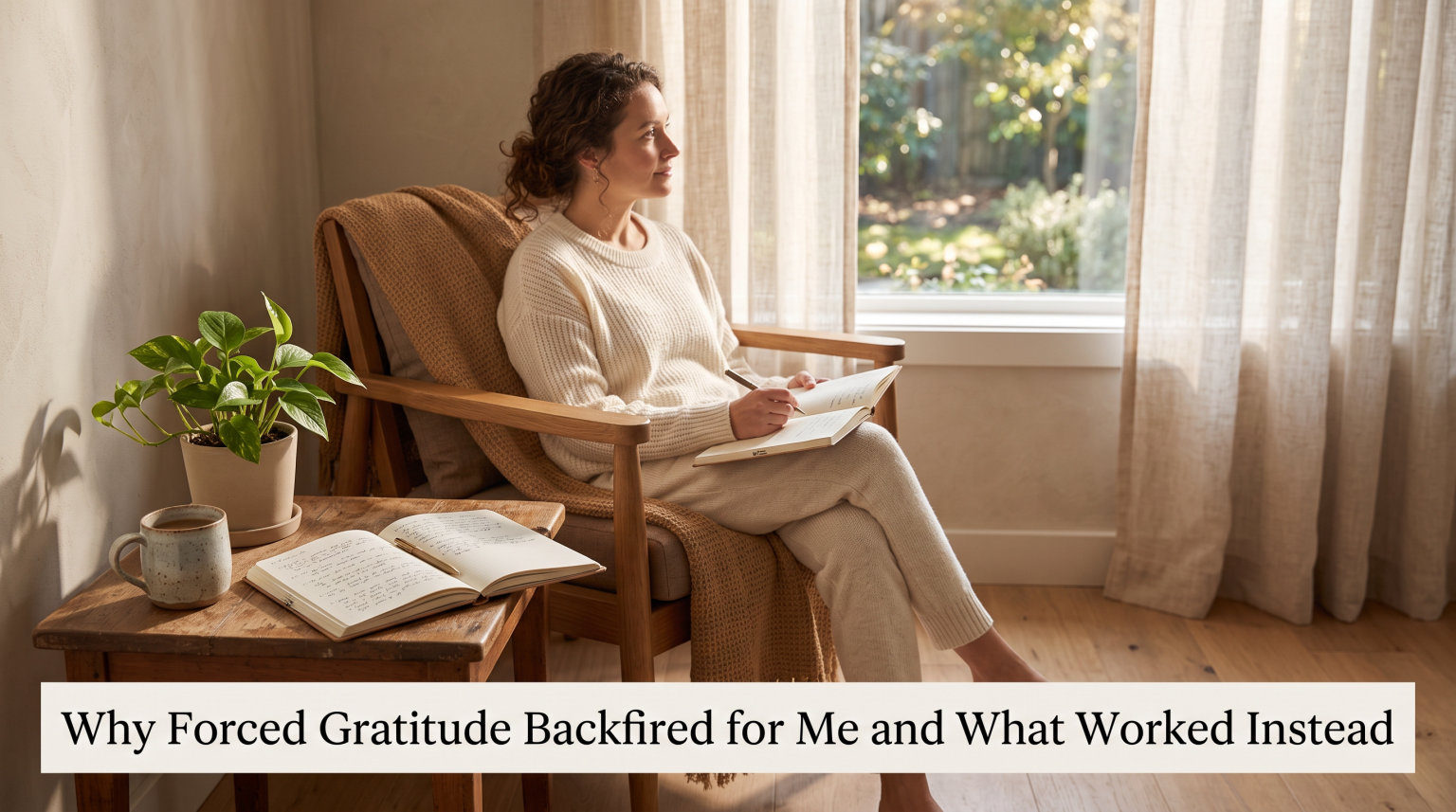
I spent two years forcing myself to write in a gratitude journal every morning. By month six, I was crying into the notebook more than I was smiling. By month eighteen, I dreaded opening it. Today, in 2026, I want to share what happened when forced gratitude backfired for me, and the four small shifts that finally helped.
If you have ever felt guilty for not feeling grateful enough, this piece is for you. You are not broken. You may just be doing gratitude the wrong way.
Table of Contents
What Forced Gratitude Looked Like in My Own Life
My forced gratitude story starts in a therapist’s office. I had just come through a rough season of burnout, and my counselor suggested I try a gratitude journal. The idea was simple: write three good things every day. I bought a notebook that evening.
For the first few weeks, it felt okay. Then the entries started sounding the same. Health, family, work, roof over my head. I kept writing them anyway because I thought that was the rule. Three things. Every day. Even when I was struggling.
The breaking point came the week my marriage hit a low. I sat down to journal and could not name a single thing I felt grateful for. I wrote “I am grateful for my breath” just to fill the page. It felt like lying on paper.
I kept going for months because I believed gratitude was supposed to help. The more I forced it, the more disconnected I felt from my own emotions. I was performing thankfulness instead of feeling it.
That is the heart of what I now call my forced gratitude backfire. The practice I had been told would save me was actually pushing me further from myself.
What Is Forced Gratitude (And Why It Hurts)
Forced gratitude is expressing thankfulness out of fear, guilt, or obligation rather than from genuine appreciation. It happens when you say thank you because you believe you should, not because you feel it. It is a form of emotional suppression dressed up as positivity.
Researchers and trauma therapists describe it as using gratitude to avoid difficult feelings rather than process them. The short-term result can feel calming. The long-term result is emotional dissonance, the gap between what you say you feel and what you actually feel.
Forced gratitude is different from authentic gratitude in one simple way. Authentic gratitude arises naturally when you notice something good. Forced gratitude is something you do to yourself, often to push away something painful. That difference matters more than most people realize.
Why Forced Gratitude Backfires: 5 Ways It Quietly Harms You
Forced gratitude backfires because it skips the very thing emotions are designed to do. They are meant to move through you, not be replaced. Here are the five ways I saw it cause harm in my own life and in my coaching practice.
It Silences the Emotions You Need to Process
Every feeling carries information. Sadness tells you something needs tending. Anger tells you a boundary was crossed. Fear tells you to slow down.
When you force gratitude on top of those signals, you mute them. You do not eliminate them. You simply teach yourself to ignore them. Over time, those ignored signals tend to come back louder, often as anxiety, numbness, or sudden tears over small things.
I learned this the hard way. During my gratitude journaling months, I stopped crying when I needed to. I thought that was progress. It was not. The grief I skipped was waiting for me on the other side of that practice.
It Creates Emotional Dissonance
Psychologists call this state cognitive dissonance. When your words and your inner experience do not match, your nervous system notices. That mismatch is stressful, even if you cannot name it.
I lived in that mismatch for almost a year. I would say “I am so grateful for this opportunity” in a job interview while my stomach was in knots. I would write “grateful for my health” while ignoring chest tightness I had not checked out. The gap between my words and my truth was exhausting.
Forced gratitude does not just feel fake. It is fake. Your body knows it.
It Feels Like Gaslighting
This one surprised me. Many of my clients have shared a similar reaction. When someone tells you to “just be grateful” while you are hurting, it can land like a small betrayal.
I have heard this phrase from parents, partners, bosses, and friends. “Other people have it worse.” “At least you have a job.” “Look on the bright side.” Each of these is a form of gratitude shaming. It teaches you that your pain is inconvenient.
For survivors of complex trauma, this pattern can be especially harmful. When gratitude was used during childhood to silence real suffering, hearing it again as an adult can retrigger old wounds. That is not a personal failing. That is a nervous system doing its job.
It Triggers Trauma Survivors
On Reddit communities like r/CPTSD, you can find thousands of people describing the same experience. Gratitude itself can be a trigger when it was used historically to minimize abuse.
I have sat with clients who cannot say the word “grateful” without feeling sick. For them, gratitude was weaponized. It became a tool that said, “Your pain is not welcome here.” When gratitude practice is layered on top of that, it can deepen the original wound rather than heal it.
If that is you, please hear this. Your reaction makes sense. You do not need to force gratitude to recover. You need safety, validation, and the freedom to feel what you feel.
It Maintains Harmful Systems
Forced gratitude has a quieter harm that often goes unnamed. It keeps broken systems in place. When employees are told to be grateful for a job that underpays them, the focus shifts from the pay to the attitude.
I coached a client last year who was told by her manager to “think about what you are grateful for” after she raised concerns about being overworked. That single sentence shut down the conversation. Her real problem, an unsustainable workload, never got addressed.
Forced gratitude can become a tool for avoiding accountability. It can silence the very people who most need to be heard. Recognizing that pattern is the first step toward breaking it.
What Worked Instead: 5 Alternatives That Actually Helped
Once I stopped forcing gratitude, I had to find what actually worked for me. Here are five practices that helped me rebuild a relationship with thankfulness on my own terms.
Naming the Hard Thing First
Before any gratitude practice, I now name the hardest thing on my mind. Sometimes that is one sentence. Sometimes it is a page.
This small shift changed everything. When I let the difficult feeling exist, it usually loosens. Then, if gratitude shows up, it is real. If it does not, that is okay too.
Practicing Self-Compassion Before Gratitude
Self-compassion researcher Kristin Neff has shown that self-compassion is often more healing than forced positivity. Her work suggests that treating yourself with kindness during hard times reduces anxiety and builds resilience faster than pretending you are fine.
I started saying one compassionate phrase to myself each morning. “This is hard, and that is okay.” That sentence did more for my nervous system than three pages of forced gratitude ever did.
Letting Emotions Be Valid Without Fixing Them
I gave myself permission to feel bad without trying to fix it. That sounds simple. It was not.
Years of forced gratitude had trained me to reach for a positive spin the second something hurt. Letting myself sit in a feeling, even for five minutes, was like learning a new language. It took practice, and I still slip. But the practice of staying with an emotion, instead of covering it, has changed how I relate to myself.
Curating Gratitude From the Body, Not the Head
When gratitude does show up for me now, it tends to arrive physically. Warm tea in my hands. A stretch that releases tension. Sun on my face during a walk.
Instead of writing what I think I should be grateful for, I ask my body what feels good in this moment. That question skips the shoulds. It leads to something honest.
Setting Boundaries With Gratitude Culture
I now set small boundaries with gratitude culture. When someone tells me to “just be grateful,” I name what is happening. “I hear you, and I am also allowed to feel hurt.”
That boundary has changed relationships in my life. Some people welcomed it. Others pushed back. Either way, I stopped abandoning myself to keep the peace.
How to Tell the Difference Between Authentic and Forced Gratitude
Authentic gratitude feels like a small, warm surprise. Forced gratitude feels like homework.
If you are unsure which one you are practicing, try this. Notice your body as you think about what you are grateful for. Do you feel softer or tighter? Do you breathe easier or hold your breath? Your body usually knows the answer before your mind does.
Forced gratitude often comes with phrases like “I should,” “at least,” or “I have to.” Authentic gratitude tends to sound simpler. “That was nice.” “I liked that.” “Thank you.” Notice which words feel true to you this week.
You are allowed to skip gratitude entirely some days. You are allowed to feel what you feel. You do not owe anyone positivity.
FAQs
What is forced gratitude?
Forced gratitude is expressing thankfulness out of fear, guilt, or obligation rather than genuine appreciation. It is a form of emotional suppression that uses positivity to avoid difficult feelings instead of processing them.
Why does gratitude make me feel worse?
Gratitude can feel worse when it is forced. If you are saying thank you while ignoring sadness, anger, or fear, you create emotional dissonance. For trauma survivors, gratitude itself can be a trigger if it was used historically to minimize suffering.
How do I stop forcing gratitude?
Start by naming the hardest feeling on your mind before any gratitude practice. Practice self-compassion phrases like u0022this is hard and that is okay.u0022 Give yourself permission to feel negative emotions without fixing them. Let gratitude arise naturally instead of performing it.
Are gratitude journals bad for you?
Gratitude journals are not bad by themselves. They become harmful when they are used to suppress real emotions or when they feel like a chore. If journaling makes you feel fake or guilty, try naming the hard feeling first, or set the practice aside for a season.
The Bottom Line on Forced Gratitude
You do not have to be grateful on demand. You do not have to perform positivity to be a good person. When forced gratitude backfires, it is not a sign that you are ungrateful. It is a sign that your emotions need a different kind of attention.
If you take one thing from my story, let it be this. Your feelings are valid, even the hard ones. Real gratitude, the kind that heals, will come back when it is ready. Until then, you are allowed to rest.
I would love to hear from you. What has helped you when gratitude stopped working? Drop a note in the comments, or share this with someone who needs the reminder that they do not have to force a smile to be okay.