
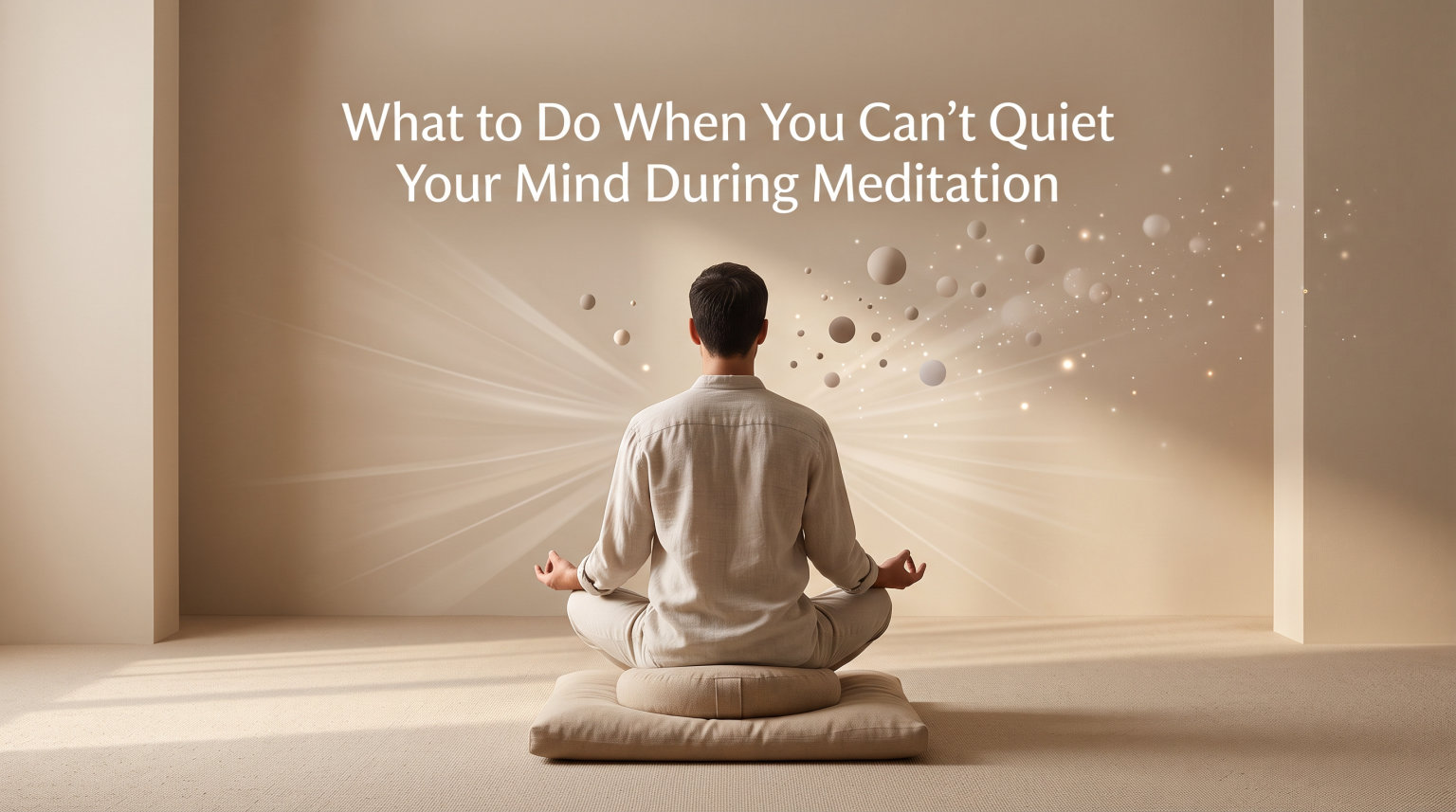
You close your eyes, settle into position, take a deep breath, and within seconds your brain serves up a grocery list, a replay of an awkward conversation from 2019, and a sudden urge to check your phone. If that sounds familiar, you are in the right place. Almost every single person who has ever tried meditation has been there, including experienced practitioners who have meditated for decades.
Here is the good news: a busy mind during meditation is not a sign that you are doing it wrong. It is not proof that you are “bad at meditation.” And it is definitely not a reason to give up. In fact, the struggle you are experiencing is exactly what the practice is designed to work with.
In this guide, I will walk you through what to do when you can’t quiet your mind during meditation. You will learn why your thoughts actually get louder when you sit still, seven specific techniques you can use today, and how to build a sustainable practice even if your mind feels like it never stops.
Table of Contents
Why Your Mind Feels Louder When You Sit Down to Meditate
Your mind does not suddenly generate more thoughts when you meditate. What changes is your awareness of them. Throughout the day, you are bombarded by external input, conversations, screens, traffic, music, and tasks. All of that noise drowns out your internal mental chatter. When you sit down and remove those external distractions, you finally hear what your brain has been saying all along.
There is also a neurological explanation. Your brain has a circuit called the default mode network, which is essentially your mind’s resting-state activity. This network is responsible for self-referential thinking, daydreaming, replaying memories, and planning for the future. It runs constantly in the background, and meditation puts you face to face with it for the first time.
For people with ADHD or anxiety, this experience can feel even more intense. Racing thoughts, impulsivity, and difficulty sustaining attention are core features of these conditions, and meditation amplifies awareness of them temporarily. That intensity is real, and it does not mean meditation is off limits. It means you may benefit from specific techniques and shorter sessions, which I cover below.
The key shift is understanding that noticing the noise is actually progress. Before you started meditating, that mental chatter was running unchecked. Now you are aware of it, and awareness is the first step toward changing your relationship with it.
What to Do When You Can’t Quiet Your Mind During Meditation: 7 Techniques
These seven approaches come from established meditation traditions, neuroscience research, and the real-world experiences of thousands of beginners who have faced the same wall you are facing. You do not need all of them. Pick one or two to start, practice them consistently, and add others as you grow.
1. Anchor Your Attention on the Breath
Your breath is the most reliable anchor for meditation because it is always with you and always happening in the present moment. The technique is simple but powerful. Find the place where you feel your breathing most clearly, whether that is the rise and fall of your chest, the expansion of your belly, or the sensation of air passing through your nostrils.
Rest your attention there. Do not try to control or change your breathing. Just observe it. When your mind wanders, and it will, gently guide your attention back to that physical sensation. Try counting each exhale from one to ten, then start over. If you lose count, simply begin again at one without any judgment.
The counting gives your thinking mind something productive to do while your attention settles. Many beginners find that this small structure makes a huge difference in the first few weeks of practice.
2. Label Your Thoughts as They Arise
Labeling is a technique from mindfulness-based stress reduction that creates distance between you and your thoughts. When a thought appears, silently give it a short, neutral label. If you are thinking about work, label it “planning.” If you are replaying a memory, label it “remembering.” If you are worrying about something, label it “worrying.”
The label is not a judgment. You are not saying the thought is bad or wrong. You are simply acknowledging what it is, the same way you might note “there goes a car” while sitting on a park bench. Once you label the thought, let it go and return to your breath or chosen anchor.
This technique works because naming a thought shifts activity from the emotional centers of your brain to the prefrontal cortex, which handles language and reasoning. That shift literally reduces the emotional intensity of the thought, making it easier to let pass.
3. Treat Thoughts Like Weather Passing Through the Sky
Imagine your mind as a vast sky and your thoughts as clouds drifting across it. Some clouds are small and fast. Others are dark and heavy. But no matter how many clouds fill the sky, the sky itself remains untouched, open, and spacious behind them all.
When a racing thought appears, do not try to push it away or argue with it. Trying to suppress thoughts is like trying to hold a beach ball underwater. The harder you push, the more forcefully it pops back up. Instead, let the thought drift through your awareness the way a cloud drifts across the sky.
You do not need to engage with every thought that passes through. You can notice it, watch it arrive, watch it change, and watch it leave. Your job is to be the sky, not the weather.
4. Remember That the Return Is the Rep
This single concept changed how I understand meditation, and it comes from experienced teachers who have worked with thousands of struggling beginners. In strength training, the bicep curl is the rep. In meditation, returning your attention to the breath is the rep.
Most people think a good meditation means sitting with a completely empty mind. So every time their attention wanders, they feel like they failed. But wandering is not failure. The moment you notice your mind has drifted and you bring it back, that is the repetition. That is where the growth happens.
Think about it this way. If your mind never wandered, you would never practice returning. A mind that wanders a hundred times gives you a hundred opportunities to strengthen your attention. The person whose mind wanders fifty times may actually be getting less practice than someone whose mind wanders two hundred times.
5. Try a Mantra or Counting Practice
If breath focus alone is not enough to hold your attention, give your mind a specific word or phrase to work with. This is called mantra meditation, and it is practiced in traditions ranging from transcendental meditation to contemplative Christianity.
Choose a word or short phrase that feels meaningful or calming to you. It could be “peace,” “calm,” “let go,” or any word that resonates. Silently repeat it on each exhale. When thoughts arise, let them pass and return to your word.
The repetition gives your busy mind a rhythmic task that is easy to sustain. For people who find silence too spacious and their minds too loud, a mantra fills just enough mental space to reduce the chatter without requiring intense concentration.
6. Practice Self-Compassion Instead of Frustration
One of the biggest obstacles in meditation is not the thoughts themselves. It is the frustration and self-judgment that arise when thoughts appear. Beginners often beat themselves up for “failing” at meditation, which creates more mental turbulence, which leads to more frustration. It is a painful cycle.
When you notice frustration building, treat yourself the way you would treat a friend who is learning something new. You would not yell at a friend for not speaking Spanish on day one. Offer yourself the same patience. Some sessions will feel calm and settled. Others will feel chaotic and restless. Both are part of the process.
Self-compassion is not just feel-good advice. Research from Kristin Neff and others shows that self-compassion actually reduces rumination and anxiety, making it easier to maintain any habit including meditation. The kinder you are to yourself during practice, the more consistent your practice becomes.
7. Start With Just One to Two Minutes
If sitting still for twenty minutes feels impossible, do not sit for twenty minutes. Start with one minute. Then two. Build slowly the same way you would build any physical habit. A consistent two-minute daily practice will serve you far better than an inconsistent thirty-minute session once a week.
Pick a specific time and place. Morning works well for many people because the mind has had less time to accumulate the day’s stress. Sit comfortably, set a timer for your chosen duration, and practice one of the techniques above. When the timer sounds, you are done.
As your tolerance grows, add a minute or two. Within a few weeks, you may find yourself naturally sitting for ten or fifteen minutes because the practice starts to feel good rather than like a struggle.
Common Meditation Myths That Make Things Worse
Several widespread beliefs about meditation cause unnecessary suffering for beginners. Let’s clear them up so they stop undermining your practice.
Myth: The goal is to empty your mind completely. This is the most damaging misconception in meditation. No tradition teaches that you must eliminate all thoughts. Even experienced meditators have thoughts during practice. The goal is to change your relationship with thoughts, not to eliminate them.
Myth: If you have thoughts, you are meditating wrong. Having thoughts during meditation is like having waves on the ocean. It is the natural state of the mind. What matters is how you respond to those thoughts, not whether they appear.
Myth: Meditation should feel relaxing immediately. Sometimes it does. Often it does not, especially at the beginning. Meditation brings you into contact with stress, tension, and unresolved emotions that you have been avoiding. Feeling restless or uncomfortable at first is normal and does not mean anything is wrong.
Myth: You need a completely silent environment. While a quiet space helps, waiting for perfect conditions means you may never start. Background noise, physical sensations, and interruptions are all part of real life. Learning to meditate amid mild distractions actually builds stronger attention skills.
Your First Week of Practice: A Simple Roadmap
If you want a concrete plan, here is a gentle first week that thousands of beginners have used successfully. The goal is consistency, not duration.
Days 1-2: Sit for two minutes each morning. Focus only on the sensation of breathing. When your mind wanders, return gently. Do this before checking your phone.
Days 3-4: Sit for three minutes. Add the labeling technique. When thoughts arise, label them silently and return to the breath.
Days 5-7: Sit for five minutes. Use whichever technique felt most natural earlier in the week. Notice whether your experience changes at all from day one.
By the end of the week, you will have meditated seven times. That is seven sessions more than zero. The momentum you build matters far more than the length of any individual session.
FAQs
How do I quiet my mind during meditation?
Anchor your attention on your breath, label thoughts as they arise without judgment, and gently return your focus each time your mind wanders. The act of noticing and returning is the practice itself. Start with just two to three minutes daily and build from there.
How do I shut down an overactive mind?
You cannot force your mind to shut off, and trying to suppress thoughts usually makes them louder. Instead, let thoughts pass without engaging them, use a breath anchor or mantra to give your attention a resting place, and practice consistently. Over time, the mind settles more easily on its own.
Why do ADHD people struggle with meditation?
ADHD involves differences in attention regulation, which makes sustaining focus on a single anchor more challenging. The default mode network that drives mind-wandering can be more active. Shorter sessions of two to five minutes, mantra-based practices, and movement meditation like walking can work better than long seated sessions.
What to do when you can’t quiet your mind?
Stop trying to quiet it. Instead, change your relationship to the thoughts themselves. Observe them without judgment, label them, let them pass like clouds, and return your attention to your breath. The return is where the practice happens, not the silence.
Is it normal to have thoughts during meditation?
Yes, completely normal. Every meditator has thoughts during practice, including people who have meditated for decades. Thoughts are the natural activity of the mind. Having them does not mean you are meditating wrong or failing at the practice.
How long before meditation starts to work?
Many people notice subtle shifts in mood and reactivity within two to three weeks of daily practice, even with short sessions. More noticeable changes in focus, stress levels, and emotional regulation typically emerge after eight weeks of consistent practice, which aligns with research on mindfulness-based interventions.
You Are Not Broken, You Are Just Beginning
If you take one thing from this guide, let it be this: when you can’t quiet your mind during meditation, you are not failing. You are doing exactly what every meditator before you has done. The busy mind is not an obstacle to practice. It is the material the practice works with.
The techniques in this guide all share one principle. You do not fight your thoughts or force them away. You notice them, label them, let them pass, and return to your anchor. And every single return, no matter how many times you have to do it in a single session, strengthens your attention a little more.
Start small. Two minutes today is better than zero. Be patient with yourself the way you would be patient with a friend. The mind that feels so loud right now will, with consistent practice, grow quieter and easier to sit with. Not because you eliminated the thoughts, but because you learned to let them be.
Your next step is simple. Set a timer for two minutes, find a comfortable seat, and try one technique from this guide. That is all it takes to begin.