
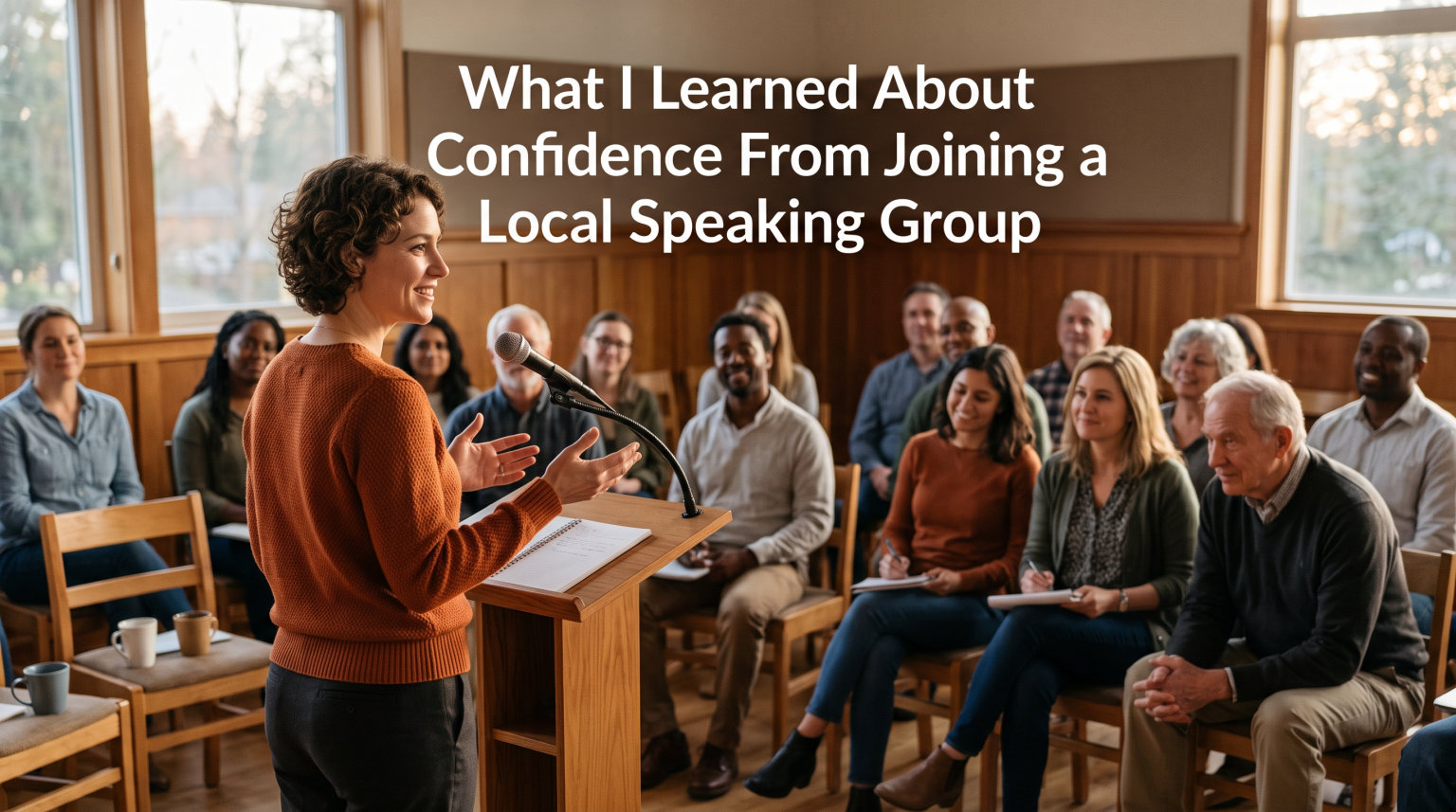
I used to think confidence was something you were either born with or you were not. That belief kept me quiet in meetings, invisible at social events, and stuck in a version of myself I had outgrown years ago. Then I joined a local speaking group, and everything I assumed about confidence got turned upside down.
If you have ever felt your heart pound before speaking up, or watched someone else share an idea and wished that could be you, this is for you. I want to walk you through what I learned about confidence from joining a local speaking group and how those lessons reshaped not just my ability to speak in public but my entire approach to life.
As a life coach, I spend a lot of time helping other people build self-belief. But honestly, my own confidence needed work. What happened over six months of standing up in front of strangers surprised me, humbled me, and ultimately changed me.
Table of Contents
My Confidence Struggle Before the Speaking Group
For years, I told myself I was just an introverted person who was not meant to speak in public. I would rehearse sentences in my head during meetings, edit them until they sounded perfect, and then never say them out loud. By the time I felt ready, the conversation had moved on.
The self-doubt was exhausting. I would agree to give a small presentation at work and then lose sleep over it for a week. My hands would shake. My voice would crack. I would rush through my notes just to get it over with. I told myself it was just nerves, but deep down I knew it was fear wearing a more acceptable name.
The breaking point came when I froze during a client call. I knew the material inside and out, but the moment all eyes turned to me, my mind went blank. I stumbled, apologized, and felt the heat rise to my face. That night, I made a decision. I was tired of letting fear make my choices for me.
A friend mentioned she had joined a local speaking group a few months earlier and said it had changed her life. I was skeptical. The idea of voluntarily standing in front of people to talk sounded like my worst nightmare. But I was also desperate enough to try anything. So I looked up a group that met weekly at a community center about fifteen minutes from my house.
I almost turned around in the parking lot that first night. I sat in my car for ten minutes, talked myself out of it twice, and then walked through the door anyway. That single decision changed the trajectory of my confidence journey.
What I Learned About Confidence From Joining a Local Speaking Group
Over the next several months, I showed up every week. I gave terrible speeches. I forgot my lines. I rambled. I also got better, one small step at a time. Here are the five lessons that stuck with me the most.
Vulnerability Is the Gateway to Real Confidence
The first speech I gave was objectively bad. My voice shook, I lost my place twice, and I am pretty sure I talked for three minutes about absolutely nothing. When I sat down, I waited for the judgment.
It never came. Instead, people nodded, smiled, and told me they had been exactly where I was. Several shared their own stories of disastrous first speeches. No one critiqued my delivery or made me feel small.
That was the moment I understood something important. Real confidence is not about being flawless. It is about being willing to be seen as imperfect and still showing up. The group gave me a safe space to be bad at something publicly, and that permission to fail is what actually built my confidence.
In my coaching practice, I see this all the time. People believe they need to feel ready before they act. But readiness comes from action, not the other way around. Vulnerability, the willingness to look foolish, is the price of admission for genuine confidence.
Feedback Builds You Up Instead of Tearing You Down
I had always associated feedback with criticism. In school, feedback meant red marks on a paper. At work, it meant a performance review where someone listed everything you did wrong. So when the speaking group assigned someone to evaluate each speech, I braced myself.
The evaluations were nothing like I expected. They followed a simple framework. The evaluator highlighted what worked well, offered one or two specific suggestions for improvement, and ended with encouragement. That structure made feedback feel like a gift rather than an attack.
I started to crave it. After every speech, I wanted to know what I could do better next time. The feedback was specific, actionable, and delivered with genuine care. Over time, I stopped fearing judgment and started seeing every evaluation as a stepping stone.
This mindset shift carried over into every area of my life. I started asking for feedback at work instead of avoiding it. I became more open to hearing hard truths from friends and family. When feedback comes from a supportive environment, it stops feeling like a threat and starts feeling like fuel for personal growth.
Preparation Outperforms Natural Talent
Before joining the group, I assumed confident speakers were just naturally gifted. They had some gene I did not get. Watching other members speak, I realized how wrong I was.
The best speakers in the group were not the ones with the most natural charisma. They were the ones who prepared the most. They rehearsed their speeches out loud multiple times. They timed themselves. They practiced their transitions. They showed up with structure and intention.
This was a revelation for me. I had always winged it and then beaten myself up when things went sideways. Once I started treating preparation as non-negotiable, everything changed. My nervousness did not disappear, but it became manageable. I knew my material, and that knowledge gave me something to lean on when the butterflies showed up.
Preparation gave me a sense of control. It turned the unknown into something I had already walked through. That feeling, the quiet certainty that comes from having done the work, is what real confidence feels like. It is not the absence of fear. It is the knowledge that you can handle what comes.
Everyone Else Feels Nervous Too
This might be the single most liberating thing I learned. Every person in that room, including the ones who seemed completely at ease, felt nervous before they spoke. The difference was not that they lacked fear. The difference was that they had learned to speak alongside their fear instead of waiting for it to go away.
One of the most experienced members told me she still gets butterflies before every speech, even after years of practice. She said the butterflies never fully leave. You just learn that they are not a stop sign.
Hearing that from someone I admired was transformative. I had spent years thinking confident people felt nothing. The truth is they feel everything. They just keep going. That realization took so much pressure off me. I did not need to eliminate nervousness. I needed to stop treating it as proof that I was not good enough.
Small Repetitions Create Lasting Change
No single speech changed my confidence. It was the accumulation of showing up week after week. Each time I stood up to speak, it got slightly easier. Each time I finished and survived, my brain logged a new piece of evidence that I could handle it.
This is how confidence is actually built. Not in one dramatic moment, but in dozens of small ones. The group provided a structure that made those repetitions possible. I did not have to figure out how to practice on my own. I just had to show up, and the format did the rest.
Progress was gradual, not overnight. Some weeks I felt like I was getting worse. But looking back over three months, then six months, the trajectory was unmistakable. The person who could barely introduce herself at the first meeting was now volunteering for table topics and actually enjoying it.
How Speaking Confidence Transferred to My Everyday Life
The most unexpected part of this journey was how the confidence I built in that room followed me everywhere else. I did not just become a better speaker. I became a different version of myself.
At work, I started speaking up in meetings without rehearsing every word in my head first. I volunteered to lead presentations that I would have previously avoided. When someone pushed back on an idea, I could hold my ground without shrinking.
In social situations, I stopped scanning the room for exits. I could walk into a networking event and actually start conversations. I was more present with people because I was not consumed by self-monitoring.
As a life coach, this experience made me better at my job. I understood viscerally what it means to push past fear, and I could speak to that process with authenticity. My clients could feel the difference. When I told them that confidence comes from action, they knew I was not just repeating a theory. I had lived it.
The confidence you build in a speaking group does not stay in the speaking group. It leaks into everything. Every time you choose courage over comfort, you expand what feels possible. That expansion is cumulative, and it changes the shape of your life.
FAQs
Why is confidence important in public speaking?
Confidence matters in public speaking because it helps you deliver your message clearly, connect with your audience, and recover gracefully from mistakes. When you trust yourself, your audience trusts you too. Confidence does not eliminate nervousness but allows you to speak effectively despite it.
What are five benefits of confidence?
The five key benefits of confidence are: (1) You speak up more often and share your ideas. (2) You handle feedback without taking it personally. (3) You take on challenges you would normally avoid. (4) You recover faster from setbacks and mistakes. (5) You build stronger relationships because you show up authentically rather than hiding behind a wall of self-doubt.
What can you learn from public speaking?
From public speaking you learn how to structure your thoughts, manage nervousness, accept constructive feedback, think on your feet, and connect with an audience. You also learn that imperfection is normal, that preparation beats talent, and that vulnerability actually builds trust rather than destroying it.
Does Toastmasters improve confidence?
Yes, Toastmasters and similar local speaking groups improve confidence for most members. The structured format of regular practice, constructive evaluations, and a supportive environment helps people gradually overcome their fear. Most members report noticeable confidence gains within three to six months of consistent attendance.
How long does it take to build speaking confidence?
Most people see noticeable improvement in their speaking confidence within three to six months of attending a speaking group regularly. The key factor is consistency. Showing up every week and giving speeches regularly creates the repetition your brain needs to rewire its fear response. Progress is gradual but real.
Final Thoughts on What I Learned About Confidence From Joining a Local Speaking Group
What I learned about confidence from joining a local speaking group is that confidence is not a personality trait. It is a skill you build through repetition, vulnerability, and the willingness to be bad at something long enough to get good at it. The group gave me the structure and the community I needed to practice being brave in small, manageable doses.
If you are sitting on the fence, here is my advice. Find a group near you. Toastmasters chapters exist in almost every city, and many offer guest visits for free. You do not need to be ready. You do not need to feel confident. You just need to show up.
Park in the lot. Sit in your car for ten minutes if you need to. Then walk through the door. That first step is the hardest one, and it is also the one that changes everything. Confidence is waiting on the other side of that door, and it has been waiting for you all along.