
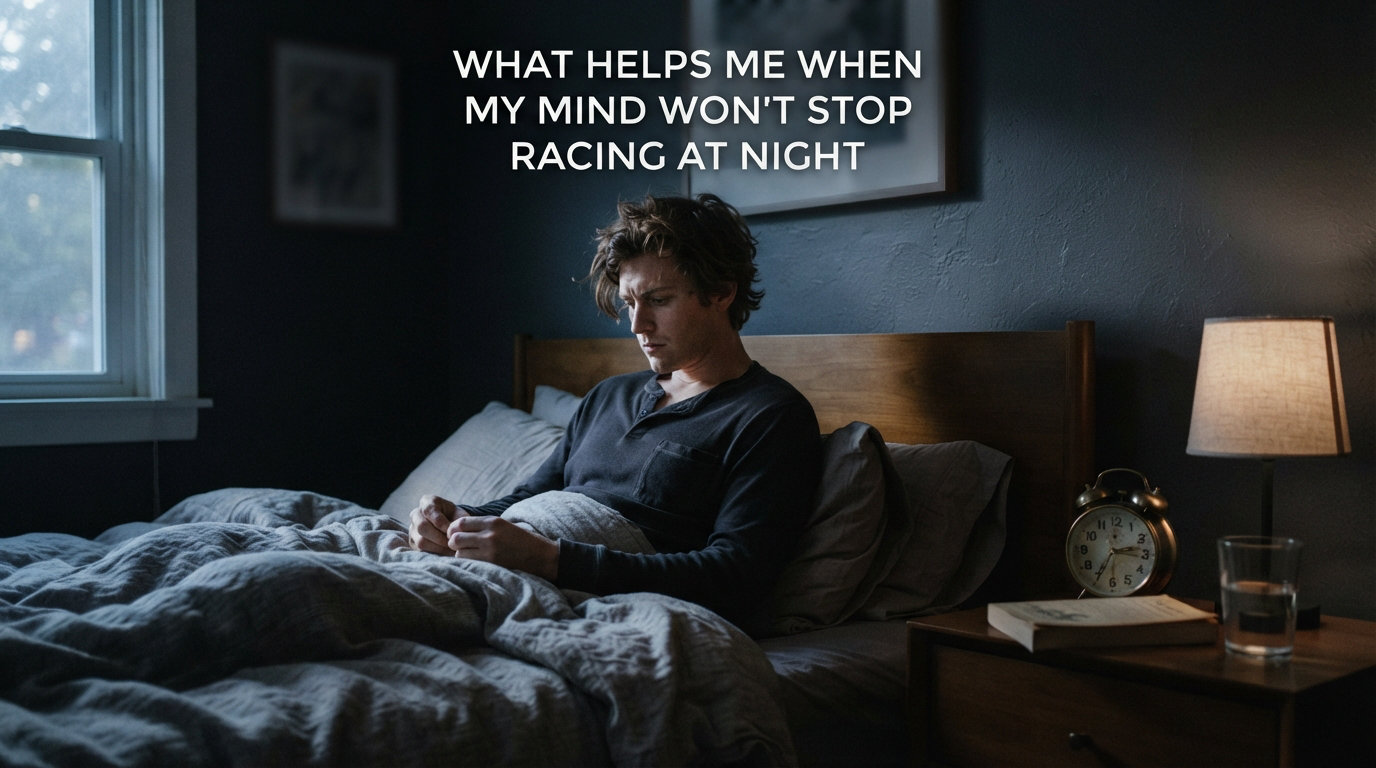
It was 2:47 AM on a Tuesday, and I was staring at the ceiling replaying a conversation from 2019. You know the one. The awkward thing I said at a work lunch that nobody else remembers. My heart was pounding, my body felt like it was buzzing, and sleep felt lightyears away. If your mind racing at night has ever kept you awake for hours, I want you to know you are not broken and you are definitely not alone.
I have spent years dealing with an overactive mind at night. I tried the apps, the white noise machines, the fancy pillows, the journaling. Some things helped a little. Nothing fully solved it. But over time, I pieced together a toolkit of techniques that actually make a difference. Not just theoretical advice from a medical website, but real strategies I use on the nights when my brain refuses to shut off.
In this guide, I want to share what helps me when my mind won’t stop racing at night. We will cover why this happens in the first place, quick relief techniques you can try tonight, longer-term relaxation practices, and what to do when you wake up at 3 AM with thoughts spinning. Everything here is something I have personally tested on my own worst nights.
If you have ever typed “I want to sleep but my brain won’t stop talking to itself” into a search bar at 2 AM, this article is for you.
Table of Contents
Why Your Mind Races at Night
Your mind races at night because the moment you lie down and the distractions of the day disappear, your brain finally has space to process everything it pushed aside. That includes work stress, that weird text from a friend, financial worries, and replaying moments from years ago. Without the noise of daily life, those thoughts get louder.
There is also a biological explanation. When you are busy during the day, your nervous system is engaged and occupied. But when you lie still in a dark room, your brain can misinterpret the sudden stillness as a signal that something is wrong. This activates your fight-or-flight response. Your body releases stress hormones, your heart rate picks up, and your brain shifts into problem-solving mode, even when there is no actual threat.
This is what I call the mind-body loop. Your racing thoughts trigger physical anxiety, and that physical anxiety feeds more racing thoughts. You feel your chest tighten, your body buzz, your heartbeat quicken, and your brain interprets those sensations as proof that you should stay alert. It becomes a cycle that is hard to break from inside.
I noticed this pattern in my own life. On nights when I had a particularly stressful day, my body would feel keyed up. My muscles would be tight without me realizing it. And the moment my head hit the pillow, my brain treated that physical tension as evidence that danger was nearby. Understanding this connection was the first real breakthrough for me.
Research from sleep specialists backs this up. The fight-or-flight system does not have an off switch that responds to willpower alone. You cannot simply tell your nervous system to calm down. You have to give it signals that you are safe through your breath, your body, and your environment. That is why the techniques in the rest of this article focus on working with your body, not against it.
What Helps Me When My Mind Won’t Stop Racing at Night
What helps me when my mind won’t stop racing at night is a combination of quick techniques for immediate relief and longer relaxation practices I build into my routine. No single technique works every time, and I have accepted that. The goal is not perfection. The goal is having enough tools that something always helps.
My approach comes down to three layers. First, I have emergency techniques I can use the moment I notice my thoughts spiraling. Second, I have relaxation practices I do as part of my pre-sleep wind-down. Third, I have habits that reduce how often racing thoughts happen in the first place.
I want to be honest about something that took me a long time to accept. The standard advice, things like meditation apps and journaling, helped me slightly but never fully addressed the problem. Many people in online sleep communities say the same thing. What actually made a difference was understanding my nervous system and learning to send it safety signals through my body, not just my mind.
Quick Relief Techniques for Racing Thoughts
These are the techniques I reach for when I am already in bed and my thoughts are spinning. They are designed to work in the moment, without any equipment, and most can be done with your eyes closed. Try them in order until one clicks.
1. The 4-7-8 Breathing Method
This is my go-to technique because it works directly on your nervous system. Inhale through your nose for 4 counts, hold your breath for 7 counts, and exhale slowly through your mouth for 8 counts. Repeat this cycle four times to start.
The long exhale is the key. When you extend your exhale longer than your inhale, you activate your parasympathetic nervous system, which is the body’s natural calming response. It sends a physical signal to your brain that you are safe. I usually feel my shoulders drop after the second or third round.
One mistake I made early on was forcing the counts too rigidly. If 4-7-8 feels like a struggle, start with 4-4-6 or even 3-3-6. The exact numbers matter less than making your exhale longer than your inhale.
2. Cognitive Shuffling
This technique changed my nights more than anything else. It works by giving your brain a random, boring task that mimics the way your thoughts fragment as you fall asleep.
Here is how I do it. I pick a random letter, say the letter M. Then I think of a word that starts with M and visualize it for a few seconds. Maybe “mountain.” Then another word: “mango.” Then “melody.” I keep going with unrelated words until my mind starts drifting.
The trick is to avoid words that connect to each other. Do not go from “meeting” to “minutes” to “memo.” That keeps your logical brain engaged. Random, disconnected words let your thinking slow down and blur, which is exactly what your brain does naturally as you transition into sleep.
3. The Body Scan Reset
When I notice my body buzzing with that keyed-up energy, I do a quick body scan. Starting from my toes, I mentally check in with each part of my body, noticing tension and consciously releasing it. I move slowly from my feet up to my calves, thighs, stomach, shoulders, jaw, and forehead.
The jaw and shoulders are where most of us hold tension without realizing it. When I consciously unclench my jaw and drop my shoulders away from my ears, I can feel my whole body exhale. That physical release often breaks the thought spiral because my brain no longer feels physical tension to interpret as a threat.
4. The 5-4-3-2-1 Grounding Technique
If your thoughts are so loud that breathing alone is not cutting it, try grounding yourself in your physical environment. Name five things you can see, four things you can physically feel, three things you can hear, two things you can smell, and one thing you can taste.
This pulls your attention out of your racing thoughts and into the present moment. I keep it simple in the dark by focusing on sensations: the weight of the blanket, the coolness of the pillow, the sound of the fan, the texture of the sheets. It interrupts the thought loop by forcing your brain to process real sensory input instead.
Relaxation Practices That Calm an Overactive Mind
Quick techniques are for emergencies. These relaxation practices are for building into your routine so racing thoughts happen less often and less intensely. I do not do all of these every night. I rotate based on how I feel.
Progressive Muscle Relaxation
This practice involves deliberately tensing and then releasing each muscle group in your body, one at a time. Start with your feet. Tense them as hard as you can for 5 seconds, then release completely and notice the contrast. Move up to your calves, thighs, stomach, hands, arms, shoulders, and face.
The first time I tried this, I was surprised by how much tension I was carrying without knowing it. The contrast between tension and release teaches your body what relaxation actually feels like. For someone like me whose body defaults to high alert, that contrast is powerful. I usually fall asleep before I finish the full sequence.
You can find free guided progressive muscle relaxation audio online if doing it silently feels difficult at first. Ten minutes is all you need. I started with guided audio and eventually learned to do it on my own.
Guided Meditation and Yoga Nidra
I used to think meditation was not for me because I could not quiet my mind. That is a common misconception. The point of guided sleep meditation is not to stop thinking. It is to give your mind something gentle to focus on so it stops racing on its own.
Yoga nidra, sometimes called yogic sleep, has been especially helpful. It is a guided practice that takes you through a body scan, breath awareness, and visualization while you lie completely still. Many people fall asleep during it, which is entirely the point. I found a free 20-minute yoga nidra recording that I turn on when my mind will not settle, and it works more often than not.
The key is choosing guided audio with a voice you find soothing. If the narrator’s tone bothers you, it will not work, no matter how good the technique is. Try a few different recordings until you find one that feels right.
Visualization
Visualization is the practice of mentally constructing a detailed, calming scene. I picture a specific beach I visited years ago. I do not just see it. I focus on the warmth of the sun, the sound of the waves, the smell of salt air, the texture of the sand under my feet. The more senses I involve, the more effective it is.
The reason this works is that your brain has a limited capacity for attention. If you are deeply engaged in building a sensory-rich mental image, there is less bandwidth left for anxious thoughts to spiral. It is like giving a restless child a coloring book. The hands get busy, and the tantrum fades.
Pick a place that feels genuinely safe and calming to you. It does not have to be a beach. It could be a childhood bedroom, a favorite hiking trail, or a cozy cabin. Make it somewhere you have actually been so the sensory details feel real.
Bedtime Routine Adjustments That Actually Help
The techniques above help in the moment. These routine changes reduce how often you need them in the first place. I resisted some of these for a long time because they seemed too simple to matter. They do matter.
Cut Screen Time Before Bed
I know you have heard this one. I ignored it for years. But when I finally committed to putting my phone in another room 45 minutes before bed, the difference was undeniable. My thoughts did not disappear, but they became quieter and easier to manage.
Screens keep your brain in consumption mode. Scrolling through social media or reading news feeds feeds your mind fresh material to process, which is the exact opposite of what you want before sleep. The blue light also suppresses melatonin, the hormone that signals to your body that it is time to rest.
If going cold turkey feels impossible, start with 15 minutes. Put your phone across the room and do something with your hands instead. Stretching, reading a physical book, or tidying up a small area all work well.
The Worry Dump Journal
Before I get into bed, I spend five minutes writing down every worry, task, and random thought bouncing around in my head. I do not organize it. I do not solve anything. I just dump it onto paper. Work deadlines, the thing I need to buy at the grocery store, the awkward conversation I had, the random memory from 2019. All of it goes on the page.
This technique works because your brain keeps repeating thoughts it is afraid you will forget. When you write them down, you give your mind permission to let go. It is like telling your brain, “I heard you, it is written down, we can deal with this tomorrow.”
I keep a notebook specifically for this purpose on my nightstand. Some nights I fill a page. Other nights I write three lines. Either way, the act of externalizing the thoughts reduces their grip.
Add a Gratitude Practice
After my worry dump, I write down three specific things I am grateful for from that day. Not vague statements like “my family” but specific moments like “the way the sunlight came through the kitchen window this morning” or “the text my friend sent that made me laugh.”
This is not toxic positivity. I am not pretending the day was perfect. But ending my thought process on something concrete and positive helps set a calmer tone as I transition toward sleep. It gives my brain one last thing to chew on that is not a worry.
When You Wake Up at 3 AM With a Racing Mind
Some of my worst nights did not start at bedtime. They started when I woke up at 2 or 3 AM with thoughts already spinning. Middle-of-night wakefulness is incredibly common with racing thoughts, and it deserves its own strategy because the techniques that work at bedtime are not always enough at 3 AM.
Here is what I have learned. If I have been lying in bed for more than 20 minutes with my mind racing and no sign of sleep, I get up. Staying in bed while frustrated trains your brain to associate your bed with wakefulness and anxiety. That makes the problem worse over time.
I move to a dim room and do something quietly absorbing but not stimulating. Reading a slightly boring book under low light works for me. Folding laundry works too. The goal is to let the sleep pressure build back up without feeding the racing thoughts with screens or stress. When I feel my eyelids getting heavy, I go back to bed.
While I am up, I do a quick worry dump if specific thoughts are driving the wakefulness. I keep the notebook by the couch for exactly this reason. Sometimes just writing down “I am worried about the presentation tomorrow” is enough for my brain to release it.
I also remind myself that waking up in the middle of the night is normal. Humans used to sleep in two segments with a quiet waking period in between. The problem is not the waking up. It is the racing thoughts that hijack that period. Treating it as normal rather than a disaster takes some of the pressure off.
One more thing. If you wake up with your body buzzing and heart pounding, try the 4-7-8 breathing before you do anything else. Sometimes the physical symptoms are what woke you up, and calming your body first makes it easier to address the thoughts.
When to Seek Professional Help
Everything I have shared works for the common experience of stress-related racing thoughts at night. But if racing thoughts are persistent, severe, or interfering with your daily life, it is worth talking to a professional. There is no shame in getting support, and sometimes the root cause needs targeted treatment.
Racing thoughts can be connected to several underlying conditions. Generalized anxiety disorder, ADHD, OCD, and chronic insomnia can all show up as a brain that will not shut off at night. If you have wondered whether your racing thoughts might be connected to something deeper, that question itself is worth exploring with someone qualified.
I also want to name something that people in online communities struggle with. It can be hard to tell the difference between ADHD-related racing thoughts, anxiety-driven overthinking, and OCD-style intrusive thoughts. They overlap, and self-diagnosing is tricky. A therapist or doctor can help you figure out what is actually going on and tailor treatment to your specific situation.
Here are signs it is time to reach out. Racing thoughts happen most nights for weeks or months. They are affecting your ability to function during the day. You feel anxious or fearful rather than just mentally busy. Or you have tried self-help strategies consistently for a month with no improvement. Any of these are valid reasons to seek support.
Cognitive behavioral therapy for insomnia, known as CBT-I, is one of the most effective treatments for sleep-related racing thoughts. It works on both the thoughts and the sleep patterns. If you have not heard of it, it is worth asking a healthcare provider about.
FAQs
How to stop thoughts racing at night?
To stop racing thoughts at night, try the 4-7-8 breathing method (inhale for 4, hold for 7, exhale for 8), do a worry dump journal before bed to externalize anxious thoughts, use cognitive shuffling by thinking of random unrelated words, and practice progressive muscle relaxation. Reducing screen time 45 minutes before bed also helps calm an overactive mind.
Why is my mind so overactive at night?
Your mind becomes overactive at night because when you lie down and the distractions of the day disappear, your brain finally has space to process everything it pushed aside. The sudden stillness can also trigger your fight-or-flight response, releasing stress hormones that keep your brain in alert mode. This creates a loop where racing thoughts cause physical tension, which feeds more racing thoughts.
How do I shut down an overactive mind?
You cannot force an overactive mind to shut off through willpower alone. Instead, send your nervous system safety signals through extended exhale breathing, progressive muscle relaxation, body scans, and grounding techniques like 5-4-3-2-1. A consistent wind-down routine with reduced screen time and a worry journal helps prevent the overactivity before it starts.
How do you calm a racing brain?
To calm a racing brain, focus on your body rather than your thoughts. Try slow breathing with a longer exhale than inhale, release physical tension through progressive muscle relaxation, and use visualization to occupy your mind with a calming sensory scene. If you have been lying awake for more than 20 minutes, get up and do a quiet, low-light activity until you feel sleepy again.
What Actually Helped Me in the End
If there is one thing I want you to take away from this, it is that calming a mind racing at night is not about finding a single magic technique. It is about building a layered toolkit and learning to work with your nervous system instead of fighting it. The nights when my mind will not stop racing are still hard sometimes. But they are fewer, shorter, and more manageable than they used to be.
Start with one thing. If you only try one technique from this article tonight, make it the 4-7-8 breathing. If that does not resonate, try the worry dump journal tomorrow. Experiment and pay attention to what your body responds to. What works for me may not be exactly what works for you, and that is fine.
And if racing thoughts are a chronic struggle that is wearing you down, please talk to someone. You do not have to white-knuckle your way through every night alone. What helps me when my mind won’t stop racing at night is a combination of all these things, but the most important step was giving myself permission to stop pretending I had it all figured out.
You deserve restful nights. Keep experimenting, be patient with yourself, and remember that a racing mind at night is a sign your brain is trying to protect you. You just need to teach it that you are safe.