
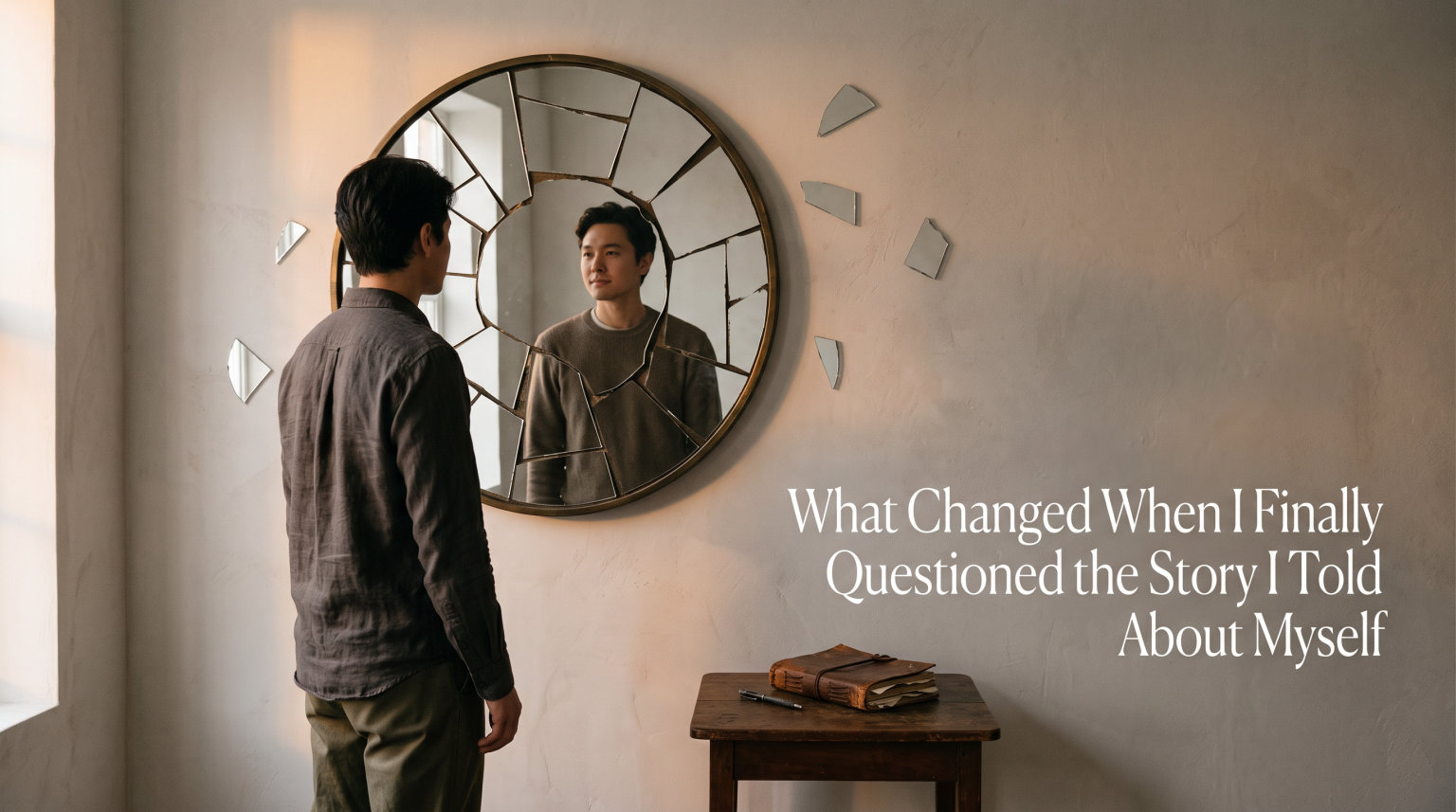
For years I carried a story about myself that I never wrote down, never questioned, and never noticed was running my decisions. I called it “just who I am.” Then I started asking one question – “is that actually true?” – and everything began to shift.
This article is the honest account of what changed when I finally questioned the story I told about myself. If you have been feeling stuck, doubtful, or quietly convinced you are not enough, the answer is rarely a new tactic. It is usually a new story. I will share what I learned, the framework I use with my coaching clients, and a short set of exercises you can try tonight.
Table of Contents
The Story I Told About Myself Was Running My Life
A self-narrative is the running interpretation you hold about who you are, what you are capable of, and how the world treats you. Researchers in narrative psychology call this your “self-story,” and it acts like a filter. Every event gets squeezed through it before you decide what it means.
Brené Brown famously said “the story I’m telling myself” whenever a moment feels confusing or loaded. She uses the phrase to pause long enough to ask whether the interpretation she just generated is actually true. That one pause is where transformation begins.
Here is what most people miss. The story you tell yourself is not a description of reality. It is a description of the version of reality your brain built from old evidence. Once that version becomes your identity, you start protecting it. You reject facts that contradict it, and you chase experiences that confirm it. This is the self-fulfilling prophecy in everyday clothes.
My old story sounded like this: “I am the practical one. I am not creative. I am not the kind of person who gets to do meaningful work. Things work out for other people, not for me.” I told myself I was being realistic. I was actually narrating myself into a smaller life.
The Day I Finally Questioned the Story I Told About Myself
The break happened on a Tuesday in late spring. I was in a coaching session with a mentor, and she asked me to describe three specific times in the last year I had felt fully alive. I struggled to name one.
She pointed out the gap. I was spending 60 hours a week building a life I had decided I was not allowed to want. The story I had inherited – work hard, stay small, do not ask for more – had quietly become my ceiling.
I went home that night and wrote the story out on paper. Reading it back was almost embarrassing. Half of it was fact. The other half was an opinion I had been treating as a verdict. Brené Brown calls this the difference between “what happened” and “the story I tell about what happened.” The first is information. The second is interpretation wearing a mask.
What changed first was not my circumstances. It was the small, private decision to stop arguing for my limitations. I caught myself saying “I’m just not a morning person” and tested it. I woke up early for two weeks. I was tired for three days, then I felt sharper than I had in years. The story was wrong. The story I had been loyal to for a decade was wrong.
Within ninety days I had changed careers, started writing again, and rebuilt a friendship I had quietly written off. None of that happened because the world changed. It happened because I stopped telling myself the story that said I could not.
Two Wolves: Which Story Are You Feeding?
There is a Cherokee parable often called the Two Wolves. An elder tells a child that two wolves live inside every person. One wolf is made of fear, resentment, and self-doubt. The other is made of courage, curiosity, and compassion. They fight constantly. The child asks which one wins. The elder replies, “The one you feed.”
The parable is not really about two wolves. It is about how your self-narrative becomes whichever voice you keep feeding with attention. Every time you repeat a limiting belief, you feed that wolf. Every time you test the belief against evidence, you feed the other one.
For most of my life, I had been feeding the wrong wolf without knowing it. Complaining, ruminating, telling the same sad story to friends – all of it was food. The moment I started feeding curiosity instead, the loud wolf got quieter and the kind wolf got stronger.
How to Question the Story You Tell Yourself
Questioning your story is a skill, not a personality trait. Here is the four-part process I now teach every client who walks through my door. None of these steps require belief in anything mystical. They just require honesty.
Step 1: Name the Story Out Loud
Write down the sentence you would finish if I asked you, “Who are you, really?” Write it as a single declarative statement. Example: “I am someone who always struggles with money.” Do not edit. Let the story come out in the exact words you have been thinking.
Step 2: Find the Origin
Ask yourself three questions about that sentence. Who first told me this? What was I going through when I decided it was true? What did it protect me from feeling? Most stories are not built from facts. They are built from a wound looking for armor.
Step 3: Test It Against Evidence
Make a two-column list. On the left, write every experience that supports the story. On the right, write every experience that contradicts it. Be ruthless on the right side. You will almost always find the right column is longer than the left.
Step 4: Write the New Story You Want to Live Into
Rewrite the sentence in the first person, present tense, as if it were already true. “I am learning to be calm with money.” “I am a person who follows through.” Read it out loud every morning for thirty days. The new story needs the same loyalty the old one had.
You can also try this 60-second exercise between coaching sessions. Set a timer. Write the story you have been telling yourself about your work, your body, or your relationships. When the timer ends, read it back and underline any word that is an opinion, not a fact. You will usually find three or four. Those are your starting points.
What Changes When You Finally Rewrite Your Story
The first thing that changes is silence. The inner critic gets quieter because it loses its favorite script. The second thing is energy. You stop spending mental fuel defending a story you no longer believe. The third thing is behavior. New stories produce new actions within weeks, not years.
You also start to notice the stories other people tell about themselves. You become a kinder listener. You stop taking their projections personally. The world feels less like a verdict and more like a conversation.
Frequently Asked Questions
What is it called when you tell a story about yourself?
It is called a self-narrative, or personal narrative. In narrative psychology it refers to the running interpretation you hold about who you are and how your life works. It acts as a filter through which you evaluate every new experience, and it shapes your beliefs, habits, and decisions without you noticing.
What is the story I am telling myself?
It is the meaning you attach to events before you check whether that meaning is accurate. Common examples include ‘I am not good enough,’ ‘I always fail at relationships,’ ‘money is hard for me,’ or ‘people like me don’t get to do that kind of work.’ The story feels like fact, but it is really a belief you have rehearsed so often it has become invisible.
What is it called when you change the narrative?
It is called narrative reframing, narrative reconstruction, or story rewriting. In therapy it shows up in cognitive behavioral therapy and narrative therapy. In everyday life it is simply the practice of catching an old interpretation, testing it, and choosing a more accurate one that you want to live into.
What is the power of telling your own story?
Telling your own story gives you authorship over your identity. It moves you from being a character in a script someone else wrote to being the writer of your next chapter. Done well, it lowers anxiety, increases self-trust, and frees up the energy you used to spend defending old versions of yourself.
Your Story Is Not Your Verdict
What changed when I finally questioned the story I told about myself was not my past. My past is still my past. What changed was my relationship to it. I stopped letting an old interpretation drive the car. I started reading the map myself.
If you take one thing from this article, take the question. Whenever you catch yourself saying “that’s just how I am,” pause. Ask, “Is that true, or is that the story I have been telling?” That pause is where every new life begins. If you want help with the next step, you can book a discovery call with me and we will start untangling your story together.