
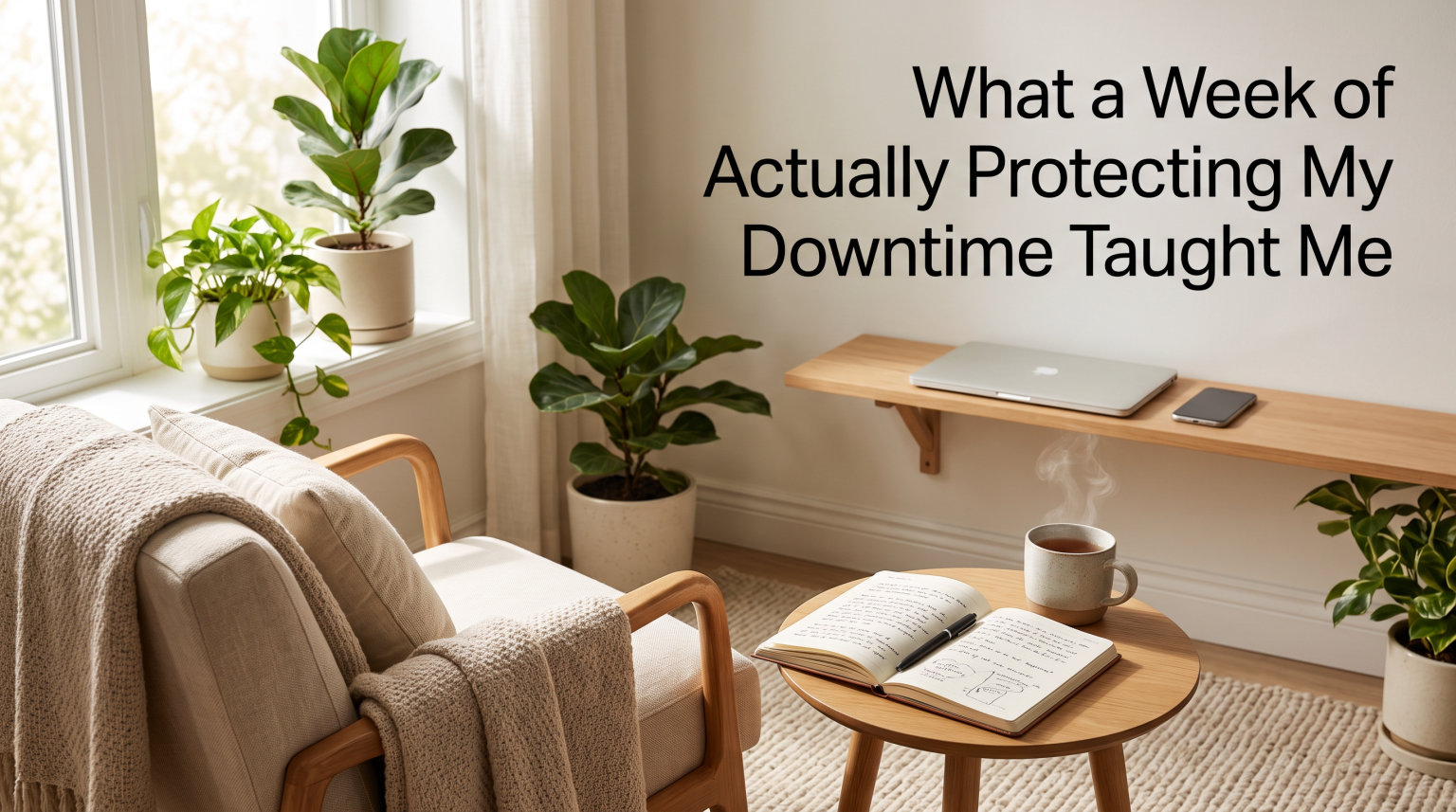
For years, I told myself I was good at boundaries. I had a coaching practice, a personal life, hobbies I genuinely loved, and a calendar I swore I respected. Then one Sunday night in 2026, I opened my iPhone Screen Time report and felt my stomach drop. Eleven hours and forty-two minutes a day. Across a single week, that was over eighty-one hours of staring at a glowing rectangle, and the number said far more than I wanted it to about how little I was actually protecting my downtime.
I am a life coach. I help other people slow down, name what matters, and stop living in reaction mode. And yet here I was, completely unable to put my phone down long enough to eat a meal without scrolling. The gap between what I teach and what I was actually living became too loud to ignore. So I gave myself one week, an honest, imperfect, sometimes grumpy week of protecting my downtime, and I wrote everything down. This is what I learned.
Table of Contents
Why I Finally Decided Protecting My Downtime Mattered
I have been a coach long enough to know that the first sign of burnout is not exhaustion. It is resentment. I started resenting the very clients I used to love working with, the notifications I used to welcome, and the small daily rituals that used to feel restorative. That resentment was the real wake-up call.
When I looked at my week honestly, I could see the pattern. My mornings started with email. My lunch breaks became doomscrolling sessions I did not even remember starting. My evenings blurred into one long Netflix-and-scroll loop, and by the time I brushed my teeth, I could not tell you a single meaningful moment from my day. I was functioning, but I was not living.
The average adult now spends more than seven hours per day on screens, and research consistently links heavy phone use to poorer sleep, higher anxiety, and shorter attention spans. I am not the kind of coach who quotes statistics to scare people, but I am the kind who notices when the data matches my lived experience. My data matched. It was time to try something different.
What a Week of Protecting My Downtime Actually Looked Like
I did not want a dramatic, week-long digital detox that I would abandon by Tuesday. I wanted something I could actually live with. So I set three small rules for myself. No phone during meals. No phone after 8 pm. No social media before noon. That was it. I kept my work calendar as is. I kept my morning routine as is. I just put a real fence around my downtime.
Days 1 and 2: The Initial Friction of Saying No
Day one was harder than I expected. I picked up my phone at breakfast three times before I caught myself, and each time I felt a small jolt of irritation, like I had been asked to give up a habit nobody had asked me to defend. I started to understand what my own clients feel when I ask them to set a new boundary. It is not the new rule that hurts. It is the absence of the old coping mechanism.
By day two, I noticed something strange. The urge to scroll was loudest at the exact moments I had built my downtime rituals around. In the morning with coffee. On the couch after dinner. Standing in line at the grocery store. Without the phone, those tiny pockets of time felt uncomfortably empty, and I had to consciously decide what to do with my own attention. I read. I stared out the window. I felt bored. I felt human.
Days 3 and 4: When Temptation Hit Hardest
The middle of the week is where most habit experiments fall apart, and protecting my downtime was no exception. A client emailed me at 9 pm on Wednesday with what turned out to be a non-urgent question, and every cell in my body wanted to reply immediately. I did not. I waited until morning, sent a kind response, and realized the world had not collapsed because I had taken one evening back.
On day four, I turned on the iPhone Downtime feature for the first time. If you have not used it, it is the built-in Screen Time setting that blocks apps and notifications during a window you choose. I set mine from 8 pm to 7 am, and for about an hour I genuinely resented the phone in my hand. Then I put it down, picked up a novel I had been neglecting, and read for forty-five minutes straight without interruption. I had not done that in months.
Days 5 and 6: The First Real Glimmers of Calm
By Friday, something had shifted. I woke up without reaching for my phone, and I noticed my morning coffee tasted better because I was actually tasting it. I am not going to pretend I became a monk. I still checked email during the workday, and I still slipped up at lunch on Saturday. But the baseline tension in my shoulders had dropped, and I could feel the difference in my body before I could name it in my head.
Friday night my partner and I cooked dinner together with no podcast, no TV, no phone on the counter. We talked. We laughed. We remembered why we like each other. It was not a grand romantic moment. It was just two people being present in the same kitchen, and I had forgotten how good that feels. Saturday I took a walk without a podcast in my ears and heard birds I did not know lived on my street. The world was louder than I thought, once I stopped drowning it out.
Day 7 and the Numbers That Surprised Me
Sunday night I opened Screen Time again, half expecting to see no real change. The number had dropped from eleven hours and forty-two minutes a day to six hours and nine. That is roughly a 48 percent reduction in seven days, with no productivity loss, no missed deadlines, and one very real improvement in how I felt about my own life. I had not realized how much unconscious time my phone had been eating.
The bigger surprise was not the number. It was what I did with the time I got back. I read two chapters of a book I had been avoiding. I called my sister. I sat on my porch for twenty minutes doing literally nothing. I went to bed earlier, slept more deeply, and woke up before my alarm for the first time in weeks. None of these are small things. Together, they felt like getting myself back.
What Protecting My Downtime Taught Me About My Own Habits
The first thing this week taught me is that I was confusing availability with value. I had quietly believed that the faster I responded, the more indispensable I was, both at work and in my personal life. The week proved the opposite. When I was slower to respond, the conversations I did have felt more present, and the people in my life did not love me less for taking a breath before answering.
The second thing I learned is that boredom is not a problem to solve. It is a doorway. Every time I felt that itchy, restless pull toward my phone, I also got a tiny invitation to ask what I actually wanted. Sometimes the answer was rest. Sometimes it was connection. Sometimes it was to simply sit with myself without narrating it. None of those answers are available when the screen is already in my hand.
The third lesson was the hardest. Protecting my downtime required me to disappoint people, including myself. I had to accept that not every email is urgent, not every scroll session is relaxing, and not every quiet moment needs to be filled. That kind of letting go does not come naturally to a recovering overachiever, which is exactly why the practice matters.
Finally, I learned that protecting my downtime is not a one-week project. It is a muscle. Some days this week were easy. Some days I white-knuckled my way to bedtime. The point was not perfection. The point was proving to myself that I could choose rest on purpose, and then doing it again the next day.
Five Practical Shifts You Can Try This Week
You do not have to do what I did. You do not even have to do a full week. Here are five small shifts I now recommend to my own coaching clients when they ask me how to start protecting their downtime.
- Set a phone-free meal rule. Pick one meal a day where the phone stays in another room. Start there.
- Use the iPhone Downtime feature. A one-hour block before bed is enough to change how you sleep within a few nights.
- Block one window on your work calendar. Treat it like a client meeting with yourself. No one is allowed to book over it.
- Replace the scroll, do not just remove it. Have a book, a journal, a deck of cards, or a short walk ready for the in-between moments.
- Tell someone you trust what you are trying. Accountability is the difference between an experiment and a wish.
None of these are flashy. That is the point. Protecting my downtime did not require a retreat, an app, or a complete life overhaul. It required noticing where my attention was actually going and choosing, again and again, to bring it back to my own life.
Frequently Asked Questions About Protecting Downtime
How much screen time per week is normal?
Most adults spend somewhere between 35 and 50 hours per week on their phone, which adds up to around five to seven hours per day. Anything consistently over 40 hours a week is worth a closer look, especially if you are also feeling tired, scattered, or resentful of your own habits.
What happens when you stop screen time?
When you intentionally reduce screen time, most people notice better sleep within a few nights, fewer headaches, more patience with the people around them, and a strange sense of quiet that can feel uncomfortable at first. The first 48 hours are usually the hardest. After that, your nervous system starts to settle and the benefits get easier to feel.
Why is it so hard to protect my downtime?
Downtime feels hard to protect because your brain has been trained to associate every open moment with a quick dopamine hit from your phone. You are not lazy or weak. You are up against a habit loop that was designed to be hard to walk away from. That is exactly why the boundaries need to be physical and visible, not just good intentions.
What counts as real downtime?
Real downtime is any activity that genuinely restores you, not numbs you. That might be a walk, a nap, a slow meal, time with people you love, a craft, a book, or simply doing nothing for twenty minutes. If you come back feeling more like yourself, it counts. If you come back feeling more drained, it was not actually downtime.
The Week After and What I Am Keeping
I am writing this the week after the experiment ended, and the honest truth is that I have not been perfect. I have scrolled at lunch twice. I have replied to one too many late emails. But the rules are still on, the iPhone Downtime feature is still set, and I am still choosing, most days, to protect my downtime on purpose.
If you have read this far and felt a small flicker of recognition, that flicker is the whole point. You do not need a sabbatical. You do not need to quit your phone or move to a cabin. You need one week of paying attention to where your attention is actually going, and one honest conversation with yourself about what you want it back. That is the work. I am still doing it. I would love to do it alongside you in 2026.