
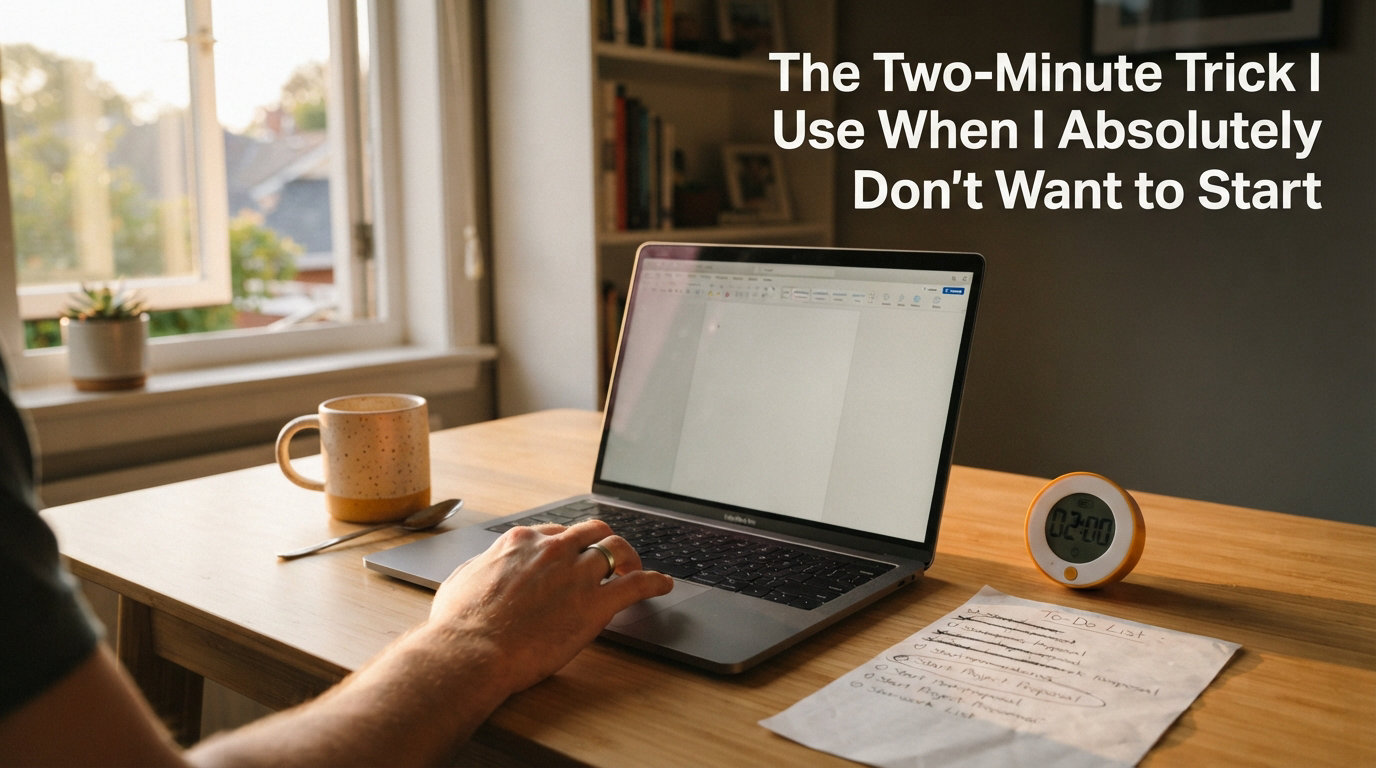
I almost didn’t write this article.
Not because I didn’t want to help you. But because sitting down to start anything, even something I care about, sometimes feels like pushing a boulder up a hill. I stared at a blank screen for twenty minutes before the first sentence appeared. That resistance, the gap between knowing what to do and actually doing it, is something I see every single day as a life coach. And it is the exact problem the two minute rule was built to solve.
If you’ve ever told yourself “I’ll start in five minutes” and then watched an hour disappear, you know the feeling. You’re not lazy. You’re not broken. Your brain is just doing what brains do when a task feels too big, too vague, or too unpleasant. The two minute rule is the smallest possible wedge I’ve found that actually cracks that wall open. Let me show you how it works, why it works, and how I use it with the people I coach.
Table of Contents
The Morning I Couldn’t Open My Laptop
A few years ago, I had a writing deadline staring me down. The kind of deadline that grows teeth the closer it gets. I knew the material. I had the outline. I had the coffee. And yet I sat at my desk for forty-five minutes doing absolutely everything except opening the document.
I reorganized my pens. I checked the weather three times. I read an article about productivity, which is the procrastinator’s favorite irony. The task wasn’t even that large. But in my mind, it had become enormous. It had become a “big scary task” that felt like it required a perfect state of mind, a clean schedule, and some mythical surge of motivation that was never going to arrive.
That afternoon, a fellow coach mentioned something she called the two minute trick. She said: “Just commit to two minutes. If you want to stop after that, stop. No guilt.” I tried it. I set a timer on my phone, opened the document, and started typing. When the timer went off, I kept going. Not because I forced myself. Because the hardest part, the starting, was already done.
That moment changed how I work. I’ve since taught this technique to dozens of clients, from overwhelmed executives to students paralyzed by thesis papers. The pattern is always the same. The resistance is almost entirely in the approach, not the doing. Once you cross the starting line, momentum takes over more often than you’d expect.
What Is the Two-Minute Rule?
The two minute rule is a productivity and habit-building strategy built on a simple idea: make starting so easy that you cannot talk yourself out of it. There are actually two popular versions, and both are useful.
The first comes from David Allen, the author of Getting Things Done. His version says: if a task takes less than two minutes to complete, do it right now instead of adding it to your to-do list. Reply to that email. Put that dish in the dishwasher. File that document. The goal is to clear small tasks before they pile up and create mental clutter.
The second version comes from James Clear in Atomic Habits. His version says: when you start a new habit, it should take less than two minutes to do. Want to read more? Read one page. Want to exercise? Put on your running shoes. Want to write? Write one sentence. The idea is to scale any habit down until it feels almost ridiculously small, then build from there.
Both versions share the same core insight. The goal at the start is not to finish. The goal is to show up. As James Clear puts it, you need to “standardize before you optimize.” Get yourself to begin consistently, then worry about doing more later.
Why the Two-Minute Rule Actually Works
Understanding why this technique works makes it easier to trust it. And trust matters, because the moment you feel resistance, your brain will look for reasons to dismiss any trick as gimmicky.
It Lowers the Activation Energy
In chemistry, activation energy is the push needed to start a reaction. Behavioral psychology borrowed the term because it fits perfectly. Every task has a mental threshold you must cross to begin, and that threshold is almost always higher in your imagination than in reality. The two minute rule shrinks that threshold to something your brain can’t argue with. Two minutes is nothing. Even on your worst day, you can stomach two minutes.
It Bypasses the Overwhelm Response
When a task feels large, your brain treats it like a threat. This triggers avoidance, not because you lack discipline, but because your nervous system is trying to protect you from something that feels uncomfortable. By shrinking the commitment to two minutes, you remove the perceived threat. There is nothing to fear in two minutes of effort. The overwhelm dissolves because the stakes drop to nearly zero.
Momentum Is Real
Here is what I’ve noticed with clients over and over. Once someone starts, they usually keep going. Not always. But far more often than not. Isaac Newton figured this out centuries ago: objects at rest stay at rest, and objects in motion stay in motion. The same applies to human behavior. The hardest part of any task is the transition from stillness to movement. After that, momentum does the heavy lifting.
It Reinforces a New Identity
This is the piece most articles miss. Every time you start something instead of avoiding it, you cast a small vote for the type of person you want to be. Someone who follows through. Someone who does the hard thing. Over weeks and months, those small wins add up. You stop seeing yourself as a procrastinator and start seeing yourself as someone who takes action. That identity shift is where lasting change comes from.
How to Use the Two-Minute Rule: A Step-by-Step Guide
Here is the exact process I walk clients through when they want to apply the two minute rule to their own lives. You can do this right now with whatever task you’ve been avoiding.
Step 1: Name the Task You’re Avoiding
Write it down. Not the vague version (“work on my project”) but the specific version (“open the spreadsheet and fill in the first row”). Vague tasks create anxiety because your brain can’t figure out where to begin. Specific tasks give your brain a clear entry point. The more concrete you can make the first action, the better.
Step 2: Shrink It to a Two-Minute Version
Ask yourself: what is the smallest possible action I could take on this task that would still count as starting? Not finishing, not making progress, just starting. If the task is “clean the kitchen,” your two minute version might be “put away three items.” If it’s “write the report,” your version might be “open the document and write the title.” Make it so small it feels almost silly.
Step 3: Set a Timer for Two Minutes
Use your phone, a kitchen timer, or a website. The physical act of setting a timer matters. It creates a boundary that tells your brain the commitment is limited and real. You are not signing up to finish the task. You are signing up for two minutes. That is the deal, and your brain needs to hear those terms clearly.
Step 4: Start and Give Yourself Permission to Stop
Begin the task. When the timer sounds, check in honestly with yourself. If you want to stop, stop. Walk away without guilt. The deal was two minutes and you kept it. But here is the secret most people discover: by the time the timer goes off, you’ve already crossed the hardest barrier. Many people find they want to continue. That is momentum showing up exactly as promised.
Step 5: Repeat Tomorrow
The magic compounds over time. If you show up for two minutes today, two minutes tomorrow, and two minutes the day after, you are building something far more valuable than any single completed task. You are building the habit of starting. And once starting becomes automatic, everything else gets easier.
Real-Life Examples of the Two-Minute Rule in Action
I’ve watched the two minute rule work across every area of life. Here are some of the transformations I’ve seen firsthand, both in my coaching practice and in my own routines.
Fitness
One client told me she wanted to exercise but couldn’t get herself to the gym. I asked her to commit to putting on workout clothes and walking to the end of her driveway. That was it. Two minutes, then she could turn around. Within a month, she was running three times a week. Not because she forced it, but because the two minute start removed the friction. I’ve seen a similar story shared online where someone lost significant weight by going to the gym and leaving after just five minutes. The starting became automatic. The duration followed naturally.
Work and Email
For tasks that genuinely take under two minutes, the David Allen version works wonders. A client who managed a team of fifteen was drowning in small requests and follow-ups. I suggested she batch process her inbox using the two minute rule: if it can be done in under two minutes, do it now. She cleared her inbox in a single afternoon. More importantly, the constant low-level anxiety of “all those little things I need to do” vanished.
Creative Work
Writers, artists, and musicians hit the same wall. Starting feels like facing a blank canvas that judges you. I tell creative clients to commit to two minutes of their craft each day. Open the notebook. Sit at the piano. Sketch one shape. The goal is not to produce something good. The goal is to show up at all. One of my clients wrote an entire book draft this way. Two minutes at a time, some days stretching into hours, some days ending at the timer.
Household Chores
The to-do list at home is where procrastination thrives. Laundry, dishes, filing, organizing. Each item is small, but together they create a wall of dread. Apply the two minute rule. Set a timer and tackle whatever you can. Most household tasks take less time than the anxiety of thinking about them. And crossing items off the list creates a cascade of small wins that fuels further action.
When the Two-Minute Rule Doesn’t Work (and What to Do Instead)
I’m not going to pretend this technique is magic. It isn’t. Being honest about its limitations is part of what makes it trustworthy. Here are the situations where the two minute rule falls short, and what I recommend instead.
You Stop After Two Minutes Every Time
Some people start for two minutes and then genuinely stop. Every. Single. Time. If that’s you, the problem might not be starting but sustaining. In that case, pair the two minute rule with the Pomodoro Technique. Start with two minutes to break the resistance, then transition into a twenty-five minute work session. The two minutes get you going. The Pomodoro keeps you in motion.
The Resistance Is Emotional, Not Practical
Sometimes you can’t start because the task is tied to fear, shame, or anxiety. You’re avoiding the conversation because you’re scared of conflict. You’re avoiding the application because you’re afraid of rejection. The two minute rule helps with task friction but not emotional friction. If that’s what you’re facing, name the emotion first. Acknowledge what you’re actually afraid of. Then decide whether the task needs a different approach, like breaking it into even smaller emotional steps or getting support from someone you trust.
ADHD Brains May Need Adjustments
The two minute rule can be genuinely helpful for people with ADHD because it addresses the “activation energy” barrier that makes starting so difficult. But it isn’t a complete solution on its own. Some people with ADHD find that external structure, body doubling (working alongside someone else), and visual timers work better than a phone timer. If you have ADHD, treat the two minute rule as one tool in a larger toolkit, not a standalone fix.
You’re Using It to Avoid Prioritizing
There’s a trap here. Some people get so good at knocking out two-minute tasks that they never touch the important, deep work. Twenty small tasks completed can feel productive while the one thing that actually matters sits untouched. If you notice this pattern, use the two minute rule to start your most important task first, before touching anything else. Protect your best energy for the work that matters most.
FAQs
Is the 2 minute rule good for ADHD?
The 2-minute rule can be helpful for people with ADHD because it lowers the activation energy needed to start a task, which is one of the biggest hurdles for ADHD brains. However, it works best when paired with additional structure like visual timers, body doubling, or external accountability. Treat it as one tool within a broader system rather than a standalone solution.
What are the downsides of the 2 minute rule?
The main downsides are that some people stop after two minutes every time, it doesn’t address emotional resistance like fear or anxiety, and it can become a way to avoid important deep work by staying busy with small tasks. You can counter these by pairing it with longer focus sessions, addressing the underlying emotion separately, and using the rule on your most important task first.
What is the 3 2 1 rule for procrastination?
The 3-2-1 rule is a countdown technique where you say ‘3, 2, 1’ and then immediately take action on the task you’ve been avoiding. The idea is to bypass overthinking by converting the decision to start into a simple, fast countdown. It pairs well with the 2-minute rule because the countdown gets you to begin and the 2-minute commitment keeps you going.
What is the Kaizen 2 minute rule?
The Kaizen 2-minute rule combines the Japanese philosophy of Kaizen, which means continuous small improvement, with the 2-minute principle. Instead of trying to make big changes all at once, you commit to spending just two minutes a day improving a process, skill, or habit. The focus is on tiny, consistent steps that compound over time rather than dramatic overhauls.
How do you stop procrastinating with the 2 minute rule?
To stop procrastinating with the 2-minute rule, name the specific task you are avoiding, shrink it to the smallest possible 2-minute version of starting, set a timer, begin, and give yourself full permission to stop when it goes off. Most people find that once they start, momentum carries them forward. Repeat daily to build the habit of starting without resistance.
Start Your Two Minutes Today
The two minute rule is not about doing less. It is about doing something instead of nothing. It is about proving to yourself, one tiny start at a time, that you are someone who follows through. That proof is what builds the confidence to tackle bigger things.
So here is my challenge to you. Think of one task you’ve been avoiding. Shrink it to its smallest possible starting point. Set a timer for two minutes. And begin. Not tomorrow. Not after you feel ready. Right now, two minutes is all it takes. The rest tends to take care of itself.