
Last Tuesday at 6:14 a.m., I sat on the edge of my bed with my coffee going cold and forty-seven unfinished thoughts fighting for the front of the line. The dog needed walking. A client email needed answering. I had a bone-deep worry about my sister. I was replaying a conversation from two years ago. None of it made sense together, and all of it felt urgent.
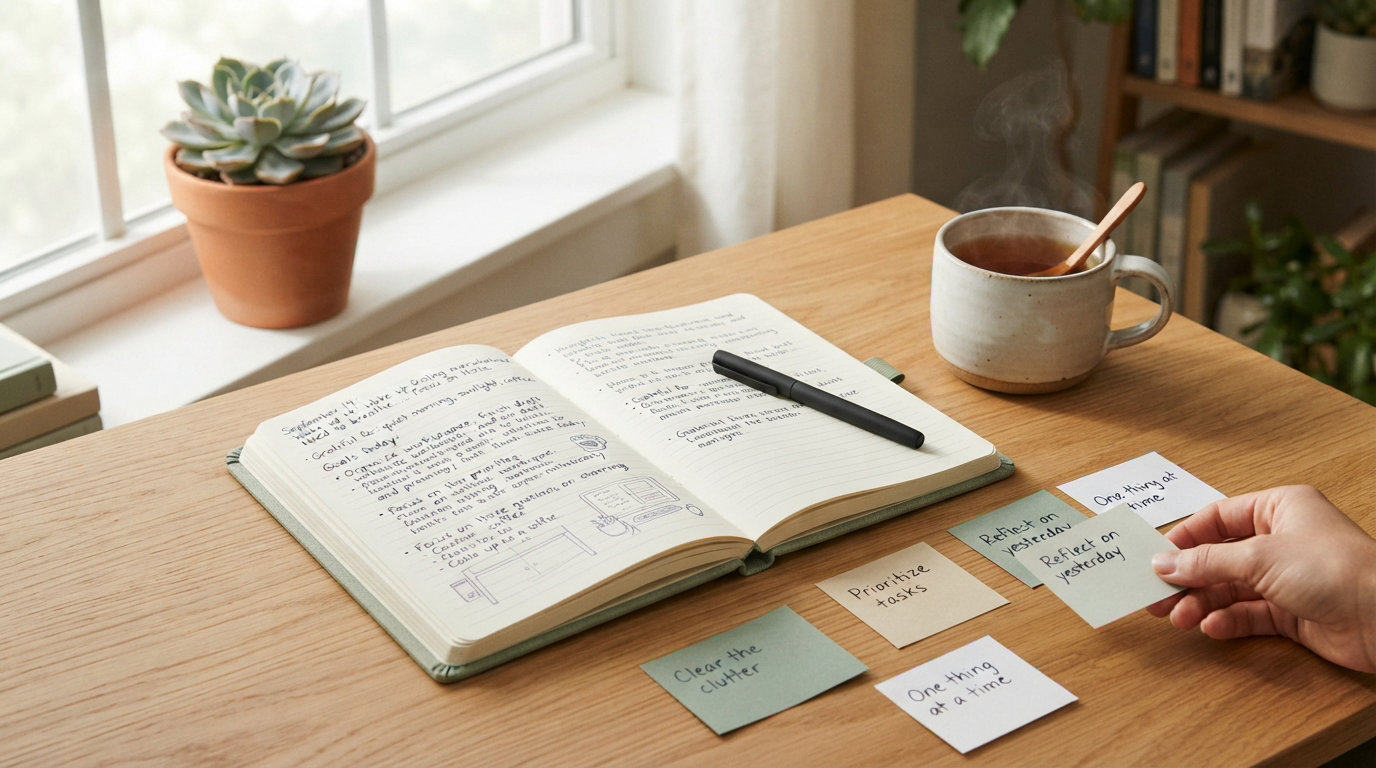
That morning I pulled out the notebook that lives on my nightstand and did the same thing I have done for the last six years when my mind feels too full to function. I wrote for exactly twelve minutes. By the time I closed the cover, the knot in my chest had loosened. I could pick one thing to do next.
This is the journaling method I now share with every coaching client who comes to me saying their head feels like a browser with too many tabs open. It is simple, slightly ugly, and it works even on the mornings when I would rather stare at the ceiling.
I call it the 3-Page Brain Release, and it is the closest thing I have to a reset button for an overwhelmed mind.
Table of Contents
How I Discovered This Method When My Own Mind Collapsed?
I did not invent this method on a meditation cushion. I invented it on the bathroom floor of a Las Vegas hotel in 2019, two weeks before my wedding, crying because I could not remember where I had put my shoes.
The shoes were in my suitcase. I had packed them carefully three days earlier. But in that moment, my mind held seventeen other things that felt more important than shoes, and none of them could find a parking space.
I grabbed the hotel notepad and a pen from the bedside table. For ten minutes I wrote down every single thing I was carrying – the catering question, the hurt feeling from my mother’s last phone call, the work deadline, the fear that I was not ready to be married. By the time the pen stopped, I had two full pages of mess.
And somewhere inside that mess, I could suddenly see the next step. I called the caterer. I cried again, but this time it was the good kind. I found my shoes an hour later, right where I had put them.
That was the day I started teaching what I now call my untangling method. It has saved me on ordinary Tuesdays and on the worst days of my life.
How to Untangle a Mind That Feels Too Full: The 3-Page Brain Release
The method is a focused brain dump done on paper, broken into three timed pages, with one question guiding each page. Here is how to do it in the next twenty minutes.
Step 1: Set a 4-minute timer for the first page and write the surface noise
Page one is for the loud stuff. The to-dos, the names, the numbers you keep forgetting, the small worries that hum in the background. Do not organize. Do not reread. Just keep the pen moving for the full four minutes.
Start with whatever is loudest. Some mornings I literally write, “I don’t know what to say,” until the next thought shows up. That sentence is a magic key. It gives your brain permission to admit confusion, and confusion is often the door to clarity.
Step 2: Reset the timer for 5 minutes and write the feeling underneath the noise
Page two is where the actual feeling lives. The first page was the inbox. This page is the emotion behind the inbox.
Ask yourself one question before you start: “If I had to name the feeling driving all of this, what would I call it?” Write the first word that arrives. Then write around it. Sad. Angry. Scared. Ashamed. Lonely. Over it. Whatever it is, let the word lead the page.
This is the page that tends to surprise people. The same client who wrote a tidy to-do list on page one often arrives at page two and discovers she is grieving a friendship, or furious about a promotion that did not happen, or terrified of an empty nest. The untangling happens here.
Step 3: Reset the timer for 3 minutes and write one true sentence you want to remember
Page three is short on purpose. After twelve minutes of releasing, your mind is quieter. It has space to hear itself.
In these final three minutes, write one sentence that you want to carry into the rest of your day. Not a goal. Not a plan. A sentence that feels true in your body when you read it back. Mine this morning was, “I am allowed to take the slow way.”
Read that sentence once out loud. Then close the notebook. You are done.
Why This Journaling Method Actually Clears Mental Clutter
There is a real reason a brain dump works, and it is not just that venting feels good. When your thoughts stay only inside your head, they loop. The same worry travels the same neural pathway over and over, gaining emotional weight with every loop.
Writing forces your brain to convert those loops into linear language. Psychologists call this externalization, and researchers have found that expressive writing lowers cortisol levels and shifts your nervous system from fight-or-flight into rest-and-digest within minutes.
The three-page structure matters too. Most people stop at the to-do list and wonder why they still feel wired. The to-do list is just the symptom. The feeling underneath the list is the real load. Page two gets to the actual weight you have been carrying.
Page three matters because it gives the session somewhere to land. Without it, the brain dump can leave you feeling raw and unfinished. The final sentence acts like a bookmark in a book you are still writing.
This is also why I do not recommend journaling apps for this method. There is something about pen on paper that slows your thinking enough for the deeper pages to show up. Typing tends to keep you on the surface.
What You Need to Start Your First Untangling Session
The good news is that the setup is small. Here is the complete list of what you need to begin.
A notebook you do not feel precious about. Lined, unlined, cheap, expensive – it does not matter. If it is too beautiful to write ugly in, pick a different one.
A pen that flows easily. Rollerball or gel works better than ballpoint for fast writing.
A timer. Your phone is fine, but a kitchen timer removes the temptation to check notifications mid-session.
Twelve minutes. That is the whole investment.
Permission to write badly. This is the most important supply.
If you want prompts to help you start, try one of these on page one when the page feels blank:
“Right now my head is holding…”
“The thing I keep avoiding thinking about is…”
“If I could put one sentence on a billboard today it would be…”
“The conversation I keep replaying is…”
“I don’t know what to say, but…” (then keep writing)
For page two, the only prompt you need is the one I gave you above. If you cannot name the feeling, write, “I do not know what I feel,” and stay with it. The word usually arrives within a minute.
For page three, try one of these to find your true sentence: “What do I want to remember from this?” or “What is one small thing I can believe right now?”
Different Versions for Different States of Overwhelm
Not every overwhelmed mind feels the same. I have watched my clients use this method in three very different emotional states, and I have tweaked the format for each one.
If your mind is loud and racing, use the full 12-minute version
This is the classic. It works best when your head has so many thoughts you cannot pick a starting point. The four-five-three structure gives your brain a runway.
If you feel numb or shut down, shorten it to 6 minutes
On the days when you feel nothing, a long session will feel punishing. Cut everything in half. Two minutes of surface noise, two minutes of feeling (even if the feeling is “blank”), two minutes of one true sentence. Some sessions the true sentence will simply be, “I am here.” That is enough.
If you are in acute anxiety, switch to voice notes for page one
There are mornings when the hand cannot move fast enough to keep up with the panic. In those moments, use the voice memo app on your phone for page one. Speak for four minutes. Let it be messy. Transcribe nothing. The act of speaking it out loud does the same externalizing work as writing.
Then go back to paper for page two and three if you can. The combination is powerful for racing thoughts.
If you are grieving or in trauma, treat the notebook like a container, not a confessional
This is the version I wish someone had told me about sooner. Write only what feels safe to write. You can stop a page mid-sentence. You can write the same word thirty times. You can draw instead of write. The notebook is a container, and you decide how much goes into it.
What to Do When You Feel Too Overwhelmed to Even Journal
This is the question I get asked most often, and it is the one I want to answer honestly here. Some days, even pulling out a notebook feels like one task too many.
Here is what I do on those days, and what I tell my clients to do.
First, lower the bar to zero. Sit near the notebook. Do not open it. Breathe for one minute. That is the practice. If at the end of the minute you still feel resistance, you are allowed to stop. The notebook will be there tomorrow.
Second, if you do open it, give yourself permission to write only one word. Just one. “Tired.” “Mad.” “Lost.” “Here.” The first word opens the door. The second word walks through it. Sometimes the third word never comes, and that is fine.
Third, if even one word feels like too much, switch the medium. Draw a shape that matches your mood. Record a thirty-second voice note. Tap out the rhythm of what you feel on a table. The act of getting the feeling out of your body and into something outside your body is what does the work. The notebook is a tool, not a rule.
Fourth, remember that this is not a homework assignment. There is no grade. There is no one reading it. The point is not the page. The point is what happens in your nervous system when the page becomes a place to put the things that do not belong inside you anymore.
FAQs
What is the 3-3-3 journaling method?
The 3-3-3 method is a grounding technique where you write down 3 things you see, 3 things you hear, and 3 things you want to remember. It pulls you into the present moment when anxiety spikes. My 3-Page Brain Release is different – it runs 4 minutes, 5 minutes, and 3 minutes, and focuses on releasing mental clutter rather than grounding through the senses.
How do you journal when your mind feels too full?
Lower the bar to one word. Set a short timer. Write the loudest thought first, then ask yourself what feeling is driving it. Finish with one true sentence you want to carry forward. Twelve minutes is enough to shift your nervous system from overwhelmed to clear when the structure is simple.
What is the dark side of journaling?
Rumination. When journaling becomes a loop of replaying the same worry with no release, it can deepen anxiety instead of easing it. The 3-Page Brain Release prevents this by including page three, which asks your brain to land on one forward-looking sentence before you close the notebook. If journaling starts to feel heavier than your actual day, that is a sign to pause and consider working with a therapist.
How to brain dump journal for anxiety?
Set a 4-minute timer and write every anxious thought as it arrives, without editing or rereading. When the timer ends, ask what feeling sits underneath the worry and write about that for 5 minutes. Close with 3 minutes on one sentence you want to remember. The structure moves you from spinning to settled in about 12 minutes.
Try This Journaling Method the Next Time Your Mind Feels Too Full
If your head feels crowded right now, you have everything you need to start. A piece of paper, a pen, twelve minutes, and the willingness to write one ugly page.
Use the 3-Page Brain Release this week. Try it on a calm day first so the practice is familiar by the time you really need it. Notice what shows up on page two. Let page three give you a sentence to carry.
This is the journaling method I return to whenever my mind feels too full, and it is the one I trust most when nothing else seems to reach the noise. Twelve minutes. Three pages. One quieter mind on the other side.