
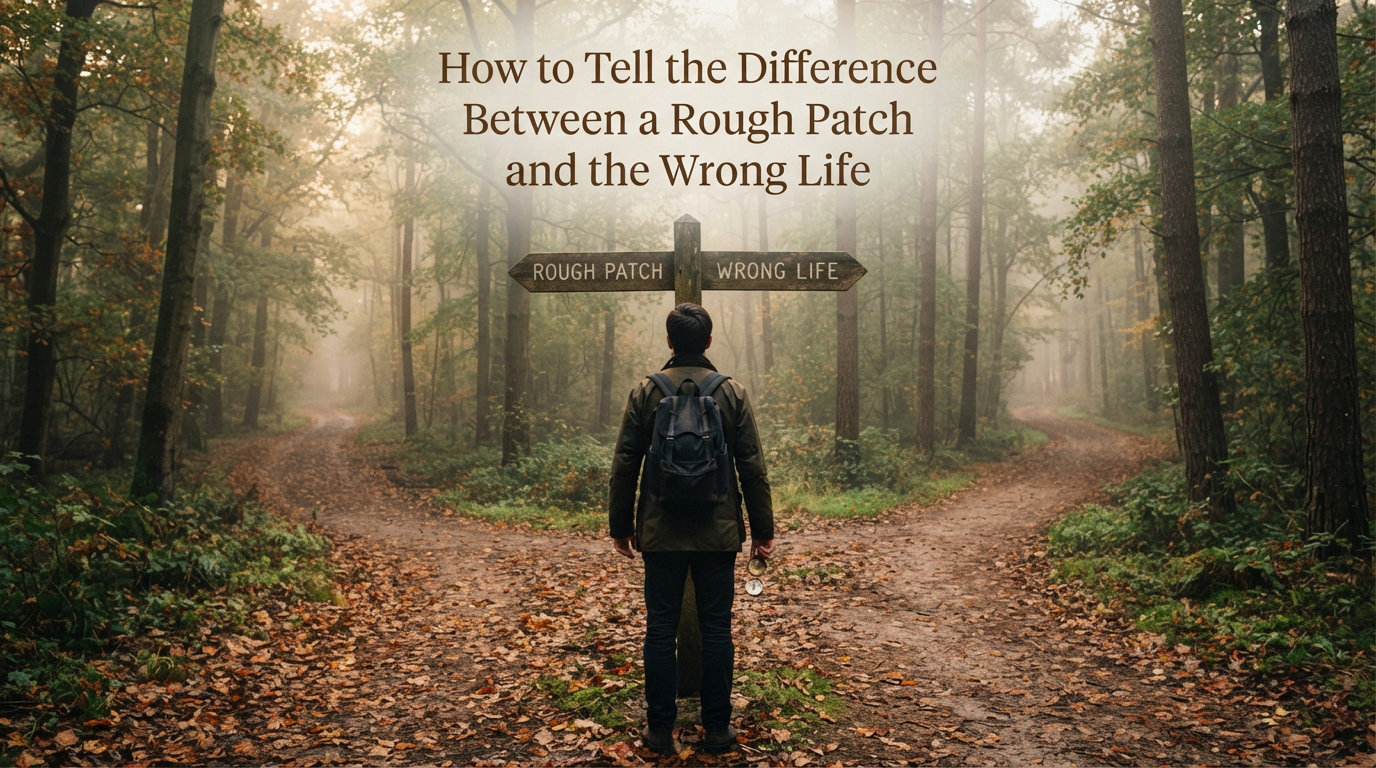
I want to start with one sentence that I’ve seen help more people than any other piece of relationship advice: a rough patch is partners struggling with each other, and the wrong life is one of them struggling for the relationship while the other has already checked out.
If you’ve been lying awake at night wondering whether your marriage, partnership, or long-term commitment is going through something you can survive or something you need to walk away from, you’re in good company. I work with people every week who are asking that exact question, and the panic that comes with it is real.
The trouble is that a rough patch and the wrong life often feel identical from the inside. Both involve pain, doubt, distance, and longing. So you end up oscillating between two extremes: “I’m giving up too soon” and “I’ve already given up too long.”
I’ve put together this guide to help you stop guessing. We’ll walk through the actual differentiators that therapists, researchers, and couples who came out the other side all point to. You’ll get a clear definition, a checklist of what to look for, ten self-reflection questions, and a three-part framework you can use today. By the end, you’ll know which one you’re in.
Table of Contents
What Is a Rough Patch vs the Wrong Life
A rough patch is a temporary season of friction where two people still want to be in the relationship and are both, in their own imperfect ways, still trying. The connection has not disappeared; it’s just buried under stress, conflict, or circumstance.
The wrong life (sometimes called a dead-end relationship, the wrong relationship, or a fundamentally wrong fit) is something different. It’s not a season. It’s a direction. The relationship has stopped being a shared project and become a one-person obligation. You might still love the other person, but the partnership has quietly ended.
Here’s the part I want you to memorize. The single biggest differentiator is mutual engagement. Dr. John Gottman’s research, which spans more than four decades of studying couples, found that the difference between relationships that recover and those that don’t is not the absence of conflict. It’s the presence or absence of repair attempts. Repair attempts are the small bids to reconnect: a joke after an argument, a hand on the shoulder, a quiet “can we start over?”
If both of you are still making repair attempts, you’re in a rough patch. If one of you has stopped trying and the other has become the sole keeper of the relationship, you’re in the wrong life.
7 Signs You’re in a Rough Patch Worth Working Through
I want to be careful here, because I don’t want to give anyone false hope. But I also don’t want you to walk away from something beautiful because you forgot what a hard season feels like. These are the signs that your struggles are temporary, not terminal.
- The difficulties have a clear external trigger. Job loss, a sick parent, a new baby, financial stress, a cross-country move. The rough patch has a “because.”
- You still like who you are in this relationship. Bustle’s piece on the same question makes this exact point. Even when things are tense, you recognize yourself. You’re not performing or shrinking.
- The good moments still outnumber the bad ones. You don’t have to ignore pain. You just have to honestly report that joy is still the dominant note.
- You can still be curious about each other. Not interested-curious. Just curious enough to ask, “how was your day?” and actually want to know.
- You fight about real things, not about nothing. Conflict exists, but it’s about laundry, money, in-laws, sex. It’s not about whether to be together at all.
- You both still apologize. Sometimes badly, sometimes late, but you still say it. Repair attempts are still landing.
- You can imagine a future together that feels good. When you picture next year, you see both of you in it, and the picture doesn’t make your chest tighten.
If four or more of those are true, the evidence strongly suggests you’re in a rough patch. That doesn’t mean you don’t need help. It means help will probably work.
9 Red Flags It’s the Wrong Life, Not Just a Rough Patch
Now the harder list. These are the signs that therapists, including the team at Empathi who write brilliantly about depleted relationships, point to as evidence that the relationship itself has ended, even if the logistics haven’t.
- You’ve stopped fighting and it doesn’t feel like peace. It feels like giving up. There’s no longer anything worth arguing about.
- Contempt has replaced frustration. Gottman calls contempt the single greatest predictor of divorce. It’s not anger. It’s disgust, eye-rolls, mockery, or quiet disdain.
- One of you has become the collapsed pursuer. You used to fight for the relationship. Now you don’t even bring things up because you’ve learned nothing changes.
- The other has become the drowning withdrawer. They retreat into work, screens, hobbies, or sleep. Not because they’re busy. Because the relationship has become a threat they need to escape.
- Polite indifference has replaced intimacy. You coexist like polite roommates. No real fight, no real warmth, no real anything.
- You’ve already left in your mind. When you picture your future, you are alone, or with someone else, or anywhere that isn’t here. You’re just waiting for permission to match your life to your imagination.
- Physical intimacy feels like a performance. Sex happens out of obligation or avoidance. Touch feels like a chore. You can no longer remember the last time it felt alive.
- You’ve stopped seeing them as a full person. They’ve become a category: “my partner who does X” or “the person I live with.” The humanity is gone.
- Repair attempts have stopped working. You try to reconnect and the attempt bounces off. Or worse, you’ve stopped trying because you already know the outcome.
If four or more of those are true, the evidence suggests you are not in a rough patch. You are in a relationship that has ended emotionally and is waiting for the paperwork. That doesn’t make you a failure. It makes you honest.
The Effort Question: Is Both Partners Still Investing?
I want to give this its own section because it’s the question that quietly determines everything else. If you take nothing else from this guide, take this.
Ask yourself: who is doing the work to keep this relationship alive?
It doesn’t have to be 50/50. Some seasons one partner carries more. That’s normal. But over a long stretch of months, if you can clearly see that you are the only one initiating conversations about the relationship, the only one suggesting therapy, the only one trying to repair after a fight, and the only one asking “are we okay?” then you are not in a rough patch. You are in a one-person relationship.
Therapists call this the pursuer-withdrawer dynamic, and it’s one of the most studied patterns in couples therapy. The pursuer chases connection, the withdrawer pulls away to feel safe, and over time the chaser burns out. Attachment theory says this happens because one partner is anxious (and runs toward the relationship to soothe fear) and the other is avoidant (and pulls away to soothe overwhelm).
Either pattern can be healed, but only if both people are aware of it and willing to do something different. When one partner is working hard and the other has gone blank, the rough patch label is no longer accurate.
10 Self-Reflection Questions to Find Your Answer
Set a timer for twenty minutes. Get a piece of paper or open a notes app. Answer each question in writing, even if it’s just one sentence. Writing changes the answer because it slows you down.
- When I picture my partner ten years from now, does that picture bring relief or dread?
- What is one thing I have been quietly hoping would change for more than six months?
- If a close friend described our relationship to me, would I tell them to stay or to go?
- When was the last time I felt genuinely chosen by this person?
- What am I most afraid will happen if I leave? What am I most afraid will happen if I stay?
- Does the relationship still make me braver, or does it make me smaller?
- Do I have a real story for why things got hard, or does it feel random and ongoing?
- Am I staying because I love them, or because I don’t know who I am without them?
- Have I told the truth about how bad it has gotten? Or am I managing their feelings about us?
- If nothing changed, how would I feel about this relationship on the day I die?
Read your answers back. You will not need me to tell you what they mean.
A Simple 3-Part Framework to Decide
The Empathi team coined a phrase I keep coming back to: Sovereign Us. The idea is that a healthy partnership is two whole people choosing each other on purpose, every day. You don’t lose yourself to keep the relationship. The relationship is the place where your fullest self gets to live.
Here’s a three-part check based on that idea. Run each part slowly.
1. The Somatic Check. Close your eyes. Picture your partner walking through the front door tonight. Notice what happens in your body. Does your chest open, your shoulders drop, your breath steady? Or does your jaw tighten, your stomach flip, your whole system brace? Your body usually knows the answer before your mind will admit it. This is the wisdom somatic therapists talk about: the felt sense of being in this relationship.
2. The Narrative Check. Tell the story of your relationship out loud, as if you were explaining it to a kind stranger on a long flight. Does the story have movement? Do you talk about hard seasons, yes, but also about what you learned and how you came back together? Or does the story sound like a slow funeral where everyone already knows the ending?
3. The Direction Check. Look at the last six months. Are things trending slowly better, slowly worse, or completely flat? Rough patches have a tilt. They curve toward repair. Dead-end relationships stay flat or drift down. Direction matters more than intensity.
If all three of those point the same way, you have your answer. If they’re mixed, give yourself permission to live in the question for a little while longer. You don’t have to solve this tonight.
When to Seek Couples Therapy or Outside Help
I want to make one thing clear before we end. None of what I just wrote is a substitute for a real therapist in the room with both of you. If you can afford it and your partner is willing, couples therapy is one of the highest-leverage decisions you can make in a rough patch.
Therapy works best when you go because both of you still want to be in the relationship but need help doing it well. It is less useful, though not useless, when one partner has already emotionally ended things. Even then, a good therapist can help you have the honest conversation you’re both avoiding.
How do you find the right person? Look for a licensed marriage and family therapist (LMFT) or a clinical psychologist who specializes in relationships. Ask whether they use emotionally focused therapy (EFT), the Gottman method, or attachment-based work. Avoid anyone who promises to “fix your partner” or who takes sides in the first session.
If your partner refuses to attend and you are sure you want to try, individual therapy is still useful. You can work on your side of the dynamic and decide what you want to do next without their participation.
If your relationship involves any form of abuse, coercion, control, or fear, please skip the couples therapist and contact a domestic violence resource directly. A rough patch never requires you to feel unsafe. If you feel unsafe, the answer is already in front of you.
Frequently Asked Questions
How do you know when you’re in a rough patch or a toxic relationship?
A rough patch has both partners still trying, with a clear external trigger and repair attempts that land. A toxic or wrong relationship shows contempt, one-sided effort, emotional disengagement, polite indifference, and repair attempts that bounce off. The key test is whether you are both still investing in the relationship or whether one of you has quietly checked out while the other does all the work.
How long does a rough patch last in a relationship?
Most rough patches last anywhere from a few weeks to several months, depending on the trigger. A rough patch tied to a specific event (job loss, illness, new baby) usually lifts when the stressor lifts or when the couple gets support. If the difficulty has no clear cause and has lasted more than a year with no movement, it is probably not a rough patch anymore.
How to know if it’s just a rough patch?
It is just a rough patch if both partners still want to be in the relationship, communication is still possible even when hard, the good moments outweigh the bad, and you can imagine a future together without your chest tightening. If you can answer yes to those four questions, you are almost certainly in a recoverable season rather than a dead end.
What are 5 warning signs of an unhealthy relationship?
Five warning signs of an unhealthy relationship are: contempt (eye rolls, disgust, mockery) replacing ordinary frustration, one-sided effort where only one person tries to repair, emotional disengagement that feels like polite indifference, repair attempts that no longer work, and fantasizing about leaving that has crossed from passing thought into a default mental movie. If you see these, the relationship has stopped being a partnership.
What is the #1 thing that destroys marriages?
Research from Dr. John Gottman identifies contempt as the single greatest predictor of divorce. Contempt is not anger. It is disgust, eye-rolling, mockery, or quiet disdain toward your partner. When contempt shows up regularly, repair attempts stop working and the relationship enters a death spiral that almost always ends the marriage unless both partners commit to serious intervention.
Is it normal to fantasize about leaving during a rough patch?
Yes, fantasizing about leaving during a rough patch is normal and does not by itself mean the relationship is over. It usually means you are craving relief, not necessarily an exit. The fantasy becomes a serious signal only when it is constant, when you have already pictured your life without them in detail, and when you feel relief instead of guilt at the thought.
You Already Know
If you’ve read this far, you probably already know what your answer is. People rarely research how to tell the difference between a rough patch and the wrong life just for fun. They’re usually looking for one more piece of evidence to confirm something their body has been telling them for months.
So let me say this clearly. If your honest read of everything above points to a rough patch, commit to the work. Get into therapy, learn the repair-attempt language, give it a real season with your whole heart. Rough patches, when you meet them together, often become the foundation of the most resilient love stories.
If your honest read points to the wrong life, give yourself permission to grieve that out loud. You are not betraying anyone by admitting what you already know. You are giving both of you the dignity of a clean ending instead of a slow bleed.
Either way, you don’t have to decide in one afternoon. You only have to keep choosing honestly. And that part, the part where you keep showing up to the truth of your own life, is the part that will carry you through.
If this guide on how to tell the difference between a rough patch and the wrong life helped you find a little more clarity, save it, share it with someone you trust, and come back to the self-reflection questions whenever you need to. The answer tends to get clearer the more often you check in with yourself. You deserve a relationship that makes you braver, not smaller. Whatever you decide, make sure it’s the one you can live with for the next ten years, not just the next ten days.