
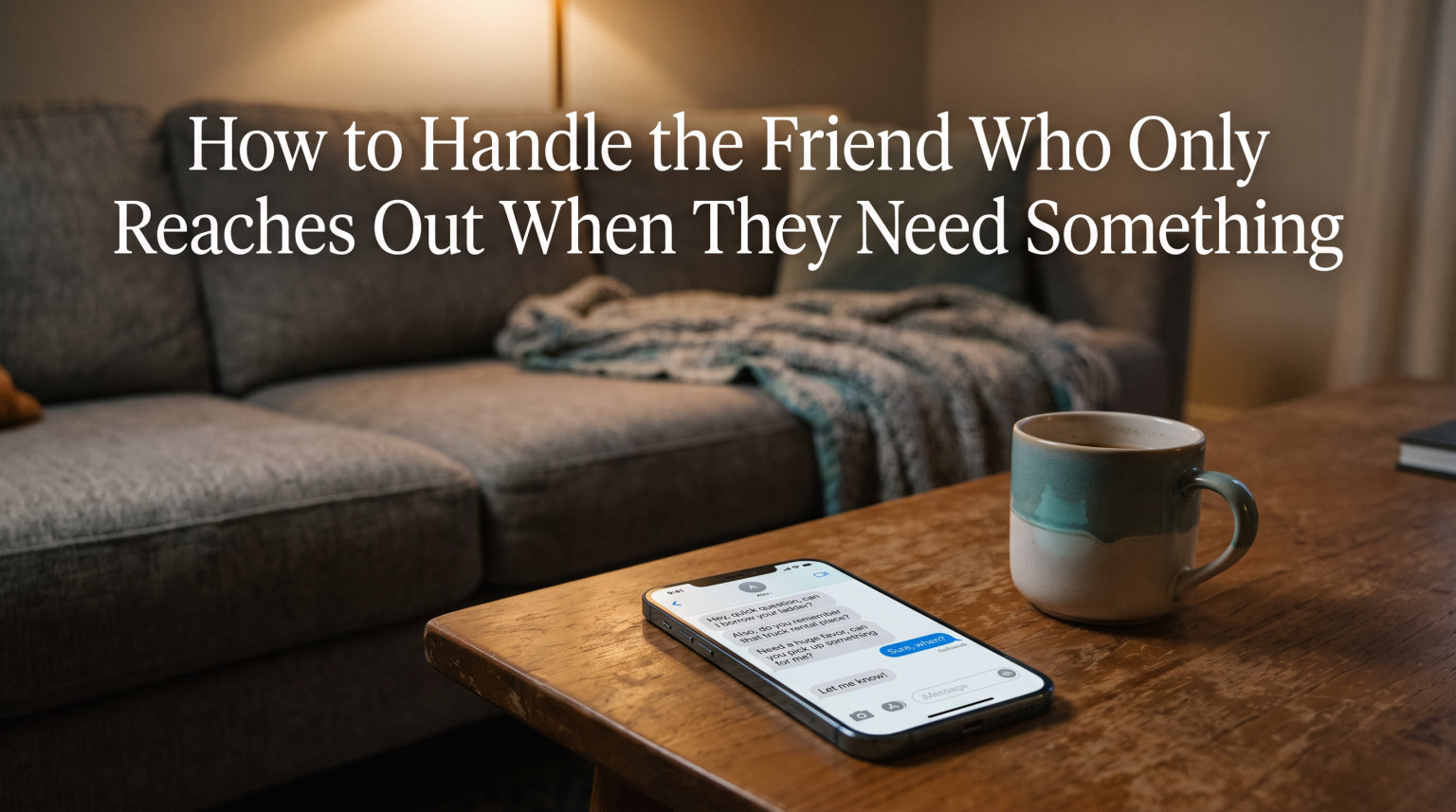
Your phone lights up. It’s that friend. You already know what is coming before you even read the message. They need a ride, a recommendation, a shoulder to cry on, or a favor only you can do.
You pick up. You help. Then the conversation goes quiet again for another three months.
If that pattern feels painfully familiar, I want you to know something right away: this experience is real, it is exhausting, and your frustration makes complete sense. As a life coach, I hear some version of this story every single week from clients who feel stuck between loyalty and resentment. Knowing how to handle the friend who only reaches out when they need something starts with one simple truth. You are allowed to want a friendship that gives back.
In this guide, I will walk you through the psychology behind this dynamic, the signs to look for, three response strategies you can try this week, and a clear framework for deciding when to address the issue and when to step back. My goal is to help you move from confusion to confidence.
Table of Contents
Why This Happens: Understanding One-Sided Friendships
A friend who only reaches out when they need something is engaging in what relationship experts call a one-sided friendship or a convenience friendship. This is a relationship where one person consistently takes without offering the same emotional investment, time, or care in return. The dynamic is often labeled emotional 911 or being someone’s emergency contact, because that is exactly how it feels. The phone only rings during a crisis.
Understanding why this happens takes the sting out of the pattern. Most people who behave this way are not sitting around plotting to use you. Instead, they have learned that you are reliable, kind, and unlikely to say no. Over time, the friendship quietly shifts into a transactional pattern where your role is helper, theirs is requester. Social psychologists call this the norm of reciprocity, the unspoken expectation that kindness gets returned. When that norm is broken over and over, resentment builds. You start questioning your own value instead of questioning the friendship.
One helpful lens here is the 11-3-6 rule of friendship. Popularized on social media, this rule suggests that close friends tend to contact you about every 11 days, share meaningful life updates roughly every 3 weeks, and check in on big life events within about 6 weeks. While these are averages, not laws, they give you a benchmark. If your friend has not reached out in months except to ask for a favor, you are far outside the normal range of a healthy bond.
Signs Your Friend Only Reaches Out When They Need Something
Before you respond, it helps to confirm the pattern. Here are the most common signs I see in my coaching work and across relationship forums like Reddit and Quora.
- You receive a text, and it is almost always a request. Catch-ups rarely happen unless they lead to a favor.
- Conversations feel one-directional. They share when they want something, but rarely ask how you are doing.
- You cannot remember the last time they initiated plans that did not benefit them in some way.
- They disappear for weeks or months and then suddenly reappear with a need.
- When you say no, they get defensive, guilt-trip you, or vanish again.
- Mutual friends or family have quietly noticed the imbalance too.
- You feel drained after every interaction instead of energized.
If three or more of these ring true, you are likely dealing with a transactional friendship, not a busy friend who simply lost touch.
3 Response Strategies You Can Use This Week
Once you recognize the pattern, you have three main paths. Choose the one that matches your comfort level and the depth of the friendship. Pick the strategy that lets you stay grounded, then give yourself permission to repeat it as many times as needed.
Strategy 1: The Gentle Redirect
Use this approach when you want to keep the friendship but shift the dynamic. The goal is to invite more mutual contact without accusing them of anything, especially if you have not said a word yet.
Try saying: “I love hearing from you, and I would love to catch up properly. Let’s grab coffee next week, just to talk, no favors needed.”
Or keep it shorter: “Hey, I missed you. Let’s not wait until something comes up. How about a call this weekend?”
This script works because it leads with warmth, sets a clear expectation of mutual time, and gently signals that you notice the imbalance. It gives them a chance to show up differently. If they respond with enthusiasm and follow through, you may have simply been dealing with a busy friend. If they ignore the invite and only text again with a need, you have your answer.
Strategy 2: The Direct Conversation
Use this when you have already tried smaller nudges and nothing changed. A direct conversation is honest, vulnerable, and often the fastest path to clarity. Pick a calm moment, not the middle of their next request.
Try saying: “I care about you, and I want this friendship to feel good for both of us. I have noticed that we mostly talk when you need something, and I miss the part where we actually check in on each other. Can we figure out a better balance?”
The key here is to describe the behavior, not attack the character. Use I-statements like I notice, I feel, I miss. This lowers defensiveness and keeps the door open. Give them space to respond honestly. Some friends will be surprised and apologetic. Others will deflect, minimize, or turn it around. Their reaction in that moment tells you more about the friendship than any words they have used in years.
Strategy 3: The Boundary Setting
Use this when the friendship has cost you time, money, or emotional energy you cannot keep giving. Boundary setting is not about punishment. It is about protecting your wellbeing and modeling what healthy reciprocity looks like.
Try saying: “I am in a season where I need to focus on my own responsibilities, so I am not able to help with this right now. I hope you understand.”
You are not required to explain further, justify your no, or offer an alternative. A clear, kind no is a complete sentence. Over time, you can also limit how quickly you respond, stop being available on demand, and let the friendship drift to a level that feels sustainable. Boundaries are not walls. They are the agreed-upon shape of a relationship you actually want to stay in.
When to Know It’s Time to Step Back
Stepping back is not failure. Sometimes it is the most loving thing you can do for yourself. Consider stepping back if the friend repeatedly ignores your boundaries, makes you feel guilty for having other priorities, or only resurfaces when they want something. You should also step back if you have already had the direct conversation and the behavior has not changed after a reasonable period, usually 2 to 3 months.
One question I often ask my clients is this: if this person texted me right now purely to say hi, how would I feel? If the honest answer is dread or obligation, that is your sign. A mutual friendship should feel safe, warm, and reciprocal. Stepping back can look like slower response times, fewer check-ins, or letting the friendship quietly fade.
Self-Reflection Prompts Before You Act
Before you send any of the scripts above, take five minutes to reflect. These prompts help you respond from clarity, not just frustration.
- Is there a chance this friend is going through something heavy, like grief, illness, or burnout, that I am not seeing?
- Have I ever told them clearly what I need, or have I been hoping they would just notice?
- What am I afraid will happen if I set a boundary?
- If this friendship ended tomorrow, would I feel relief or grief?
- What would a truly reciprocal friendship look like for me, and am I modeling that in other relationships?
Your answers will guide you toward the right strategy and protect you from reacting in a way you later regret.
Frequently Asked Questions
What is the 11 3 6 rule of friendship?
The 11-3-6 rule of friendship suggests that close friends tend to reach out every 11 days, share meaningful life updates roughly every 3 weeks, and check in on big life events within about 6 weeks. These are averages, not hard laws, but they give you a useful benchmark for measuring how reciprocal a friendship really is.
What is it called when someone only talks to you when they need something?
It is commonly called a one-sided friendship, a convenience friendship, or sometimes a transactional friendship. The pattern shows up as someone treating you like an emergency contact who only hears from them during a crisis or when they need a favor.
What is the biggest red flag in a friendship?
The biggest red flag is a consistent lack of reciprocity combined with defensiveness when you bring it up. If a friend only contacts you for help, disappears for months, and reacts with guilt or anger when you ask for more balance, the friendship has likely crossed from busy into transactional.
How do you deal with an overly needy friend?
Start with a gentle redirect by inviting genuine catch-up time. If nothing changes, have a direct conversation using I-statements like I notice or I miss. If the behavior continues, set clear boundaries, slow your response time, and limit what you give until the friendship feels balanced or you decide to step back.
You Deserve a Mutual Friendship
You came here looking for how to handle the friend who only reaches out when they need something, and I hope you are walking away with both validation and a plan. Use the gentle redirect first. Speak directly if nothing shifts. Set boundaries without guilt when the friendship drains you. And if it is time to step back, give yourself permission to do that too.
A real friendship is not a series of favors. It is a shared space where both people feel seen, supported, and free. You are allowed to expect that. In 2026, I would rather you invest in relationships that fill your cup than keep pouring into one that only opens the tap when it is thirsty.
If you want help unpacking your specific situation, I work one-on-one with clients who are ready to rebuild healthier friendships and stronger boundaries. You do not have to figure this out alone.