
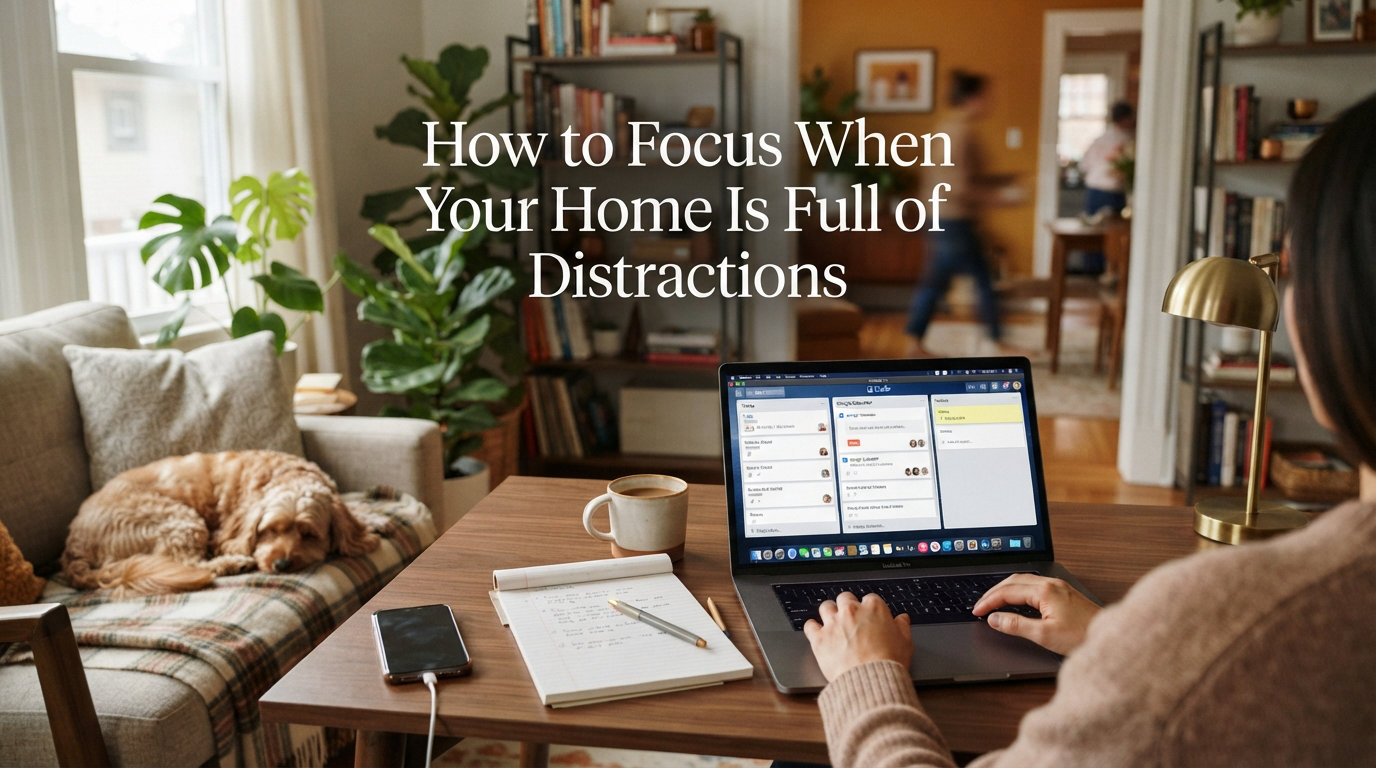
You sit down to work, and within five minutes the dog barks, your phone lights up, and someone starts loading the dishwasher like it is an Olympic sport. If you have ever wondered how to focus when your home is full of distractions, you are not alone. Millions of remote workers, students, and freelancers wrestle with the exact same problem every single day.
The good news is that focus is not a personality trait you either have or lack. It is a skill you can train and an environment you can engineer. The strategies in this guide are pulled from productivity research, community-tested routines from forums like r/WFH and r/productivity, and real techniques that people use every day to stay on track at home.
Here is the short version: you regain focus by controlling your physical space, managing your digital habits, building a routine that signals “work mode” to your brain, and using proven techniques like the Pomodoro method and time blocking. Below, I break down each of those pieces into actionable steps you can start using today.
Table of Contents
Why Your Home Wrecks Your Focus
Your home is designed for comfort, not concentration. That is the core reason focusing feels so much harder there than in an office. Your brain has spent years associating your living space with relaxing, eating, watching TV, and unwinding. When you try to work in that same environment, those associations fight against you.
There is also a psychological shift that almost no productivity guide talks about. In an office, you adopt a work identity the moment you walk through the door. At home, you are constantly switching between “family member,” “relaxed person,” and “focused professional” without ever physically moving. This identity friction drains mental energy before you even open your laptop.
Then there is the cost of interruptions. Research from the University of California found that it takes an average of 23 minutes to fully refocus after a distraction. That is the 23-minute rule, and it means a single phone notification can eat up nearly half an hour of your productive time. Two interruptions in a morning and you have lost an entire deep work session.
Your home also removes the built-in structure an office provides. No one expects you at a certain desk. No manager walks by. There is no natural rhythm of meetings and breaks. Without that scaffolding, your brain has to make hundreds of micro-decisions about what to do next, which is exhausting and leads to reaching for your phone.
How to Create a Distraction-Free Environment at Home
Creating a distraction-free environment starts with removing visual and physical clutter from your line of sight. A pile of laundry or a sink full of dishes is not just untidy. Each item sends a small signal to your brain that something is unfinished, which pulls attention away from your work. Clear your workspace before you start, even if that means shoving everything into a closet temporarily.
Sound is the second biggest environmental culprit. If your home is noisy, invest in noise-canceling headphones or use a white noise track. Reddit users in r/WFH consistently rank headphones as the single most important tool for home focus. Brown noise, rain sounds, and instrumental music all work well because they mask unpredictable household sounds without adding lyrics that compete for your attention.
Visual distractions matter too. Face your desk toward a wall or a window rather than a high-traffic area like the kitchen. If you can see the TV, a cluttered counter, or people walking by, your attention will drift. One simple trick is to use a room divider or a bookshelf to create a visual barrier between your work zone and the rest of your home.
Keep only what you need on your desk: your laptop, a notebook, a pen, and water. Everything else is a potential distraction. When your environment is clean and minimal, your brain has fewer objects to process and more energy left for the task in front of you.
Tame Digital Distractions Once and For All
Your phone is the number one source of digital distraction at home, and the solution is simple: put it in another room. Out of sight truly is out of mind. If your phone is on your desk, you will check it even when it does not buzz. Studies show the mere presence of a smartphone reduces cognitive capacity. Move it to a drawer, a charging station in the kitchen, or anywhere you cannot reach without standing up.
For your computer, site-blocking apps are a game changer. Tools like Freedom, Cold Turkey, and StayFocusd let you block social media, news sites, and any rabbit-hole destination during your work hours. Set them up once and let the software do the willpower work for you. Users on r/productivity swear by these tools because they remove the decision entirely.
Email is another silent focus killer. Instead of leaving your inbox open all day, check it at two or three scheduled times. Try 9 AM, noon, and 4 PM. This practice, called email batching, prevents the constant context-switching that fragments your attention. Turn off all new-email notifications and close the tab between checks.
Turn on Do Not Disturb mode on every device during your deep work blocks. On your phone, this silences calls and texts except from specific contacts. On your computer, it stops calendar pings, message alerts, and app badges. You can always set it for a 90-minute window and then catch up on messages during a break.
If you struggle with social media specifically, try a “phone-free morning” rule. Commit to not touching your phone for the first hour after you wake up. This prevents the dopamine loop that starts with one quick scroll and derails your entire morning before you have done a single productive thing.
Establish a Dedicated Workspace (Even Without an Office)
A dedicated workspace is non-negotiable for home focus, and it does not require a separate room. The key is consistency. Pick one spot, even if it is just a corner of your kitchen table or a small desk in your bedroom, and use it only for work. Over time, your brain starts associating that specific location with concentration.
This is called context-dependent memory. When you always work in the same spot, sitting down there becomes a trigger for focus, much like walking into a gym triggers exercise mode. If you work from the couch one day, the bed the next, and the kitchen table the third, your brain never builds that association.
If you genuinely have no space, create a portable workspace. Use a specific tray, placemat, or laptop stand that you set up at the start of the workday and put away when you finish. The act of assembling and disassembling your workspace creates a physical ritual that separates work time from personal time.
Never work from bed if you can help it. Your brain associates bed with sleep, and trying to focus there creates a tug-of-war between drowsiness and alertness. It also trains your brain to associate your bed with wakefulness, which damages your sleep quality over time.
Set Clear Boundaries with Family and Roommates
Setting boundaries with the people you live with is one of the hardest but most important steps. The problem is rarely that family members do not care. It is usually that they cannot see when you are in deep work and when you are available. You have to make your availability visible.
Use a physical signal. A closed door, a small flag on your desk, a sign that says “In Focus, Back at 2 PM,” or even wearing headphones all communicate that you are unavailable. Make sure everyone in the house knows what the signal means and agrees to respect it. One r/WFH user shared that a simple red light on their desk reduced family interruptions by 80 percent.
Schedule check-ins so people do not feel ignored. Tell your partner or kids, “I will be unavailable from 10 to noon, but I will come find you for lunch.” When people know when they will get your attention, they are far less likely to interrupt you mid-task.
Have an honest conversation about what working from home actually requires. Explain the 23-minute recovery cost of interruptions. Most people are genuinely surprised to learn how much a quick question costs you. Once they understand, they usually become far more willing to hold their questions.
If you have young children, this is harder but not impossible. Coordinate with your partner on coverage shifts, use nap times for your most demanding tasks, or trade childcare with a neighbor. Some parents swear by a “quiet box” of special activities that only comes out during work calls.
Use Time-Blocking and the Pomodoro Technique
Time-blocking and the Pomodoro Technique are two of the most effective focus methods because they replace willpower with structure. Instead of sitting down and hoping you stay focused for four hours, you work in defined bursts with built-in breaks.
The Pomodoro Technique works like this: set a timer for 25 minutes and work on a single task with zero distractions. When the timer rings, take a 5-minute break. After four rounds, take a longer 15 to 30-minute break. This method works because 25 minutes feels manageable, and the ticking timer creates a sense of urgency that keeps you from drifting.
Many people find that 25 minutes is too short once they get into a groove. Adjust the duration to fit your rhythm. A 50-minute work block with a 10-minute break is a popular variation for deep work. Experiment to find the interval that keeps you locked in without burning out.
Time blocking takes this further by assigning specific tasks to specific blocks on your calendar. Instead of a vague to-do list, your day looks like: 9 to 10 is for the report, 10 to 10:30 for email, 10:30 to noon for the presentation. This removes decision fatigue because you always know what you should be doing right now.
Protect your most mentally demanding task for your peak energy window. For most people, that is the first two to three hours of the workday. Do your hardest thinking when your brain is freshest, and save routine tasks like email and admin for the afternoon slump.
One technique worth knowing is deep work, a term coined by author Cal Newport. Deep work means extended, uninterrupted focus on a cognitively demanding task with no distractions whatsoever. Schedule one deep work block per day, protect it aggressively, and you will get more meaningful work done in 90 minutes than most people manage in a full distracted day.
Take Strategic Breaks That Actually Recharge You
Not all breaks are created equal. Scrolling social media for 10 minutes does not recharge your brain. It floods it with new information and fragments your attention even further. The best breaks involve stepping away from screens entirely.
Move your body during breaks. Stand up, stretch, walk around the block, or do a few squats. Physical movement increases blood flow to the brain and clears mental fog faster than any other break activity. Reddit users in r/productivity frequently recommend short outdoor walks as the single most effective reset.
Try “deskercises” if you cannot leave your space. Shoulder rolls, neck stretches, and standing up every 30 minutes prevent the physical stiffness that builds during long sessions and keeps your energy up. Set a gentle reminder to stand every half hour.
Do something genuinely different from work during your break. Load the dishwasher, water your plants, pet the dog, or step outside for fresh air. The key is switching to a completely different type of activity so your brain can truly disengage before the next focus block.
Optimize Your Physical Environment for Concentration
Lighting, temperature, and sensory details have a measurable impact on your ability to focus. Natural light is the single best thing you can add to your workspace. Position your desk near a window whenever possible, because daylight regulates your circadian rhythm and keeps you alert during the day.
Temperature matters more than most people realize. Research suggests that the ideal temperature for cognitive work is around 70 to 72 degrees Fahrenheit. If your home office is too warm, you will feel drowsy. Too cold, and your body burns energy staying warm instead of thinking.
Sound and scent also play a role. If your environment is too quiet, every small noise becomes distracting. Brown noise, instrumental music, or ambient sounds fill that silence without competing for your attention. Some people find that certain scents, like peppermint or citrus, help them feel more alert during afternoon slumps.
Consider the colors around your workspace. While you do not need to repaint your walls, small changes like a blue or green desk accessory can have a calming effect. Avoid overly bright or stimulating colors in your direct line of sight, as they can increase restlessness.
Build a Morning Routine That Triggers Work Mode
A consistent morning routine is how you bridge the gap between home mode and work mode. Without a commute or a boss expecting you at a desk, you need to create your own transition ritual that tells your brain it is time to shift gears.
Start by getting dressed for work, even if “dressed” means clean sweatpants instead of sleep sweatpants. The act of changing clothes sends a psychological signal that something has changed. You do not need a suit, but you do need to feel put together enough that you would not be embarrassed on a video call.
Build a short sequence of habits you do every morning before work. This could be making coffee, reviewing your top three priorities, and doing a 5-minute stretch. The specific activities matter less than the consistency. After a few weeks, this routine becomes an automatic trigger that drops you into focus mode.
Review your task list the night before, not in the morning. When you wake up already knowing your first task, you eliminate the morning paralysis of figuring out what to do. Start your first work block within 30 minutes of sitting down to build momentum before distractions creep in.
Focus Strategies for ADHD and Neurodivergent Brains
If you have ADHD or suspect you might, standard focus advice often falls short. ADHD brains struggle with dopamine regulation, which means routine tasks feel genuinely harder to start and sustain. The strategies that work need to account for this neurological difference.
Body doubling is one of the most effective ADHD focus tools. This means working alongside another person, either in person or over a video call, where you both work silently on your own tasks. The presence of another working person provides external accountability that an ADHD brain cannot generate internally. Platforms like Focusmate pair you with a stranger for 50-minute work sessions.
Break tasks into absurdly small steps. If “write the report” feels paralyzing, shrink it to “open the document and write the title.” Then “write one sentence.” ADHD brains often need the barrier to entry to be nearly zero to get started. Once you start, momentum usually carries you forward.
Use visual timers rather than digital ones. Seeing time physically disappear on a visual timer creates urgency in a way that numbers on a screen do not. Many ADHD adults also benefit from working in shorter bursts, like 15-minute blocks, rather than the standard 25-minute Pomodoro.
Manage sensory input aggressively. ADHD brains are more sensitive to background noise, visual clutter, and physical discomfort. Noise-canceling headphones, a fidget tool, and a stripped-down workspace are not luxuries for neurodivergent workers. They are necessities.
Reward yourself immediately after completing a task block. Because ADHD brains process dopamine differently, the satisfaction of a finished project is often not enough to sustain motivation. Build in small, immediate rewards like a favorite snack, a short walk, or five minutes of a podcast.
Your Quick-Reference Focus Checklist
Use this checklist every morning to set up your day for deep focus. It combines the most effective strategies from this guide into a fast routine you can run through in under five minutes.
Step 1: Clear your desk of everything except what you need right now.
Step 2: Put your phone in another room or on Do Not Disturb.
Step 3: Launch your site-blocking app for your work hours.
Step 4: Write down your top three tasks and pick the first one.
Step 5: Set a timer for your first focus block, whether that is 25 or 50 minutes.
Step 6: Put on headphones with brown noise or instrumental music.
Step 7: Display your “do not disturb” signal so your household knows you are working.
Step 8: Start. Do not wait to feel ready. Action creates momentum.
FAQs
Why do I have a hard time focusing at home?
Your home is wired for relaxation, not work, so your brain associates the space with unwinding. On top of that, you lose the built-in structure of an office, face constant household interruptions, and deal with easy access to chores and entertainment. It takes an average of 23 minutes to refocus after each distraction, which compounds throughout the day.
How do you handle distractions at home?
Start by creating a dedicated workspace and removing visual clutter from your desk. Put your phone in another room, use a site-blocking app like Freedom or Cold Turkey, and turn on Do Not Disturb during work blocks. Communicate clear boundaries with family using a visible signal, and use the Pomodoro Technique to work in focused 25-minute bursts with scheduled breaks.
What is the 23 minute rule?
The 23-minute rule comes from research by Gloria Mark at the University of California, which found that it takes an average of 23 minutes and 15 seconds to fully regain focus after an interruption. This means every phone notification, family question, or quick email check costs you far more than the few seconds the interruption itself takes.
How to focus despite distractions?
Engineer your environment so focus is the path of least resistance. Block distracting websites, silence your phone, use noise-canceling headphones, and work in timed blocks using the Pomodoro Technique. Take movement-based breaks between sessions, and protect your peak energy hours for your hardest tasks.
Conclusion
Learning how to focus when your home is full of distractions is not about having more willpower. It is about building systems that make focus the default instead of the exception. Clear your space, silence your phone, set boundaries with your household, and use timed work blocks to structure your day.
You do not need to do everything at once. Start with one change, like moving your phone to another room or running through the morning checklist. Add another strategy next week. Small, consistent improvements compound into a focus routine that transforms how you work from home.
Your home will always have distractions. But with the right environment, boundaries, and techniques, those distractions stop controlling your day and you start controlling them.