
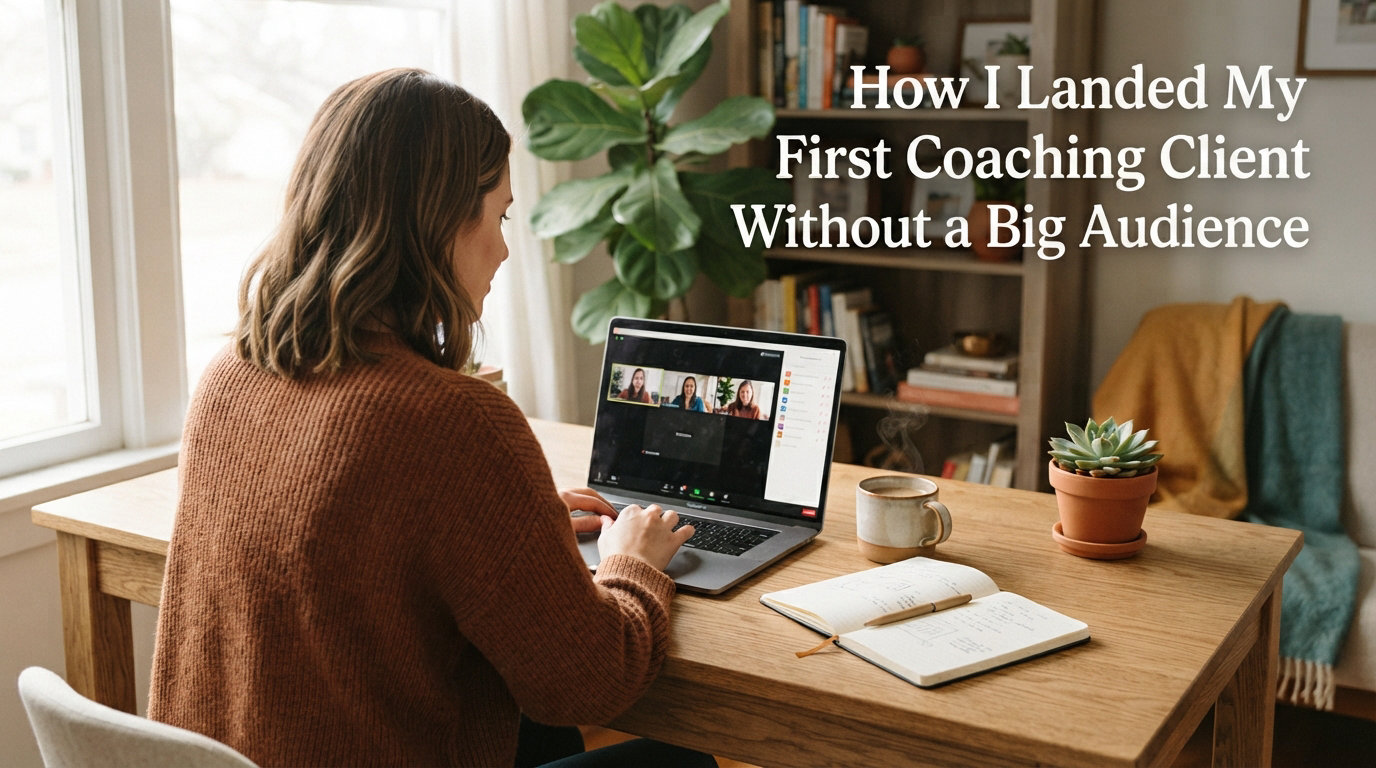
I remember staring at my laptop, three weeks into my coaching certification, with zero clients and zero followers. My Instagram had 43 followers, half of whom were family members. I had no email list, no podcast, no YouTube channel, and no idea how I was going to convince anyone to pay me for coaching.
If you are wondering how to land your first coaching client without a big audience, I want you to know something right now: I have been exactly where you are. And I want to share exactly what I did, step by step, so you can skip the months of frustration I went through.
Within 30 days of starting, I signed my first paying client for $200 a month. Within 60 days, I had three clients. None of it required a viral post, a massive following, or a single dollar in ads. What it did require was a system I stumbled into after plenty of trial and error.
This guide walks you through that entire system. You will learn the exact strategies I used, the scripts I sent, the mistakes I made, and the mindset shifts that changed everything. By the end, you will have a concrete 48-hour action plan to land your own first client.
Table of Contents
My Story: Starting With Zero Followers and Zero Clients
When I tell people I am a life coach, they usually assume I had some big platform first. The reality is far less glamorous. I started my coaching business in 2026 while still working a full-time job. My marketing budget was exactly zero dollars. My social media presence was a personal Facebook account I used mostly for sharing photos of my dog.
The first two weeks were brutal. I posted inspirational quotes on Instagram and waited. Crickets. I joined a few coaching Facebook groups and lurked. Nobody responded to my comments. I felt invisible, and honestly, I started wondering if I was cut out for this at all.
The turning point came when I stopped trying to build an audience and started looking for one person I could help. That shift in thinking, from broadcasting to connecting, changed my entire approach to client acquisition.
I made a list of people I actually knew. Not a huge list, just 15 names. Former coworkers, a college friend going through a career change, a neighbor who mentioned she felt stuck. I reached out to each one individually with a genuine message. No sales pitch. No “book a call” link. Just a real conversation.
Three of those conversations turned into free coaching sessions. One of those free sessions turned into my first paying client within two weeks. That client referred me to someone else. That person referred me to another. Suddenly I had a small but growing practice, all from 15 names on a napkin.
The lesson hit me hard: you do not need a big audience to land your first coaching client. You need a clear offer, genuine conversations, and the willingness to put yourself out there before you feel ready.
The 3-Part System That Got Me My First Client
After that first client signed, I sat down and reverse-engineered what actually worked. I realized I had stumbled into a simple three-part system that I have since refined and taught to dozens of new coaches. Here it is.
Part 1: Get Crystal Clear on Who You Help and How
The biggest mistake I see new coaches make is trying to help everyone. “I help people live their best lives” sounds nice, but it tells nobody why they should hire you. My first client came when I narrowed my focus to helping professionals in their 30s navigate career transitions.
Suddenly my messaging made sense to the right people. Instead of talking to everyone and resonating with no one, I was speaking directly to a specific person with a specific problem. That clarity made every conversation more productive.
Part 2: Get Visible Through Conversations, Not Content
You do not need thousands of followers to get coaching clients. You need the right conversations with the right people. For me, that meant reaching out to 15 warm contacts. For you, it might mean joining one community where your ideal clients hang out and showing up consistently.
The goal here is not to go viral. The goal is to have five genuine conversations per week with people who fit your ideal client profile. Some will not need coaching. But some will, and those are the ones who matter.
Part 3: Get Them on a Call Using the Taster Session Framework
Every paying client I signed started with a free 30-minute coaching session. Not a sales call disguised as a free session. An actual coaching session where I helped them with a real problem. This approach builds trust faster than any amount of content or social proof.
During that session, I coached them on one specific challenge. By the end, they had experienced my coaching firsthand. Then, and only then, did I mention that I had availability for ongoing clients. About 40 percent of those free sessions converted to paying clients.
How I Landed My First Coaching Client Without a Big Audience: 7 Strategies
Here are the seven specific strategies I used to go from zero clients to a full practice. I have ranked them roughly in order of speed, starting with the fastest ways to land that all-important first client.
Strategy 1: Leverage Your Warm Network (Start Here)
This was the strategy that landed my first client, and I recommend it as the starting point for every new coach. Your warm network includes friends, family, former coworkers, classmates, and anyone you have a genuine relationship with. These people already trust you, which eliminates the hardest part of client acquisition.
Make a list of 15 to 20 people. Do not filter based on whether you think they need coaching. You are not pitching them directly. You are letting them know what you do and asking if they know anyone who might benefit. The script I used was simple: “Hey [name], I just started my coaching practice helping [specific group] with [specific problem]. I am taking on a few clients and wanted to let you know in case you know anyone who might be a good fit.”
Notice what that message does not do. It does not pressure the person. It does not ask them to book a call. It simply opens a door. About 30 percent of the people I messaged responded, and several connected me with friends or colleagues who became clients.
I cannot stress this enough: warm outreach beats cold outreach every single time for your first client. The trust is already there. You are not starting from zero.
Strategy 2: Offer Free Sessions That Actually Convert
Free coaching gets a bad reputation in the coaching industry. Some coaches say you should never give away your time. I disagree, at least for your first few clients. Offering a free session was the single most effective tool in my toolkit.
The key is structuring the free session as a real coaching experience, not a sales pitch. I called mine a “taster session” because it gave people a taste of what working with me felt like. Thirty minutes, one specific problem, one actionable takeaway. That was it.
During the session, I spent 25 minutes coaching and 5 minutes discussing next steps. I never launched into a hard sell. Instead, I said something like: “If you found this helpful, I work with clients on an ongoing basis to help with exactly this kind of challenge. I have space for two more clients right now if you are interested.”
That soft, direct approach felt natural and respected their autonomy. It also converted at a rate I was happy with. Out of every 10 free sessions I offered, roughly 4 became paying clients. For a new coach with no audience, those numbers are gold.
Strategy 3: Pitch With Proof: Cold Outreach That Works
After I exhausted my warm network, I turned to cold outreach. Most cold outreach fails because it is generic. “Hi, I am a coach, do you want coaching?” gets ignored by everyone. The approach that worked for me was what I call pitching with proof.
Instead of asking for a call, I offered value first. I would find someone in my target audience, study their situation, and send a specific, personalized message. Something like: “I noticed you mentioned struggling with burnout in your last post. I put together a quick framework for managing energy as a manager that might help. No strings attached, just thought it might be useful.”
About one in five people responded to those messages. Not all became clients, but several booked free sessions. The ones who experienced my coaching through the free session were the ones who eventually paid.
The formula is simple: offer specific value, make no demands, follow up once if they do not respond. Never send a generic pitch to a stranger. Always give them a reason to care before you ask for anything.
Strategy 4: Go Where Your Ideal Clients Already Gather
One of the biggest advantages of not having an audience is that you do not need to build one to find clients. Instead, you can show up where audiences already exist. For me, that meant joining two online communities where career-changing professionals hung out.
I did not join these groups to spam my services. I joined to contribute. I answered questions, shared resources, and engaged genuinely with other members. After a few weeks, people started reaching out to me privately asking about my work.
This strategy takes patience. You will not get a client in week one. But if you consistently show up and add value in one or two communities for 30 days, conversations will start. And those conversations are warm because people already know you from your contributions.
The mistake I see most often is coaches joining five groups and posting the same promotional message in all of them. That is spam, not networking. Choose one community, become a valued member, and let the connections happen naturally.
Strategy 5: Master the Taster Call Framework
The taster call was the engine that powered my entire early client acquisition. I want to break down exactly how I structured it, because the details matter enormously.
Before the call, I sent a short intake form with three questions: What is the biggest challenge you are facing right now? What have you tried so far? What would success look like for you? This took five minutes to fill out and gave me everything I needed to prepare.
During the call, I spent the first three minutes building rapport and setting expectations. Then I dove into coaching. I asked powerful questions, challenged their assumptions, and helped them see their situation from a new angle. The goal was to create a shift they could feel.
At the 25-minute mark, I paused and asked how they were feeling about the conversation. If they said it was helpful, I made my offer. If they seemed hesitant, I asked what was coming up for them. Either way, I kept it low pressure.
The final five minutes covered logistics: pricing, session format, next steps. I always ended with a clear call to action, even if that action was “take a few days to think about it.” Clarity beats ambiguity every time.
Strategy 6: Build a Referral Engine From Day One
My second and third clients both came from my first client. That is the power of referrals, and you can start building that engine from your very first client. The trick is to make referrals a natural part of your client relationships, not an afterthought.
I told every new client something like: “My practice grows through referrals. If you know anyone who might benefit from what we are doing together, I would love an introduction. And if they become a client, your next session is on me.” That simple offer generated more clients than any other strategy after the first few months.
You can also build referral partnerships with other coaches who serve different niches. I connected with a health coach and a financial coach. We referred clients to each other regularly because our services complemented each other rather than competing.
Referrals work because they come pre-loaded with trust. When your ideal client hears about you from someone they already trust, half the sales work is done before they ever speak to you.
Strategy 7: Create Content Even Without an Audience
I almost did not include this strategy because it feels counterintuitive when you have no audience. But content played a role in my early client acquisition, just not in the way you might think. I did not need thousands of readers. I needed the right piece of content in front of the right person.
I wrote three articles answering specific questions my ideal clients were asking. I shared them in communities, included them in outreach messages, and referenced them during calls. Even with almost no traffic, these articles served as proof of expertise and gave me something valuable to offer.
Think of early content as a conversation starter, not a traffic generator. One well-placed article shared in the right community can lead to three or four client conversations. You do not need a blog with 10,000 monthly visitors for that.
Overcoming the Fear of Selling and Rejection
Nobody talks about this enough, so I am going to be direct: the hardest part of landing your first coaching client is not the strategy. It is the emotional weight of putting yourself out there and facing potential rejection. I almost quit three times in my first month because of this.
Every time I sent an outreach message and got no response, I took it personally. Every free session that did not convert felt like proof I was not good enough. The fear of rejection was louder than any logical strategy I had learned.
What helped was reframing what rejection meant. A no is not a judgment of your worth as a coach. It is simply information. Maybe the timing is wrong, maybe the fit is wrong, maybe they genuinely cannot afford it right now. None of that reflects your ability to help people.
I also learned to separate my identity from my outcomes. I am a coach regardless of whether someone books a session with me. My value is not determined by my conversion rate. Once I internalized that, reaching out became less terrifying.
If you are struggling with this, start with the lowest-stakes outreach possible. Send one message to one person you trust. Then send one to an acquaintance. Build up gradually. Confidence comes from action, not the other way around.
Transitioning From Free to Paid Clients
This was the area I struggled with most, and it is a gap I see in almost every coaching resource out there. How do you move from giving away free sessions to asking for money without feeling awkward or losing the client?
The answer is that the transition starts before the free session even happens. When someone books a taster call with you, be upfront that it is a one-time session and that you offer ongoing coaching for those who want to continue. Setting this expectation early removes the awkwardness of bringing up pricing later.
During the session, focus entirely on delivering value. Do not think about the sale. If you are mentally calculating your pitch while your client is sharing a vulnerable challenge, they will feel it. Be fully present as a coach first.
When the session ends, make a clear, direct invitation. Avoid wishy-washy language like “If you ever want to, maybe, possibly work together.” Instead, try: “Based on what we covered today, I think ongoing coaching could really help you with [specific challenge]. I have space for one more client this month. Would you like to discuss what that looks like?”
Some people will say yes. Some will say they need to think about it. Some will say no. All of those responses are fine. Your job is to make the offer clearly and let them decide. The awkwardness comes from hedging, not from being direct.
One more tip: have your pricing ready before the call. Nothing kills a potential client’s confidence faster than a coach who stammers when asked about rates. Pick a number, write it down, and own it.
Mistakes I Made So You Do Not Have To
I made plenty of mistakes during those first few months. Here are the biggest ones so you can avoid them and save yourself weeks of frustration.
I spent two weeks building a website before I had a single client. That was a complete waste of time. Nobody visited the website because I had no traffic, and the clients I did land never asked to see it. Your energy is better spent having conversations than designing a homepage.
I also tried to coach everyone who showed interest, even people who were clearly not a good fit. Taking on a client who is not right for your niche drains your energy and rarely leads to good outcomes. It is okay to say no or to refer someone to a coach who is a better match.
Another mistake was underpricing my services out of fear. My first client paid $200 a month, which felt like a lot at the time. Looking back, I was delivering enormous value for that price. I raised my rates with the next client and lost zero conversions. Price reflects confidence as much as it reflects skill.
Finally, I wasted time consuming coaching content instead of taking action. I watched webinars, read books, and took courses while avoiding the one thing that actually gets clients: reaching out to people. Learning has its place, but action is what builds a business. Set a rule for yourself: for every hour of learning, spend two hours on outreach.
Your 48-Hour Action Plan to Land Your First Client
If you want to move fast, here is a concrete plan you can execute in the next 48 hours. This is the exact sequence I wish I had followed from day one instead of wasting time on things that did not matter.
Hour 1 to 4: Get Clear. Write down your niche in one sentence: “I help [specific people] overcome [specific challenge] so they can [specific outcome.” If you cannot do this in one sentence, keep refining until you can. This clarity is the foundation of everything else.
Hour 4 to 8: Build Your List. Write down 15 to 20 people you know who might either need coaching or know someone who does. Do not overthink this. Include friends, family, coworkers, acquaintances. The goal is a list of names, not a list of perfect prospects.
Hour 8 to 16: Send Your Messages. Craft a warm, genuine message to each person on your list. Use the template from Strategy 1 above. Customize it for each person. Send them all within a 24-hour window so you can track responses together.
Hour 16 to 24: Prepare Your Taster Session. Create a simple intake form with three questions. Outline a 30-minute session structure. Decide on your pricing for ongoing coaching so you are ready when someone asks. Write it down. Do not wing it.
Hour 24 to 48: Follow Up and Book Calls. Respond to every reply within a few hours. Offer free taster sessions to anyone who seems interested. Book the calls on your calendar. Show up prepared. Coach well. Make your offer at the end.
This is not a guarantee of a client in 48 hours, but it is a guarantee of momentum. If you follow this plan, you will have had real conversations with real people about your coaching within two days. That is more than most new coaches accomplish in their first month.
Frequently Asked Questions
How to get your first coaching client?
To get your first coaching client, start by leveraging your warm network. Make a list of 15 to 20 people you know, reach out with a genuine message about your coaching practice, and offer free taster sessions to those who show interest. Focus on having real conversations rather than building a big audience. Most first clients come from existing relationships, not social media.
What is the 70 30 rule in coaching?
The 70 30 rule in coaching suggests that during a coaching session, the client should be talking about 70 percent of the time while the coach talks about 30 percent. This ratio keeps the focus on the client’s experience, insights, and goals. The coach’s role is to ask powerful questions and guide the process, not to lecture or dominate the conversation.
What are the 5 C’s of coaching?
The 5 C’s of coaching are Clarity, Competence, Confidence, Consistency, and Communication. These five principles guide effective coaching relationships: getting clear on goals, building the client’s skills and competence, developing their confidence, maintaining consistency in action, and fostering open communication throughout the coaching process.
What is the 80/20 rule in coaching?
The 80/20 rule in coaching, based on the Pareto Principle, means that 80 percent of your results come from 20 percent of your efforts. For coaches building a practice, this typically means focusing on the small number of activities that actually generate clients, such as warm outreach and free sessions, rather than spreading yourself thin across dozens of marketing tactics that produce little return.
Can I get coaching clients without social media?
Yes, you absolutely can get coaching clients without social media. The fastest methods include warm network outreach, referral partnerships with other coaches, attending networking events, offering free taster sessions, and joining online or in-person communities where your ideal clients gather. Social media helps but is not required for landing your first several clients.
How many free sessions should I offer before charging?
There is no fixed number, but most coaches find that offering free sessions to your first 5 to 10 prospects is enough to land your first 1 to 3 paying clients. Structure each free session as a real coaching experience, not a sales pitch, and make a clear invitation to ongoing paid work at the end. Stop offering free sessions once you have enough testimonials and confidence to charge upfront.
You Already Have What You Need
If there is one thing I want you to take away from this guide, it is this: learning how to land your first coaching client without a big audience is entirely possible, and the path is simpler than you think. You do not need thousands of followers, a polished website, or a viral post. You need a clear offer, a willingness to have real conversations, and the courage to make a direct invitation.
My first client came from a text message to a former coworker. My second came from a referral. My third came from a conversation in an online community. Not one of them found me through content or social media. They found me because I showed up, started conversations, and offered real value before asking for anything.
The strategies in this guide are not theories. They are the exact steps I took to build a coaching practice from nothing. Some will work better for you than others, and that is fine. The important thing is to start taking action today rather than waiting until you feel ready.
Start with your list of 15 names. Send the messages. Book the free sessions. Coach well. Make your offers. Repeat. The first client is always the hardest, not because the strategy is complex, but because the fear is real. But once you land that first yes, everything shifts.
You already have what you need. The people you know, the skills you have developed, and the genuine desire to help others are enough to start. The only thing standing between you and your first client is the first message. Send it today.