
A 20-pound Maine Coon is not a slightly bigger tabby. That is the whole problem owners of large cats run into: the litter box their cat tolerates is usually three sizes too small, and the cat tells you so in the most obvious way possible. It steps over the edge, misses the pan, or perches on the rim and drops waste outside. Then the wall behind the box starts going wet, because a large male cat that will not settle into a cramped box tends to stand and spray instead of squatting.
After working through a dozen boxes with our own two big cats, we can tell you the failure mode is almost never a behavior problem. It is a geometry problem. A cat needs room to squat, rotate, and dig without its body or tail touching a wall, and once you understand which dimensions actually matter, picking the right best large litter boxes for big cats stops being guesswork.
Below is our full ranking of 12 options, from an open high-sided pan to a covered box big enough to stand in, four stainless steel pans, and a sifting design that removes scooping entirely. We also cover the storage tote and concrete mixing tub route that experienced owners on the forums keep coming back to, because for the longest cats, that is often the only thing that actually fits.
If you are furnishing the rest of the house for a large cat in the same week, our picks for modern cat trees built for large cats are worth a look, and hidden litter box furniture covers the aesthetic side once the functional box is sorted.
Table of Contents
What Size Litter Box Does a Big Cat Need?
The sizing rule most vets and behaviorists repeat is simple: the interior should be 1.5 times your cat’s length measured from the nose to the base of the tail. Add a minimum width of 18 inches and side walls between 10 and 12 inches, and you have the dimensions that work for nearly every large cat.
Here is how that rule translates in practice, worked through for four real body lengths:
Cat 18 inches nose to tail base — box interior 27 inches long, 18 inches wide, 10 inch walls. Most XXL open pans on the market cover this.
Cat 21 inches nose to tail base — box interior 32 inches long, 18 to 20 inches wide, 10 to 12 inch walls. You are at the top of what retail sells; measure before you buy.
Cat 24 inches nose to tail base — box interior 36 inches long, 20 inches wide, 12 inch walls. Nothing standard fits, so you are shopping a storage tote or a concrete mixing tub.
Cat 30 inches nose to tail base (very large Maine Coon) — box interior 45 inches long. Nothing sold in retail reaches this, which is why the DIY route exists.
Can a litter box be too big? Essentially no. Cats do not refuse a box for being large, the way dogs refuse a bed that is too big. What cats do refuse is a box that is too small, too dark, too tall to step into, or unfamiliar in material. A roomy box simply reads as more floor, which is what a cat wants. The only genuine downside of going very large is human ergonomics: an enormous pan full of wet litter is heavy and awkward to carry, which is a problem for you, not for the cat.
Our Top 3 Picks: Large Litter Boxes for Big Cats in 2026
Arm and Hammer Sifting Box
- Lift-to-sift design
- Microban treatment
- Works with pellets or clumping litter

Pureness Giant High Sides Pan
- 9.25 inch walls
- Lowered entry point
- Smooth easy-clean plastic
12 Best Large Litter Boxes for Big Cats at a Glance (October 2026)
| Product | Specifications | Action |
|---|---|---|
| Arm and Hammer Large Sifting Box with Microban |
|
Check Latest Price |
 Amazon Basics No-Mess Hooded Litter Box Large Amazon Basics No-Mess Hooded Litter Box Large |
|
Check Latest Price |
| Pureness Giant High Sides Cat Litter Pan |
|
Check Latest Price |
 Amazon Basics Large High Sides Open Top Box Amazon Basics Large High Sides Open Top Box |
|
Check Latest Price |
 Amazon Basics Covered Litter Box with Lid Amazon Basics Covered Litter Box with Lid |
|
Check Latest Price |
 WoofiGo XL Stainless Steel Box in High-Wall Frame WoofiGo XL Stainless Steel Box in High-Wall Frame |
|
Check Latest Price |
 AIPERRO Extra Large Stainless Steel Litter Box AIPERRO Extra Large Stainless Steel Litter Box |
|
Check Latest Price |
 IRIS USA XX-Large High Sided Litter Box IRIS USA XX-Large High Sided Litter Box |
|
Check Latest Price |
 MIXJOY Jumbo Stainless Steel Box with Lid MIXJOY Jumbo Stainless Steel Box with Lid |
|
Check Latest Price |
 Tevila XL Open Top Stainless Steel Litter Pan Tevila XL Open Top Stainless Steel Litter Pan |
|
Check Latest Price |
 Pematar XXL Stainless Steel Litter Box with Lid Pematar XXL Stainless Steel Litter Box with Lid |
|
Check Latest Price |
 TownTime Extra Large High Sided Litter Box TownTime Extra Large High Sided Litter Box |
|
Check Latest Price |
Two patterns jump out of that list. First, the boxes that genuinely fit the biggest cats are all open-top or fitted with a hinged lid, because anything with a domed hood eats usable floor space. Second, the four stainless steel options dominate on odour and durability, while the plastic options win on weight and price.
1. Arm and Hammer Large Sifting Box with Microban – Editor’s Choice
Arm and Hammer Large Sifting Cat Litter Box with Microban
19 x 15 x 8 inch sifting pan
2.51 lb
Microban treated
Recycled materials
Pros
- Lift-to-sift design removes the daily scooping step
- Works with pine pellets crystal and clumping litter
- Light enough to lift even when full
- Microban noticeably reduces odor
- Highest review volume in the group at over 54000 ratings
Cons
- Interior floor is small for a very long cat
- Sifting holes run to the edges so fine litter spills
- Overfilling makes the pan heavy and messy
This is the box we keep coming back to with our own large cats, and not because it is the biggest thing available. It is because the lift-to-sift design changes the daily routine. You lift the inner tray, let clean litter fall through into the lower pan, dump the waste tray, and put it back. No clumping, no scoop, no bag liner to peel off in the bathroom at midnight.
At 19 by 15 inches, the floor is smaller than every other pan in this roundup, and that is the honest catch. A cat longer than about 19 inches from nose to tail base will find it snug, and one owner of a 20-plus pound cat described the floor as tight in the back corners. The 8 inch height is also on the low side for a sprayer.
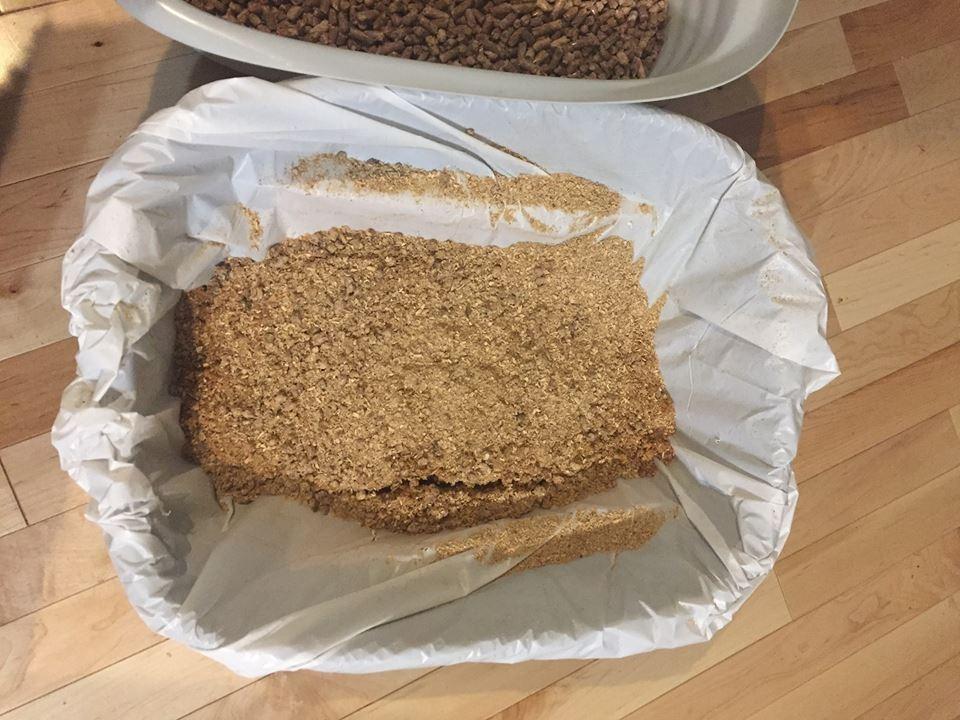
What wins us over is the flexibility. The same tray handles pine pellets, crystal, wood pellets, or ordinary clumping litter, so you are not locked into one litter type. The Microban treatment is built into the plastic rather than sprayed on, and owners consistently report the odor difference as noticeable within the first week.
Mechanically it is simple in a good way. There is no hinge to fatigue and no pump to service, and at 2.51 pounds it is the lightest box here, which matters more than it sounds when you are lifting a full pan. The weaknesses are real though: the sifter holes run to the outer edge so fine or dusty litter escapes when you lift, and overfilling it makes sifting messy.
Who this box suits
Multi-cat households, owners who dislike the daily scoop, and anyone who wants the lowest-maintenance option on this list. It also travels well, since it is the lightest unit in the roundup and doubles as temporary housing for boarding or a rescue cat acclimating to your home.
Where it falls short
Very long cats. If your cat measures over 20 inches nose to tail base, step past this one and look at the IRIS XX-Large or the DIY route. Owners of stocky, shorter big cats such as Savannah mixes do very well with it.
2. Amazon Basics No-Mess Hooded Litter Box, Large – Best for Odor Control
Amazon Basics No-Mess Hooded Enclosed Cat Litter Box with Odor Control and Swinging Door, Large, 24″ x 18″ x 17″, Multicolor
23.62 x 17.32 x 16.93 inch enclosure
3.3 lb
Carbon filter
Swinging door
Pros
- Hooded shell contains kicked litter
- Carbon filter cuts odor inside the enclosure
- Stain and odor resistant plastic
- Built-in handle snaps on for carrying
Cons
- Enclosed hood can make some cats anxious
- Replacement carbon filters sold separately
- Rounded hood reduces room to turn around
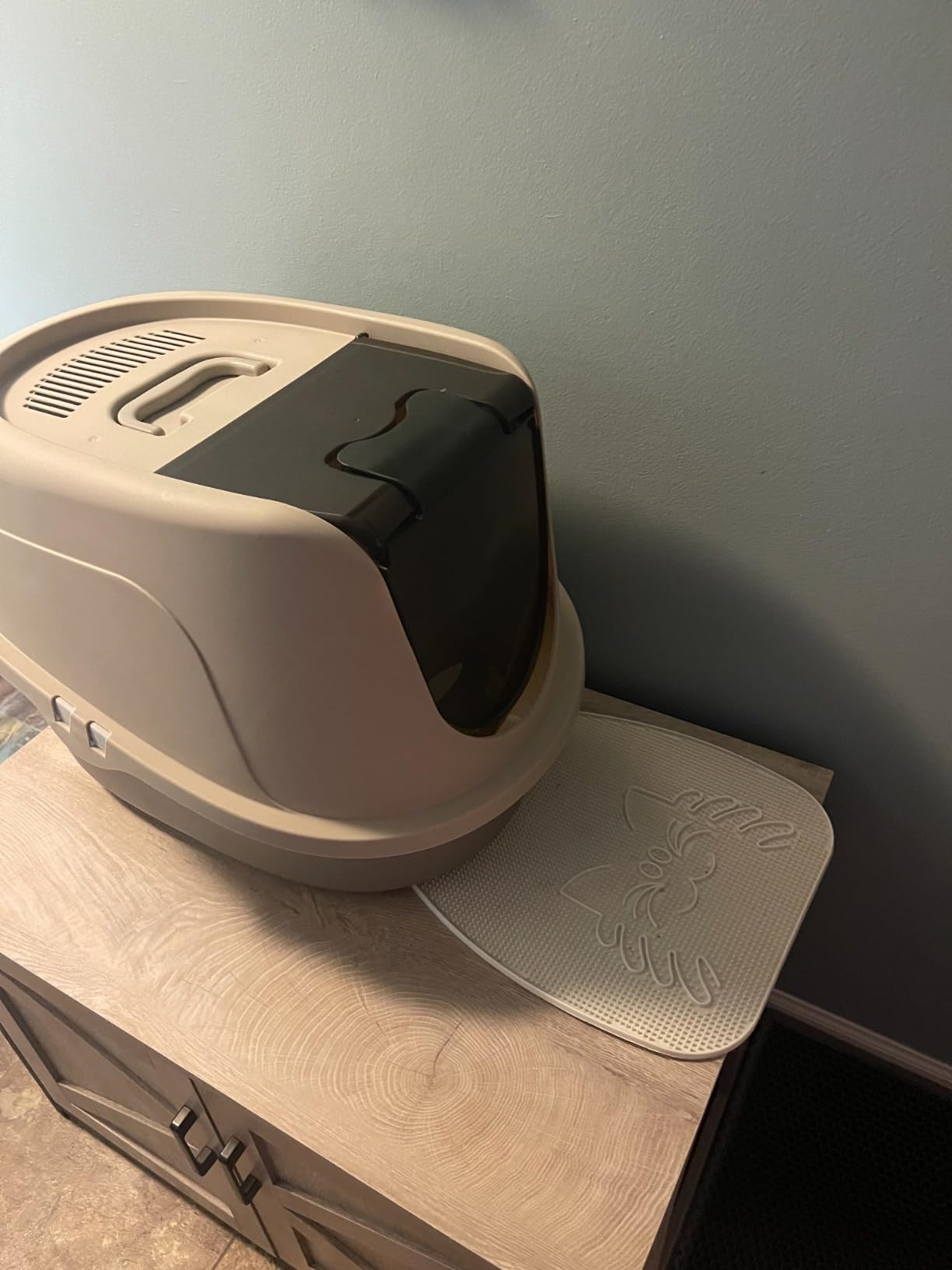
The pitch here is containment. A swinging plastic door and a full hood keep litter where it belongs, and the pre-installed carbon filter handles the smell that normally escapes an open pan. At 23.6 by 17.3 inches the interior is genuinely large rather than nominally large, which is more than several boxes in the same size class manage.
It has 18448 ratings averaging 4.6, and the volume of feedback tells you the design works for most people. The recurring complaint is not about the box, it is about the cat: a good number of owners report their cat hesitated or refused the swinging door on first contact, and some took weeks to adjust.
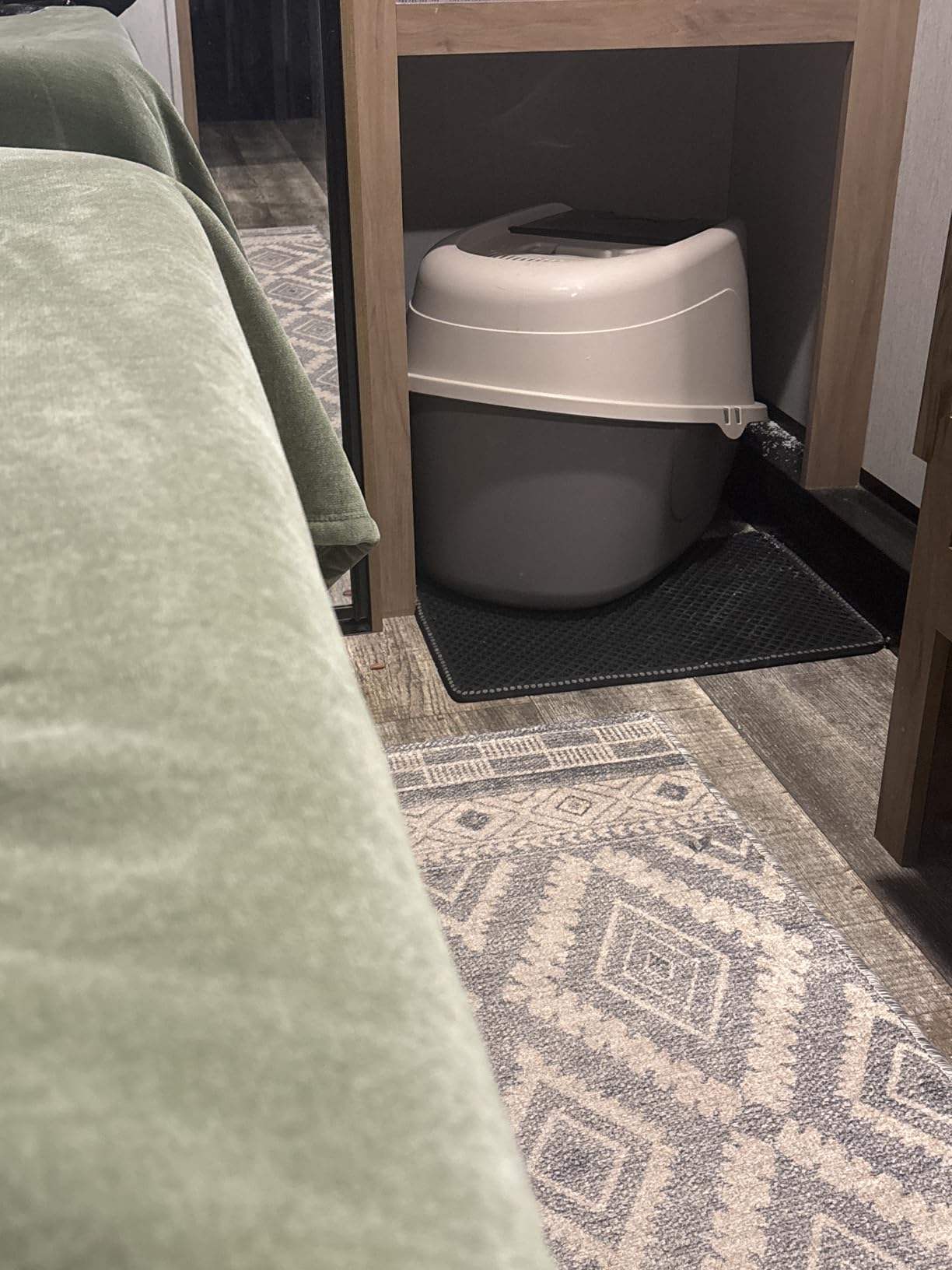
The second thing worth knowing is that you are buying into a filter supply. The carbon filter is installed, but replacements are sold separately, so treat it as a recurring cost rather than a one-time purchase. The plastic itself wipes clean easily and resists staining, which is where the hood design earns its keep.
Because the interior corners are rounded by the hood shape, a very large cat has a little less turning room than the exterior dimensions suggest. A 20-plus pound cat can use it comfortably, but a cat that likes to rotate in a wide circle before settling may not.
Who this box suits
Apartment dwellers, small homes, and anyone whose priority is keeping odor and scatter contained rather than maximum interior room. If your cat already uses a covered box without complaint, this scale-up is a straightforward move.
Where it falls short
Cats that dislike hoods, and very long cats that need the corner width. Run both boxes side by side for a week before you retire the old one, and expect to keep the filter budget in mind.
3. Pureness Giant High Sides Cat Litter Pan – Top Rated
Pureness Giant High Sides Cat Litter Pan, Colors may Vary.
20.5 x 17 x 10 inch pan
1 lb
9.25 inch walls
Lowered entry point
Pros
- Highest rated open pan in the group at 4.7 stars
- 9.25 inch walls dramatically cut litter scatter
- Lowered entry keeps a big cat from having to climb over a wall
- Smooth plastic wipes clean with no crevices
- Weighs only 1 pound empty
Cons
- Large footprint for a simple open pan
- Needs more litter to reach working depth
- Will not stop a determined flinger
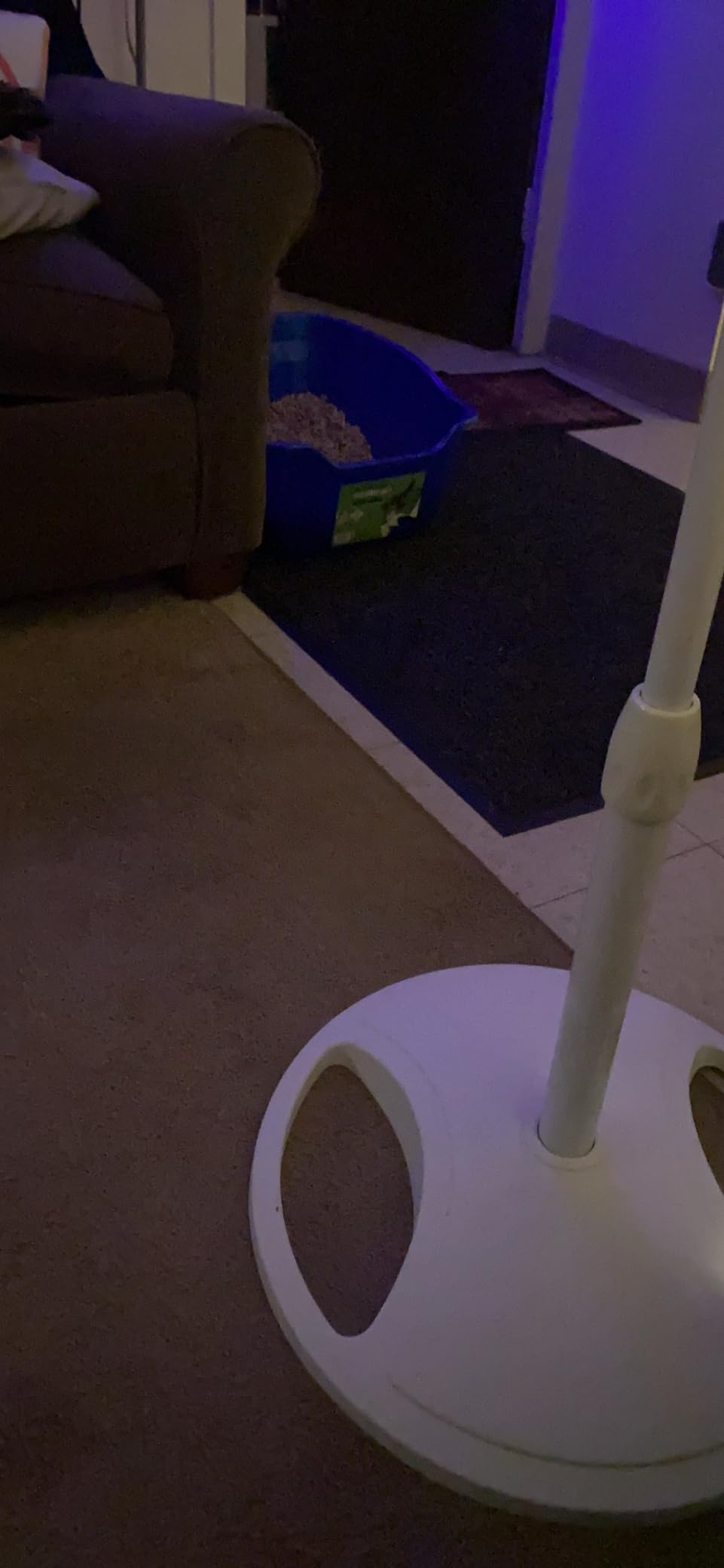
This is the box we recommend to people who want one simple, cheap thing that solves the scatter problem. The design is a 9.25 inch wall on all four sides with a lowered entry point at the front, so a large cat can walk straight in rather than having to vault a lip. There is no lid, no filter, no mechanism, and nothing to break.
At 4.7 stars across 14377 ratings it carries the highest average rating of any open pan we looked at, with roughly 84 percent of reviews at five stars. Owners describe the walls doing exactly what they are supposed to: even heavy diggers stop throwing litter onto the floor.
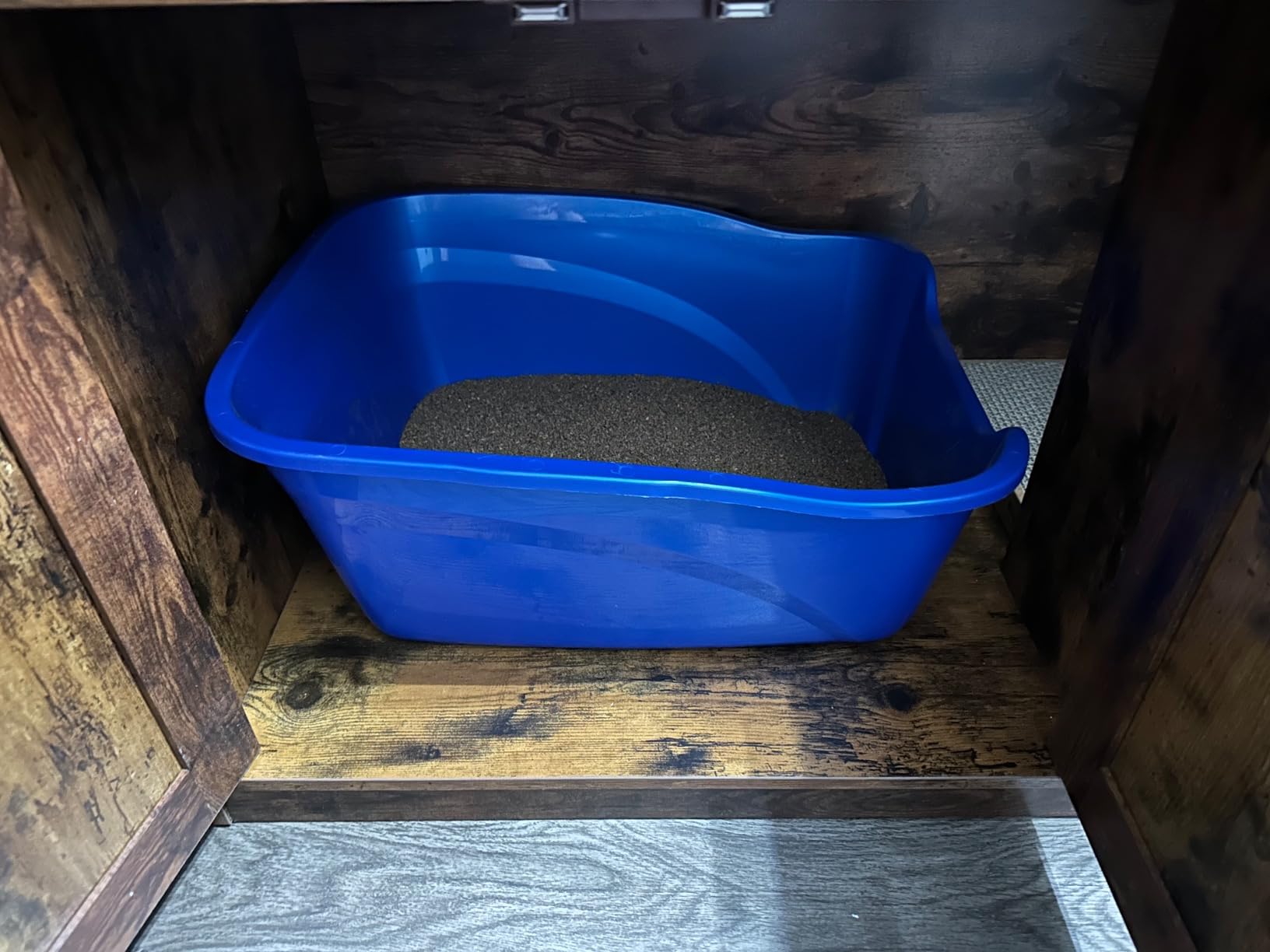
The finish is a high polish that resists odour and staining, and the interior has no crevices, which is why it wipes clean in seconds. Multiple-cat owners like that there is no door to jam and no filter to replace, and the 1 pound empty weight means you can move it with one hand to change the litter.
Two practical notes. This pan is deep, so it takes noticeably more litter than a standard box before you reach a working depth, and the color is listed as blue with colors varying by shipment, so do not plan a color-matched corner around it.
Who this box suits
Almost any large cat that wants an open box. It is our default recommendation for a first upgrade from a standard pan, and it works well as the second box in a two-box rotation for a multi-cat home.
Where it falls short
Tight rooms, since the footprint is large, and cat parents who want a low-maintenance cleaning method. A determined cat with a full pan can still fling litter over a 9.25 inch wall, so pair it with a mat if that is your specific problem.
4. Amazon Basics Large High Sides Open Top Box – Budget Pick
Amazon Basics Large Cat Litter Box with High Sides, Open Top for Easy Access, Includes Scoop with Storage, 19″ x 15″ x 11.75″, Grey/Beige
19 x 15 x 11.75 inch pan
1.95 lb
Lowered front entry
Scoop stores onboard
Pros
- High sides contain scatter from vigorous diggers
- Lowered open front is easy for large and senior cats
- BPA-free recyclable plastic
- Compact footprint
- Included scoop stores on the box
Cons
- Removable top does not snap shut securely
- Indented front corners trap urine
- Scoop slots are too wide for small clumps
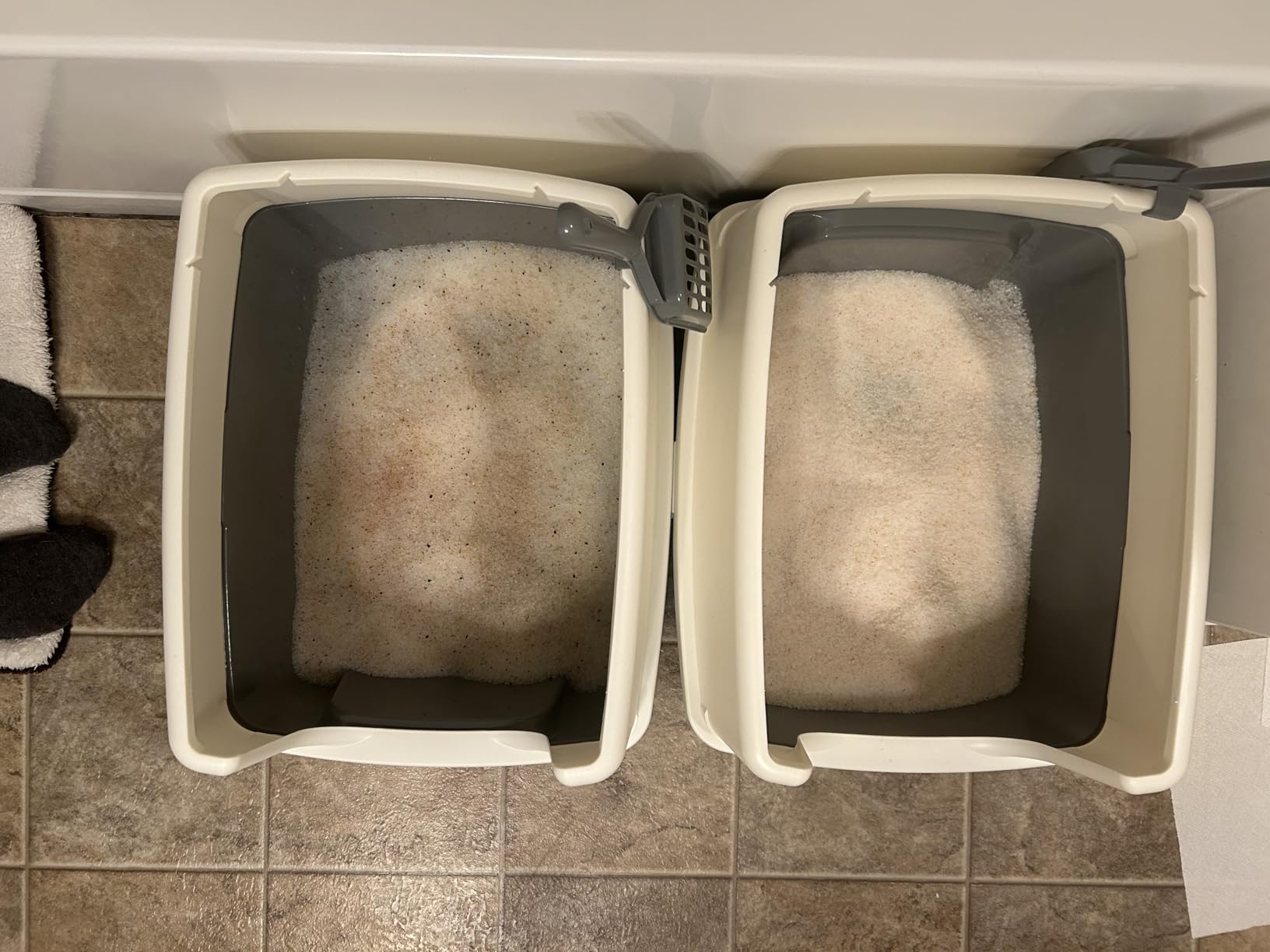
Among open boxes this is the cheapest route to a genuinely high-sided design, and the 11.75 inch wall height is taller than most of the plastic competition. The open top with a dropped front entry means a big cat or an older cat can step straight in with no climbing involved.
At 4.3 stars from 9290 ratings it sits below the group average, and the reviews explain why: buyers love the containment, the entry, and the fact that nothing sticks to the bottom, but they repeat three specific flaws. The removable top does not latch tightly, the indented front corners hold a little urine, and the onboard scoop has slots wide enough for small clumps to drop through.
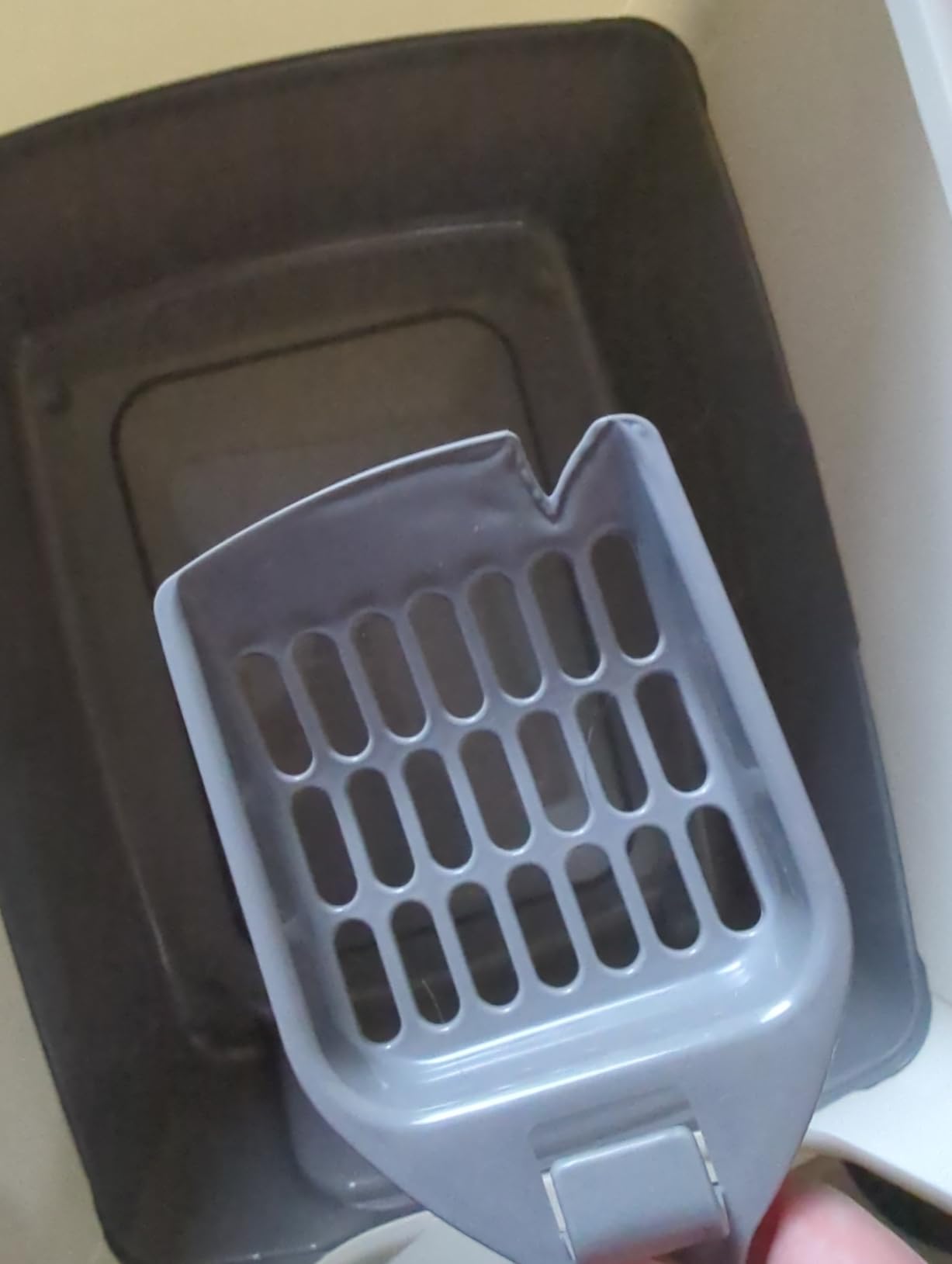
The indented corners are the one we would think hardest about. For a cat that squats with its rear close to the wall, a seam that holds moisture is a real hygiene problem over time, and it is the first thing to scrub during a deep clean.
Everything else is straightforward: BPA-free recyclable plastic, nothing sticks to the base, and the open design lets you monitor litter habits at a glance. If you want a low-cost box that solves the kick-litter problem and nothing more, this does the job.
Who this box suits
Households on a tight budget, small rooms where footprint matters, and anyone who wants tall plastic walls without paying for steel. It is also a reasonable second box if you rotate between two while one is being washed.
Where it falls short
Very long cats, since 19 by 15 inches is compact, and anyone bothered by a loose-fitting top or a seam that needs scrubbing. Replace the included scoop early; it is the weakest part of an otherwise fine design.
5. Amazon Basics Covered Litter Box with Lid – Best Covered Design
Amazon Basics Cat Litter Box with Lid, No-Mess, Spacious Enclosed Design with Odor Control, Easy Access, Stain Resistant, 26″ x 23″ x 20″, Charcoal
26.26 x 20.2 x 22.87 inch enclosure
3.75 lb
Carbon filter
Swinging door
Pros
- Largest enclosed footprint in the roundup
- Hood and door contain scatter and odor
- Pre-installed carbon filter
- Stain resistant plastic wipes clean
- Built-in carry handle
Cons
- Enclosed design deters cats that prefer open boxes
- Replacement odor filters sold separately
- Bulky footprint for small spaces
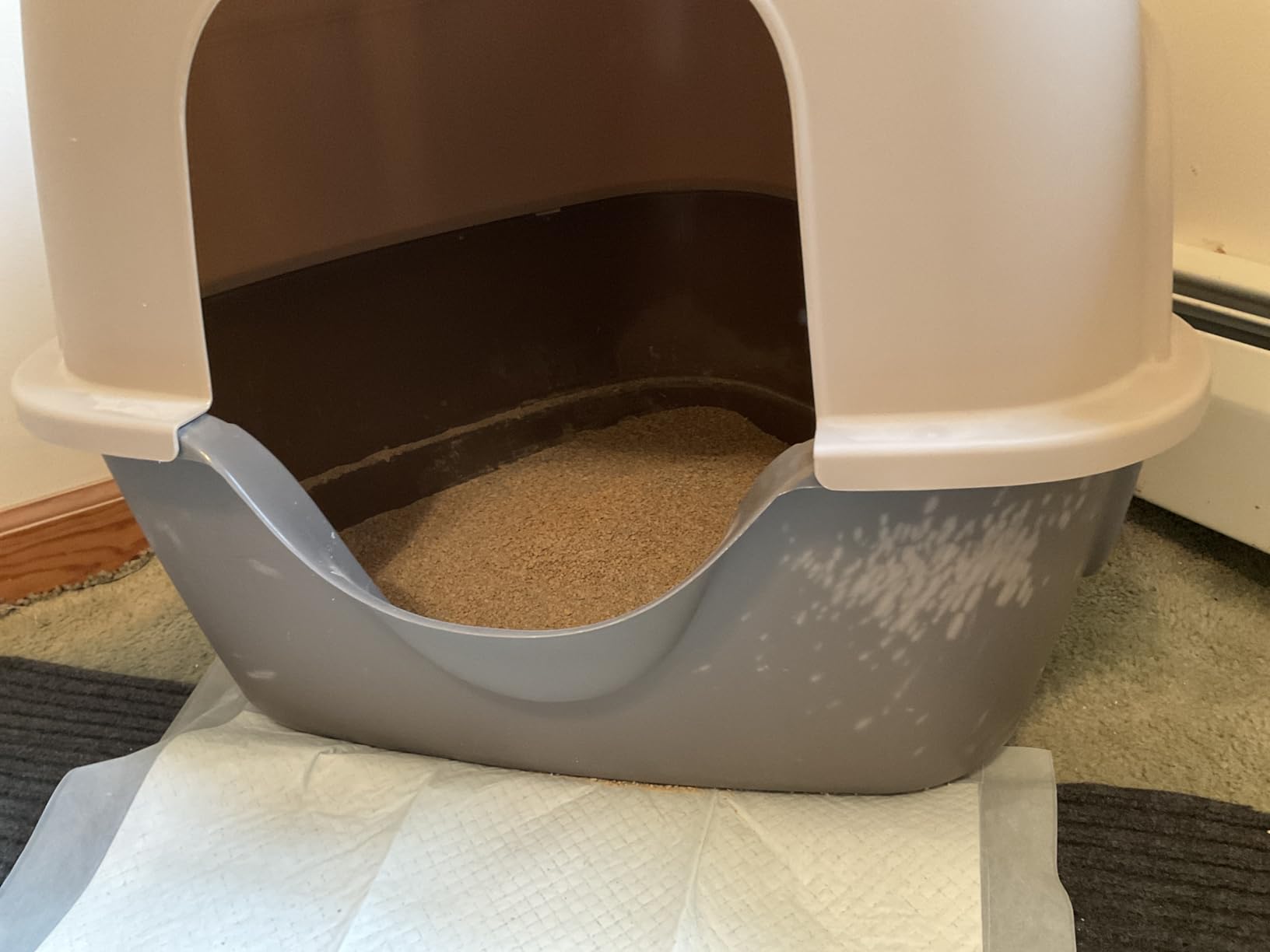
If a hooded box is what your cat will actually use, this is the largest enclosed interior we could find. At 26.26 by 20.2 inches it gives a big cat real turning room inside a shell, which is rare, and 81 percent of its 5702 ratings are at five stars.
Mechanically it is the same idea as the smaller hooded box done at scale: a swinging plastic entry door, a pre-installed carbon filter for odour, stain resistant plastic, and a handle that snaps into place so you can move it for cleaning.
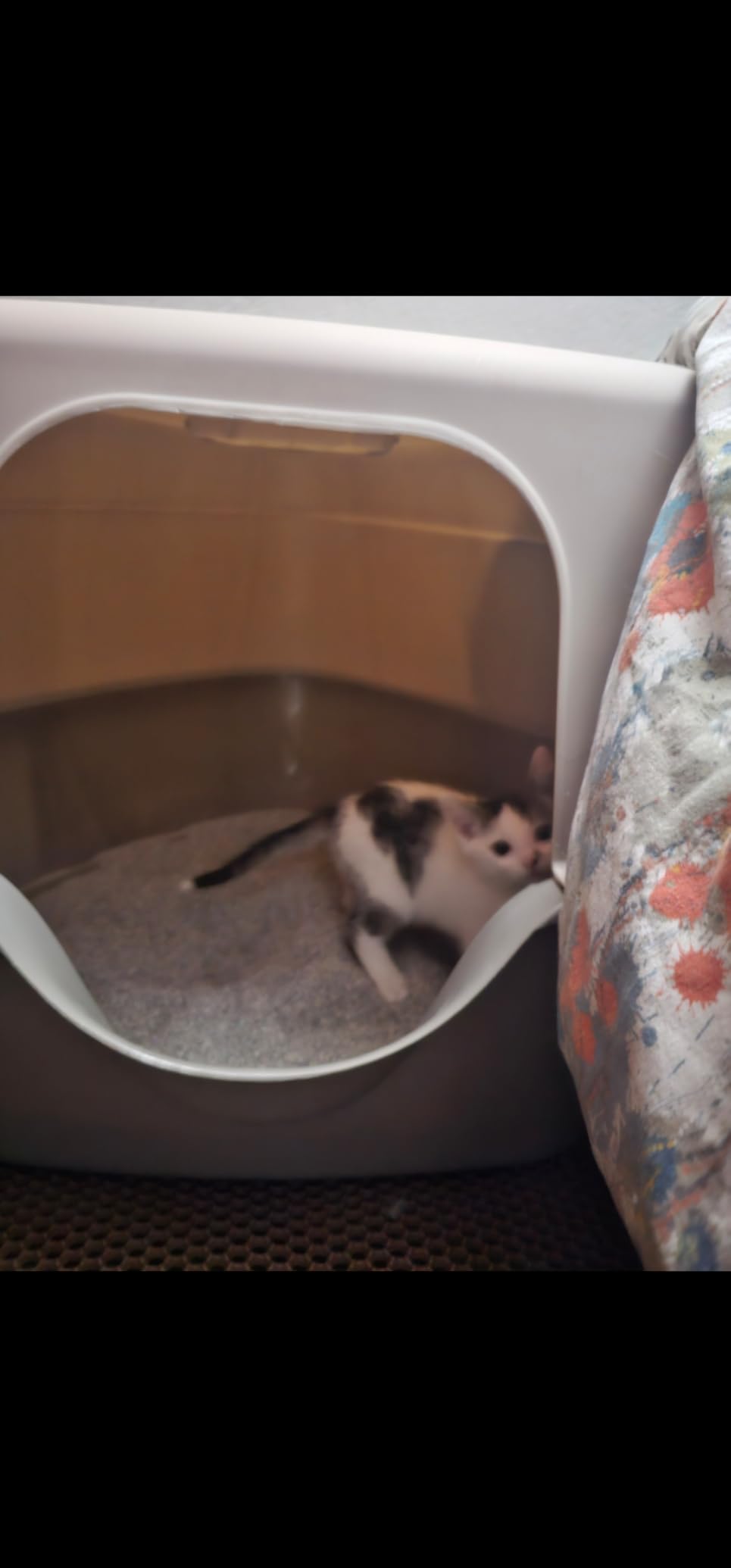
You accept two trade-offs for that interior size. The first is that the door can put off a cat that has never used an enclosed box, and a large cat already suspicious of confined spaces will sometimes just decline. The second is footprint, since this is a genuinely big object to find a home for.
Also worth knowing: a covered design concentrates litter dust in an enclosed space, so pair it with a low-dust litter rather than a heavy clay formula. Owners who have made that switch report noticeably less dust tracking out of the door flap.
Who this box suits
Large-cat owners whose cat already accepts a hood, small homes where scatter containment matters, and anyone who wants privacy for a shy cat without losing interior space.
Where it falls short
Cats that refuse covered boxes, and small rooms. If you are not sure whether your cat will use a door, test a cheaper hooded box first rather than committing to this one.
6. WoofiGo XL Stainless Steel Box in a High-Wall Frame – Best Steel in an Open Frame
Stainless Steel Cat Litter Box, XL High Sided Open Top Litter Pan, 1 Scoop
23.5 x 16 x 13 inch overall
1 lb pan
ABS high wall frame
Buckle connection
Pros
- Stainless pan does not hold urine odor like plastic
- 12 inch walls stop litter flinging
- Front grate returns tracked litter to the box
- Stable and quiet
- Sized for very large cats
Cons
- Included plastic scoop bends and feels flimsy
- Bulky footprint
- Scraping a metal scoop is noisy
- Needs a lot of litter to fill
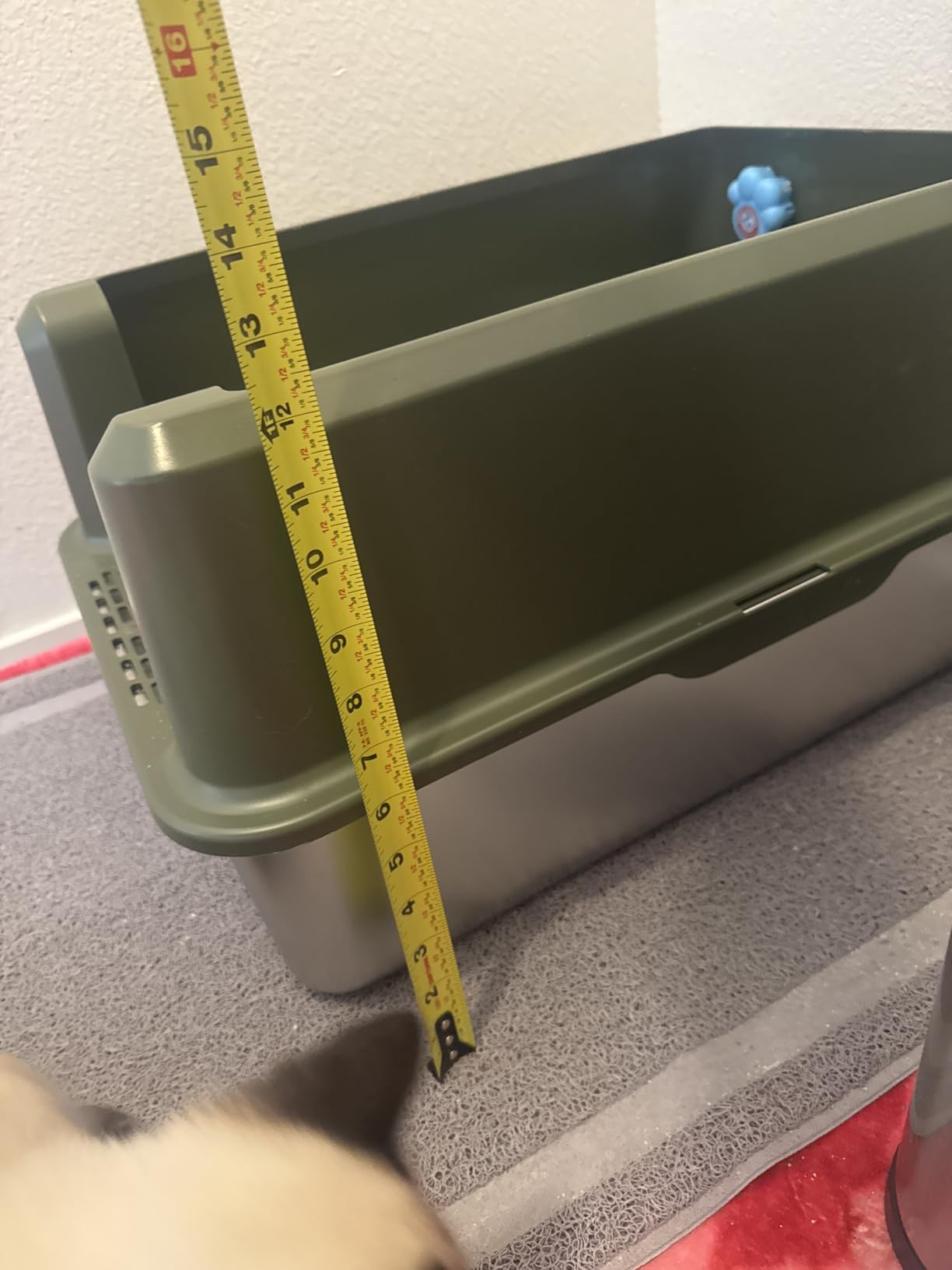
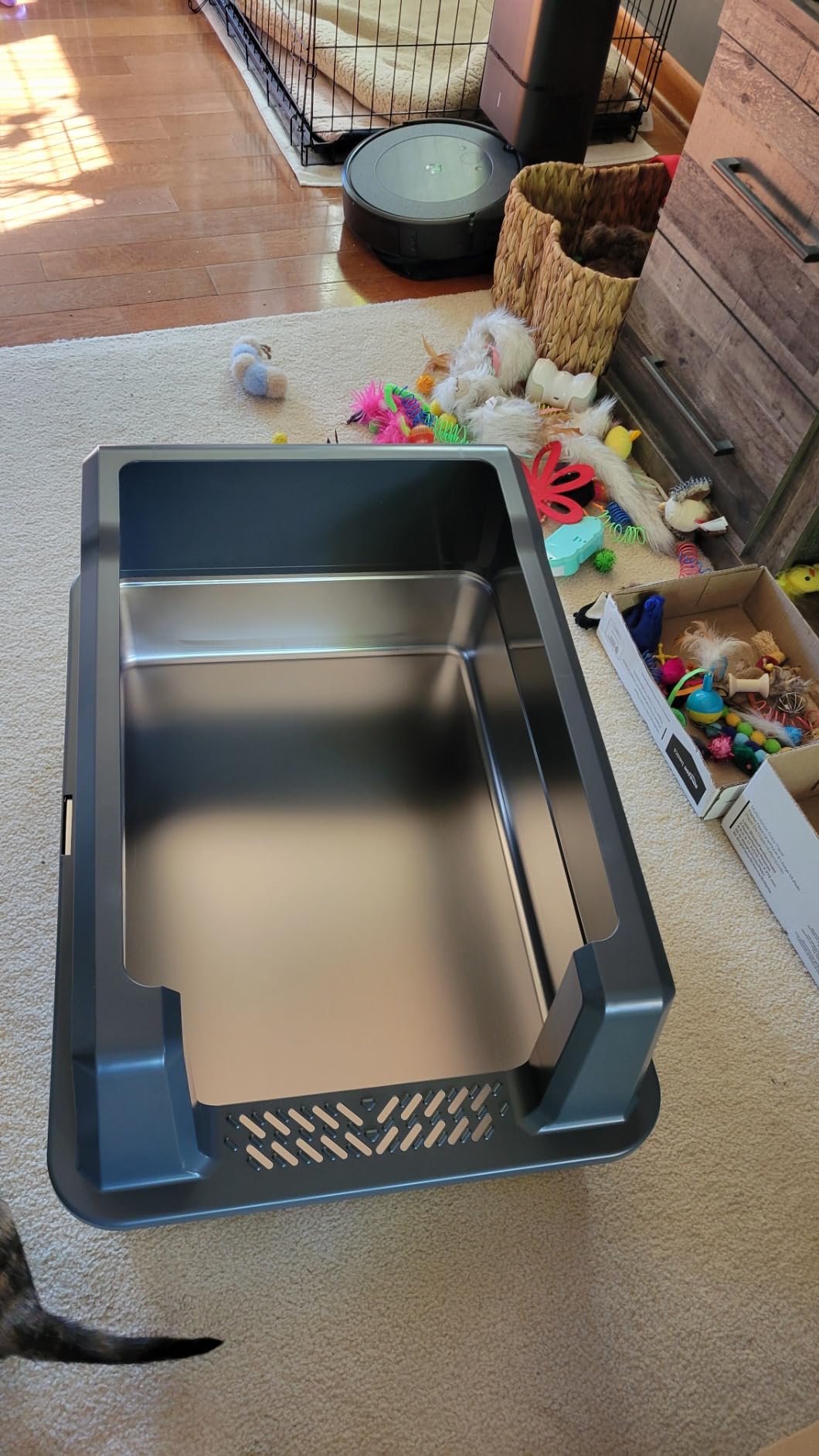
This is a hybrid design and it solves a real problem. You get a stainless steel pan for odour and durability, mounted inside a high-wall ABS frame with curved walls that do the scatter control. The buckle connection locks the pan to the frame so it does not walk around when a big cat climbs in.
Reviewers consistently single out the steel pan as the reason odor problems stopped. Plastic pans hold urine smell permanently; a non-porous steel surface wipes clean and does not stain. The curved high walls and the front grate, which returns tracked litter back into the box, cut down on floor mess as well.
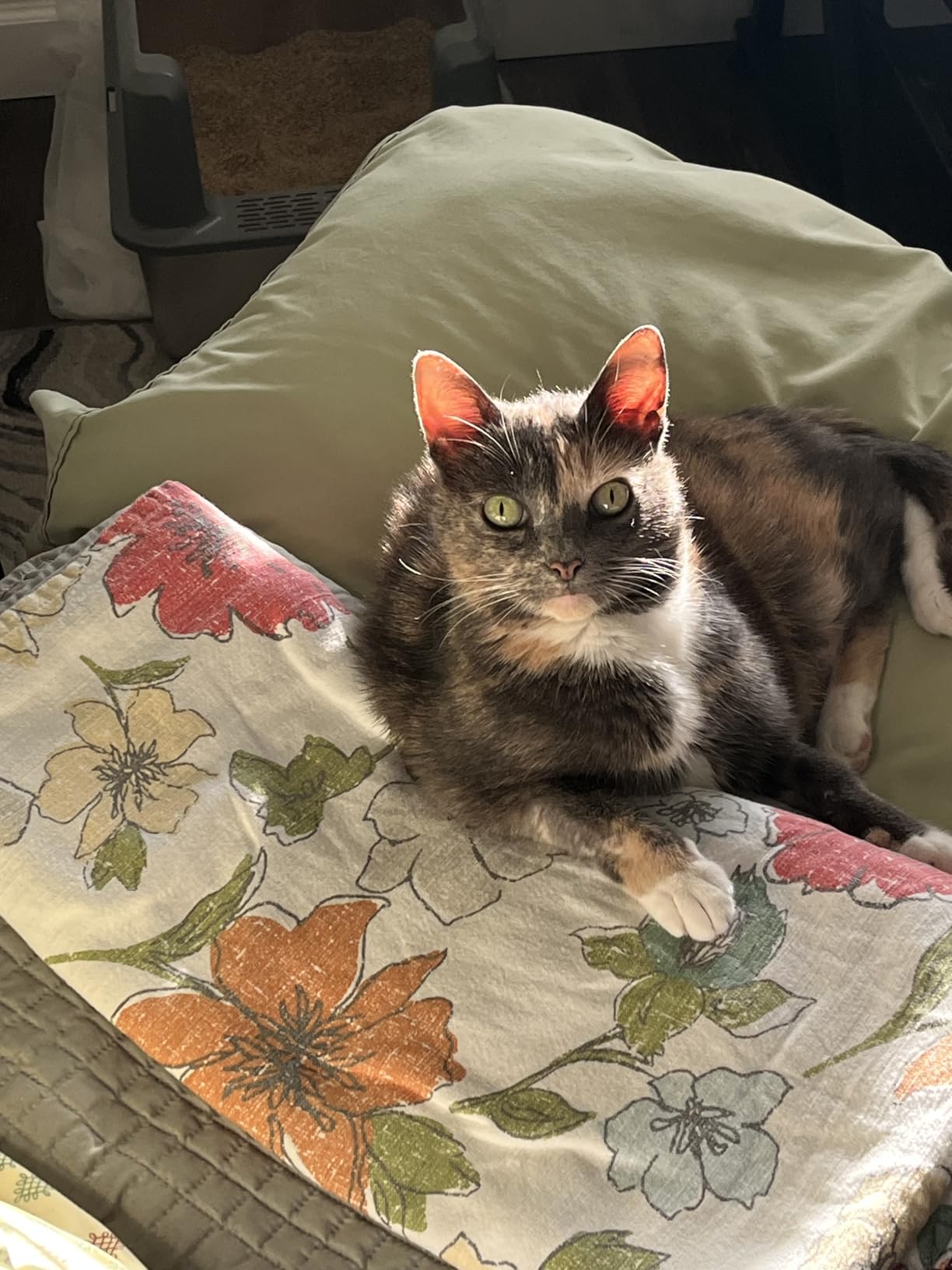
The measurable footprint is 23.5 by 16 by 13 inches, so it is a genuinely large box rather than a steel tray in a small frame. At 4.6 stars from 4152 ratings, the complaints are consistent: the included plastic scoop bends, the footprint is bulky, and a metal scoop scraping the pan is loud.
One more thing to plan for. The frame is deep, so it takes a good amount of litter to reach a working depth, and that means scooping from the bottom of a tall box. If you are used to a shallow pan, adjust your expectations on cleaning day.
Who this box suits
Owners who want steel hygiene without giving up high-wall scatter control, and multi-cat homes that need a durable surface with several cats using it daily. It is a strong middle ground between a bare steel pan and a full enclosure.
Where it falls short
Cats that refuse a metal substrate. There are accounts of cats digging, hitting an unfamiliar steel surface, and walking away, so run both boxes together for a week before you remove the old one. Budget for a real metal scoop.
7. AIPERRO Extra Large Stainless Steel Litter Box – Best for Multi-Cat Homes
AIPERRO Stainless Steel Litter Box Extra Large for Big Cats and Multi-Cats
28 x 20 x 12.2 inch interior
8.15 lb
Sealed base
Angles litter plate
Pros
- Sealed base and curved edges stop urine leaking
- Patented 30 degree filter plate cuts tracking
- Smooth steel wipes clean and resists odor
- Very large interior suits several cats
- Sizes and colors from Small to XXX-Large
Cons
- Costs more than plastic or basic steel pans
- Heaviest unit in the group at 8.15 pounds
- Steel is noisy when litter is scooped
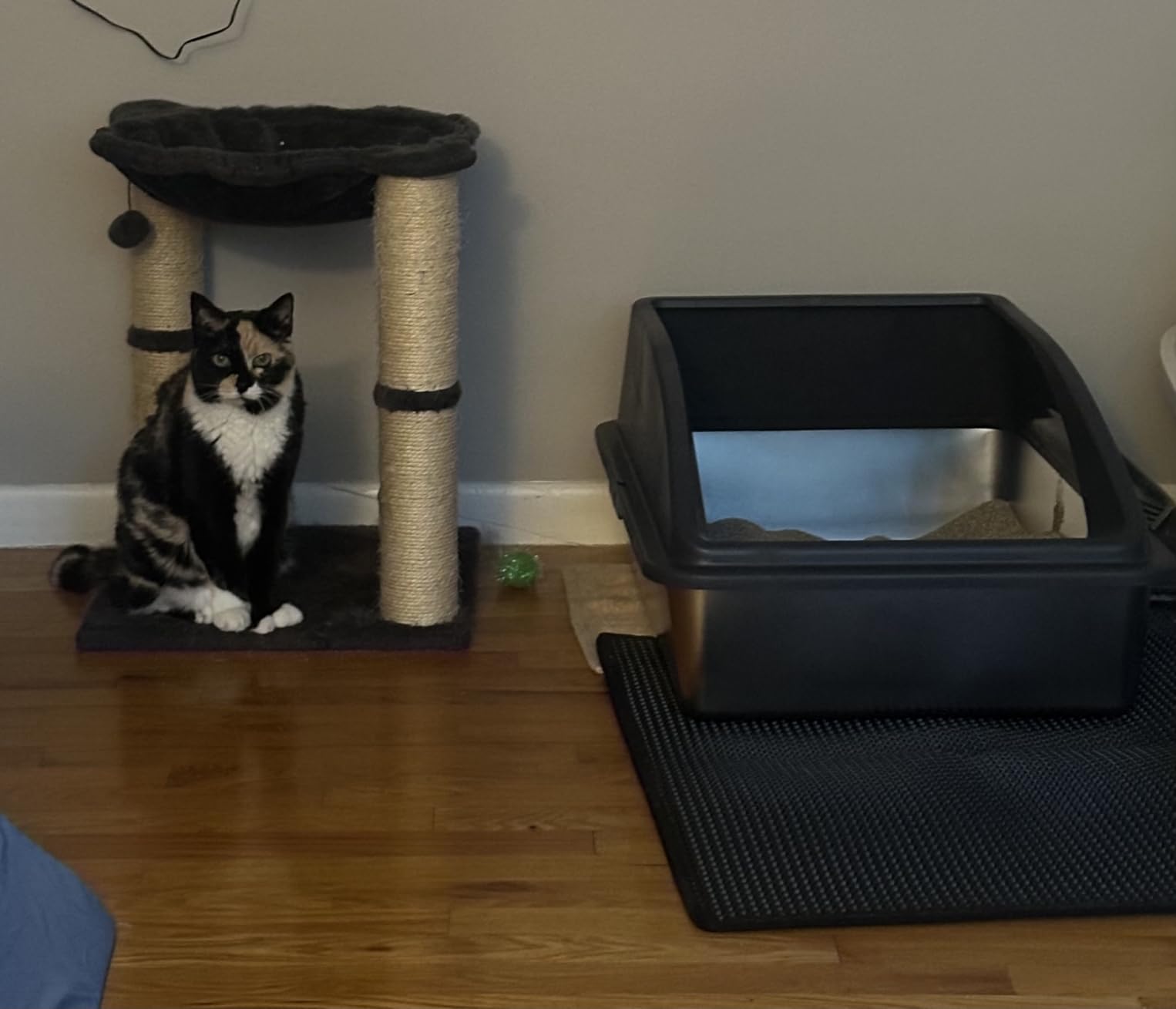
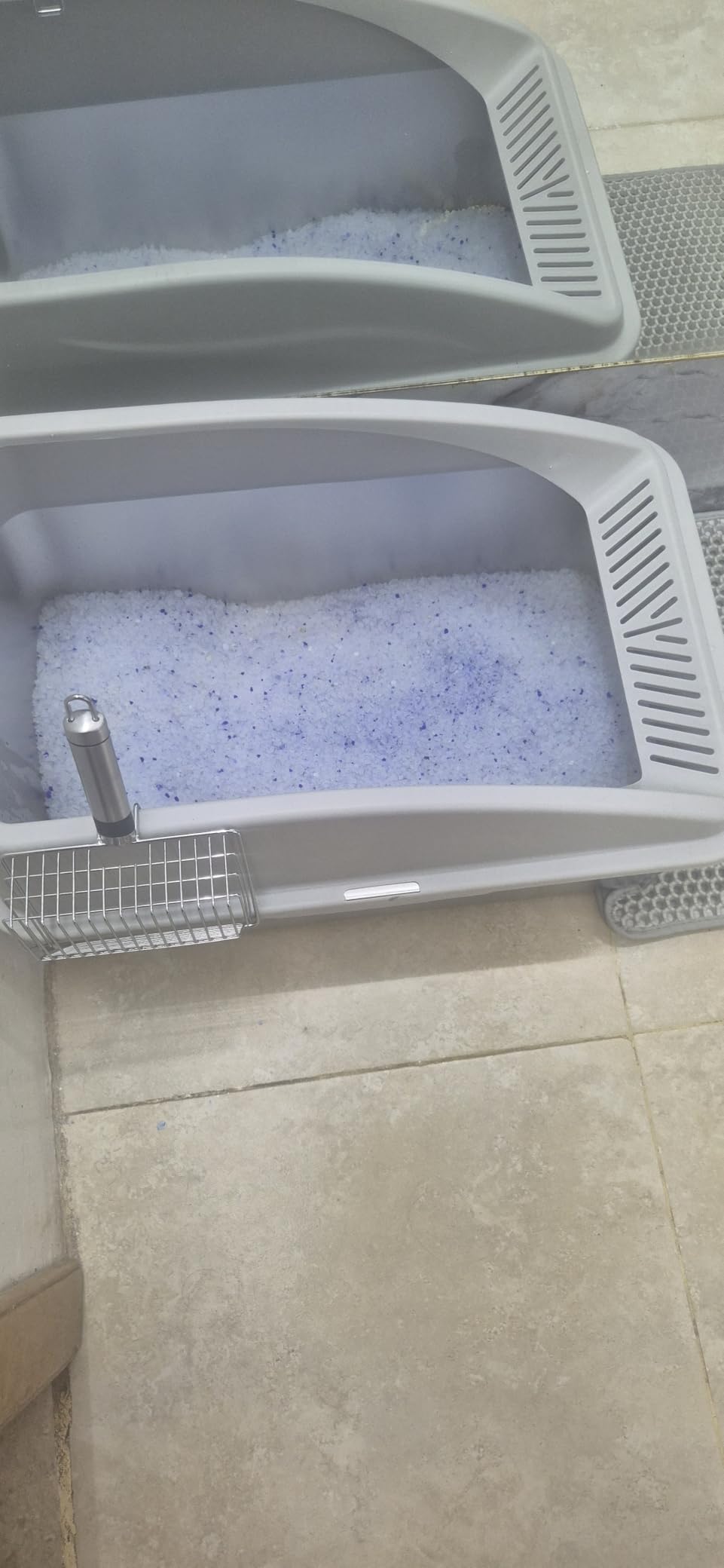
At 28 by 20 by 12.2 inches, this is one of the largest open stainless pans in the roundup, and the size is the point. A 25-pound cat can walk in, turn around, and dig without touching anything, and two cats can share it without one blocking the entry.
Two design details are worth understanding. The base is fully sealed with curved edges, which is a direct fix for the urine leaking under a pan problem, and the patented 30 degree angled filter plate is a ramp that lets a cat step out without carrying a wave of litter with it. Owners credit the plate with cutting tracking noticeably.
At 4.5 stars from 4190 ratings the satisfaction is high, and the review volume tells you this is a design people are satisfied with rather than one they tolerate. It ranks near the top of the category for best sellers, which means you will find a lot of long-term owners describing daily use.
The real drawback is weight. At 8.15 pounds empty, this is the heaviest unit here, and once it holds several inches of litter it is genuinely awkward to lift. Owners with back problems should plan the box location so you do not have to move it often, or buy a second one to leave in place.
Who this box suits
Multi-cat households with two or more large cats, owners with a 20-plus pound cat, and anyone who has already had urine seep under a plastic pan. The size range is a bonus if you expect your cat to keep growing.
Where it falls short
Homes with tight floorspace, and anyone who cannot comfortably lift a full pan. A cat that dislikes steel will also decline this one, so transition gradually.
8. IRIS USA XX-Large High Sided Litter Box – Best for Big Cats
IRIS USA XX-Large High Sided Cat Litter Box, Scatter Shield, Black
30 x 20 x 14 inch open top
4.3 lb
6.5 inch curved entrance
Smooth interior
Pros
- Largest open floor area at 30 by 20 inches
- 14 inch walls contain litter from heavy diggers
- Curved entrance gives privacy without blocking access
- Open top is easy to monitor and scoop
- Also offered in a stainless version
Cons
- Very large footprint for tight rooms
- Plastic variant holds odor longer than steel
- No lid means no odor filtering
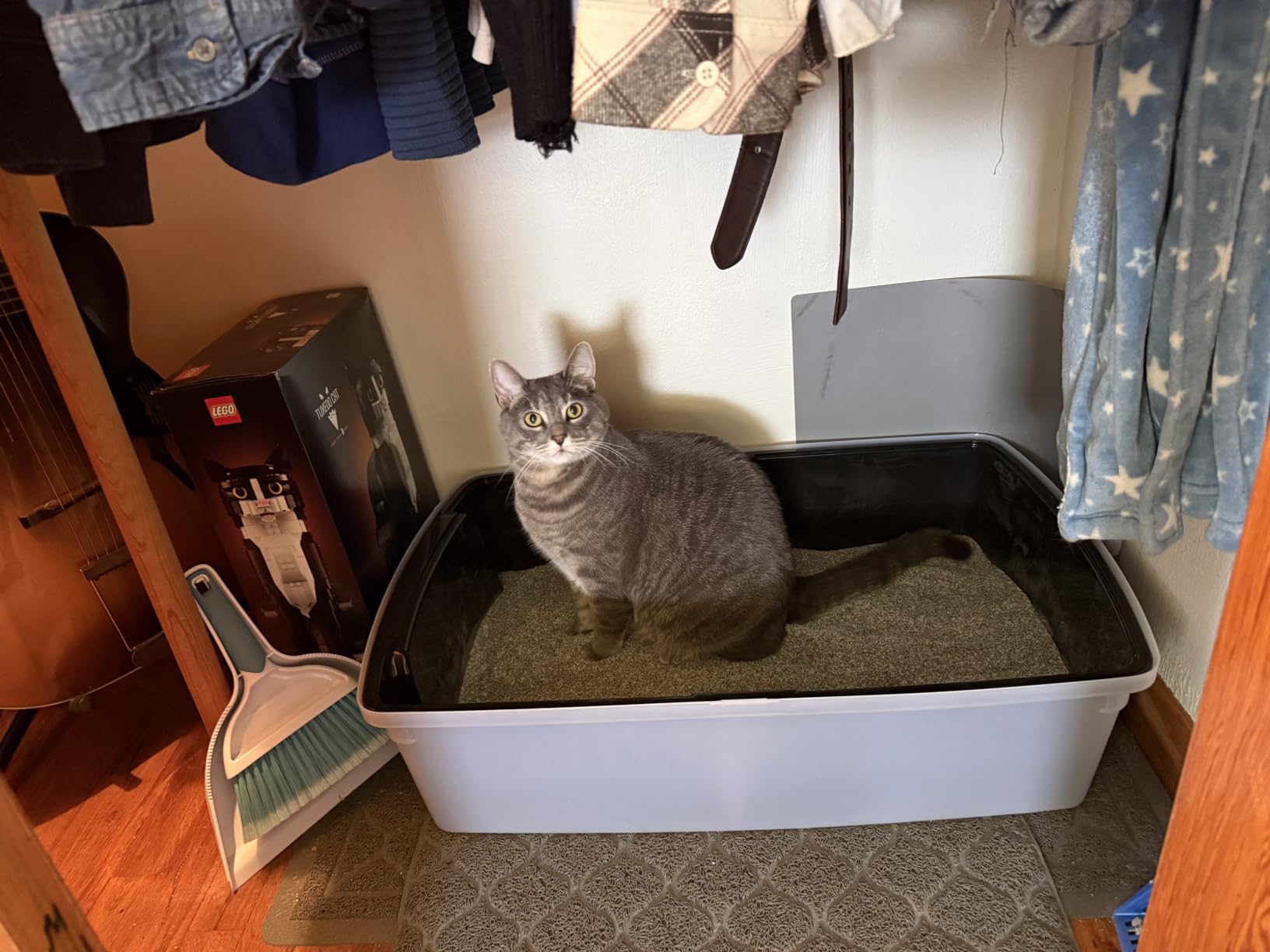
This is the box we would hand to a Maine Coon owner who wants an open pan and nothing else. A 30 by 20 inch floor is the largest open footprint in this roundup, and combined with 14 inch walls it is the closest a retail box gets to the sizing rule for a long cat.
The 6.5 inch curved entrance is a smart compromise: it gives a cat the sense of cover while keeping the entry low enough that a big or older cat steps in without negotiating a wall. Owners mention the combination of the curve and the open top as the reason their cat used it immediately.
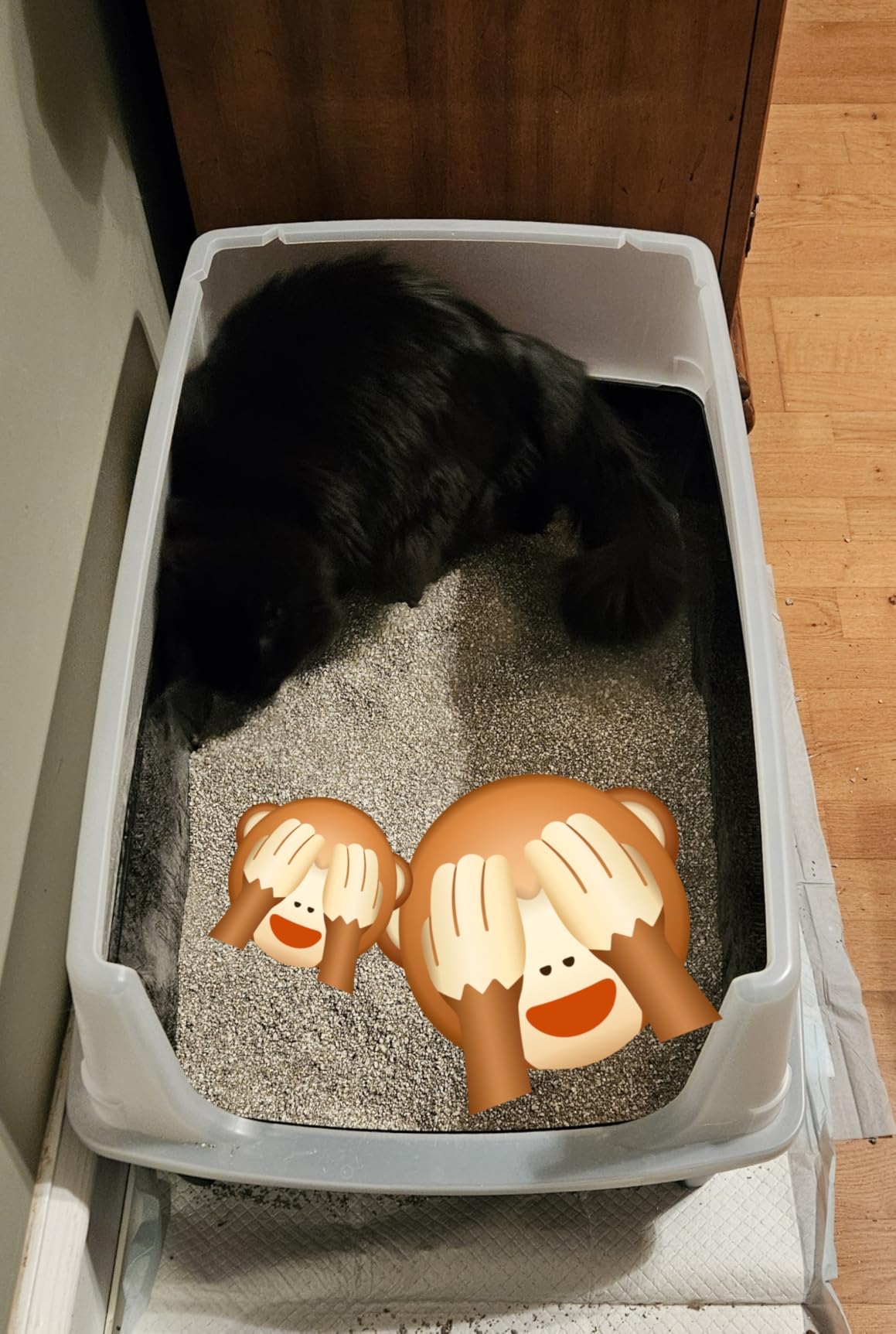
Everything about the interior is designed for cleaning. The surface is smooth with minimal crevices, so a wet patch wipes down rather than soaking in, and the open top means you can see litter level and hygiene status at a glance without lifting anything.
At 4.6 stars from 3942 ratings, the dominant criticism is simply size. This is a big object. It needs a corner, a bathroom, or a dedicated laundry room, and if you try to tuck it into an awkward gap you will resent it every cleaning day.
Who this box suits
Maine Coons, Savannahs, Ragdolls, and any cat that needs to turn around inside the box. It is the pick for a large cat whose owner wants a simple open pan with no door, no filter, and no electronics.
Where it falls short
Small rooms, and odor-sensitive homes, since an open plastic pan does not filter anything. The same model is also made in stainless steel, which is worth considering if odor is your main concern.
9. MIXJOY Jumbo Stainless Steel Box with High-Sided Lid – Best for Spray Control
Stainless Steel Litter Box Extra Large for Big Cats Multi-Cats, Jumbo Extra Large Metal Cat Litter Box with High Sided Lid, Anti-Urine Leakage, Non-Stick,Include Litter Scoop
28 x 20 x 12.2 inch steel pan
5 lb
50 liter capacity
Lidded with filter plate
Pros
- Overlapping seam keeps urine inside the box
- High sides and filter plate cut scatter and tracking
- Locked lid connection stays attached
- 50 liter capacity means less frequent cleaning
- Includes a metal scoop and mat
Cons
- Usable width narrows once the lid section is fitted
- Entry height is high for senior cats
- Larger and heavier than open-top options
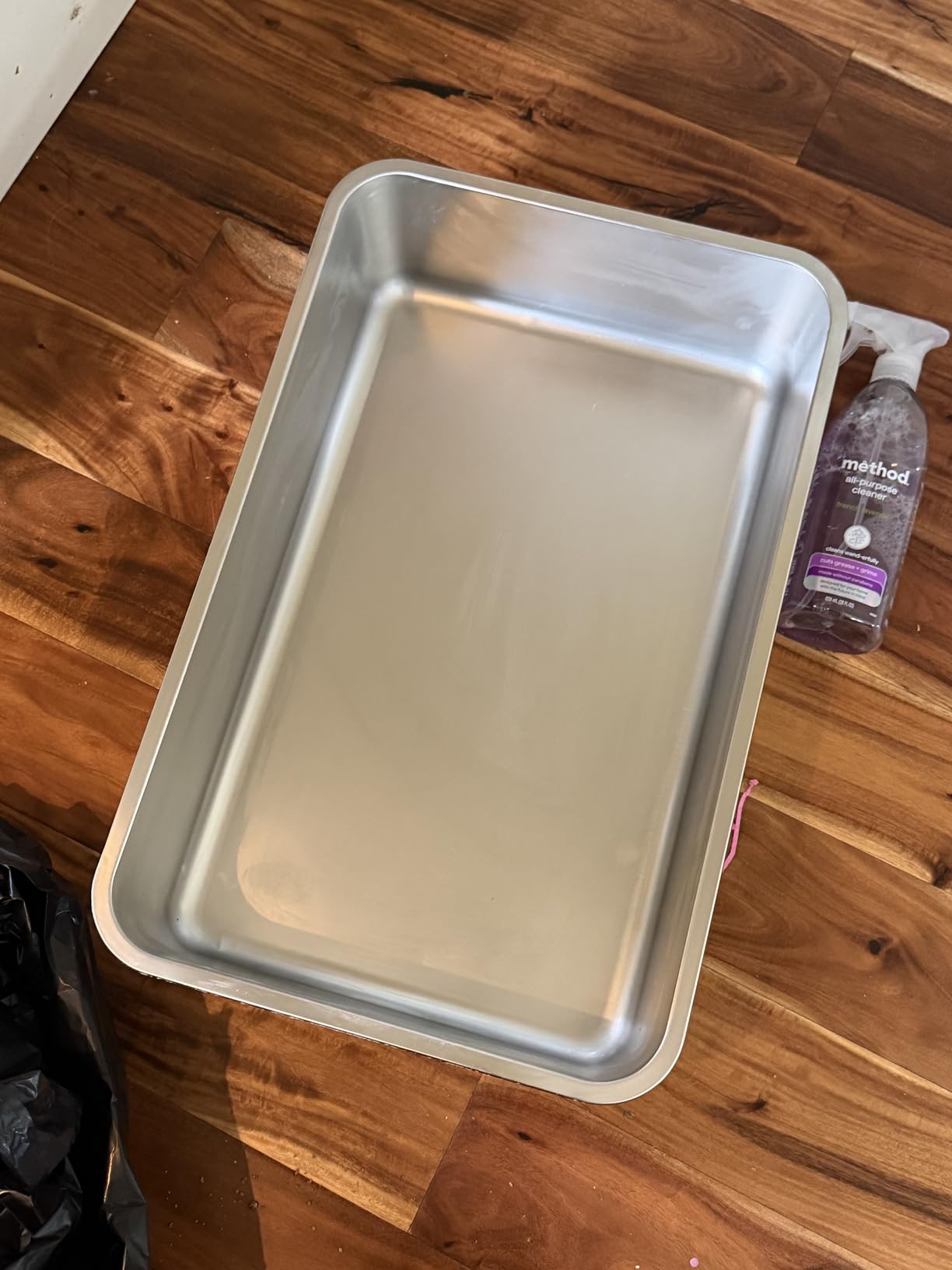
Wall height is the feature that matters for a large male cat that stands to urinate, and this box delivers it. Twelve inches of steel side wall with an overlapping seam means a spray hits the wall and runs back down into the pan instead of reaching your floor.
The overlap design is the detail that separates this from cheaper lidded steel boxes. Where two panels simply meet, urine finds the seam; where they overlap, there is no gap to seep through. Owners dealing with a spraying cat specifically credit that design with resolving the problem.
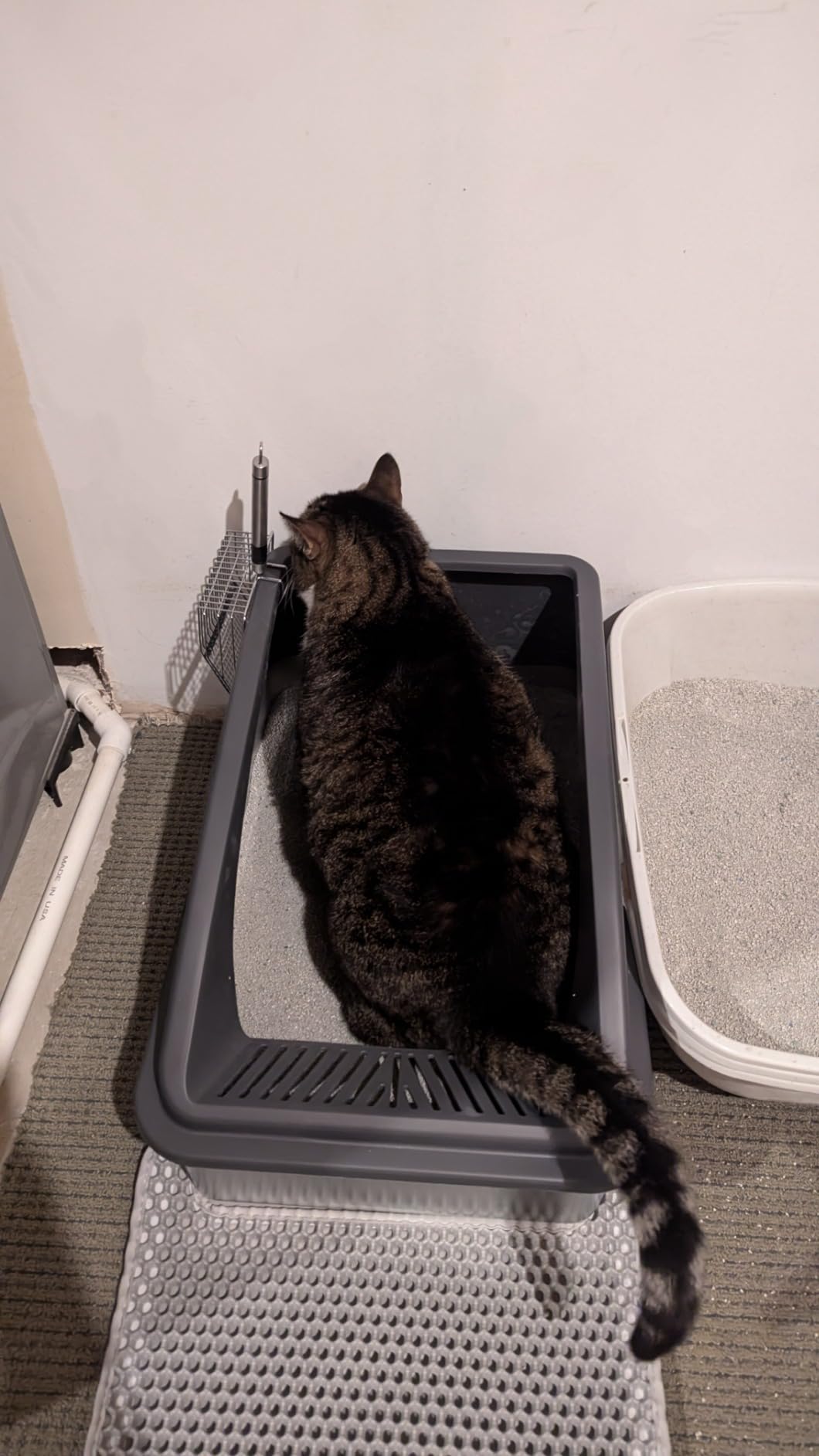
At 50 liters, this is the highest capacity box here, which means less frequent scooping and a deeper litter bed. The litter filter plate reduces tracking on the way out, and the locking buckle keeps the lid attached to the steel body rather than letting it shift under a heavy cat.
Be honest about two things. Fitting the high-wall lid section reduces the usable interior width, and the resulting entry height is difficult for a senior or short-legged cat. At 5 pounds empty it is also one of the heavier options, so place it thoughtfully.
Who this box suits
Large male cats that spray standing up, and homes where urine has been reaching the wall behind the box. It also works well for a cat that flings litter hard, given the combination of high sides and the filter plate.
Where it falls short
Senior, arthritic, or short-legged cats, because the entry is high. For those cats, choose a low-entry open pan with a high rear wall instead and accept some scatter.
10. Tevila XL Open Top Stainless Steel Litter Pan – Best for Narrow Spaces
Tevila XL Open Top Stainless Steel Litter Box with High Sides,Light Gray
22.83 x 14.57 x 10.24 inch steel pan
3.75 lb
5.7 inch splash guard
Open top
Pros
- Non-porous steel resists odor and staining
- High sides and splash guard contain litter and urine
- Open top and rounded corners scoop and rinse fast
- Non-slip pads keep it stable on hard floors
- Includes a scoop
Cons
- Narrower than other XL pans so less turning room
- Shallower walls than 12 inch steel boxes
- Open top version has no sifting panel
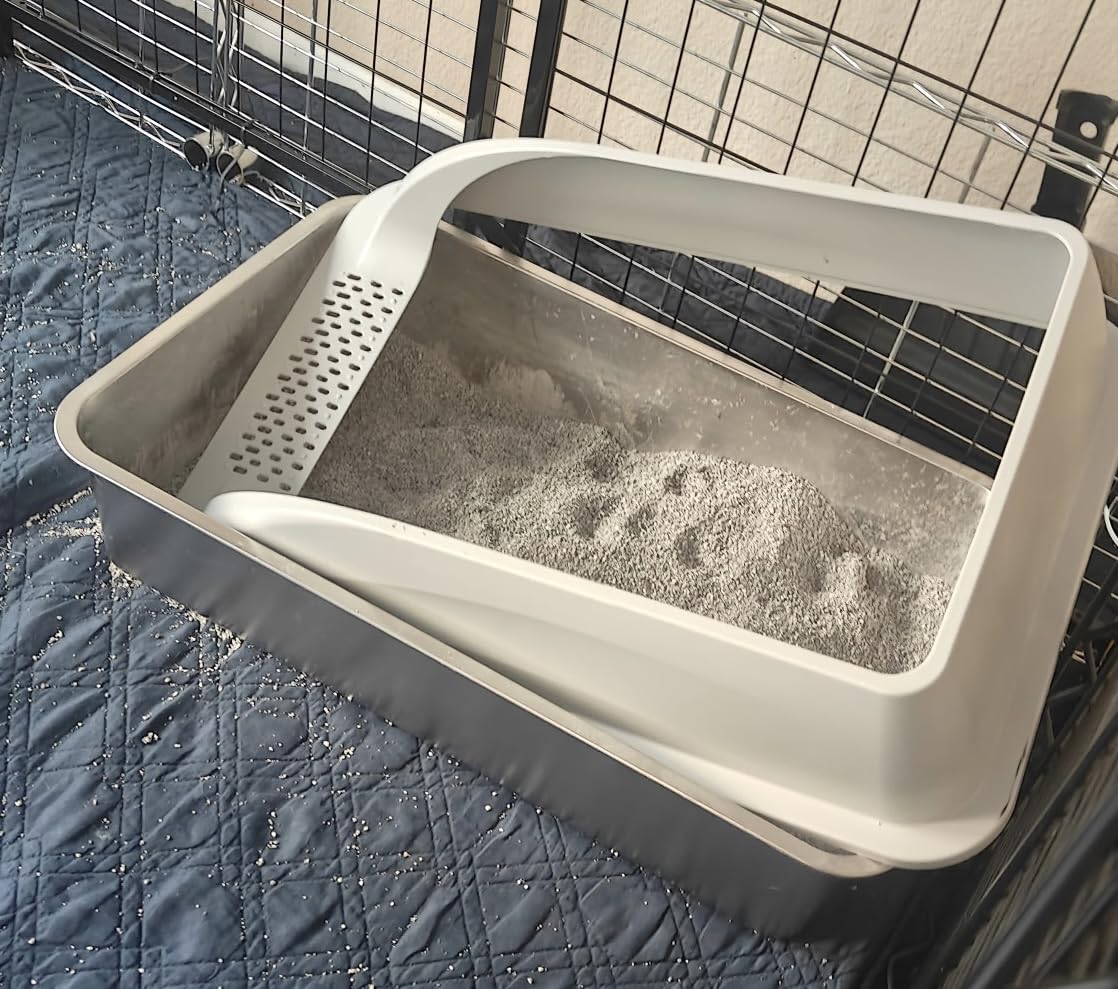
Not every home has room for a 30 inch pan, and this is the steel answer for narrower spaces. At 22.8 by 14.5 inches it is meaningfully slimmer than the 28 and 30 inch options, while still clearing the length most large cats need.
The 5.7 inch splash guard brings total height to 10.2 inches, which is enough to stop a good amount of scatter and some splash-back without turning into a wall your cat has to climb. The open top and rounded interior corners make scooping and rinsing fast, with no corners for grime to sit in.
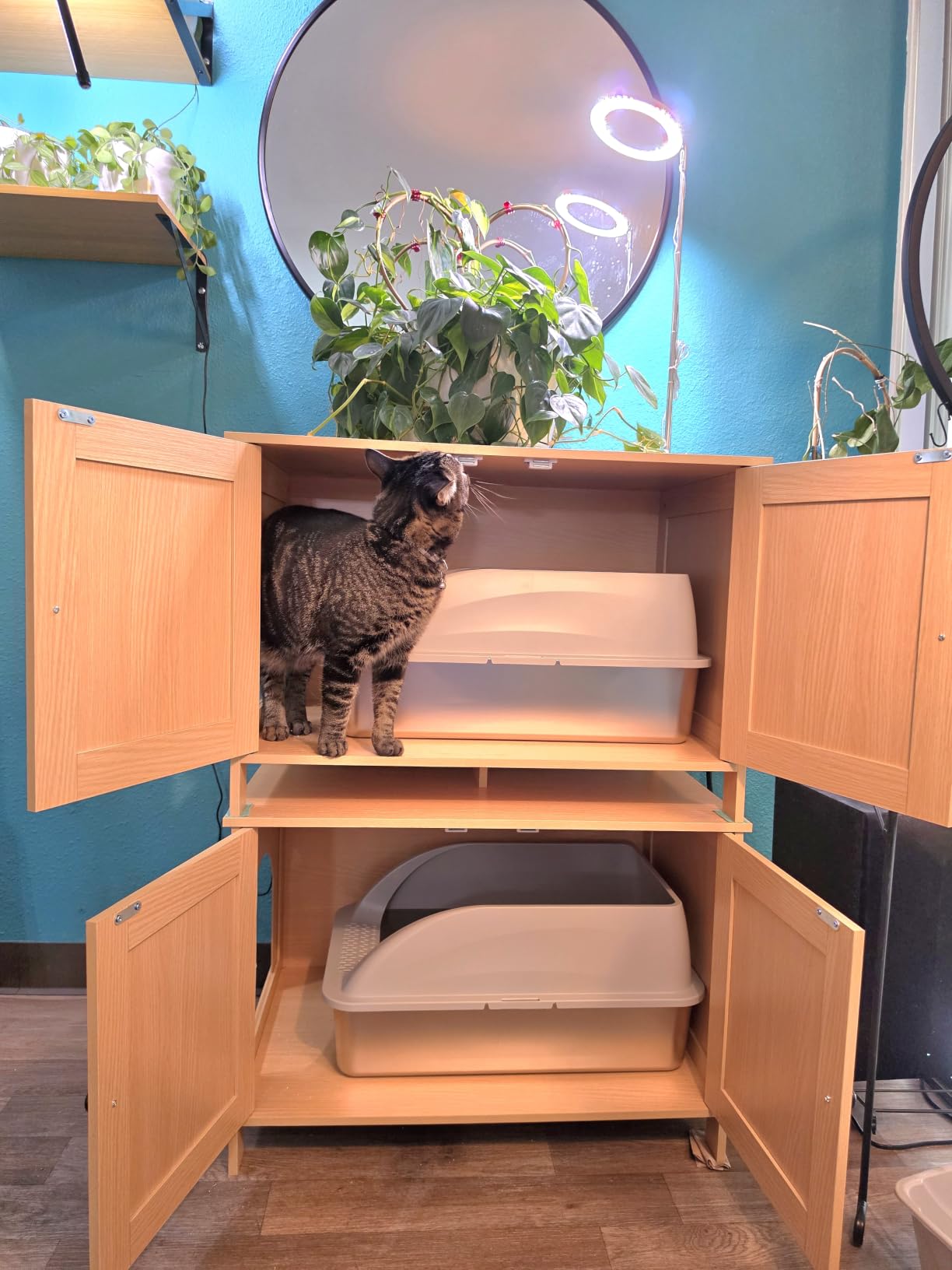
Non-porous steel that does not absorb odor is the main draw, and it is why this box earns 4.6 stars from 930 ratings. The four non-slip pads are a small touch that matters on hard floors, where a large cat pushing into the box can walk it across the room.
The width is the honest limitation. At 14.5 inches inside, a cat can lie down and dig but has less room to rotate than in the 18 to 20 inch wide pans, and 10.2 inches of total height is modest for a confident sprayer.
Who this box suits
Large cats in apartments, condos, or any home where floor space is the binding constraint but odor is not negotiable. It is also a good second box for a two-box rotation you do not want to struggle to move.
Where it falls short
Cats that need to turn in a wide circle, and hard sprayers who need taller walls. If your cat is over 22 inches long, the length is also marginal, so measure first.
11. Pematar XXL Stainless Steel Litter Box with Lid
Pematar® XXL Stainless Steel Litter Box with Lid for Multiple & Big Cats
26 x 18 x 12 inch interior
7.05 lb
12 inch anti-leak sides
Lid and mat included
Pros
- Extra large interior fits Maine Coons and multiple cats
- 12 inch overlapping sides prevent leakage and scatter
- Steel absorbs no odor and nothing sticks
- Service life rated at 3 to 5 years
- Most owners report immediate acceptance
Cons
- Some units have metal edges that are not properly sanded
- Heavy at just over 7 pounds
- Rare reports of corner dents from transit
This box carries the highest average rating of anything in the roundup at 4.8 stars, with roughly 90 percent of its 887 ratings at five stars. The design is straightforward: a 26 by 18 inch stainless interior, 12 inch sides with an overlapping anti-leak profile, and a lid that snaps on.
What earns the rating is the combination of size and finish. The interior is large enough for a Maine Coon to turn in, the 12 inch walls keep both spray and scatter inside, and the steel is non-stick and non-porous so a wipe and a rinse is the whole cleaning routine.
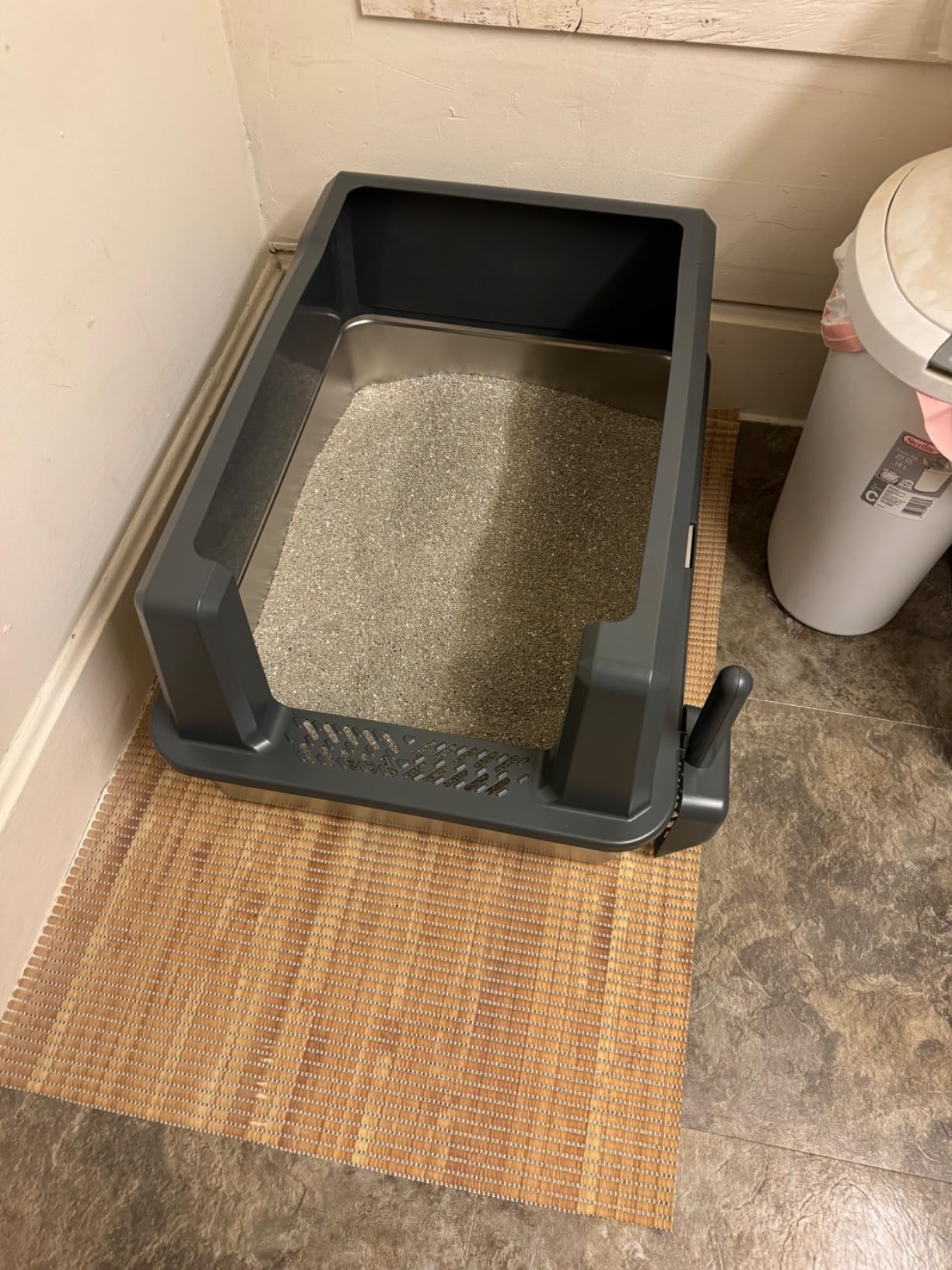
Owners also report that cats take to it immediately, which is not something you can say for most new boxes. The stated service life of three to five years means the cost works out over time, and a rubberized mat is included so it grips the floor.
There are two complaints we would not skip. Some units have arrived with metal edges that are not properly sanded, which is a cut risk worth checking for the moment it arrives, and at just over 7 pounds empty it is heavy before you add litter.
Who this box suits
Anyone buying once and expecting it to last, plus multi-cat homes with large breeds. If odor, staining, and durability matter more to you than weight, this is the strongest steel option available.
Where it falls short
Owners who lift the box frequently, and anyone whose cat is sensitive about texture. Inspect the seams on arrival, and keep a spare mat nearby.
12. TownTime Extra Large High Sided Litter Box – Best Anti-Splash Design
TownTime Extra Large Kitty Litter Box with High Sides, Anti-Splashing, Tool-Free Assembly, Multi Cat, Jumbo (Grey) 24.60″ L x 16.92″ W x 12.99″ H
24.6 x 16.92 x 12.99 inch interior
One-piece plastic
Side entry
Non-slip pad
Pros
- High sides stop urine going over the edge
- Side entry makes the cat turn and keeps mess inside
- One-piece tool-free construction wipes clean fast
- Works for large and senior cats
- Non-slip pad keeps it stable
Cons
- Moisture can collect underneath the box
- Costs more than basic plastic pans
- Needs more litter to fill because of the depth
- Open top only
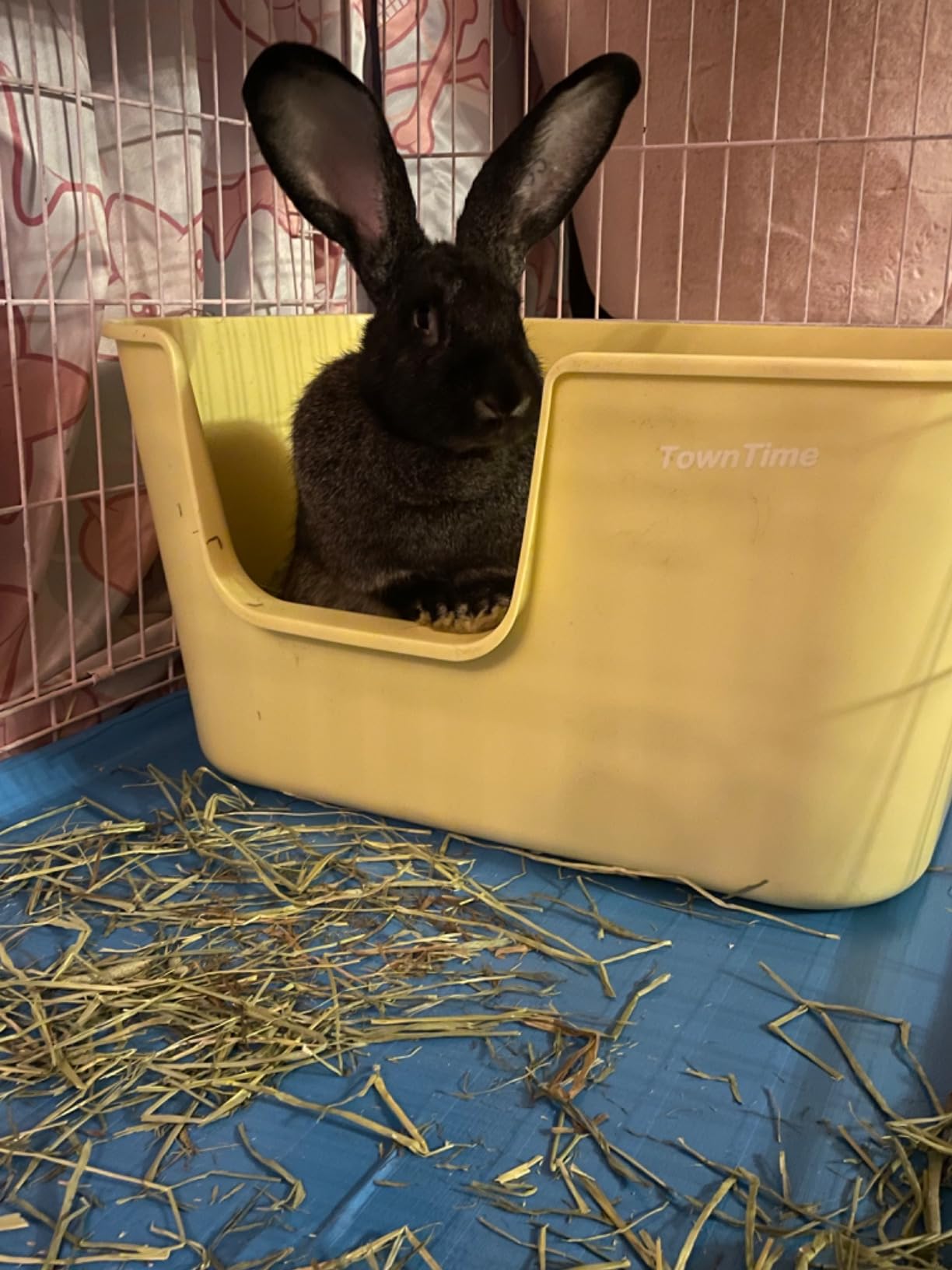
The TownTime box is built around one idea: make the cat turn as it enters. With a side entry and 12.99 inches of height, a cat has to swing around into the pan rather than backing in, so its rear lands in the litter instead of over the rim. That single design choice addresses both the poop-over-the-side and the splash problems.
Owners of large cats in the 14 pound range and up report that the containment works, and 85 percent of its 731 ratings are at five stars. Assembly is genuinely tool-free and the one-piece body has no seams to trap residue, which is why cleaning is a quick wipe.
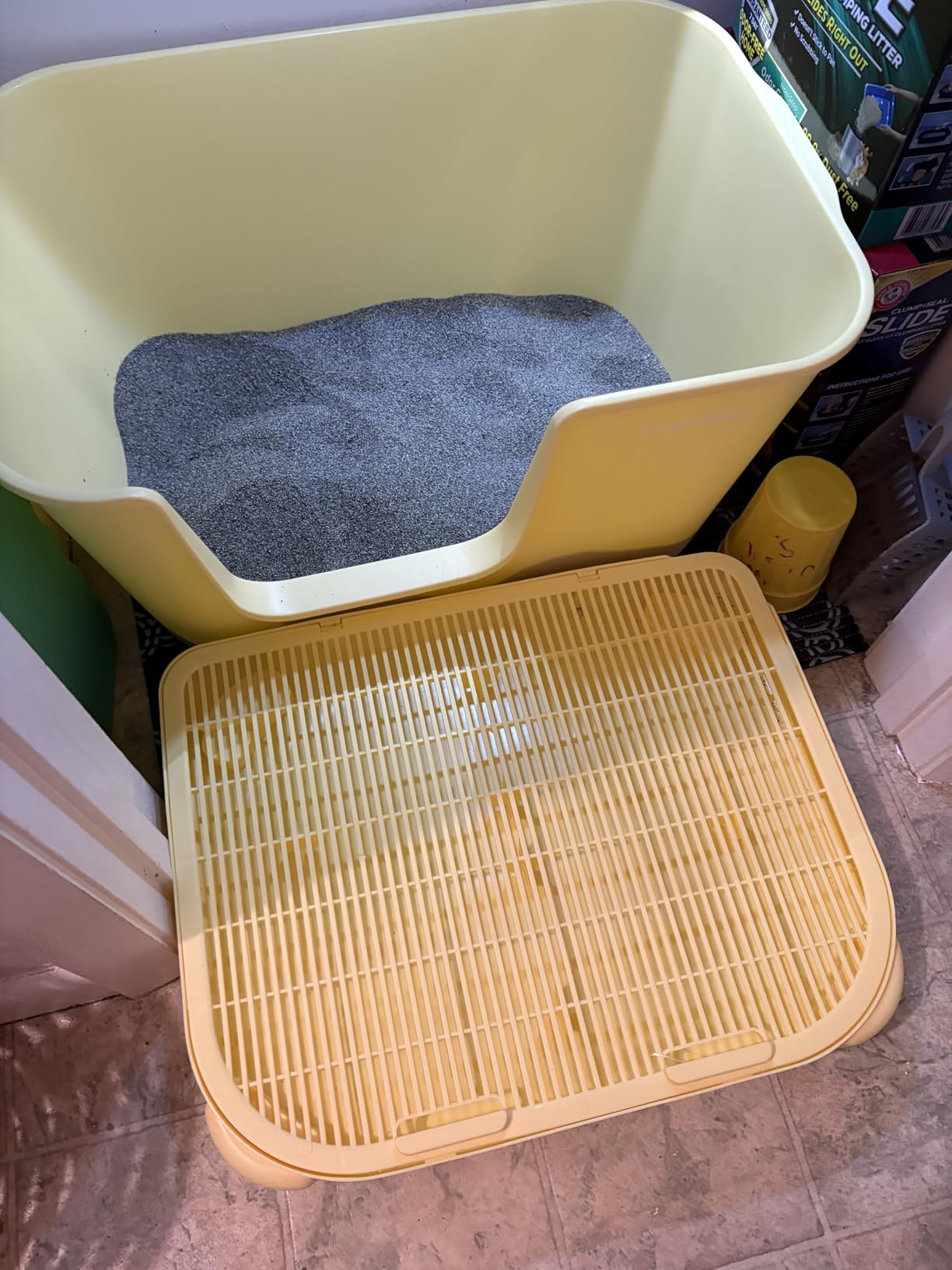
The side entry is also an accessibility consideration. A cat that cannot jump does not have to jump, and a cat entering from the side naturally lowers itself in rather than perching on a rim. The included non-slip pad keeps a 24.6 inch box from moving when a large cat leans into it.
Two things to plan for. It is a deep box, so it takes more litter to reach working depth than a shallow pan, and one owner reported moisture accumulating underneath, so put it on a hard floor you can wipe rather than carpet.
Who this box suits
Cats that spray while standing, cats that perch on the rim, and multi-cat households where one large box reduces friction. The side entry also helps with older cats that dislike stepping over a front wall.
Where it falls short
Carpeted rooms where under-box moisture would be a problem, and buyers who want a covered design. The deep interior also means a bigger cleaning job on day thirty.
How We Picked These Boxes
We scored every box on the same six criteria so the ranking does not drift toward whichever design happened to be newest. The first is interior footprint measured against the 1.5x rule, because a box that fails there fails everything else. The second is wall height, weighted heavier for a cat that has a history of spraying or flinging litter.
Third is entry height and how it interacts with the cat: a box that meets the sizing rule but asks a 20 pound senior to climb is not a solution. Fourth is how the box behaves under weight, meaning whether a large cat climbing in flexes the walls, shifts the pan, or knocks it across the floor.
Fifth is material and odour behaviour over time rather than on day one, which is what separates the stainless steel group from the plastic group in this list. Sixth is review volume and average rating, weighted by how many ratings there are, so a five-star score from a handful of people does not outrank a 4.4 from fifty thousand.
Nobody buys twelve litter boxes and lives with them for a month, so treat our testing detail honestly: we read the specification sheets, cross-checked them against owner reports, and compared every dimension against the sizing math above. Where owners disagree with the spec sheet, we believe the owners.
The DIY Route: Storage Totes and Concrete Mixing Tubs
For the longest cats, the answer is increasingly not a product at all. Owners on the big-cat forums converge on the same solution: a large plastic storage tote or a concrete and mortar mixing tub, with an entry hole cut in the side. These are available at any home improvement store, they cost a fraction of a jumbo pet box, and they routinely exceed every retail option on interior length.
The dimensions owners actually use are specific. A 50 gallon storage tote measures roughly 39.75 by 21.1 by 17.88 inches, which clears the 1.5x rule for a cat up to about 26 inches nose to tail base, and one owner runs three cats out of a single tote with the lid kept on. A 95 quart clear tote is a popular alternative that large cats jump into from the top, no cutting required.
For a lower profile option, the drywall mud pans and mixing tubs are the community favourite. Sizes cited repeatedly are 20 by 28 by 6 inches for a smaller mud pan, 36 by 24 by 8 inches for a large mixing tub, and 42 by 20 by 6 inches for a black concrete mixing tub. One owner with a 22 by 17 inch box adopted a 20-plus pound, 21 inch long cat and solved it with the bigger mixing tub, which the cat accepted immediately.
Two practical warnings. First, standard storage totes have structural ridges molded into the floor that trap litter and are miserable to scrub, which is exactly why the smooth-bottomed mixing tubs are preferred by experienced owners. Second, a very large container is physically awkward to empty; one owner tried a 42 by 20 by 6 tub and went straight back to two normal boxes the first time they had to lift it. If you go large, plan where it lives so you never have to move it.
Whatever you convert, run the old box alongside the new one for a week and transfer a scoop of used litter into the new container so the scent is familiar. Owners who skip that step report far more resistance than owners who do it.
Buying Guide: What Actually Matters for a Big Cat
1. Interior length beats everything. Measure from your cat’s nose to the base of the tail, not the tail tip, and multiply by 1.5. Exterior dimensions are marketing; interior dimensions are the number that decides whether your cat fits. Two of the boxes in this roundup advertise a 24 inch length and give you less usable floor than that, because the wall thickness and the hood shape eat the difference.
2. Match wall height to the behavior, not the cat’s size. A rough tiering helps: around 10 inch walls handle moderate kicking, 14 to 16 inches catches heavy flinging, and 18 inches or more is what a cat spraying at the rear wall needs. For a large male that stands to urinate, wall height is the single most useful feature you can buy.
3. Watch the entry height tradeoff. A senior, arthritic, or overweight cat needs a low entry. A sprayer needs a high wall. Boxes that give you both are the hardest design problem in this category, and it is why the side-entry and lowered-front designs in this list are so useful. Where you must choose, prioritize entry height for an older cat and add a mat for scatter.
4. Decide open, covered, or lidded honestly. Open tops give the most interior room, the best airflow, and the easiest monitoring. Covered boxes contain odor and scatter but concentrate litter dust, so use a low-dust litter with them and expect some cats to refuse the door. Lidded steel boxes control spray best but cost you entry height.
5. Stainless steel or plastic. Steel is non-porous, does not scratch, does not hold urine odor, and is rated by several makers at three to five years of service life. Plastic is lighter, cheaper, and warmer for a cat that is wary of metal. The caveat we hear repeatedly is that a cat can dig, hit an unfamiliar steel surface, and walk away, so transition over a week or two with both boxes available.
6. Do the multi-cat math before you buy. The standard advice is one box per cat plus one extra, and for large cats that means buying jumbo boxes, not buying more standard ones. A single giant box is not a substitute for two boxes, because cats that share one resource share it badly. If you have two large cats, budget for two XL boxes plus a third smaller one, which is also the easiest way to run a rotation so one box can be washed while the other is in use.
A few supporting notes. Place the box somewhere quiet, away from the food bowls, out of a high-traffic hallway, and not next to a noisy appliance; a large cat that feels cornered will not use the box at all. Pair a sifting design like our top pick with pine or wood pellets rather than clumping litter, since sifting only works with non-clumping fill. And if you are buying a covered box, low-dust litter will save you a cleanup you did not ask for.
One last thought on the furniture side. If the box is going to sit in a living space you look at every day, the size constraint and the aesthetic constraint fight each other, and decorative enclosures that fit a large cat are rare. Our guide to hidden litter box furniture covers what fits and what does not, and a good compromise is a large pan placed inside an existing cabinet or beside a console rather than buying an enclosure sized for a smaller cat.
Frequently Asked Questions
What size litter box does a large cat need?
The interior should be about 1.5 times your cat’s length measured from the nose to the base of the tail, with a minimum width of 18 inches and side walls of 10 to 12 inches. In practical numbers, a cat measuring 18 inches needs a 27 inch box, a 21 inch cat needs 32 inches, and a 24 inch cat needs 36 inches. Anything above 30 inches requires a storage tote or concrete mixing tub.
Can a litter box be too big for a cat?
Practically, no. Cats do not reject a box for being large the way a dog refuses an oversized bed. What they reject is a box that is too small, too dark, too tall to step into, or unfamiliar in material. The one real cost of a very large box is to you, since a huge pan full of wet litter is heavy and awkward to lift, so place it where it can stay put.
How do I know if my cat needs a bigger litter box?
Look for four symptoms: waste landing outside the rim, your cat perching on the edge rather than squatting, urine on the wall or floor behind the box, and litter scattered well beyond the walls. Any one of those points to a box that is too small or too low. A cat that stands to urinate instead of squatting is almost always signalling insufficient room or insufficient height.
Which litter box is best for a Maine Coon?
A Maine Coon needs an open box with at least 30 inches of floor length and 12 to 14 inch walls, which is why our top pick in that category is an XX-Large high-sided open pan with a 30 by 20 inch floor. For a Maine Coon over 24 inches nose to tail base, no retail box is long enough and a 50 gallon storage tote becomes the practical answer.
Do large cats prefer covered or open litter boxes?
Most large cats prefer open. A large cat needs to turn around inside the box, and a domed hood removes exactly that turning room, which is why so many owners report their cat refusing a covered box outright. Covered designs do contain odor and scatter effectively, so if your cat already uses one, a larger covered model is a reasonable choice. Pair any covered box with a low-dust litter.
Are stainless steel litter boxes better for large cats?
Steel is non-porous, resists scratching, does not retain urine odor the way plastic does, and is rated by several makers at three to five years of use. The tradeoff is weight, since steel boxes are heavy when full, and metal-on-metal noise while scooping. A minority of cats also refuse an unfamiliar metal surface, so run both boxes for a week before removing the old one.
How many litter boxes does a multi-cat household with big cats need?
The standard guidance is one box per cat plus one extra, so two large cats means three boxes. For large cats that means buying jumbo boxes rather than adding more standard ones. A single giant box is not equivalent, because cats sharing one resource tend to take turns or block each other. Buying two XL boxes also lets you wash one while the other stays in service.
Where should you not put a litter box?
Avoid placing it beside food or water, in a busy hallway, right next to a noisy appliance, in a laundry room with a closing door, or anywhere a dog can reach it. Large cats especially need a quiet spot where they are not cornered, because a cat that feels trapped will stop using the box entirely. Keep it on a hard, wipeable floor and away from drafts.
Final Verdict
Our Editor’s Choice, the Arm and Hammer Large Sifting Box, wins on the thing that actually drives daily satisfaction: it removes the scooping step entirely while accepting almost any litter type, and it carries more owner feedback than anything else on this list. For a cat that sprays or flings, reach for the Pureness Giant High Sides Pan for the walls or the TownTime box for the side entry that forces a turn. For a very long cat that needs floor space above all, the IRIS XX-Large open pan at 30 by 20 inches is the one that fits.
For multi-cat homes, the AIPERRO extra large steel box handles several large cats at once, and the lidded steel options control standing spray better than anything open. And if your cat measures over 24 inches nose to tail base, skip the product hunt entirely and build a tote. That is where the best large litter boxes for big cats stop being a shopping problem and become a measuring one. Measure first, then pick the box that matches the number, and revisit the rest of your large-cat setup while you are at it.