
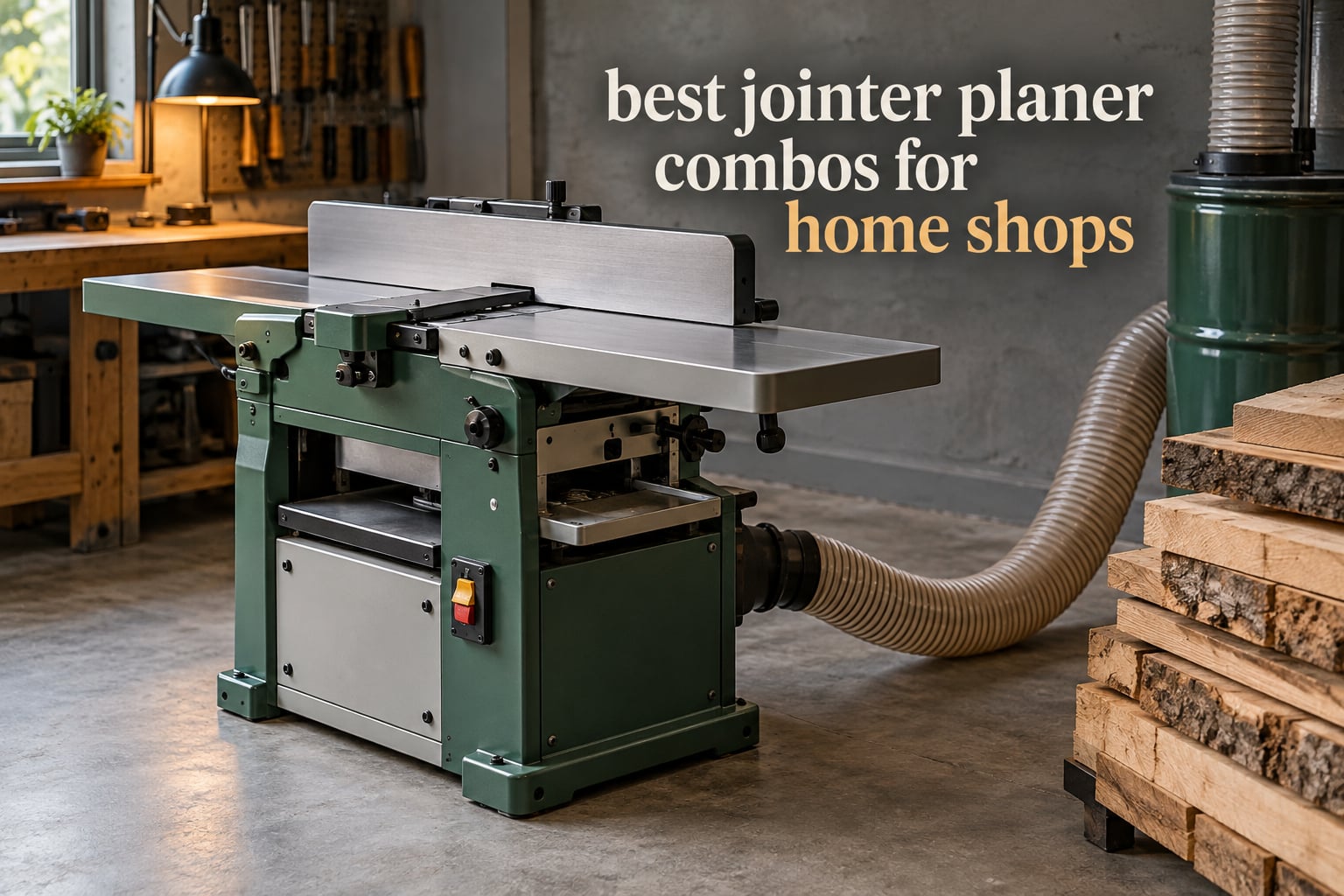
A jointer planer combo is one machine that contains both a jointer and a thickness planer sharing a single cutter head, which saves floor space and money versus buying the two machines separately. In jointer mode the cutter head sits below two tables with an adjustable fence; to switch to planing you lock or lower those tables and raise the planer bed so the same knives feed the board under pressure rollers.
That shared cutter head is the real argument for a combo, and it is stronger than most roundups admit. Because one set of knives flattens the reference face and thins the board to final dimension, the jointed face and the planed face are matched to each other. Separate machines with different cutter heads can leave a slight mismatch, and that mismatch is exactly what a glue-up will find.
We spent the last several weeks reading every listing in this category and the forum threads that dominate the search results. What we found is a narrow market: a handful of genuine combo machines, a lot of benchtop pairs sold as bundles, and a decisive constraint that almost no roundup covers honestly, which is the electrical requirement in your shop.
The rest of this guide walks through all six jointer planer combos available here, then explains the cutter head types, the wiring reality, and the question that comes up on every woodworking forum about whether the jointer knives stay parallel to the planer bed. If you have a residential panel and no subpanel, read the electrical section before anything else, because it eliminates half of these machines instantly.
Table of Contents
Top 3 Picks: Jointer Planer Combos for Home Shops (October 2026)
Jet JPJ-12BHH 12-Inch Helical Combo
- 42 four-sided carbide inserts
- 5300 RPM
- Quick jointer to planer changeover
- 230V single phase 15A

Hoteche 10-Inch Benchtop Combo
- 13A 120V motor
- 10-inch cutting width
- Stand included
- 37.3 inch jointer table

FORESTWEST BM10420H 12-Inch Helical Combo
- 28-blade helical cutterhead
- 9500 RPM
- 12-inch capacity
- 4-inch dust port
The Jet is the only name-brand, purpose-built combo here, and it earns the top spot on build quality rather than on rating count. The Hoteche is the machine most home shops can actually plug in, since it runs on a standard 120V circuit. The FORESTWEST has the most interesting cutter head in the group but no owner history at all, so buy it with your eyes open.
Best Jointer Planer Combos for Home Shops (October 2026)
| Product | Specifications | Action |
|---|---|---|
| Jet JPJ-12BHH 12-Inch Helical Combo |
|
Check Latest Price |
| Hoteche 10-Inch Benchtop Combo |
|
Check Latest Price |
| FORESTWEST BM10420H 12-Inch Helical Combo |
|
Check Latest Price |
 Banfluxion CB-022828 8-Inch 220V Combo Banfluxion CB-022828 8-Inch 220V Combo |
|
Check Latest Price |
 JARYANNIX FT022828 8-Inch 220V Combo JARYANNIX FT022828 8-Inch 220V Combo |
|
Check Latest Price |
 WEN PL1337 and JT630H Bundle WEN PL1337 and JT630H Bundle |
|
Check Latest Price |
Two of these six are true single-motor combo machines you flip between modes. Two are 220V machines that need a dedicated circuit. One is a pair of separate benchtop machines sold as a bundle, and one is a 120V benchtop combo that ships with a stand. Knowing which category a machine falls into before you start reading specs saves a lot of wasted time.
1. Jet JPJ-12BHH 12-Inch Helical Combo – The Best Overall Jointer Planer Combo
Jet 12-Inch Planer/Jointer, Helical Cutterhead, 3 HP, 230V 1Ph (JPJ-12BHH)
42 four-sided carbide inserts at 5300 RPM
12-inch width, 1/8 inch depth
230V single phase, 15A
453 pounds
Pros
- 42 four-sided carbide inserts give four usable edges per tooth
- Quick changeover keeps the fence in place
- Parallelogram table design for precise depth of cut
- Ground finish cast iron tables
- 5-year warranty
Cons
- 230V 15A needs a 30A circuit and the paperwork is contradictory
- 453 pounds is beyond a typical home shop
- One owner reported a unit that would not start until a loose wire was reattached
The JPJ-12BHH is the machine every other combo in this guide gets measured against. It is a purpose-built jointer planer combination machine from JPW Industries, with a 42-tooth four-sided carbide insert cutterhead spinning at 5300 RPM and a 12-inch cutting capacity rated to 1/8 inch per pass.
The four-sided inserts are the reason owners describe the finish as amazingly smooth. Each tooth has four usable edges, so you rotate the insert instead of grinding it, and the cutting geometry stays consistent for far longer than a straight knife would. Reviewers mention this machine turning rough, nail-filled 2x4s into finished boards in a single pass, which is not a small claim for a machine doing both jobs.
Two design decisions stand out. The changeover from jointing to planing happens without removing the fence, which is the step that makes many combos annoying. And the parallelogram table design keeps the planer table close to the cutterhead, so the large handwheel gives you fine, repeatable depth adjustments instead of a long throw that makes it hard to find a good thickness.
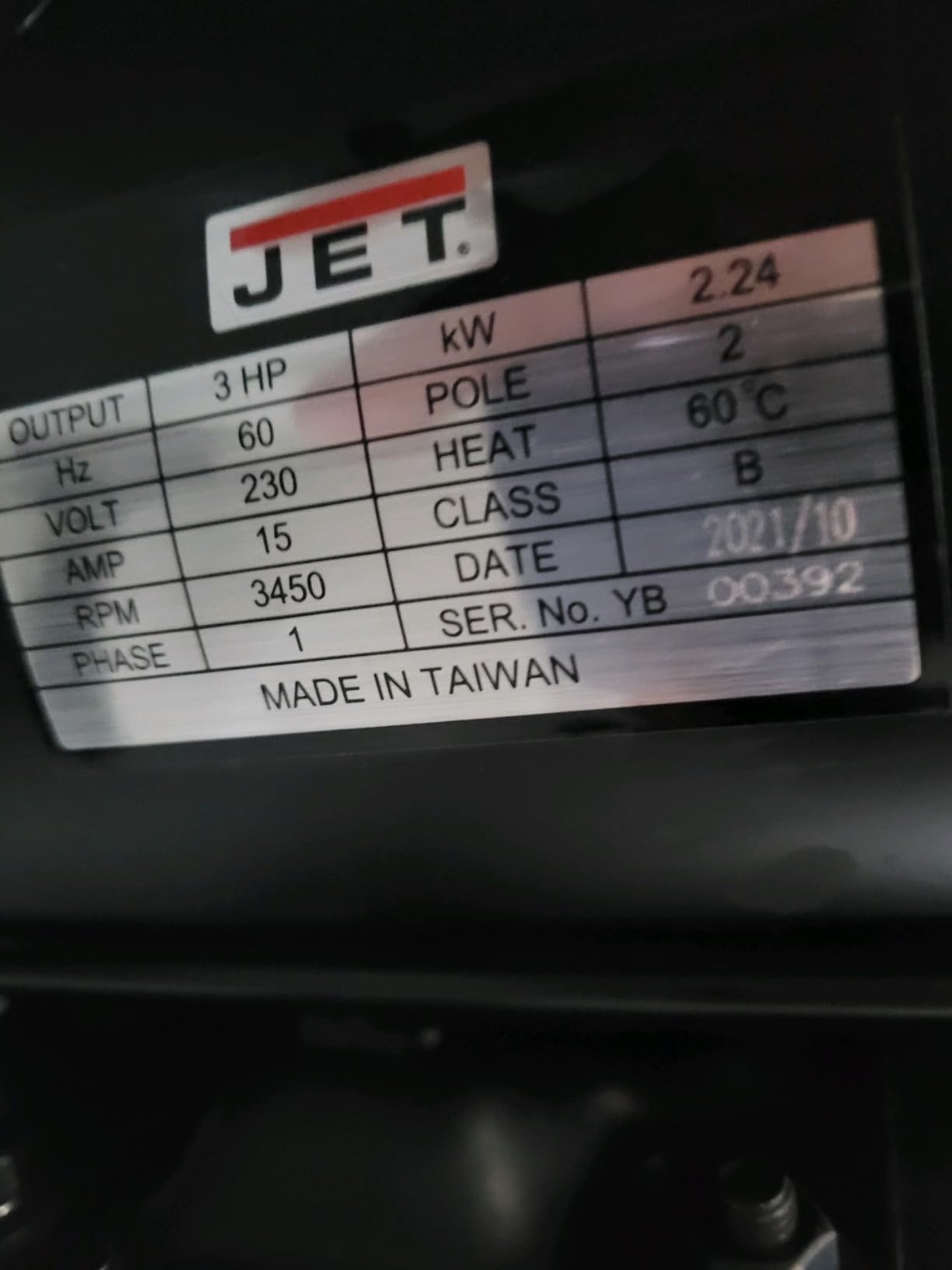
Here is the part nobody likes. The motor is 3 HP on 230V single phase with a 15A running draw, and the documentation calls for a 30A branch circuit with 10-gauge wiring, yet the machine arrives with a 14-gauge cord and a 15A plug. Two electricians and at least one buyer were confused by the contradiction, and the fix is usually a cord and plug swap at installation.
One owner also had a machine that would not start until the start switch was disassembled and a loose wire reattached, and another reported the jointer infeed randomly sticking in the down position. Those are isolated reports, but they are the kind of fault you cannot troubleshoot yourself if the machine is four hundred pounds of cast iron in a basement.
What confirms the Jet is worth the effort
The ground finish cast iron tables and the one-piece steel closed stand with mounting tabs are what separate this from the lighter machines. Cast iron tables that arrive flat stay flat, and a rigid stand means the whole thing behaves like one machine instead of a bed flexing with every pass.
The quick changeover also changes how you work. On a machine where you have to unbolt the fence and reposition tables, you tend to stay in one mode all day. On this one, moving from flattening a face to dimensioning a board takes a couple of minutes, so both operations get used.
Who should walk away from it
Anyone in a residential shop without a 230V circuit should stop here. Four hundred fifty-three pounds also means a two-person lift, a freight delivery to a driveway rather than a doorstep, and a machine that occupies the center of the shop rather than a corner.
If your work is 8-inch boards and hobby furniture, this is more machine than the job requires. The 10-inch and 8-inch options below serve those shops better, even though neither has the build quality of this casting.
2. Hoteche P805302A 10-Inch Benchtop Combo – The Best Value Jointer Planer Combo
Hoteche 10-Inch Benchtop Planer and Jointer Combo with Stand 13-Amp Heavy Duty Thickness Planer for Woodworking, Adjustable Depth 0-3mm
13A 120V 60Hz motor at 9000 RPM
10-inch maximum cutting width
0-3mm jointer depth, 0-2mm planer
Stand included
Pros
- Runs on a standard 120V home shop circuit
- Included stand removes the need to build support
- 37.3 x 10 inch jointer table handles long lumber
- Owners report strong power once it is running
- Most reviewed combo in this guide with 18 reviews
Cons
- Assembly documentation widely criticized
- Reported transit damage and missing stand parts
- One outfeed table arrived out of level with no adjustment
- Reported bearing failure after roughly 200 boards
This is the machine most home shops can actually install without an electrician. A 13A 120V 60Hz motor at 9000 RPM no-load speed, a 10-inch maximum cutting width, and a stand in the box mean you can unbox it and start cutting the same afternoon if the assembly goes well.
The geometry is sensible. The jointer takes 0 to 3 mm per pass and the planer 0 to 2 mm, the feed speed is 6 meters per minute, and the jointer table measures 37.3 by 10 inches while the planer table is 10.6 by 12 inches. That jointer table is long enough to walk a warped board across without sagging it off the edge.
Owners who get it running describe strong power and good finished surfaces on pallet lumber, which is a fair test for a machine in this class. Some use it daily and rate it 5 stars outright.
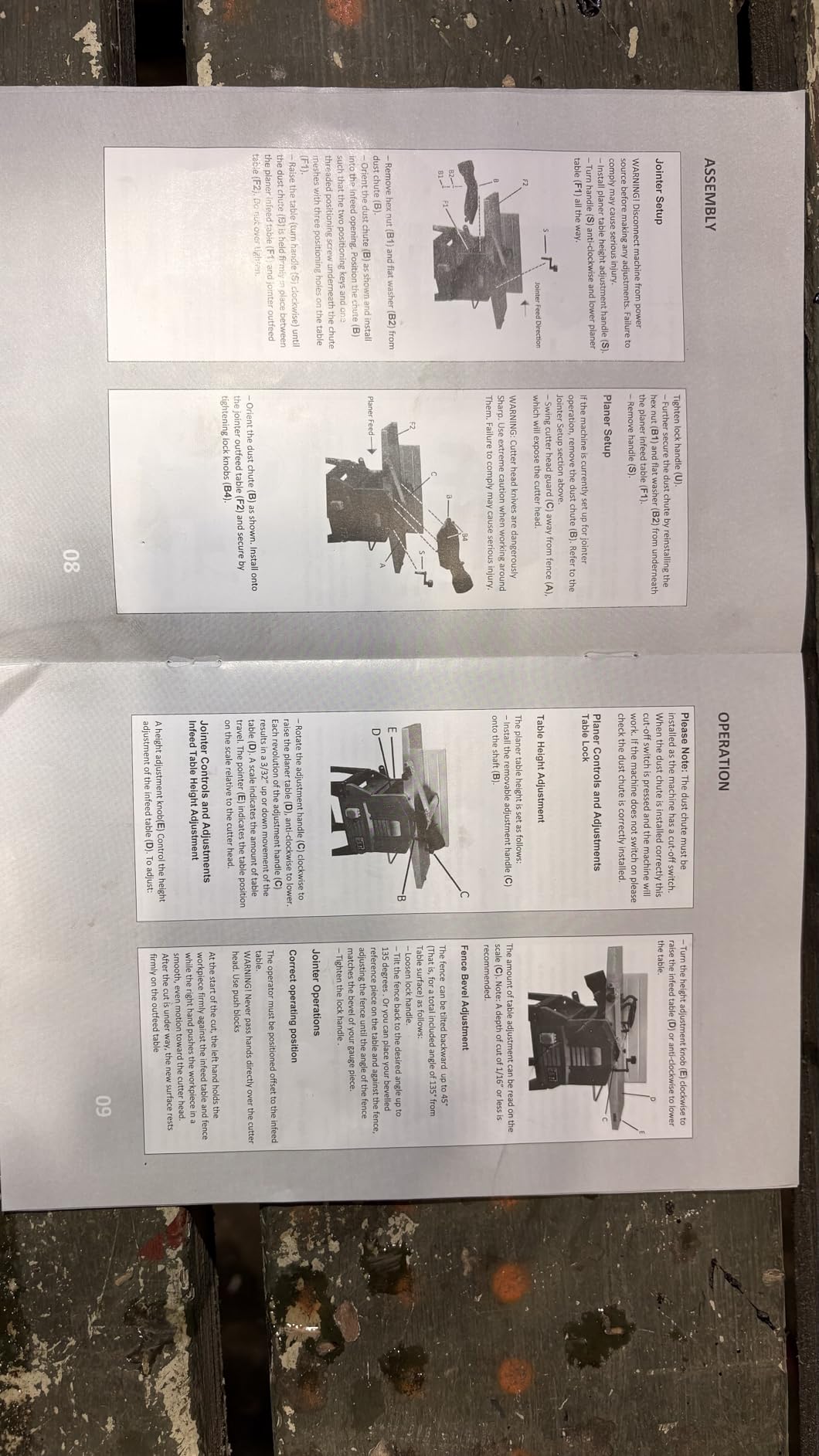
Now the honest part. The ratings are bimodal rather than middling: about half the reviews are five stars and roughly a third are one star, with very little in between. Almost every one-star review traces back to assembly documentation, missing parts, cosmetic damage in transit, or an early bearing failure rather than to how the machine cuts.
Specific complaints worth knowing before you order: the instructions and parts list are widely criticized as inadequate, and several buyers had to contact the seller just to get the machine running. Reported transit problems include missing stand legs, loose or chipping paint, scratches, and boxes that looked repacked. One outfeed table arrived out of level with no adjustment available, and some machines would not power on until an internal limit plate was repositioned onto the starter button.
The failure mode that worries us most is a reported bearing failure after roughly 200 boards, on a machine where one of the bearings is a needle type that cannot be replaced separately. That turns a repair into a return.
What confirms this machine is a genuine bargain
The 120V 13A rating is the headline. No panel work, no subpanel, no dedicated circuit beyond a normal shop outlet, which removes the single largest hidden cost in this entire category. The included stand does the same job, removing the need to build or weld a support stand before first use.
The 9000 RPM motor speed is the highest no-load figure in this group, and combined with the iron and metal construction it explains the surface quality owners report once the machine is together. For a shop working thin hardwoods off a thickness planer, that is the specification that matters.
Who should walk away from it
If you cannot spend an evening with assembly and a set of missing-parts troubleshooting before your first cut, pick a different machine. The pattern here is clear: reviewers either got it running and love it, or never got past setup.
Jointer and planer modes on this machine also require partial disassembly to switch, so plan your workflow around that rather than expecting a quick flip. And if you are milling dense hardwood at full width, a 13A 120V motor is not the tool for it.
3. FORESTWEST BM10420H 12-Inch Helical Combo – The Best Combo for Hardwood
FORESTWEST 10420H, 16.4-Amp 12-Inch Jointer Planer Combo with 9,500RPM Helical Cutterhead
28-blade helical cutterhead at 9500 RPM
2.5 HP 1800W, 16.4A draw
12-inch maximum stock width
4-inch dust collection port
Pros
- 28-blade helical head at 9500 RPM is a serious cutting geometry
- True 2-in-1 single machine at 12-inch capacity
- Fence adjusts 90 to 135 degrees
- Large cast iron working tables
- 4-inch dust port and 1-year warranty
Cons
- No customer reviews at all
- so build quality is unproven
- 16.4A draw needs a dedicated 20A branch circuit
- Weight is listed as 91 pounds in the spec table and 102 pounds in the features
The FORESTWEST BM10420H has the most attractive cutter head specification in this entire guide, and that is exactly why we picked it for hardwood work. A 28-blade helical cutterhead rotating at 9500 RPM is the geometry experienced woodworkers ask for: the blades are small, numerous, and shallow-angle, so each one takes a light bite and leaves the surface nearly unmarked.
Everything else follows the same pattern. A 2.5 HP 1800W motor, a 12-inch maximum stock width rated at 3 mm per pass, large cast iron working tables, a fence that adjusts from 90 to 135 degrees for bevels and chamfers, and a 4-inch dust collection port that will accept a standard 4-inch hose.
The helical head is also the quietest thing you can buy in this category. If you work next to a bedroom wall or share a building, that difference is real, and no straight-knife machine in this guide comes close.
And here is the honest caveat. This listing has no customer reviews and no rating history at all. Everything we know comes from the manufacturer’s own feature copy, which is detailed but is still marketing copy.
The electrical figure is the practical constraint. At 16.4A it needs a dedicated 20A branch circuit rather than a general purpose shop outlet, which is a smaller job than the Jet’s 30A requirement but still more than a duplex receptacle on an existing 15A circuit provides.
What confirms the design is right for dense wood
Cutterhead speed and blade count do most of the work here. A 28-blade head at 9500 RPM breaks the chip into 28 small slices rather than two or three heavy ones, which is precisely why helical heads hold an edge through figured maple and quartersawn oak without the tear-out that spiral heads produce.
Cast iron tables matter equally at 12-inch capacity. A warped table at that width shows up immediately as an out-of-square joint and an inconsistent thickness, and cast iron is the material that resists moving with humidity. The 90 to 135 degree fence range covers the bevel work that furniture makers ask for first.
Who should walk away from it
Buyers who need proof before they commit. With zero owner history you have no way to judge casting quality, bearing life, or whether the fence holds position over a few hundred boards, and those are the things that separate a good machine from a shop ornament.
Also skip it if your electrical panel cannot spare a 20A circuit, and note the weight conflict in the listing, which lists 91 pounds in the specification table and 102 pounds in the feature copy. Either way it is a two-person lift needing a properly leveled floor position.
4. Banfluxion CB-022828 8-Inch 220V Combo – The Best Safety Package
Banfluxion 8″ Benchtop Woodworking Jointer Planer with 4 Blades, 220V 2.2KW
2200W 220V motor at 5000 RPM
4-blade cutterhead, 8-inch width
72.2 inch cast iron table
3.9 inch dust port
Pros
- Overload switch cuts power before the motor burns out
- Fully enclosed cutterhead guard
- Two 35.3 inch cast iron tables make a 72.2 inch surface
- Fence locks at 45
- 90 and 135 degrees
- Foot-pedal locking swivel casters
Cons
- 220V 2.2kW needs a dedicated circuit
- No reviews at all
- 4-blade head is quieter than nothing but no match for a helical head
- Cannot handle material thinner than 0.5 inch
This 8-inch machine is defined by its safety engineering rather than its cutting performance. It carries an NHD safety electromagnetic switch that monitors motor current and temperature and cuts power on overload, which on a 2.2kW machine is a real safeguard rather than a marketing line. The cutterhead guard is fully enclosed.
The table is the other standout. Two 35.3 inch cast iron tables form a 72.2 inch work surface, which is more support than you will find on most 8-inch benchtop machines and enough to handle long narrow trim without tipping.
Fence setup is quick, locking instantly at 45, 90 or 135 degrees, and the dovetail lifting mechanism carries a precision-etched scale with depth settings up to 1/8 inch. Four swivel casters with foot-pedal locks mean one person can move it, and the 3.9 inch dust port feeds a standard hose. A minimum workpiece size of 12 by 1 by 0.5 inches is specified.
The tradeoff is the cutterhead. Four blades at 5000 RPM means more noise and more tear-out on figured wood than any helical machine here, and that is the compromise most likely to show up in daily use.
What confirms the safety package is worth attention
Thermal overload protection matters most on 220V machines because they run hot under sustained load. Cutting wide hardwood boards takes long passes that smaller motors cannot absorb, and an overload switch that disconnects before the windings cook is cheap insurance against a several-hundred-dollar loss.
The enclosed head guard is the second practical benefit. A jointer is the one machine in the shop where a loose sleeve can end up in the knives, and a fully enclosed guard removes that possibility entirely.
Who should walk away from it
Anyone whose shop has only standard residential wiring. A 2.2kW 220V induction motor needs a dedicated circuit that most home shops simply do not have, and the electrical work is the cost that decides this purchase.
Skip it if tear-out on figured wood is a problem you care about, if you machine veneer or very thin resawn stock, or if you need to draw conclusions from owner experience, since there are no reviews on this listing at all.
5. JARYANNIX FT022828 8-Inch 220V Combo – The Best Combo for Long Boards
JARYANNIX Woodworking Jointer Planer 8 Inch Heavy-Duty Benchtop Thickness Planer and Jointer Combo 220V 2.2KW with Mobile Casters for Precision Woodworking Professional Use
220V 2.2kW pure copper motor
5000 RPM, 8-inch width
Dovetail lift with lifting scale
Cast iron and chrome-plated table
Pros
- 2.2kW pure copper winding gives strong continuous capacity
- Precision-ground chrome-plated table reduces friction
- Locking swivel casters for one-person repositioning
- Sliding fence with quick 45 and 90 degree positioning
Cons
- 220V 2.2kW requires a dedicated circuit most home shops lack
- Zero reviews so quality is unverified
- 8-inch capacity is narrower than the 10 and 12 inch machines
- 5000 RPM is roughly half the helical head speed of the FORESTWEST
Where the previous machine emphasizes safety, this one emphasizes continuous motor capacity and table length. The 2.2kW pure copper winding motor is a meaningful step up from anything else in this guide, and pure copper windings hold heat better than cheaper alternatives, which is what decides whether the motor survives a long pass in walnut.
The dovetail lifting structure with a clear lifting scale gives positive, repeatable table-height positioning, which matters more than it sounds. A cheap screw and slide table drifts as it wears; a dovetail does not, and it makes the same depth setting repeatable months later.
The precision-ground cast iron table with chrome-plated surfaces reduces workpiece friction on the way in, and a box-type integrated power transmission structure keeps the drive geometry fixed. The sliding-table fence has quick positioning at 45 and 90 degrees.
The 72.2 inch table surface is listed for this machine too, and the locking swivel casters let a single operator reposition it, which is a real benefit on something this heavy.
What confirms this machine handles long material
Long boards fail at the ends. If the table sags or the outfeed is short, a ten-foot board bows downward as it leaves the machine and the far end comes out thinner than the near end. A full-length cast iron surface removes that failure mode entirely, and this is the machine in the guide where that length is most clearly specified.
The sliding-table fence is a genuine upgrade for batch work. Setting one dimension and running a stack of boards is faster than walking an edge to each one, and the quick 45 and 90 degree stops make repeat angled cuts simple.
Who should walk away from it
The electrical requirement is the deal-breaker for most home shops. A 220V 2.2kW machine means a dedicated circuit, and if your panel has no room for one, that panel work will exceed the machine itself.
Skip it if 8-inch capacity is too narrow for your stock, and treat the zero-review listing accordingly. There is also a listing inconsistency worth flagging: the dimensions are given as 72.2 by 72.2 by 32.2 inches, and equal length and width dimensions are usually a data entry error rather than a real footprint, so measure before you plan the floor space.
6. WEN PL1337 and JT630H Bundle – The Best Starter Pair
WEN Thickness Planer (PL1337) and Jointer (JT630H) Woodworking Machine Bundle
13-inch planer, 26 and 16 FPM feed speeds
6-inch jointer with 30 by 6 inch table
Spiral cutterheads with staggered HSS blades
Removes 0 to 1/8 inch per jointer pass
Pros
- Gives you both functions from a single brand
- Two feed speeds handle rough dimensioning and finish passes
- Spiral cutterheads with staggered HSS blades on both machines
- Jointer fence bevels up to 45 degrees
- Planes boards up to 6 inches thick
Cons
- This is two separate benchtop machines
- not one combo
- Ships without a stand so you must supply bench support
- Only a 2-item review base
- 6-inch jointer is narrow by current standards
We are including this bundle with a clear caveat, because it is not a jointer planer combo. It is two separate benchtop machines, a 13-inch thickness planer and a 6-inch jointer, grouped into one order. Each has its own motor, its own stand space, and its own dust port, which defeats most of the reasons to buy a combo in the first place.
What you get instead is a name-brand starting point. The PL1337 is a two-speed planer running 26 FPM for rough dimensioning and 16 FPM for finish passes, handling boards up to 6 inches thick and 13 inches wide. That feed-speed control is the feature most beginners underestimate and eventually rely on daily.
The JT630H jointer has a 30 by 6 inch table, removes 0 to 1/8 inch per pass, and its fence bevels to 45 degrees. Both machines carry spiral cutterheads with staggered HSS blades, which produce a finer, more tear-out-resistant finish than a straight-knife head and stay sharp longer between sharpenings.
The rating is 5 stars from 2 reviews. That sample is too small to mean anything about reliability, so read it as new-listing enthusiasm rather than a track record.
What confirms this pair is worth considering for a first machine
For someone who has never owned a jointer or a planer, this is a low-commitment way to learn both jobs before spending on a 400-pound casting. You can find out whether you actually enjoy dimensioning stock flat and square before a combo locks you into it.
The two-speed feed control is the real long-term value here. Taking a rough board down at 26 FPM and finishing at 16 FPM reduces the number of passes and the amount of stock you remove, which matters most on expensive hardwood.
Who should walk away from it
Anyone short on floor space, which is the main group we are writing this guide for. Two benchtop machines take roughly twice the footprint of one combo, and neither is narrow.
Skip it if your lumber is wider than six inches for jointing, since the jointer is a six-inch machine and will leave you hand-planing the edges. Also skip it if the planer arrives without a stand, because building or buying support furniture is the first thing you will have to solve on delivery day.
Should You Buy a Combo Instead of Separate Machines?
A combo is worth it when floor space is your binding constraint, and it is not worth it when it is not. Two standalones cost roughly the same as one combo, take roughly twice the floor space, and give you independent adjustment of the jointer tables and the planer bed, which is a real benefit most of the time.
Three arguments decide it. First, shared cutter head: jointing and planing with the same knives means the jointed face and the planed surface match each other, which separate machines with different cutter heads cannot guarantee. Second, footprint: one combo occupies one station instead of two. Third, cost of ownership: one motor, one set of knives to maintain, one machine to move.
Against that, separate machines win on independence and on risk. If the planer bed needs service, a stand-alone planer does not take your jointer out of service with it. And a shop that does not need both functions on the same day will run two standalones more efficiently.
There is also an honest budget point that forum users make constantly. A quality combo is a several-thousand-dollar proposition for a hobbyist once electrical work is included, and that number moves a lot depending on whether your panel needs a subpanel. We built [a guide to shop equipment that fits small spaces](/best-multiprocess-welders-for-home-shops/) for the same reason this guide exists: the machine is rarely the biggest line item.
Are the Jointer Knives Guaranteed Parallel to the Planer Bed?
No. Setting the jointer knives flush to the outfeed table does not guarantee they are parallel to the planer bed, because the jointer tables and the planer bed are separate castings or separate adjustments. Most combos ship coplanar but not calibrated, so you verify with a straightedge after setup.
The machines that do allow independent adjustment let you bring the jointer tables to the blades and the planer bed to the blades separately, then check that both are true. On machines without independent adjustment, you set one and verify the other with a machinist square and a scrap board.
This is the single most common question in the comment sections of jointer planer combo threads, and it is a fifteen-minute job if you know how to do it. Plane a test board flat on the planer bed, flip it, and check it against the jointer outfeed table. If the two surfaces disagree, you have an alignment step ahead of you, not a defective machine.
Cutter Head Types: Straight Knife, Spiral, Helical and Tersa
The cutter head determines how the machine sounds, how the surface looks, and how much money the knives cost you over ten years. Four types cover this entire category, and no jointer planer combo below surprises us on this axis.
Straight knives are two or four HSS or carbide blades mounted radially. They are cheap to replace and easy to sharpen at a hardware store, and they produce a perfectly flat surface. The trade-off is noise, since a straight blade entering solid wood at full width sounds like an impact. On figured wood they lift grain and produce tear-out that no amount of feed speed fixes.
Spiral cutter heads are the big upgrade. Two or four bevel-edged knives mounted at an angle cut a shearing slice rather than pushing straight down. They run far quieter, hold an edge much longer, and reduce tear-out dramatically. The downside is that changing a blade opens the head to dust and debris, so you have to clean it before reassembly, and a four-blade spiral head on a wide machine bogs down sooner than a bigger head.
Helical cutter heads are the current standard and the reason we picked the FORESTWEST for hardwood. Dozens of small four-sided carbide inserts sit at a shallow angle across the head, as in the 28-blade head at 9500 RPM on that machine and the 42-insert head at 5300 RPM on the Jet. Each insert has four usable edges and rotates rather than being sharpened, so the head stays sharp for thousands of hours with a screwdriver.
Tersa heads use thick disposable carbide knives held in a clamping wedge. Knife changes are the fastest of any system, taking seconds, and the cut quality sits between spiral and helical. The ongoing cost is the disposable knife itself, which has to be replaced rather than rotated.
For a home shop, the practical ranking is straightforward. Helical if you can run 230V and value quiet surfaces, spiral if you are on a 120V circuit and want the improvement over straight knives, straight only when budget is the deciding factor, and Tersa when knife changes happen many times a day.
Electrical Requirements for a Home Shop Combo
Electrical capacity eliminates more home-shop combo purchases than any other factor, and it is the section we would read twice. A machine that needs a circuit you do not have is not a cheaper machine, it is an unavailable machine.
120V, 15A general purpose circuits support the Hoteche at 13A. This is the only truly plug-and-play option in the guide, and it caps motor size at roughly the equivalent of a 1.5 HP machine. Fine for softwood and thinner hardwood, marginal for wide dense boards.
Dedicated 20A branch circuits at 120V support the FORESTWEST at 16.4A. This is a modest electrical project in most homes and opens up meaningfully more motor capacity.
230V single phase, 30A circuits are what the Jet requires. Its 15A running draw on 230V, combined with the manual calling for a 30A breaker and 10-gauge wiring, means a real branch circuit and very likely a subpanel. The 2.2kW 220V machines from Banfluxion and JARYANNIX sit in the same territory.
Three-phase power is the requirement none of the six machines here have, and that is a deliberate filter. Larger 16-inch and 20-inch combos in this category typically need it, which puts them out of reach for a residential shop entirely.
One more number people forget: your dust collector. A collector that shares a circuit with a jointer planer combo will trip the breaker every time the cutterhead load spikes. Budget a separate 15A circuit for the collector and, if the machine is at the limit, check the collector’s rated amperage against the machine’s running draw before you plan the panel work.
Related reading for tightening up the rest of the shop: [home safes worth reviewing](/best-home-safes/) for storing your blades and chisels once you have a place to put them, and [small-space equipment picks](/best-robot-vacuum-and-mop-combos/) for the same floor-space logic applied elsewhere.
Frequently Asked Questions
What is the best jointer planer combo?
The Jet JPJ-12BHH is the best overall for a home shop with 230V power, because its 42 four-sided carbide insert cutterhead, ground finish cast iron tables and parallelogram table design give the most precise and quietest results in this group. For a shop limited to a standard 120V circuit, the Hoteche 10-inch benchtop combo is the most realistic choice.
Do you need both a jointer and a planer?
Only if you work with rough lumber and want finished, square, flat boards. A jointer establishes one flat reference face and a straight edge; a planer brings the board to an even thickness. A planer plus a long straightedge and a router sled handles flattening, but you give up speed and accuracy.
Are planer jointer combos worth it?
Yes when floor space is the constraint and you use both functions regularly, because one machine replaces two and the shared cutterhead keeps the jointed face and planed face matched to each other. They are not worth it when your panel has no room for a dedicated circuit, since the electrical work can cost more than the machine.
Which should I buy first, a jointer or a planer?
A planer first, in most cases. A planer is what turns rough lumber into usable boards, and beginners often get more out of one good machine than two mediocre ones. You can defer the jointer and use a long straightedge to flatten stock until you need a second reference face regularly.
Do jointer planer combos need three-phase power?
The combos in this guide do not, which is deliberate. All six run on single-phase power between 120V and 230V. Larger 16-inch and 20-inch machines in this category generally do require three-phase power, which rules them out for most residential home shops.
What is the difference between helical and spiral cutter heads?
A helical head uses dozens of small four-sided carbide inserts set at a shallow angle, so each blade takes a light bite, producing quiet, tear-out-free surfaces that stay sharp for thousands of hours. A spiral head uses two or four larger blades at a steeper angle, which is a big improvement over straight knives but leaves the head open to debris during a knife change.
Is a 10 inch or 12 inch jointer planer combo better for a home shop?
A 12-inch machine fits standard dimensional lumber without crosscutting boards and handles full-width hardwood, so it is the more useful choice if you have the power. A 10-inch machine costs less, weighs less and fits tighter shops, but wide boards need a second pass.
Final Verdict: Which Jointer Planer Combo to Buy in 2026
After working through all six, the Jet JPJ-12BHH is the jointer planer combo we would own. Forty-two four-sided carbide inserts, cast iron tables that stay flat, a fence that never moves during changeover, and a warranty that assumes you will use it hard. Budget for a 30A circuit and for a freight delivery, because at 453 pounds that is not optional.
If your panel cannot deliver that, the Hoteche 10-inch benchtop combo is the honest answer. It runs on 13A at 120V, it comes with a stand, and its split ratings tell you exactly what to expect: excellent once assembled, frustrating if you are not willing to work through the setup. The FORESTWEST BM10420H is the one to watch if you can get a 20A circuit and you care most about quiet, tear-out-free surfaces on figured hardwood.
Whatever you choose, measure the machine, confirm the amperage against your panel, and budget dust collection as a separate circuit. That preparation is what separates a machine that sits in the corner from one that actually gets used every week. For the rest of your shop, our [home equipment guides](/best-air-fryer-toaster-oven-combos/) and [small-space storage picks](/best-chinchilla-cages-for-home/) cover the same floor-space planning.