
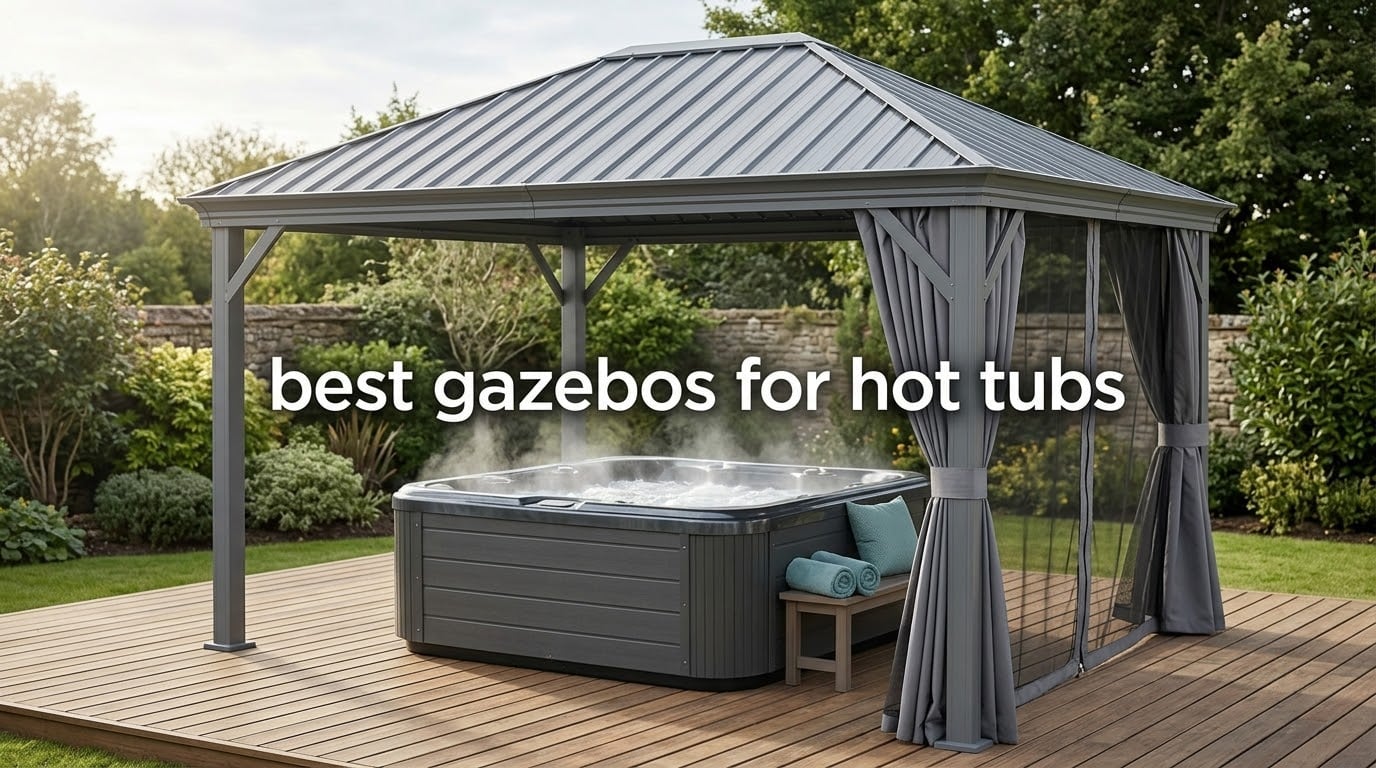
Yes, you can put a gazebo over a hot tub, and in most climates you should. A spa throws off a surprising amount of steam, so the shelter needs a vented peak, a roof that will not warp under wet heat, and a frame that will not corrode in a constantly humid space. Sizing matters more than brand: you are buying room around the tub, not a lid that matches it.
This roundup covers the twelve best gazebos for hot tubs we could justify on published specifications, real owner feedback, and the exact details that trip people up — interior head clearance, cover lifter swing, walk-around space, and the pad underneath. Every footprint, eave height, snow rating and weight below comes from manufacturer spec sheets and retailer listings, not from marketing copy. We also flag where a listing claims a rating it does not back up.
Two things change how you shop. First, clearance over the tub rim: a standard 8 ft post with roughly 7.5 ft of interior height is the number owners most often regret, because getting in and out means ducking every single time. Second, moisture: an enclosure without a ventilated upper roof will grow mildew on the frame within a season or two, and that is what forum owners mean when they say the gazebo damaged their roof. If you are still choosing the tub itself, our backyard hot tub guide covers sizes worth pairing with each gazebo below.
Last updated in 2026. Specs, ratings and review counts are pulled from live retailer listings and can change, so treat them as a snapshot.
Table of Contents
Top 3 Picks: Gazebos for Hot Tub Owners (October 2026)
PURPLE LEAF 12×20 Hardtop
- Double vented roof
- 4.7 inch aluminum posts
- Built-in drainage
- 260 GSM Textilene screens

Kozyard Alexander 12×12
- 2500 lb snow load
- 60 mph wind rated
- 29-gauge steel roof
- Integrated gutters

HAPPATIO 12×12 Aluminum
- 144 sq ft covered area
- Double steel roof
- Vented top hooks
- Dual rail curtains
Best Gazebos for Hot Tubs in October
All twelve shelters below, ranked by how well they handle the specific problems a spa creates. Ratings and review counts are copied exactly as listed at the time of writing.
| Product | Specifications | Action |
|---|---|---|
| PURPLE LEAF 12×20 Hardtop Gazebo |
|
Check Latest Price |
| HAPPATIO 12×12 Aluminum Hardtop |
|
Check Latest Price |
 Aoxun 12×12 Double Galvanized Steel Roof Aoxun 12×12 Double Galvanized Steel Roof |
|
Check Latest Price |
 Aoxun 10×12 Cedar Wood Gazebo Aoxun 10×12 Cedar Wood Gazebo |
|
Check Latest Price |
 Aoxun 12×16 Hardtop with Drainage Aoxun 12×16 Hardtop with Drainage |
|
Check Latest Price |
 HOTEEL 10×15 Hardtop for Hot Tubs HOTEEL 10×15 Hardtop for Hot Tubs |
|
Check Latest Price |
| Kozyard Alexander 12×12 |
|
Check Latest Price |
 UDPATIO 12×20 Pavilion UDPATIO 12×20 Pavilion |
|
Check Latest Price |
 Domi 12×12 Cedar Wood Double Roof Domi 12×12 Cedar Wood Double Roof |
|
Check Latest Price |
 Domi 12×15 Four-Season Sunroom Domi 12×15 Four-Season Sunroom |
|
Check Latest Price |
 PURPLE LEAF 12×16 Solarium PURPLE LEAF 12×16 Solarium |
|
Check Latest Price |
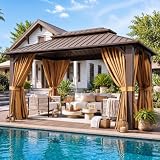 Breezestival 10×12 Hardtop Breezestival 10×12 Hardtop |
|
Check Latest Price |
1. PURPLE LEAF 12×20 Hardtop Gazebo — The Best All-Round Pick
PURPLE LEAF Patio Gazebo 12′ X 20′ Built-in Drainage System, Gray
240 sq ft footprint
Double vented roof
4.7 in aluminum posts
5 yr roof warranty
Pros
- Highest rated in the group at 4.8 stars
- Strong drainage routes water down the poles
- Hardware packed in labeled draw bags
- 260 GSM Textilene screens outlast cheaper mesh
Cons
- Interior runs hot on still summer days
- No clean way to hide a power cord
- Roof panels dent in hail
This is the one we keep coming back to. It carries a 4.8 average across more than 1,500 reviews, which is the highest rating and one of the two largest review bases in the entire group. For a structure you might anchor to a slab and leave standing through a decade of soaking, that combination of rating and volume is the strongest evidence available in this category.
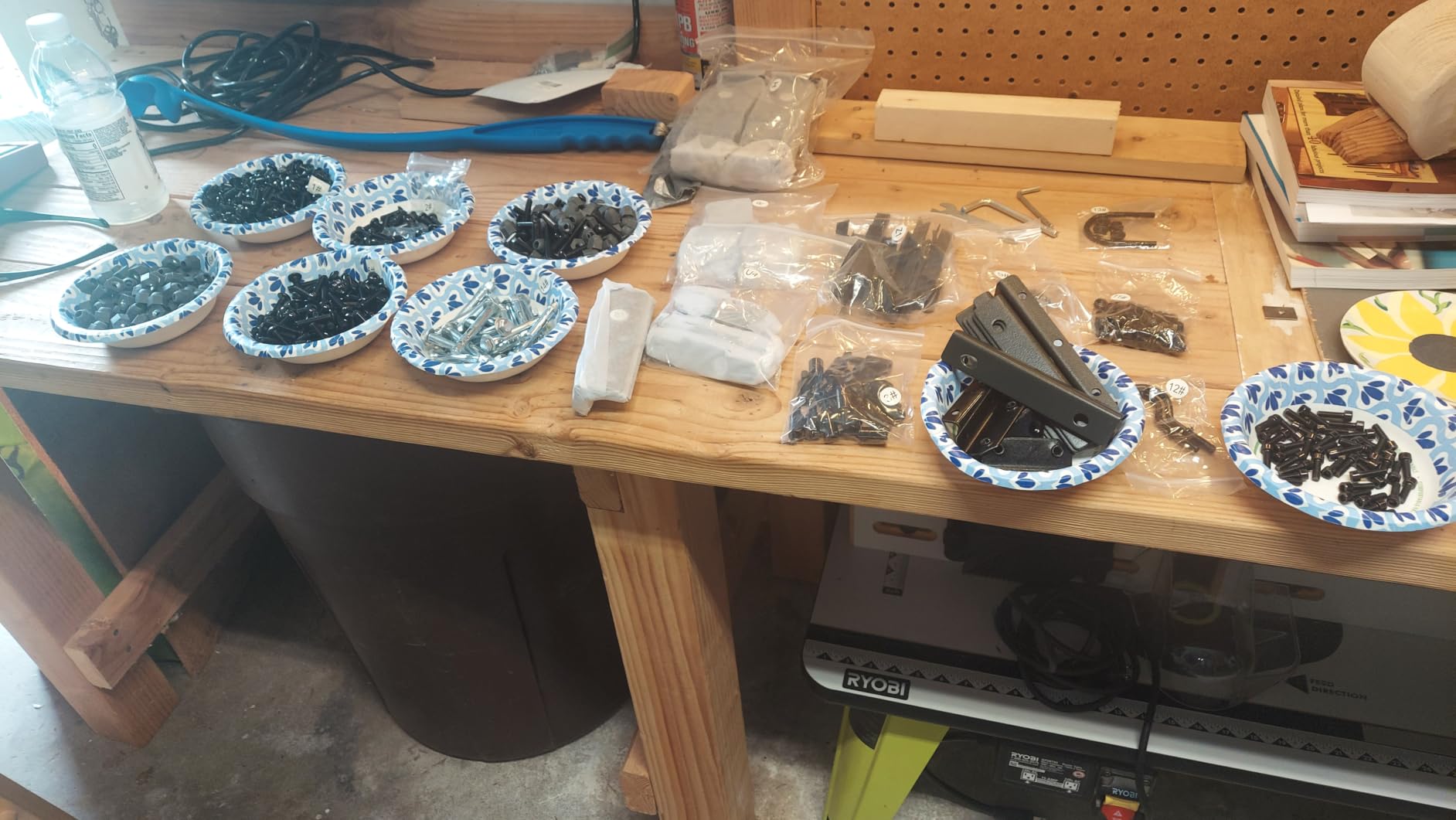
The physical design is right where a spa needs it. The roof is a double-tier design with a vented upper level, and the sloped panels feed a built-in drainage system that carries water down the frame and out through the poles rather than dripping at the wall line. That matters more than it sounds: a gazebo that dumps runoff along the edge of your tub pad is a standing puddle problem, and puddles around a spa mean mildew.
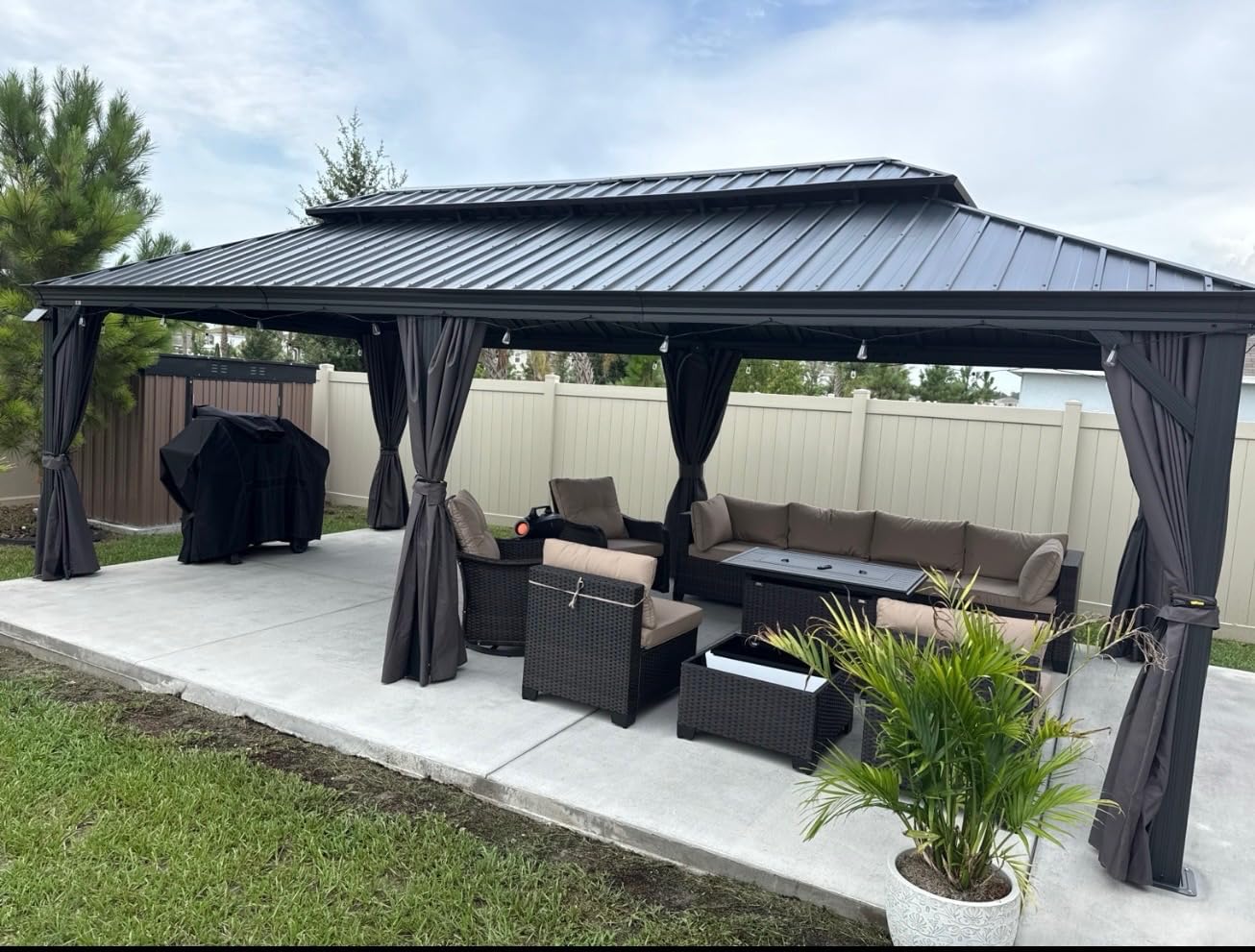
Owners describe the parts organization as the tell of a well-made kit. Hardware comes in labeled draw bags, and reviewers repeatedly report nothing missing. The 260 GSM Textilene netting and polyester curtains are a step up from the 35 to 40 GSM mesh used on cheaper builds, and the warranty is unusually specific: five years on the top panel, two on curtains and netting, one on the frame. Purple Leaf customer service also draws repeated praise, with same-day replies and free replacement parts after storm damage.
Size is the reason to look here. At 234 by 144 inches you get 240 square feet, which is enough to put a tub in one half and a bench or towel shelf on the other without crowding the walk-around. Owners use the extra span for dining sets, so a large tub plus seating fits without a second structure.
What to check before you buy
Measure the cover lifter’s fully open height, not the tub height. A vertical lifter on a 36 inch tub can push past 6 feet, and a horizontal shelf lifter needs the full deck run clear. If the lifter is tall, confirm the interior height under the upper roof tier rather than the published peak number.
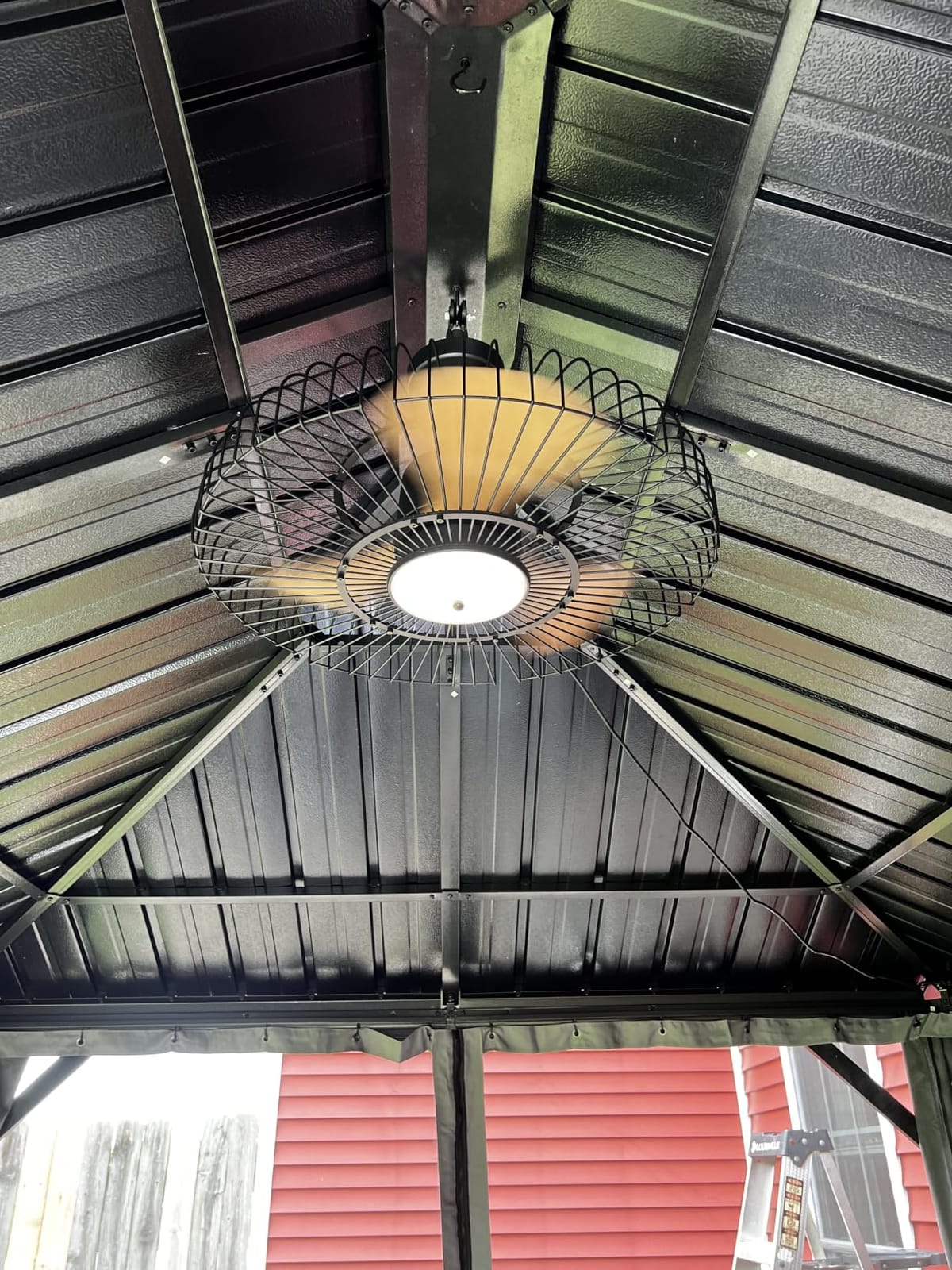
Plan the power run before the build. Owners report no built-in conduit or concealed channel, so a fan or lighting needs an outdoor-rated extension routed along a post, ideally inside a surface-rated conduit rather than a loose cord. Fans matter more here than in most gazebos because of the heat note below.
Who should skip it
Skip it if you have a small yard. A 12 by 20 footprint is a substantial structure, and the 240 square feet is wasted on a compact patio. It is also the wrong pick for someone unwilling to bolt it down, because panels can dent in hail and the frame can overturn in extreme wind if anchoring is skipped.
Skip it if your budget is mid-range, since this sits at the top of the metal class and a buyer who will not use the extra length has no reason to pay for it.
2. HAPPATIO 12×12 Aluminum Hardtop — Best Value for a Standard Tub
HAPPATIO 12’x12′ Outdoor Hardtop Gazebo, Aluminum Gazebo with Double Galvanized Steel Roof, Curtains and Netting for Patio, Backyard, Deck, Lawn, Easy Assembly (Grey)
144 sq ft covered area
Waterproof double steel roof
Aluminum frame
117.5 in peak
Pros
- Aluminum frame shows no rust after multiple winters
- Double roof ventilates and blocks UV
- Dual rail system runs curtains and mesh independently
- Top hooks for lights
- fans or decor
Cons
- Mesh hooks leave a gap at the top
- Roof panels do not seat perfectly flush
- Dark curtains faded within one summer
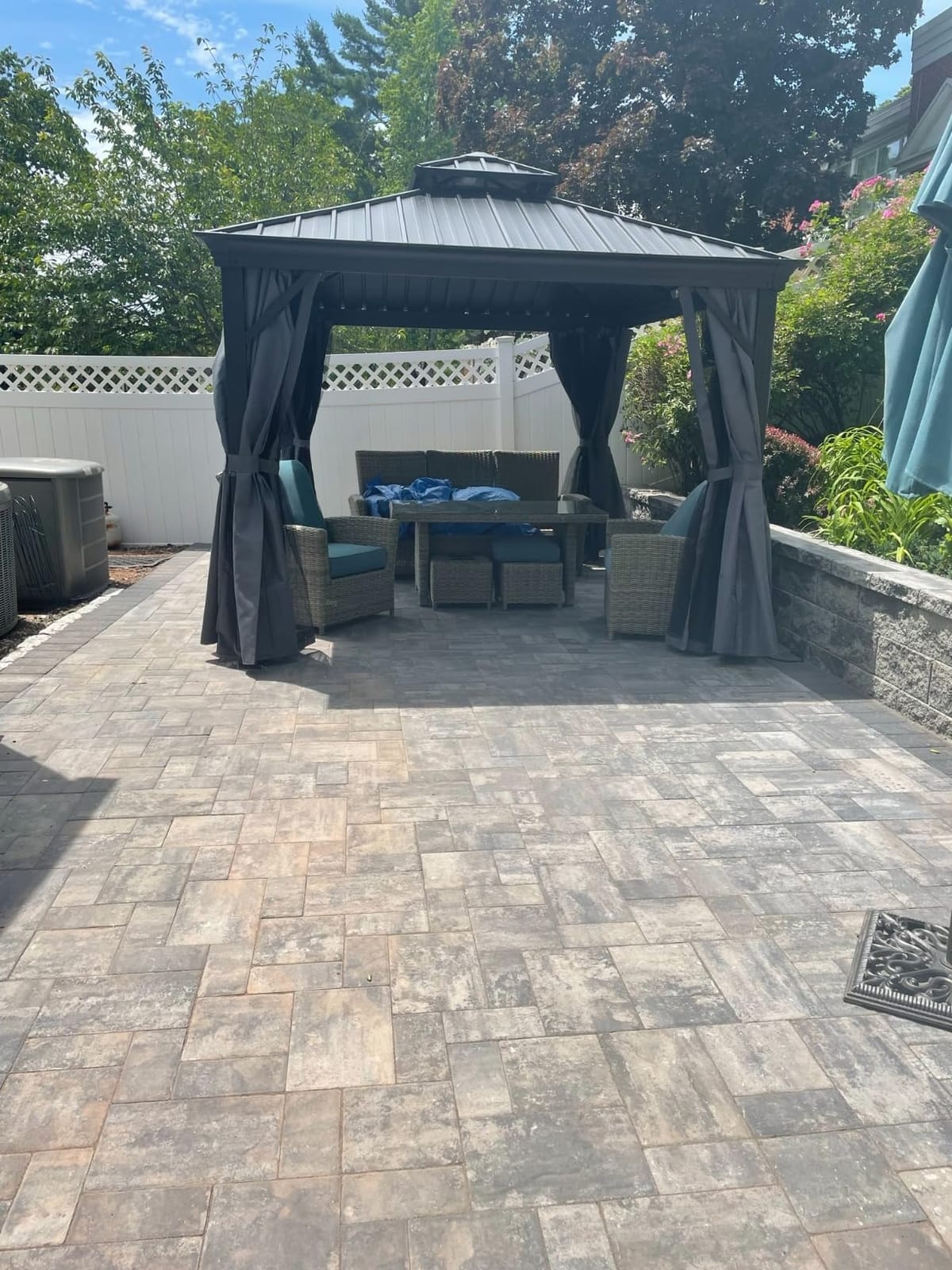
This is the most common answer we give to an eight foot tub in a normal backyard, and the reasoning is arithmetic. A 144 square foot footprint over a 7 by 8 or 8 by 8 tub leaves roughly 24 to 30 inches on the two long sides, which is the tightest walk-around most owners accept. Step up to 12 by 16 if your tub is larger or you want a bench inside.
Owners report no rust after multiple winters, which is the specific failure mode that pushes people toward aluminum in the first place. A hot tub enclosure lives in permanent humidity, and steel frames are where corrosion starts showing.
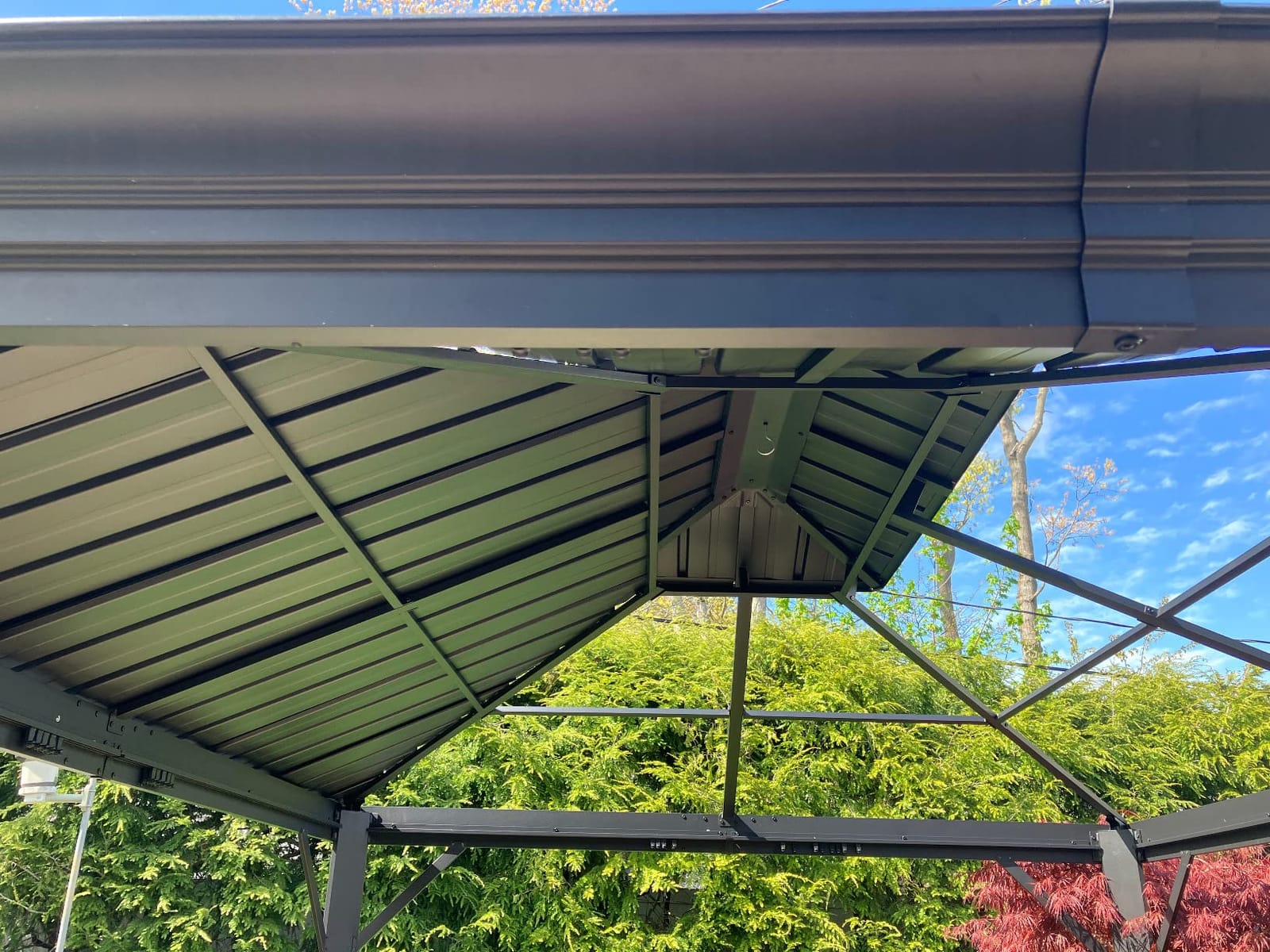
The double roof with integrated ventilation is the part that matters most under a spa. Hot air and moisture rise to the upper tier and leave through the gap between the two roofs, and the top hooks let you hang a light, a fan or a small heater from the frame without touching the panels. Several owners have mounted heaters, TVs and solar lighting inside and use the space as a small living area in warmer months.
Curtains and mesh run on a dual rail system, so you can slide each independently. That flexibility is what makes a four-season structure practical: mesh only in summer, curtains in spring and fall, both in winter. The included netting is removable, and customer service has replaced damaged parts at no cost for buyers who asked.
What to check before you buy
Look closely at how the mesh attaches at the top. Owners report shower-curtain-style hooks that leave a gap where insects get in, and a spa already attracts them. If mosquitoes matter in your area, plan to add a strip of screening or velcro along the top rail rather than assuming the included netting seals.
Budget real time for assembly. Owners describe it as tedious and realistically a two-person job over several hours, and the roof panels do not seat perfectly flush with one another. If you are building around a tub that is already plumbed in, that time cost lands on top of an already awkward site.
Who should skip it
Skip it in a snow belt. No published psf or mph rating appears on this listing, so there is nothing to check a local code requirement against. If you live where snow accumulates on roofs through the winter, pick a model with a stated snow load instead.
Skip it if you want a sealed, heated room in January. The rails accept sidewalls, but this is still a shade-and-shelter structure, and a fully enclosed four-season room solves a different problem at a different budget.
3. Aoxun 12×12 Double Galvanized Steel Roof — Best Seller With the Most Feedback
Aoxun Gazebo 12×12 Hardtop Gazebo with Double Galvanized Steel Roof, Gray
144 sq ft
Metal frame
119.6 in peak
Listed as water resistant
Pros
- Best sellers rank #5 in Gazebos
- 703 reviews give the deepest read on long term fit
- Double roof insulates and ventilates
- Top hook holds 44 lbs
Cons
- Lowest average rating here at 4.0
- UV protection figure of 25 is low
- Only water resistant rather than waterproof
This is the listing with the most long-term feedback in the roundup. A large sample means you can see the failure patterns clearly, and the 4.0 average with a 12 percent one-star share is the lowest here, with 56 percent of reviews at five stars compared to 73 to 85 percent across most of the group.
Physically it is a solid 144 square foot hardtop with a metal frame at 297.6 pounds and a 119.6 inch height. The double roof design does two jobs at once: it insulates the top layer and vents rising heat through the gap, which is the pairing you want under a spa.
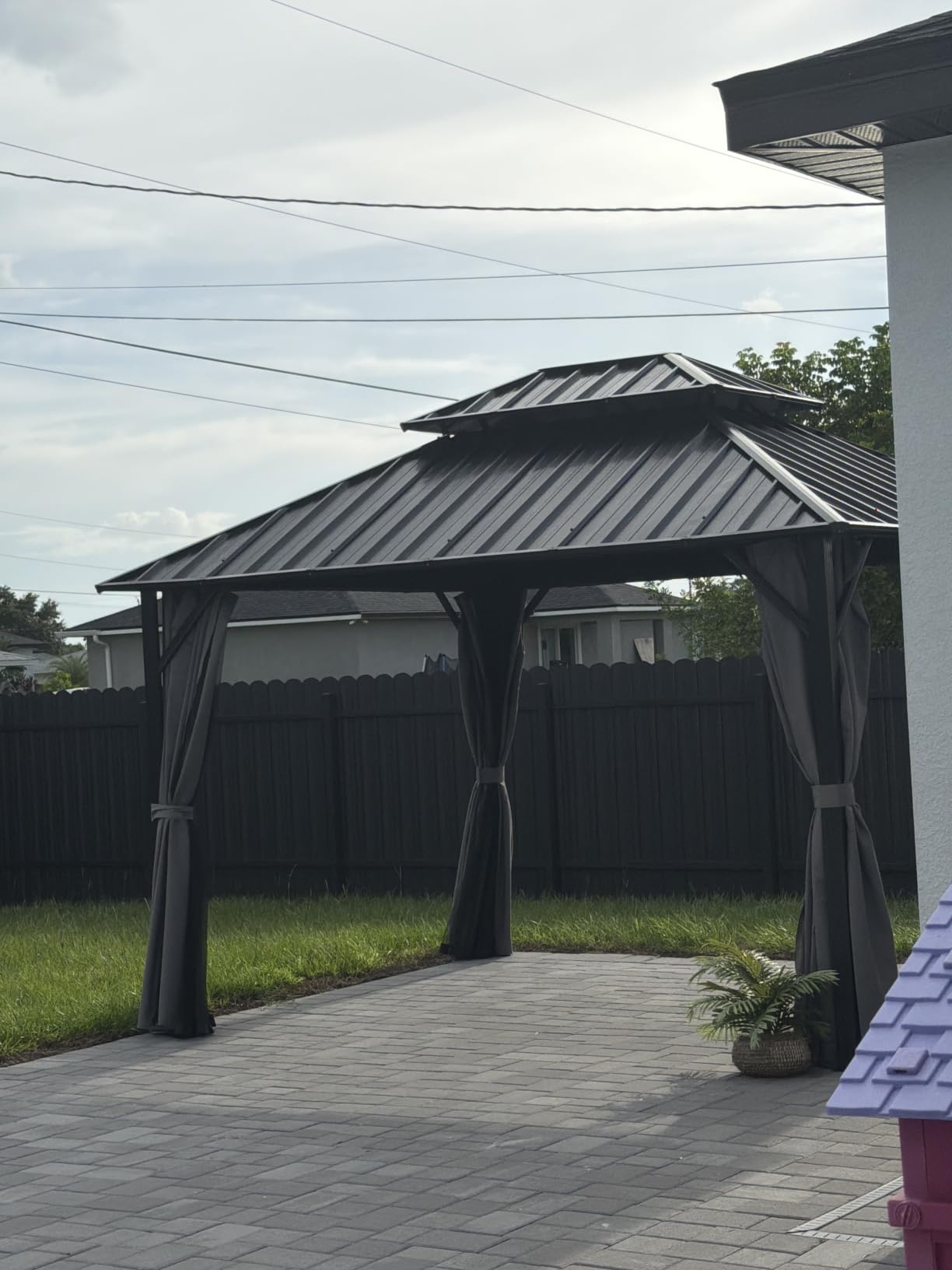
Sidewalls are 180 GSM gray polyester curtains plus 40 GSM insect netting, both on the dual rail, and the top hook is rated to hold 44 lbs for a ceiling fan or a small infrared heater. The listed assembly time is two to three hours for two to three people.
The frame uses a triangular structure with a powder coat finish that reviewers say resists scratching and corrosion. That triangular post geometry shows up across this category and it matters: a triangular section resists racking far better than a square tube of the same width, which is what keeps a frame square in wind.
What to check before you buy
Read the water resistance line carefully. This listing says water resistant rather than waterproof, and the UV protection figure of 25 is the lowest in the group. For a cover that already lives under direct sun, a roof that blocks less UV is a small but real cost in cover life.
Check the corner fit. A 4.0 average with a 12 percent one-star share usually points to a specific recurring complaint rather than random noise, so read the one-star reviews before ordering. Expect at least two people and a full morning.
Who should skip it
Skip it if a hot tub is involved and you plan to run sides through winter in a cold climate. Water resistance plus a modest UV figure is not the pairing you want where moisture will sit against fabric for months. Choose a listing that states a waterproof level and a higher UV block.
Skip it if you want the strongest published weather numbers. This listing publishes neither a snow load nor a wind speed, so it cannot be checked against a local requirement the way the Kozyard or HOTEEL specs can.
4. Aoxun 10×12 Cedar Wood Gazebo — Best for a Natural Backyard Look
Aoxun 10′ x 12′ Patio Wood Gazebo Cedar Wood, Natural
120 sq ft
4 by 4 in cedar columns
Rated 73-83 mph
370 lb build
Pros
- Real cedar posts and frame for a warmer look
- Only published wind and snow ratings in the cedar class
- Labeled parts with a spare parts kit included
- Held intact through 60+ mph storms
Cons
- Hollow legs reported on some builds despite solid cedar listing
- Thin written instructions
- Roof panels get loud in wind
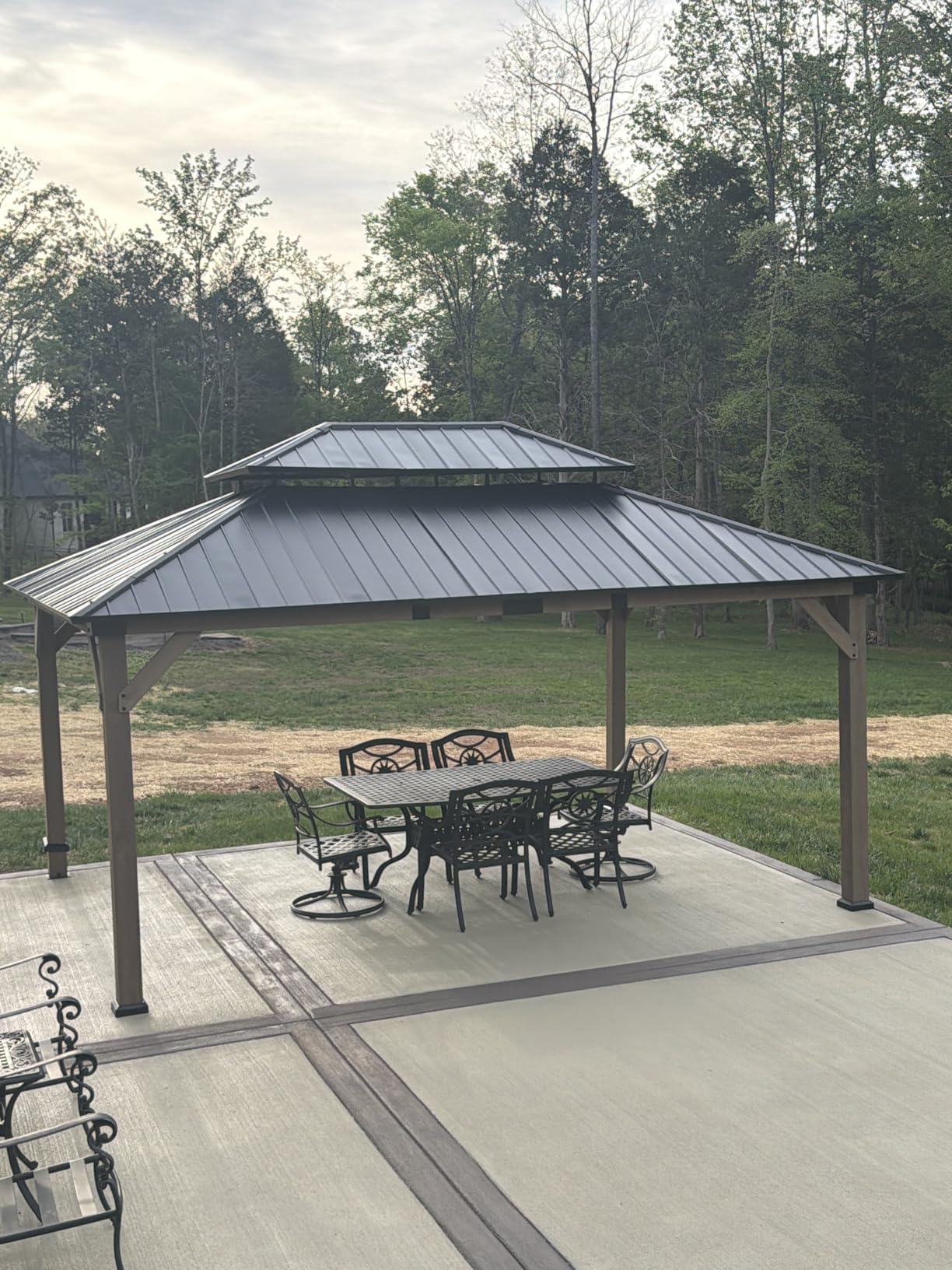
Most shelters in this category are gray metal. If your yard is timber, a garden beds or anything warm toned, cedar changes how the structure reads. This 10 by 12 uses a metal frame with cedar wood columns at 120 square feet, and owners consistently describe the appearance as richer and more premium than the listing suggests.
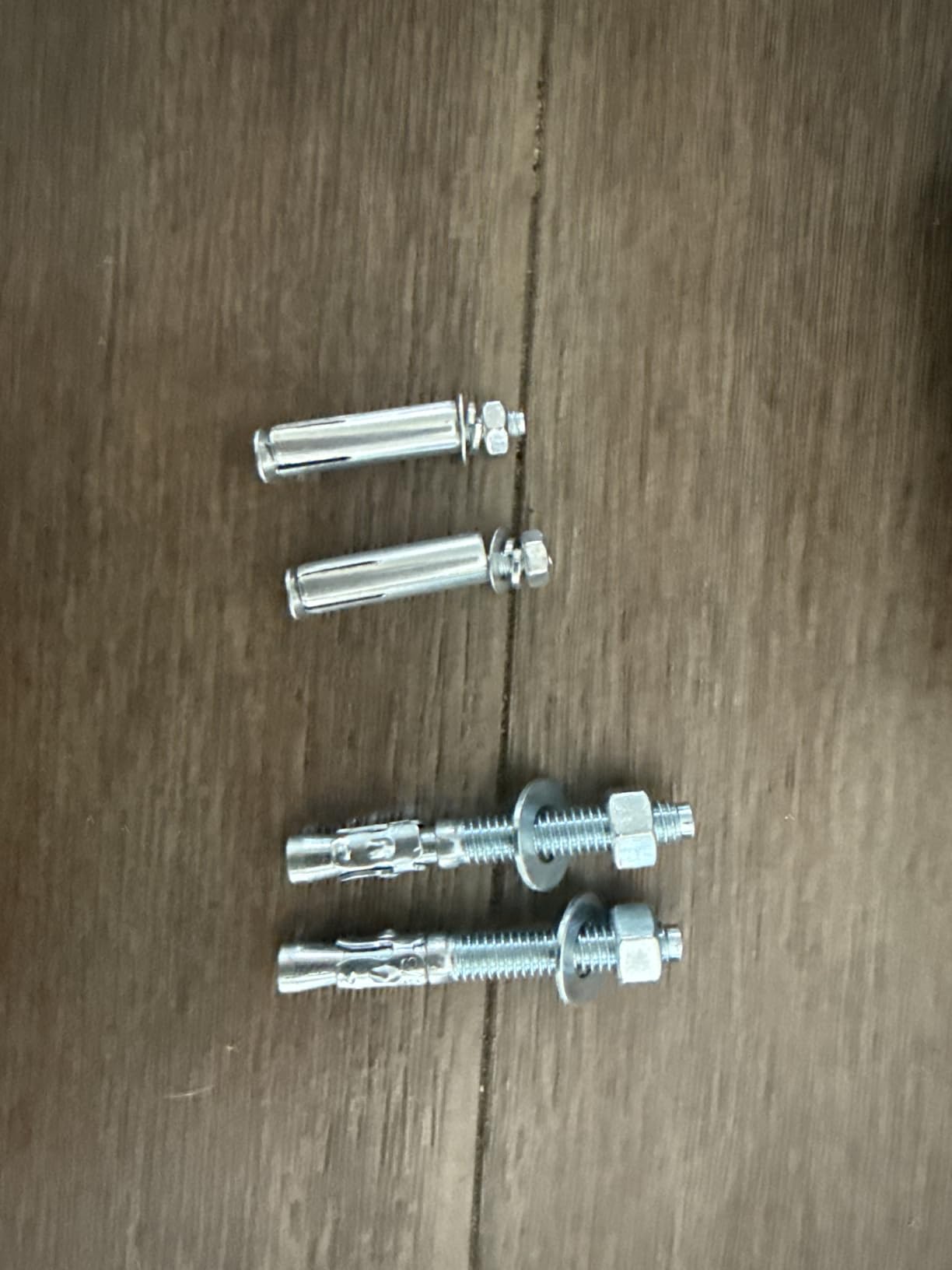
It is also the only cedar option here with published weather numbers: rated for a 10 inch snow load and a 12 wind class, which the manufacturer puts at 73 to 83 mph when anchored with expansion bolts. That is the highest stated wind figure in the roundup. Reviewers report it holding intact through 60 mph plus wind storms, which lines up.
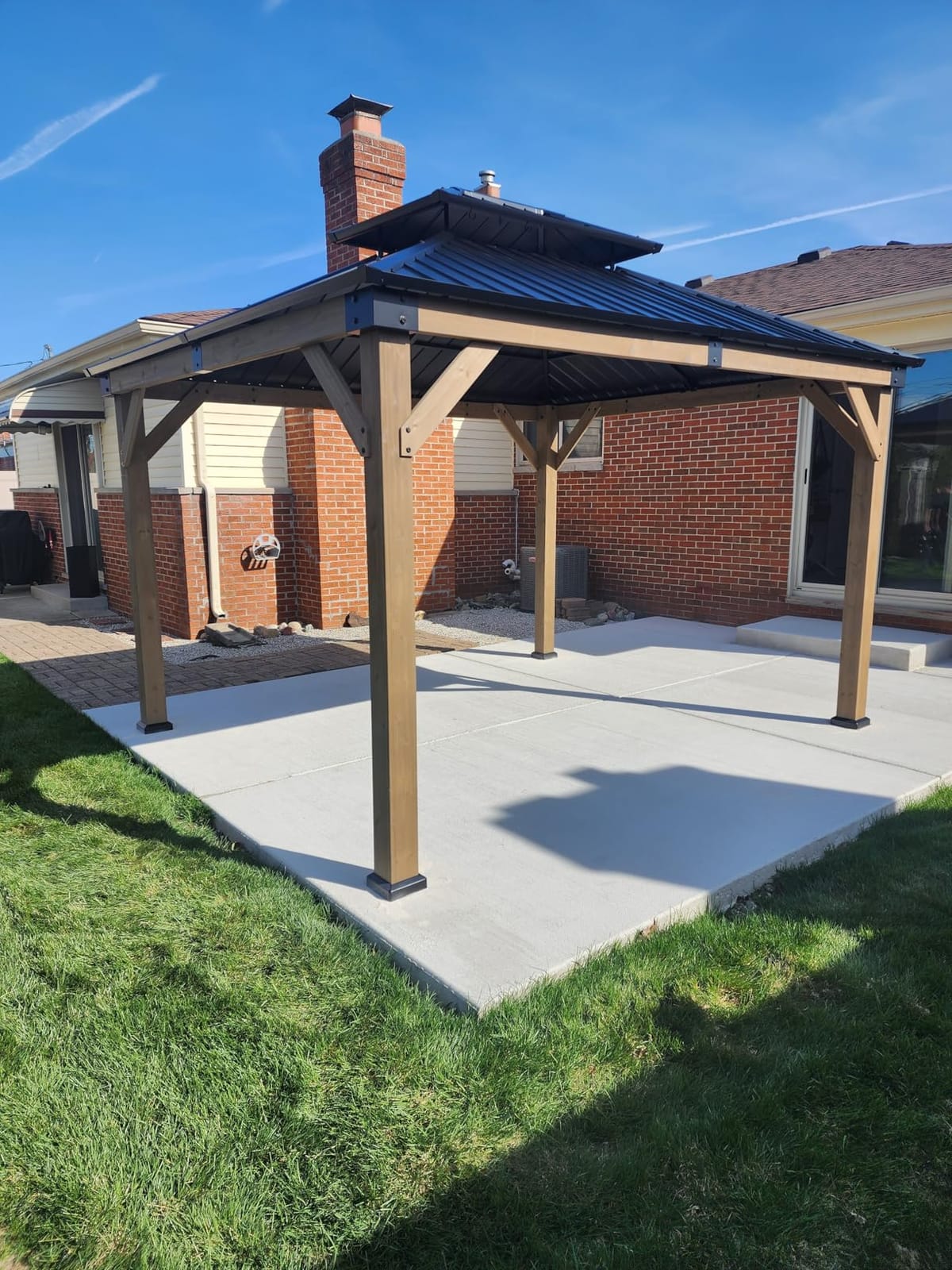
The dual sloped roof promotes airflow to keep the interior cooler on hot days, and ceiling hooks hold up to 44 lbs. All parts are labeled and a spare parts package is included, and most buyers report no missing hardware.
Wide four by four inch columns add both strength and the classic look. At 370 pounds it is one of the heavier units here, so plan the site and the crew accordingly. If a vertical cover lifter is on your hot tub, confirm the 114 inch height clears its fully open position before ordering.
What to check before you buy
Ask about the leg construction when it arrives. Some buyers report hollow four-piece legs rather than solid cedar despite the listing, and that is a meaningful gap between the description and the build. Check one leg before you commit a full day to assembly, and photograph the delivery.
Factor in wood maintenance. Cedar needs sealing in wet climates, and this is a structure that will sit in a permanently humid microclimate next to a spa. If you are not willing to reseal it every couple of seasons, a powder-coated aluminum frame is the lower-maintenance choice.
Who should skip it
Skip it for a large tub. At 120 square feet this is a tight fit, and a 7 by 8 tub inside it leaves very little walk-around. Owners running 12 by 12 over an 8 by 8 tub are the pattern that works; scale that up for a bigger spa and you are past this footprint.
Skip it if you will not anchor it. The stated wind rating only applies with expansion bolts, and an unanchored cedar frame is the first thing to go in a storm.
5. Aoxun 12×16 Hardtop with Built-In Drainage — Best for a Large Tub and a Lounge Area
Aoxun 12′ X 16′ Hardtop Gazebo with Built in Drainage, Outdoor Gazebos
190.56 sq ft
99 percent UV blocking
Hidden gutter system
Dual-track sidewalls
Pros
- Concealed gutters drain through the corner posts
- UPF 50 plus blocks 99 percent of UV
- Vented top tier moves rising hot air
- Largest covered area per dollar in the group
Cons
- Aluminum posts are lighter than steel rivals
- Style listing says country on a modern build
- 12 by 16 means a longer multi-person assembly
This is the one to look at if your tub is a six person or larger model and you want somewhere to sit that is not the tub. At 192 by 144 inches it gives you 190.56 square feet, which owners use for large dining sets and outdoor bars alongside the spa. It ranks #21 in Gazebos with 171 reviews and a 78 percent five-star share.
The drainage detail is the standout. A hidden gutter system channels rainwater through the corner posts, so runoff leaves at the four corners instead of sheeting off the roof edge. If your tub sits on a pad shared with a seating area, that keeps the deck dry and avoids the splatter line along the base of the structure.
UV performance is the other reason to like it. The double metal roof is listed at 99 percent UV blocking, UPF 50 plus, which is the highest stated figure in this roundup, and the elevated top tier vents rising hot air. That combination matters for cover life: a spa cover that spends its life in direct sun degrades faster than anything else on the tub.
The sidewalls use independent dual tracks with 180 GSM polyester curtains and 35 GSM insect mesh, both with double-headed zippers, so they slide independently and meet in the middle cleanly. The frame is a reinforced all-metal build with triangular aluminum posts, and a reinforced ceiling hook takes lights, a chandelier or a fan.
What to check before you buy
Anchor carefully. Owners and the spec sheet both point out that the aluminum posts are lighter than the heavy steel competitors, so a 12 by 16 needs real anchoring rather than a token screw into a paver. The lighter frame is also why the highest wind figures in this roundup come from steel-heavy models.
Confirm the site is level and square. At this footprint, a small base error shows up as visibly out-of-square posts, and 190 square feet of roof amplifies any lean. A laser level and a day of prep pay for themselves.
Who should skip it
Skip it if you are in a snow belt and need a published figure. This listing gives neither a snow load nor a wind speed, so there is nothing to compare against a local requirement the way the Kozyard or HOTEEL specs can.
Skip it if you need the ventilation benefit. The double roof does shed heat well, but it has no screened vent in the peak like the PURPLE LEAF solarium, so the steam from a large spa stays in the structure longer without a fan moving it.
6. HOTEEL 10×15 Hardtop — Best for Snowy Climates
HOTEEL 10×15 Hardtop Gazebo On Clearance with Heavy Duty Galvanized Steel Metal Roof, Patio Hard Top Gazebo with Curtains & Netting, Outdoor Permanent Hot tub Gazebo Pavillon for Backyard, Black
150 sq ft
18.43 psf snow rating
9 ft peak height
345 lb build
Pros
- Publishes a snow load in psf at 18.43
- Marketed and sized specifically for hot tub use
- CPAI-84 flame-resistant washable curtains
- Pre-drilled base with expansion screws
Cons
- Instructions are cluttered and hard to follow
- Roof assembly is the hardest part
- Post legs and screws arrive damaged sometimes
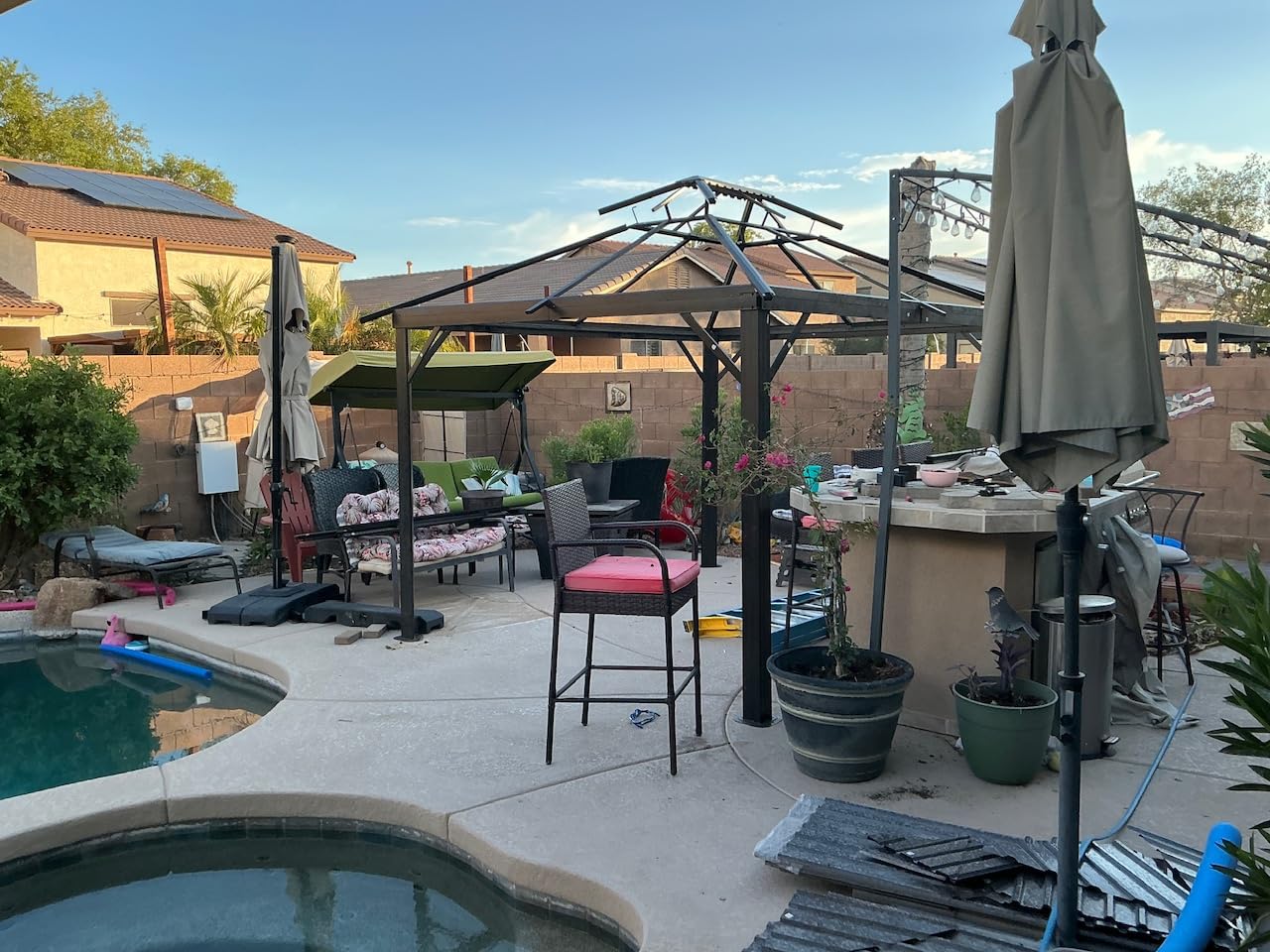
This is the pick for anyone whose tub still gets used when it snows. It is one of two products in the roundup marketed and sized explicitly as a hot tub gazebo, and it is the only one publishing a snow load figure in psf: 18.43 psf on the galvanized steel roof, with a ventilated double roof above it.
The 10 by 15 footprint gives 150 square feet across, which fits a rectangular tub with walk-around on the long sides and leaves a strip for a towel shelf. The listed peak height is nine feet, and at 108 inches of overall height the interior clearance is the most generous in the group, which matters for standing up and for a vertical cover lifter.
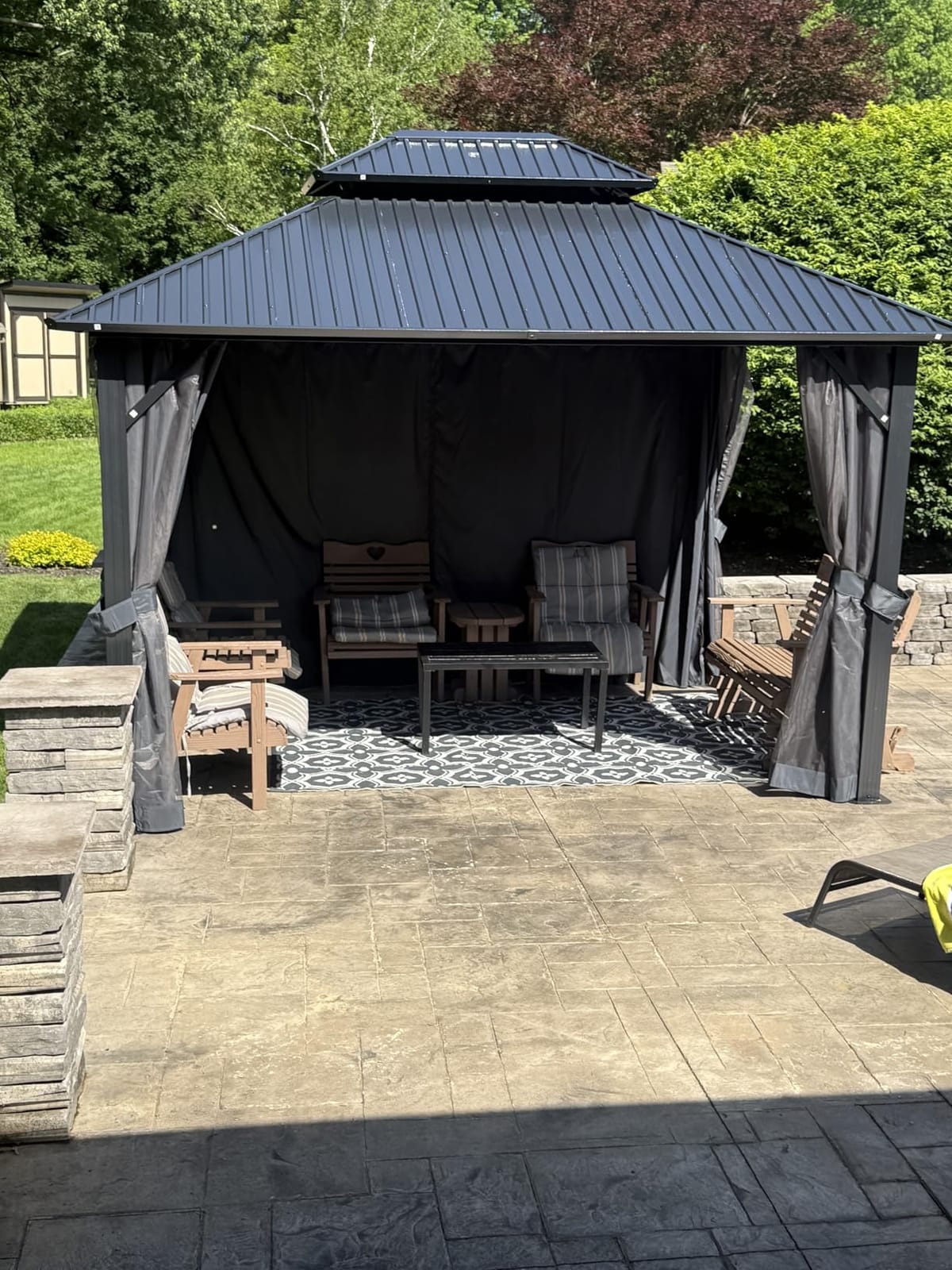
Sidewalls are CPAI-84 flame-resistant 160 GSM polyester curtains in four pieces and machine washable, plus sidewall mosquito netting with top netting on dual tracks. The pre-drilled base ships with expansion screws for concrete; if you are mounting to a wood deck you will need separate screws, which the listing calls out. Owners report the curtains have held up over a year of weather and that it does not leak.
At 345 pounds it is a serious structure and the frame is powder-coated aluminum. Two ceiling hooks take lights or fans. Assembly is listed at three to four people for about four hours, so plan the crew before the delivery date rather than after.
What to check before you buy
Read the manual before the boxes arrive, because reviews single out documentation as the weak point and one buyer could not complete the build. The frame is reported as easy; the roof is reported as the difficult part. Set aside an uninterrupted block of time and have the roof panels sorted before you start on the frame.
Inspect the hardware on arrival. Post legs and screws occasionally arrive damaged or missing, and some parts ship without protective packaging and show up scratched. Everything spare is easier to order before the build than halfway through it.
Who should skip it
Skip it if you are impatient with assembly, and pay for assembly help instead of fighting the instructions.
Skip it if your tub is a large square model. Ten feet of width is tight for a 7 by 7 tub, and you will end up with very little walk-around on the ends. In that case go to a 12 by 12 or 12 by 16.
7. Kozyard Alexander 12×12 Hardtop — Best Heavy-Engineered Build
Kozyard Alexander 12′ x 12′ Hardtop Gazebo, Aluminum Frame
144 sq ft
2500 lb snow load
60 mph wind
397 lb build
Pros
- Thickest roof panels in the group at 29 gauge
- Published 2500 lb snow and 60 mph wind ratings
- Integrated gutters run water down the posts
- Over 1500 reviews of long term feedback
Cons
- Heaviest unit here at 397 pounds
- Highest cost in the 12 by 12 class
- Roof panels take a long time to fasten
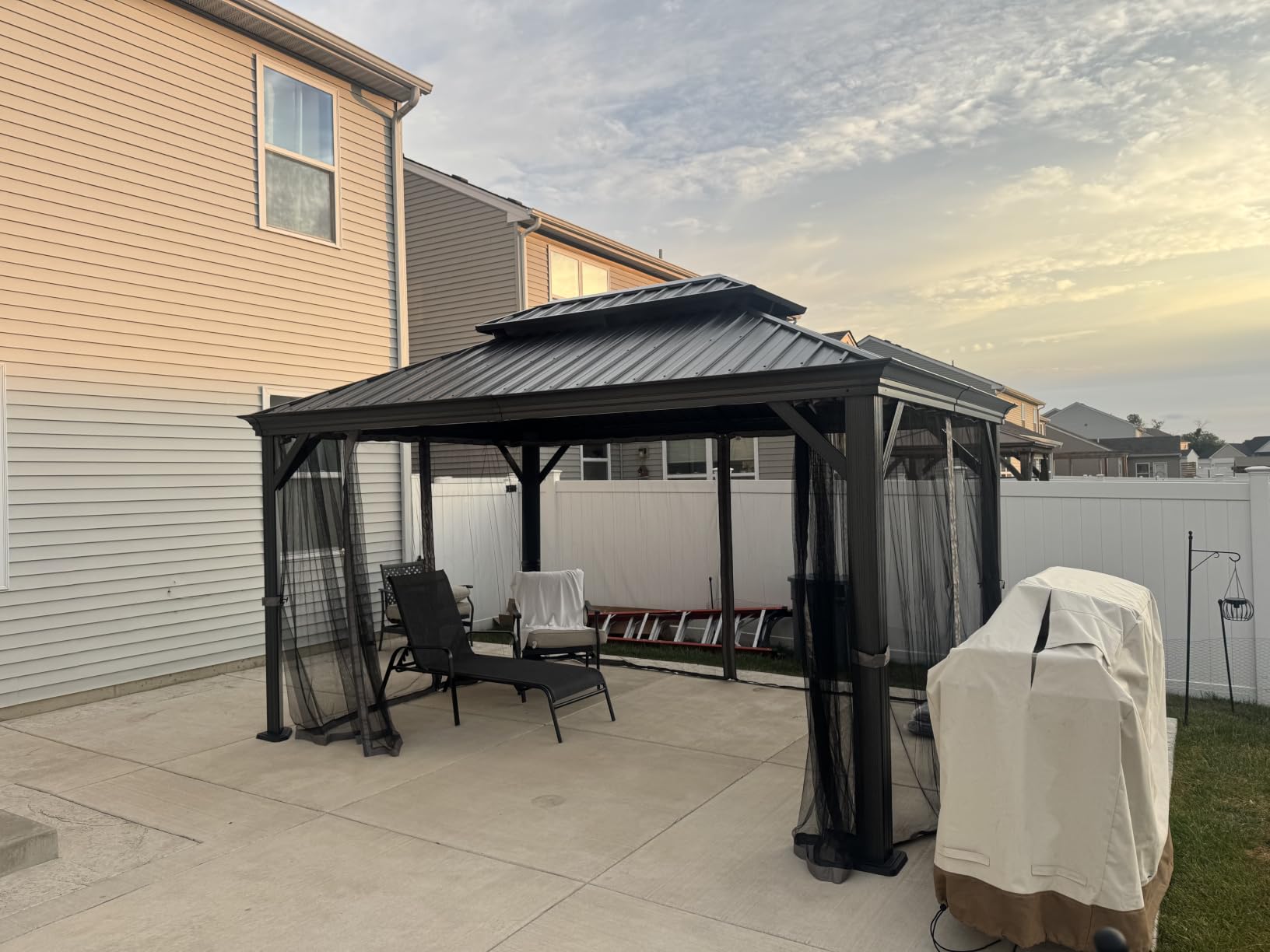
The Kozyard Alexander is the most engineered 12 by 12 in this roundup, and the specifications back that up rather than just claiming it. The frame uses 4.7 by 4.7 inch triangular aluminum posts with 5 by 4 inch reinforced beams, and it is rated for a 2,500 lb snow load and wind up to 60 mph when properly anchored.
Those two numbers are the reason it matters under a hot tub. Snow load in pounds is directly comparable to a filled spa sitting beneath the roof, so a 2,500 lb rating tells you the structure can carry the load path above the tub. Wind speed is the other half, since a 12 by 12 roof presents a real sail area to a storm.
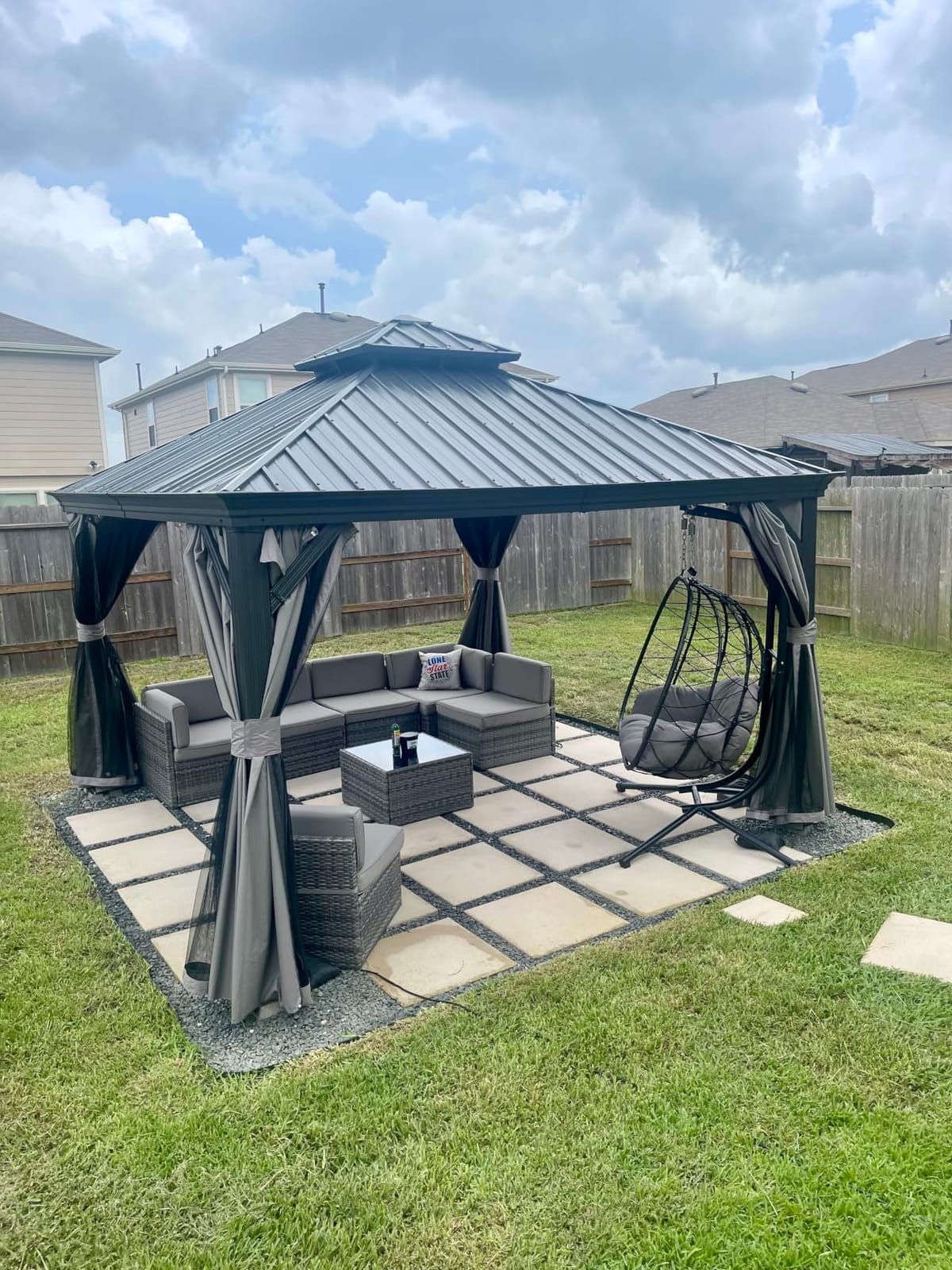
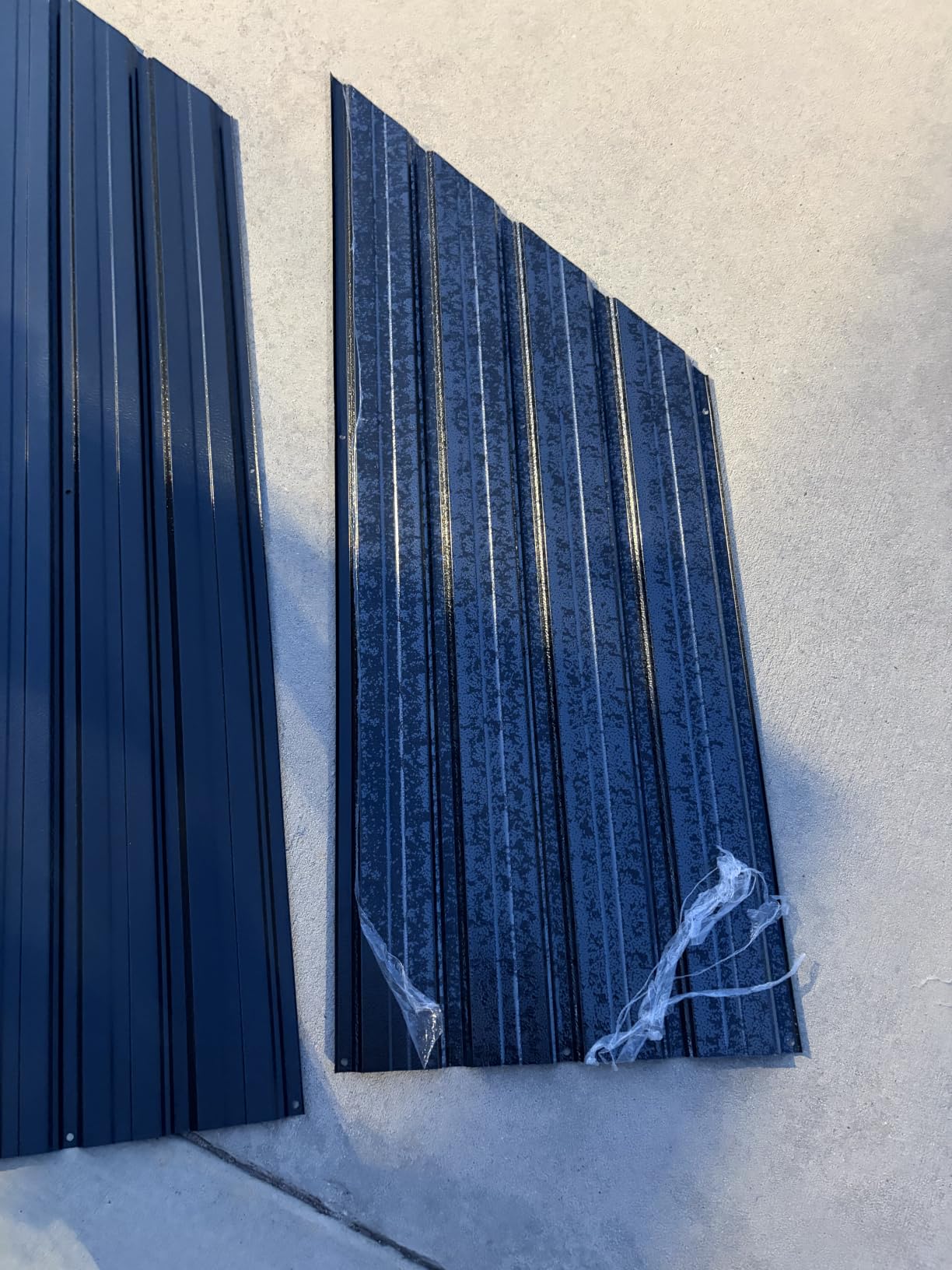
The roof is 29-gauge galvanized steel, thicker than the panels on most competing gazebos, with an integrated gutter system that routes water down the poles to keep the deck dry. The double-roof design improves airflow, reduces heat buildup and adds wind resistance, which is exactly the combination the steam problem needs.
Sidewalls are dual-track double-layer with double-sided zippers, gray polyester curtains and mesh. With more than 1,500 reviews and a 77 percent five-star share, the recurring theme is that it feels permanent. The dominant complaint is weight: 397 pounds means several strong people and probably professional assembly.
What to check before you buy
Budget for professional assembly rather than a weekend. At 397 pounds, the frame is the heaviest here and the roof panels take a long time to fasten together. Several owners describe the whole build as a multi-day proposition with more than one helper, and the roof in particular slows things down.
Note that the listing calls the roof water resistant rather than fully waterproof. On a well-sloped double roof over a tub that is covered most of the time, this is a minor distinction, but if you plan to run open sides through heavy rain, ask about it directly.
Who should skip it
Skip it on budget if a mid-range aluminum 12 by 12 will do the job. The engineering premium is real, and you only earn it back in a snow and wind climate or if you intend to keep the structure up permanently.
Skip it if you are building alone or with one helper. The weight is the single most reported friction point and it is not something the instructions solve.
8. UDPATIO 12×20 Pavilion — Best for a Large Yard
UDPATIO 12’x20′ Hardtop Gazebo, Permanent Pavilion for Lawn Garden, Beige
240 sq ft
Reinforced brackets
Splice card frame
120 in height
Pros
- 240 sq ft footprint at the top of the roundup
- Reinforced corner brackets cut frame sway
- Mounts on concrete or lawn with included fixings
- New splice card design reduces screw count
Cons
- Longest build here at 8-10 hours for 3-4 people
- Beige shows dirt faster than darker finishes
- Newer listing with a smaller track record
This is the footprint pick for anyone who wants the tub, a dining table and a bar under one roof. At 240 square feet it matches the largest structure in the roundup, and the engineered details are aimed at the problem that comes with a span that size: sway. Thickened reinforced corner brackets and secure horizontal crossbars are what keep a 20 foot side from flexing under heavy furniture.
The frame uses a new splice card slot design that reduces the number of screws and increases frame strength, which cuts both assembly time and the number of joints that can work loose over years. Dual-track sidewalls come with privacy curtains, screens and reinforced ceiling hooks rated for lights, fans or heaters.
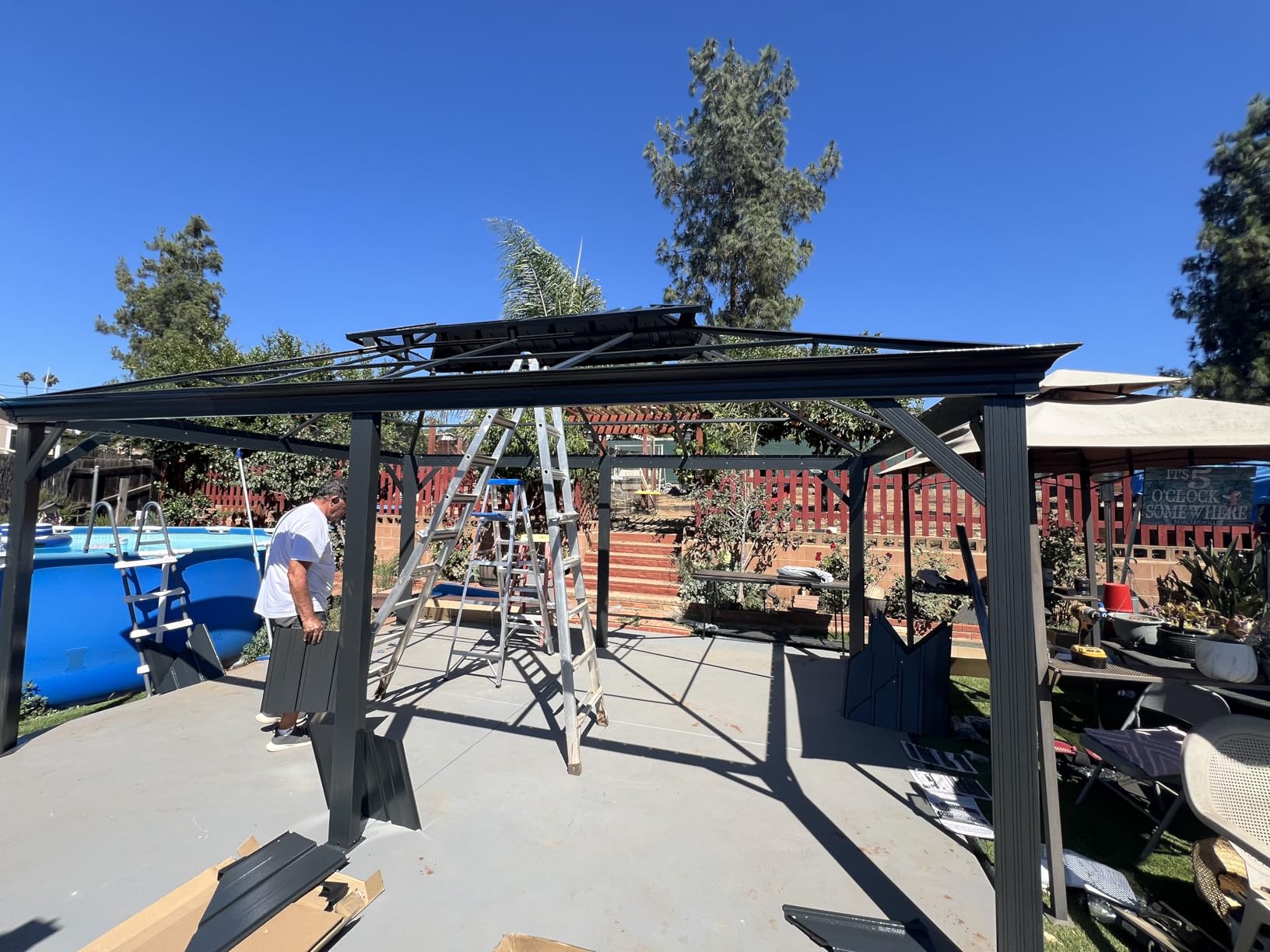
The anchoring system is the sleeper feature. One ground fixing system is compatible with concrete, wood decks and lawns, and anchor bolts and ground stakes are included. That matters for hot tub sites specifically, because not every pad is a poured slab and some owners are working on an existing deck.
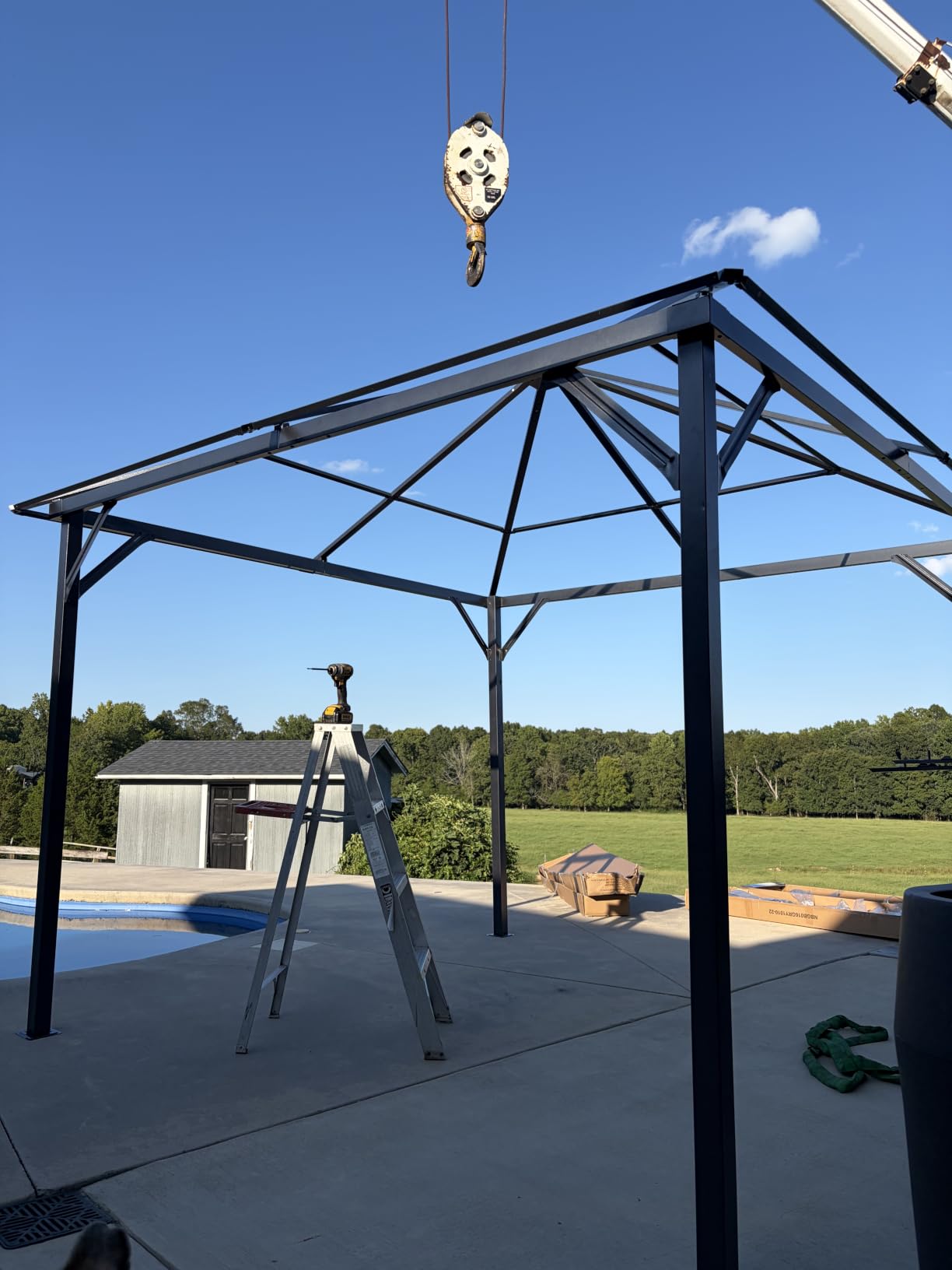
The build is the honest drawback. It is listed at roughly eight to ten hours for three to four people and the parts are split across five cartons, so more than one delivery may be needed and the layout space has to be real. At 4.3 stars with a 64 percent five-star share and a low sales rank of #214 in Gazebos, it is also the newest listing in the group with the least history behind it.
What to check before you buy
Plan the build as a two-day job with a crew of three or four. Do not plan it as a Saturday project. The 120 inch height gives a ten foot peak, so measure your cover lifter against that, and confirm the tub plus a walk-around fits inside a 240 square foot rectangle rather than assuming it will.
Check your finish choice carefully. Beige fabric and frame show dirt more readily than the gray and black options, and a structure next to a spa collects splash and pollen. Dark finishes hide it better if you are not set on the color.
Who should skip it
Skip it if you have a normal-sized patio. You are buying 240 square feet and a full day of assembly for shelter that a 144 square foot model delivers more cheaply. This is for owners who plan to build an outdoor living room, not just a tub cover.
Skip it if you want an established track record. With the lowest five-star share in the group and the thinnest review history, you are buying on engineering claims rather than on years of owner reports.
9. Domi 12×12 Cedar Wood — Best for Thick Cedar Posts
Domi 12’X12′ Gazebo with Double Roof Steel, Heavy Duty Outdoor Patio Gazebo
144 sq ft
5.5 in cedar posts
2500 lb snow
10 ft peak
Pros
- Thickest cedar posts in the group at 5.5 inch
- Galvanized double roof rated for 2500 lbs of snow
- Built-in roof netting traps leaves while air flows
- Warmest looking structure here
Cons
- 40 mph wind rating is the lowest in the roundup
- Cedar needs sealing in wet climates
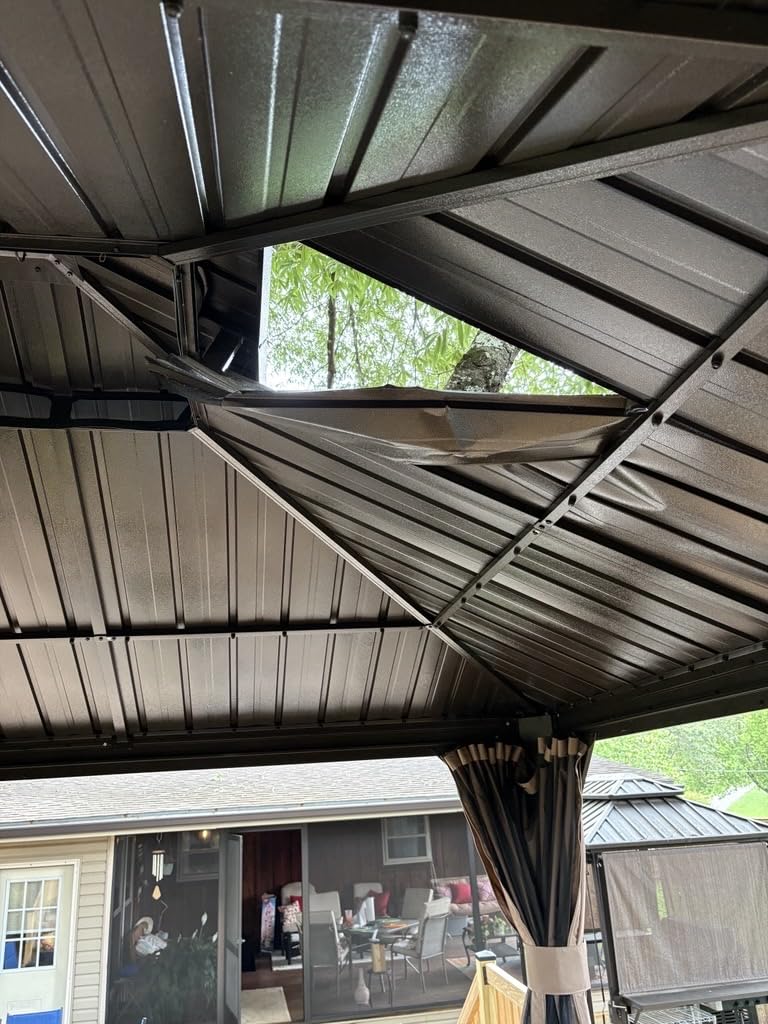
- Posts can arrive split or damaged
If you want timber, this is the better-built cedar option. The posts are 5.5 by 5.5 inch extra strong triangular cedar with pre-drilled bases, which is thicker than any other frame in this roundup including the metal ones, and it still reaches 144 square feet at a 122.4 inch height with a ten foot peak.
The galvanized steel double roof is rated for 2,500 lbs of snow, matching the Kozyard. A useful detail for a spa setting is the built-in leaf netting inside the double roof layer: it traps fallen leaves while still circulating air. Owners on hot tub threads point to leaf and debris accumulation as one of the main reasons they wanted a shelter in the first place.
Sidewalls are double-track detachable with double-sided zippers, netting and privacy curtains, and ceiling hooks take lights, fans and heaters. With 620 reviews and a 74 percent five-star share, buyers like the cedar look, the post thickness and the snow-rated roof, and several describe it as the most premium-looking structure at this footprint.
The wind figure is the thing to weigh. A 40 mph rating is the lowest published among the metal-framed gazebos here, and the cedar frame needs sealing and maintenance over time in wet climates. Both are manageable, but they are real ongoing costs that an aluminum frame does not carry.
What to check before you buy
Anchor it properly or do not bother. A 40 mph rating assumes a fixed base, and cedar posts with pre-drilled bases are designed to be bolted down. Inspect the posts on arrival, since splits and damage are reported by a small number of buyers.
Budget for sealing. Cedar outdoors in a humid microclimate needs periodic sealing to hold its finish, and skipping it leads to greying and surface checking within a few seasons. Set a reminder the first year rather than reacting after it looks tired.
Who should skip it
Skip it in exposed or coastal wind. Forty miles per hour is below the ratings several metal gazebos in this list publish, and a spa enclosure is often sited in an open yard where nothing breaks the wind. In that situation, take the aluminum and steel options.
Skip it if you want zero maintenance. Wood is the higher-touch option, and the price point here is also the highest among 12 by 12 units even before maintenance is counted.
10. Domi 12×15 Four-Season Sunroom — Best for Full Enclosure
Domi 12x15FT Sunroom Gazebo with 4 Sliding Doors on All Sides, Aluminum Patio Solarium Sunroom Kit All Season, Freestanding Enclosed Gazebo with Galvanized Steel Roof and Movable PVC Windows
175 sq ft
Four sliding doors
PVC screen walls
675 lb build
Pros
- Only fully enclosed option with doors on all four sides
- UV protected PVC walls moderate temperature
- Lockable sliding door is unusual for a gazebo
- Assembly listed at just 3-6 hours for 2-3 people
Cons
- Heaviest product in the roundup at 675 pounds
- Fully enclosed roof traps heat
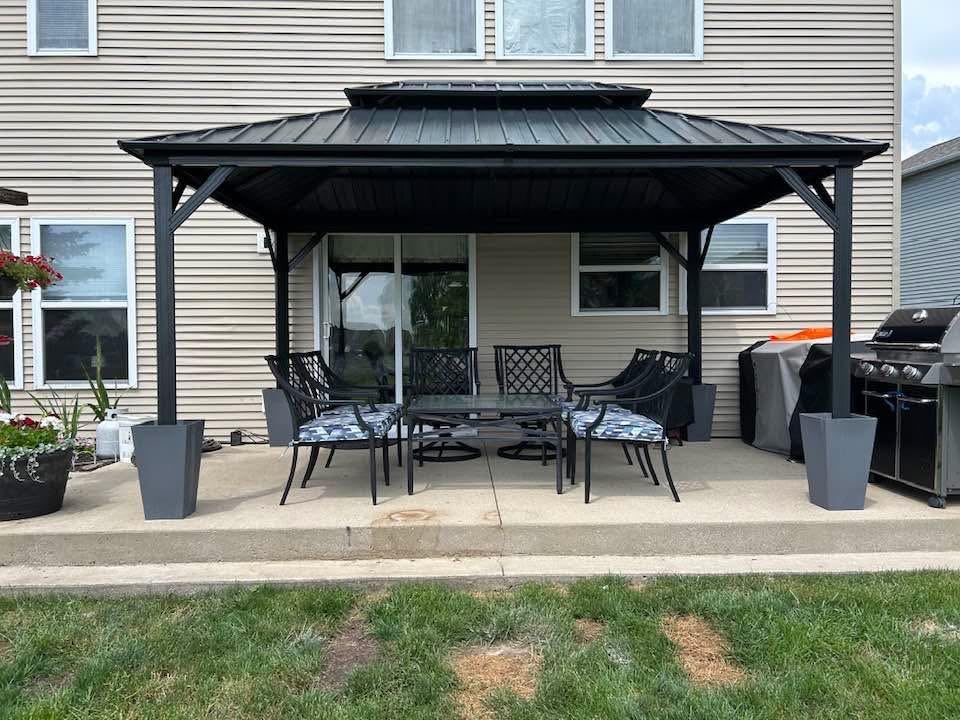
This is the only structure here that behaves like an actual room. Four sliding doors on all sides means you can open any face to the yard, and the adjustable UV-protected PVC screen walls let you trade airflow against temperature without removing panels. A lockable sliding door adds a layer of security that no open gazebo in this roundup offers.
Underneath it is a galvanized steel hardtop on a heavy-duty aluminum frame with 3.9 by 3.9 inch reinforced columns, giving 175 square feet at 176 by 142 inches and 112 inches high. Fixed Textilene mesh screens let a breeze through while keeping mosquitoes out, and optional removable snow support poles are included for winter stability.
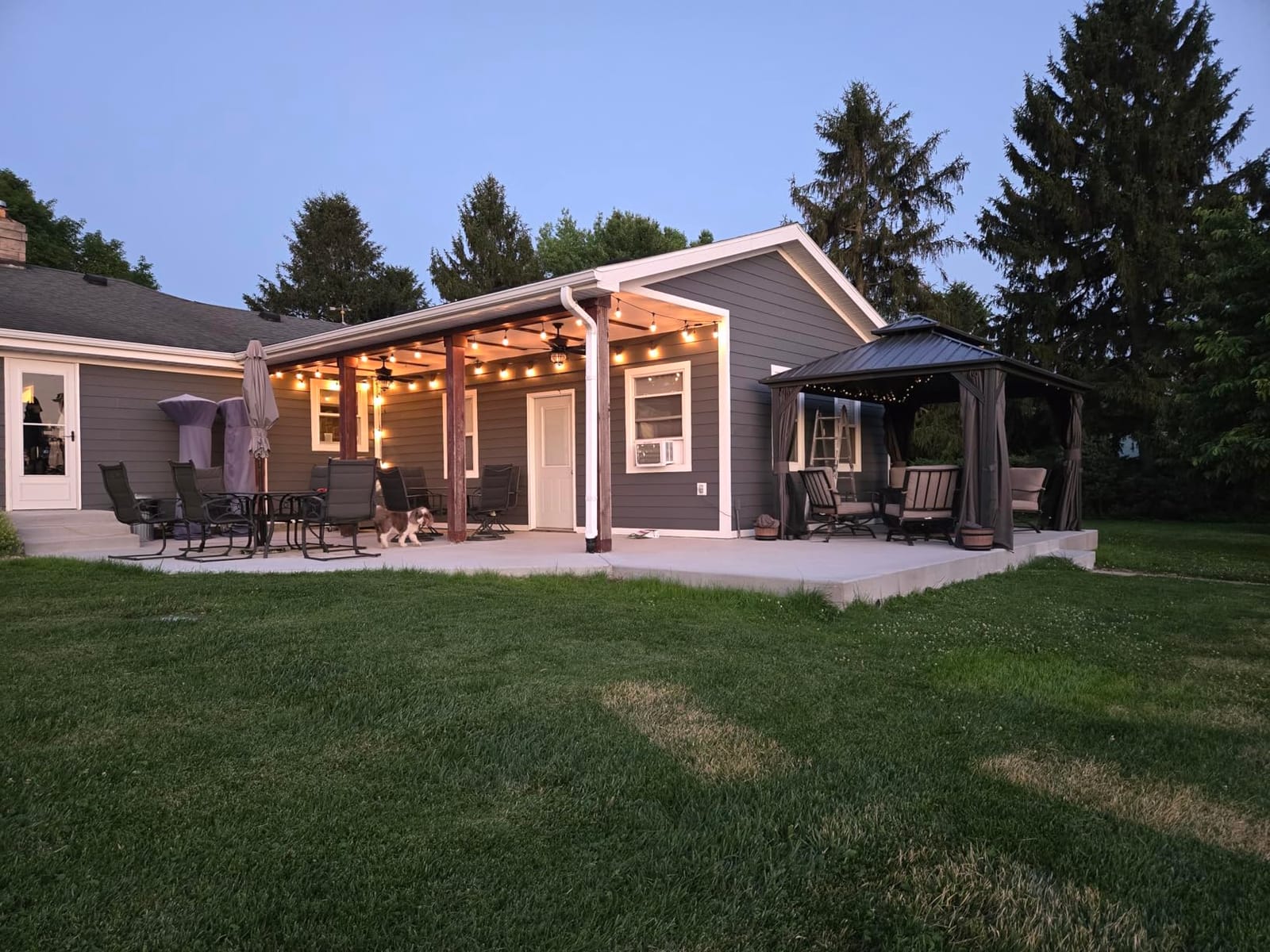
The counterintuitive advantage is the assembly time. At 675 pounds it is the heaviest product in the roundup, yet the listed build is only three to six hours for two to three people, which is unusually quick for a fully enclosed structure. Buyers treat it as a genuine four-season room rather than a shade structure, and the sliding doors and movable windows are the deciding features.
Plan ventilation deliberately. A fully enclosed roof traps heat, so usable cooling depends on opening the doors and screens. In summer the practical setup is doors open on two or three sides with a fan moving air through, and the same structure in winter with everything closed does real work for heat retention.
What to check before you buy
Check local permit rules before you buy. A fully enclosed structure with a lockable door can be treated differently from an open gazebo by a building department, and one reviewer flagged local permit rules as a real consideration. Ask your municipality what triggers a permit, since an unpermitted enclosed room can create a resale problem.
Plan the electrical for a fan and a heater from the start, and use a licensed electrician for anything hardwired. A structure this enclosed is exactly where an extension cord left running across a floor becomes a hazard, and the panels are not designed to carry wiring.
Who should skip it
Skip it if you only need shade and rain protection. This is the heaviest item in the roundup and you would be paying for enclosure you may never close. For a summer-use structure, an open 12 by 20 hardtop does the same job at a fraction of the weight.
Skip it if the site cannot carry it. At 675 pounds the structure concentrates a serious load on the base, and the footprint is large enough that the pad underneath has to be properly engineered rather than a standard patio.
11. PURPLE LEAF 12×16 Solarium — Best for Winter Soaking
PURPLE LEAF Outdoor Hardtop Gazebo 12′ X 16′ Solarium Double Roof Bronze
179 by 132 in footprint
360 degree enclosure
Three window modes
Vented double roof
Pros
- Full 360 degree privacy and year round usability
- Three window modes for airflow
- panels or open views
- Screened vent in the double roof
- Storage racks keep removable panels organized
Cons
- Picture-only instructions with no written steps
- Curtain zippers installed upside down
- About six feet of peak height feels cramped when tall
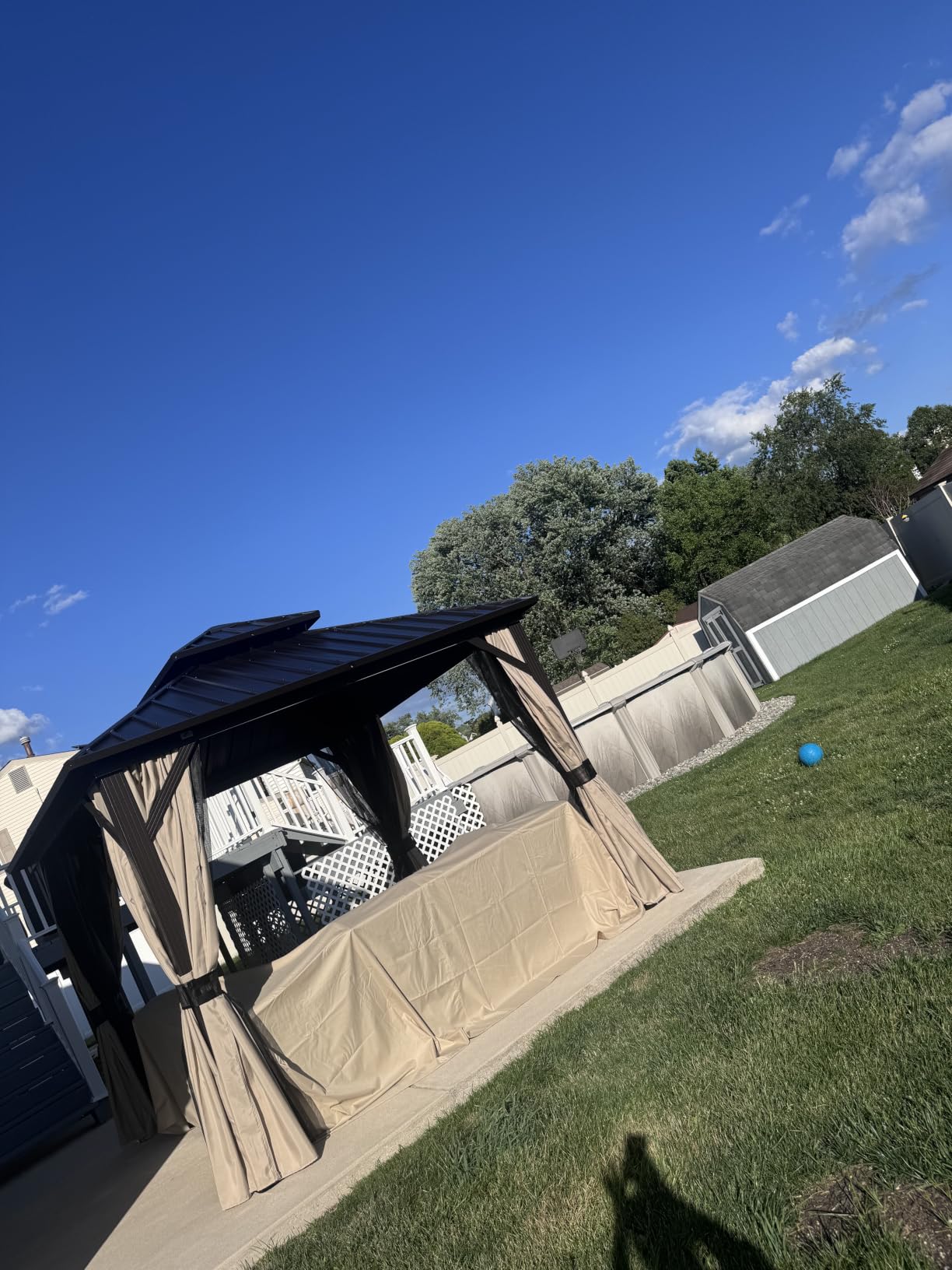
Where the Domi sunroom uses hard PVC walls on every face, this solarium gives you three window modes: removable screens, polycarbonate panels, or open views. That flexibility is the difference between a structure you tolerate in August and one you enjoy in January, because you choose airflow on a mild day and full protection on a cold one.
The roof is a ventilated galvanized steel double roof with a screened vent, built for heavy snow and strong wind, on a wood-grain aluminum frame that resists rust while blending into a garden. Front and back dual sliding doors create the indoor-outdoor flow, and built-in storage racks hold the removable panels so they do not end up leaning against the house.
Protection plan is five years on roof panels and one year on bolts, nuts and frame. One owner reports it held firm through 25 mph gusts once screwed down to the joists, and owners consistently praise the finished look, the privacy and the perceived build quality, with a 79 percent five-star share across 170 reviews.
Assembly is the dominant theme in the feedback. Several buyers completed it solo in about a day with a drill, but the picture-only instructions and upside-down curtain zippers are recurring complaints, and customer support is responsive yet often unable to solve assembly problems. That is the honest trade: a better finished room with a rougher build.
What to check before you buy
Measure yourself against the peak height. At roughly six feet of peak, taller owners report it feeling cramped, and you will feel it every time you stand up on the deck of the tub. If you are above average height, a hardtop gazebo with a listed ten foot peak is a better fit for headroom.
Expect to work from pictures. The instructions carry no written explanation, so budget a day and assemble it in one session rather than in pieces. Check the zipper orientation as you go, since reversing them later is annoying and the hardware is easy to reinstall.
Who should skip it
Skip it if headroom is your priority over enclosure. This is a room you sit and soak in, not one you stand and move around in, and the height is the one compromise in an otherwise very well-specified structure.
Skip it if you want easy assembly. Among fully enclosed options this is on the harder end, and the support experience will not fix a misassembled frame.
12. Breezestival 10×12 Hardtop — Budget Pick for a Tight Yard
Breezestival 10x12FT Hardtop Gazebo Brown
120 sq ft
200 lb build
38 mph wind
112 in height
Pros
- Lightest structure here at 200 pounds
- Quickest honest assembly estimate at under 6 hours
- 99 percent UV blocking double roof
- Includes mesh netting and thermal curtains
Cons
- 10 percent one-star share which is the highest in the group
- Tightest footprint for a tub plus furniture
- 38 mph wind rating is low
This is the entry point, and for one specific job it is the right job. At 200 pounds it is by far the lightest structure in the roundup, which means it is the only one most people can reposition themselves, and the listed assembly time of under six hours with three to four people is the shortest claim here.
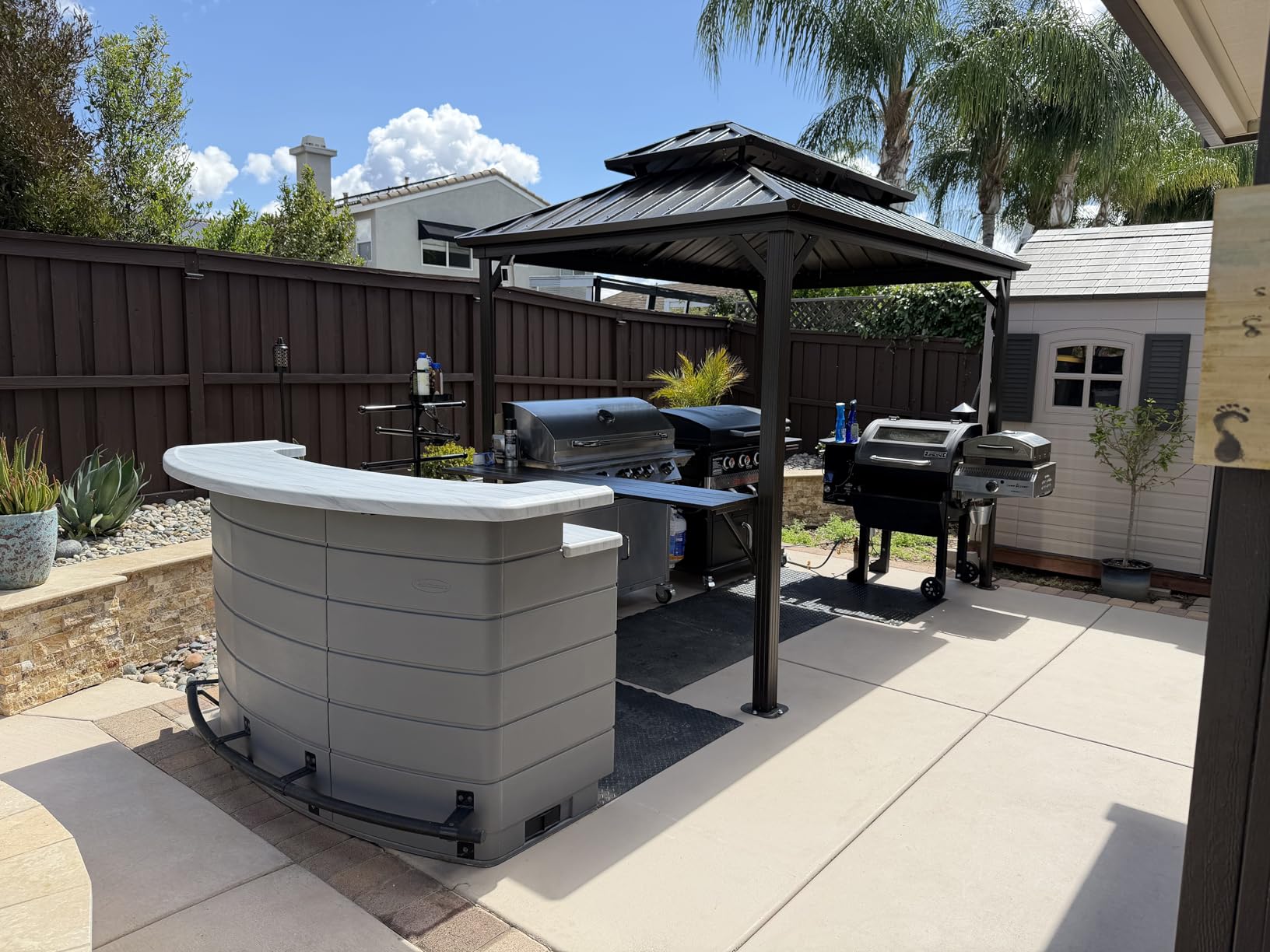
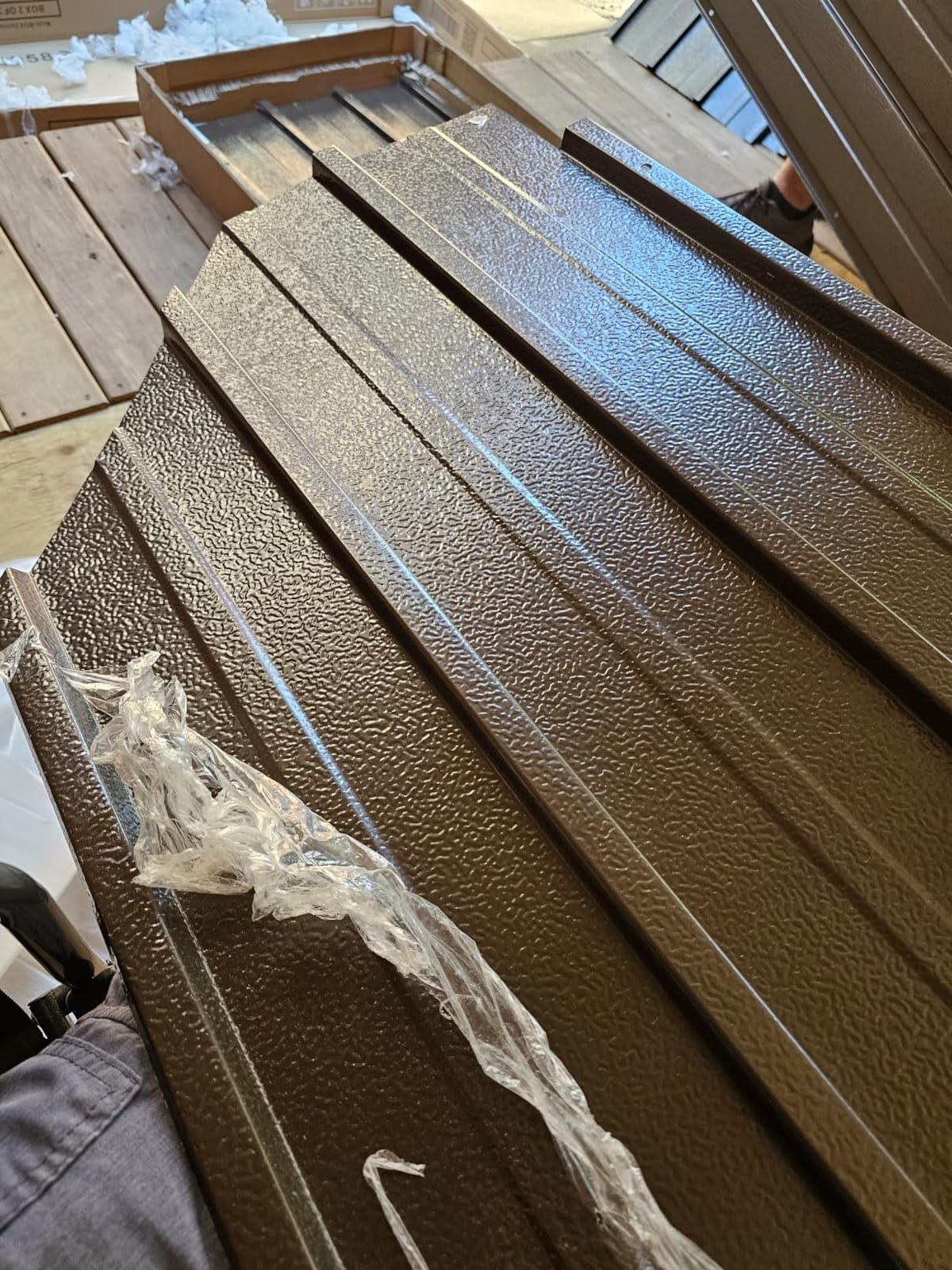
The roof is a galvanized steel double roof rated for heavy snow and 38 mph winds, and it blocks 99 percent of UV rays while the double layer handles insulation and ventilation. The frame is powder-coated galvanized steel with triangular reinforcements and pre-drilled legs, and sidewalls are breathable 360 degree mesh netting plus zippered thermal curtains, with top hooks for lights or fans.
The trade is space and evidence. At 120 square feet it is the tightest footprint here, and owners looking for shelter over a tub plus a bench will find the walk-around cramped. With 76 reviews it also has the smallest track record in the group, and a 10 percent one-star share is the highest negative proportion of any pick on this list.
It also splits across separate packages, so more than one delivery may be needed. For a small patio, a tight yard or a rental where you want a hard roof without a heavy build, that is a reasonable compromise. For a full-size spa you use in winter, it is the least generous shelter on the list.
What to check before you buy
Do the footprint math honestly. A 10 by 12 over a 7 by 8 tub leaves very little on the ends, and the walk-around space is where you will feel the squeeze. If your tub is square and larger than 7 by 7, step up a size even if the budget is tight.
Anchor it and accept the wind ceiling. Thirty-eight miles per hour is the lowest published rating here, and the pre-drilled legs are there for a reason. If you are in an open yard, this is the model most likely to need replacing after a bad storm.
Who should skip it
Skip it if you want year-round, all-weather use. A tight footprint and a 38 mph rating are poor matches for soaking in snow, and the thinnest review history here means the long-term picture is the least known.
Skip it if you plan to add enclosed sides and a heater through winter. This is built for a light seasonal shelter, not a conditioned room, and a better-engineered frame is the right spend for that use.
How Big Should a Hot Tub Gazebo Be?
Size your gazebo to the space around the tub, not to the tub itself. The working rule is to leave a walk-around of 24 to 30 inches on the two long sides, keep 30 to 40 inches of clearance above the tub rim for the lid or cover lifter to open fully, and check that the service panel on the tub can be removed with the gazebo frame in place. An 8 by 8 tub under a 12 by 12 gazebo is the ratio most owners settle on.
The 5 foot rule that comes up in searches is shorthand for the same idea: roughly five feet of total clearance along the walk-around sides of the tub, which works out to about 30 inches per side. It is not a building code requirement and it does not appear in any gazebo spec sheet, but it is the number spa owners and installers use most often when they say a structure feels right.
Cover clearance is the mistake that shows up after the structure is standing. Measure the height of your lid or lifter in its fully open position, then add the frame thickness and the roof rise. A vertical lifter raises fast, and a horizontal shelf lifter needs the full deck run clear of posts and beams. Interior headroom matters for the same reason: owners repeatedly describe standard 7.5 foot clearances as feeling cramped, and the listed peak heights here range from about 9.3 feet to 10.2 feet.
Service access is the detail nobody checks. Spas need their equipment compartment opened for maintenance, and if a gazebo post lands in front of that panel you will end up dismantling structure to service the tub. Measure the panel swing, not just the tub footprint.
Hardtop vs Soft Top for Hot Tubs
A hardtop is the right call for almost every hot tub installation, and the reason is moisture plus sun. Soft top gazebos are fabric canopies stretched over a frame, and fabric under a spa degrades in three ways at once: it holds pooled rainwater against the canopy, UV breaks down the weave, and a wet canopy in cold air grows mildew at the seams. Over a few seasons the canopy is replaced rather than repaired, and the replacement cost lands in the first five years of ownership.
Hardtops take that off the table. A galvanized steel or aluminum roof over a ventilated upper tier does not absorb water, does not mildew, and carries published snow and wind ratings you can check against your local requirement. The metal models in this roundup are rated from 18.43 psf to 2,500 lb of snow and from 38 mph up to 73 to 83 mph, while no fabric model in this category publishes comparable figures because the material cannot carry them.
The real soft top case is a temporary or seasonal structure: a rental patio, a mild climate, or a tent-style pop-up that gets stored in summer. Forum owners also point out the honest counter-argument to any roof at all, that some people specifically like soaking under open sky and will happily sit in light rain. If that is you, a hardtop is solving a problem you do not have.
Ventilation and Steam Under the Roof
Yes, you need a vented roof for a hot tub gazebo. A spa puts a large volume of water vapor into the air above it, and in an enclosed structure that moisture has exactly one place to go: into the frame, the fabric and the ceiling. A vented peak or a double roof with an open upper tier lets warm moist air escape before it condenses on cold surfaces.
This is the single most-cited praise point among owners on hot tub forums, and it is the first thing experienced owners check on a new build. The double roof designs in this roundup do it structurally, with a gap between the lower panel layer and the upper tier, and the PURPLE LEAF solarium adds a screened vent so you keep insects out of the opening.
A practical protocol matters as much as the vent. Leave the upper vent clear of stored items, run a fan during and after a soak to move moist air out, open the doors or roll back the side panels when the weather allows, and dry any standing water off seating and rails. In an enclosed room, dry air is the goal; a small fan on a smart plug costs very little to run and prevents the condensation cycle that starts mold.
There is a heat trade to know about. Owners of the highest-rated model here report the interior gets very hot and stifling on still, warm days because the roof-level opening does not move much air on its own, and they add a fan, ducting and a smart plug. That is a ventilation plan, not a defect, and it is the same reason enclosed structures need deliberate airflow rather than passive assumption.
Base, Pad and Anchoring
Yes, the gazebo can sit on the same pad as the hot tub, and in most installations it should. A filled spa is a concentrated load of roughly 3,000 to 5,000 or more pounds sitting on a small footprint, and the gazebo posts need that same engineered base. Putting the posts on the tub slab is simpler, stronger and far better than setting them on adjacent pavers or on soil.
What the pad needs is a reinforced concrete slab rather than individual footings, sized so the spa weight and the gazebo post loads land on the same pour. If you are starting from scratch, extend the existing pad to the full gazebo footprint before it is poured rather than trying to add a second slab later, because the two need to move together under freeze-thaw cycles.
Anchoring is what actually keeps the structure on the ground. The published wind ratings in this roundup assume anchoring with expansion bolts, and several listings say so directly. One model in the group offers a single ground fixing system compatible with concrete, wood decks and lawns with anchor bolts and ground stakes included, which is useful when your pad is not poured concrete. Unanchored is the condition under which owners lose gazebos, and it is the one thing not to compromise on.
Also plan the site as level as you can. A 12 by 16 or 12 by 20 frame amplifies any base error into visible lean, and a laser level saves far more time than it costs. If you are installing around a tub that is already plumbed in, that is a longer and trickier job than a fresh build, so protect the deck and the tub during assembly.
Buying Guide: Frame, Roof and Side Panels
Choose the frame first. Aluminum is the right default under a spa because it will not corrode in persistent humidity, and owners consistently prefer it to steel for exactly that reason. Steel frames are heavier and often carry higher published wind ratings, so they win in exposed and snowy sites, but they need to be genuinely coated and anchored. Cedar looks best in a garden and needs periodic sealing in wet climates. Check the frame material on the listing, not the roof material, since the two are often conflated.
Then check the roof against your climate, in the numbers rather than the adjectives. A psf snow load tells you what the roof carries, and 2,500 lb or 18.43 psf is the range that appears on the models here. A wind figure in miles per hour tells you whether the structure suits an open lot or a sheltered yard, and 60 mph is the mid-point of this group while the 73 to 83 mph cedar model is the outlier for the better. If a listing publishes neither number, treat it as unrated and size your anchoring generously.
Vented roofs are non-negotiable under a spa, and so is drainage. A hidden gutter system that carries water down the corner posts keeps runoff off the seating area and out of the tub, and it is one of the clearest quality differences between models in this roundup. A double roof with a ventilated upper tier handles both the steam problem and the heat problem, which is why so many of the picks share that design.
Side panels decide whether the structure is seasonal or year-round. Dual-track systems that let curtains and insect mesh slide independently are the most flexible, and detachable panels matter in autumn when you want light without bugs. Check the GSM weight of the mesh and fabric: 180 GSM polyester curtains and 40 GSM netting are common, while 260 GSM Textilene is a clear step up. Be realistic about fade, since dark curtains on at least one model here showed fading after a single summer, and treat curtains as a consumable rather than a permanent part.
For build effort, match the crew to the weight. Anything around 300 pounds and up is realistically a three or four person job measured in hours, and the two heaviest products here run into the 600 pound range with far more complex assembly. If you are not hiring help, choose a lighter frame and a simpler enclosure, and set aside an uninterrupted day rather than several short evenings.
Our roundup of the best gazebos for backyard shade covers the general picking criteria if you also want a structure that is not sized around a tub, and our cold plunge tub guide covers the opposite end of the temperature range where a roof matters just as much.
Frequently Asked Questions
Can you put a gazebo over a hot tub?
Yes. A gazebo over a hot tub is a standard installation, provided the structure has a vented upper roof, enough interior height for the lid to open, walk-around clearance on the sides, and a reinforced base that carries both the filled spa and the post loads.
What size gazebo do I need for a hot tub?
Size to the space around the tub, not the tub itself. Leave 24 to 30 inches of walk-around on the two long sides and 30 to 40 inches of clearance above the rim. The common ratios are a 7 by 8 or 8 by 8 tub under a 12 by 12, a 7 by 8 under a 12 by 14, and a 6 person tub under a 12 by 16.
What size gazebo do I need for a 7 person hot tub?
A 12 by 16 hardtop is the practical answer for a 7 person tub, because larger spas are usually close to square and a 12 by 12 leaves too little walk-around on the ends. A 12 by 20 gives room for a tub plus a bench or table without a second structure.
Will the hot tub cover clear the gazebo roof?
It will if you measure first. Check the lid or cover lifter in its fully open position, then add the frame thickness and the roof rise. A vertical lifter raises quickly and a horizontal shelf lifter needs the full deck run clear, so measure the lifter rather than the tub rim.
Do I need a vented roof for a hot tub gazebo?
Yes. A spa releases a large volume of water vapour, and an unvented enclosure traps it until it condides on the frame and ceiling, which is what causes mildew. A double roof with an open upper tier or a screened peak vent lets warm moist air escape before it soaks the structure.
Can the gazebo sit on the same pad as the hot tub?
Yes, and it usually should. A filled spa weighs roughly 3,000 to 5,000 lb or more on a small footprint, so the posts need the same engineered base. Pour one reinforced concrete slab covering the full gazebo footprint and the tub rather than setting the posts on adjacent pavers or soil.
What is the 5 foot rule for hot tubs?
It is shorthand for clearance, not a code requirement. It means roughly five feet of total space along the walk-around sides of the tub, which works out to about 30 inches per side. Owners use it as a comfort check when a gazebo starts to feel tight.
What are the best waterproof gazebos for a hot tub?
A hardtop with a galvanized steel or aluminum roof over a vented double tier is the waterproof option. Listings differ between water resistant and fully waterproof, so check the stated level, and prefer models where water is routed through gutters and down the corner posts rather than sheeting off the roof edge.
What is the best pop-up gazebo for a hot tub?
A pop-up style is a seasonal answer only. It gives you shade and light rain protection quickly, but it is not rated for snow or sustained wind, and the fabric canopy is the first thing to degrade. For year-round use, a frame-mounted hardtop is the durable choice.
How do I stop mildew forming under a hot tub gazebo?
Vent first. Keep the upper roof vent clear, run a fan during and after soaking, open the doors or roll back the side panels when the weather allows, and dry any standing water on surfaces. In an enclosed room, moving air is what breaks the condensation cycle that starts mold.
Final Verdict
The best gazebos for hot tubs come down to climate and how much room you have around the tub. For most people, the PURPLE LEAF 12×20 is the one to buy: it is the highest rated at 4.8 across more than 1,500 reviews, the drainage runs water down the posts, and the 240 square feet leaves genuine walk-around space. In a snow belt, take the HOTEEL 10×15 for its 18.43 psf rating and nine foot peak, or the Kozyard Alexander 12×12 for the thickest frame in the roundup.
For a warm climate and a tight yard, the HAPPATIO 12×12 is the value pick that gets the double vented roof right without the premium. If you want to soak through January with the sides closed, look at the Domi 12×15 sunroom or the PURPLE LEAF 12×16 solarium, and budget for the assembly time. And if the tub is already plumbed in, measure the cover lifter and the service panel before anything else, because that is the mistake that costs a rebuild.