
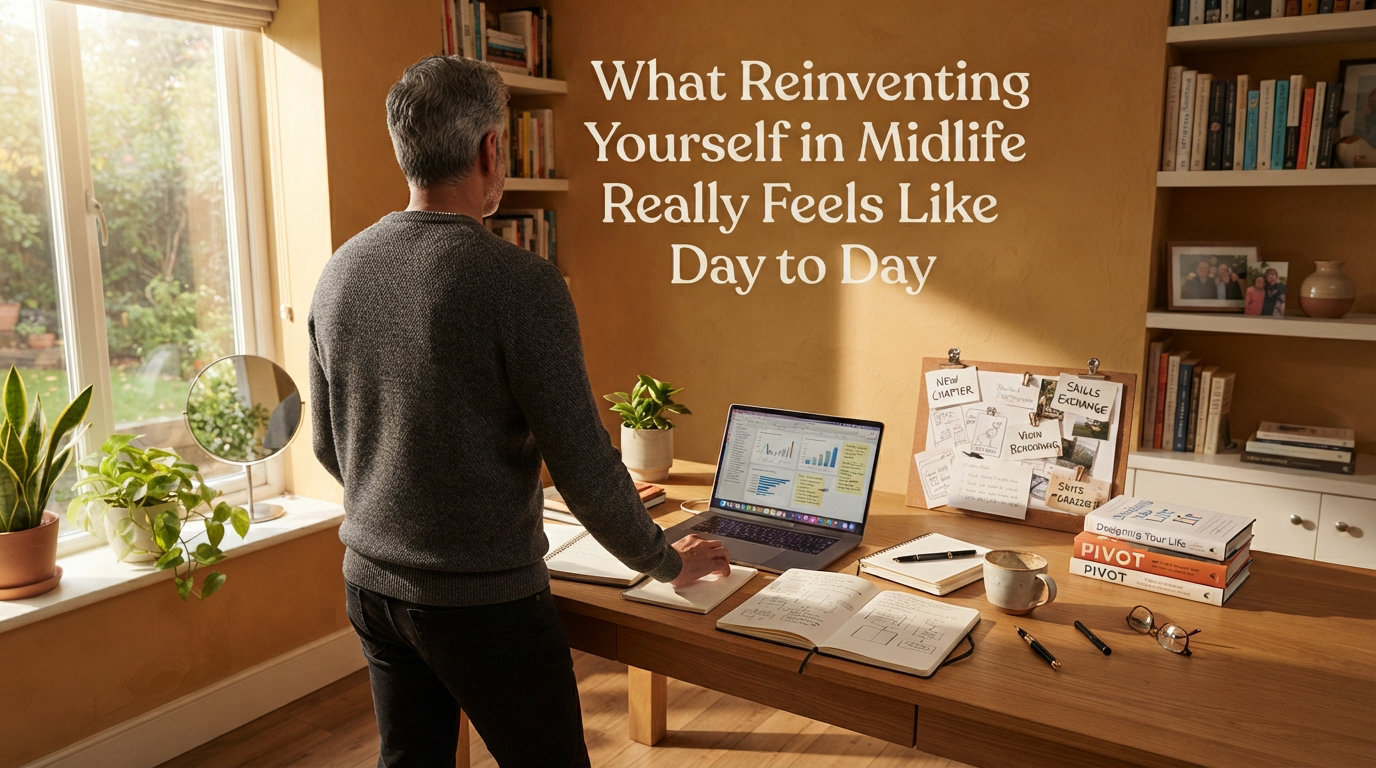
It usually begins in the quietest moments. A Sunday night when you open your calendar and feel a heaviness in your chest. A Tuesday afternoon at your desk when the next ten years stretch out in front of you like a corridor you have already walked. Standing in the grocery store staring at oat milk without quite knowing why you are crying.
I have talked with hundreds of people about the day-to-day experience of midlife reinvention, and almost no one describes it the way the movies do. There is rarely a red sports car. There is rarely a dramatic resignation letter. There is usually a low hum of longing that has been there for months, sometimes years, that you keep trying to talk yourself out of.
This article is for the part of you that already knows something is shifting. It is for the moment you realize you are not in a bad mood, you are in a different life than the one you thought you would be living. I want to walk you through what midlife reinvention day to day actually feels like, the body sensations, the small betrayals, the guilt, the hunger for something more. Because the day-to-day is where the real reinvention happens. The big leaps are loud. The truth is in the laundry.
Table of Contents
What Midlife Reinvention Actually Is (And What It Is Not)
Midlife reinvention is the slow, often uncomfortable process of letting the life you built stop fitting who you are becoming. It is not a personality makeover. It is not a crisis you are having. It is, more accurately, a nervous-system reckoning, the moment the story you have been telling yourself about your life stops matching the body living inside it.
I think the word reinvention is a little misleading. It sounds like tearing something down and starting over. In my experience, it feels much more like a long exhale. The roles, the routines, the relationships you grew into in your twenties and thirties start to feel like shoes two sizes too small. You did not pick the wrong shoes on purpose. Your feet just changed.
Here is what I mean by that. In your thirties and forties, you likely built a life in service of roles: the competent professional, the reliable partner, the good daughter, the present parent. Those roles were not a lie. You meant every one of them. But identity in midlife tends to fuse with role in a way that is hard to see until the fusion starts to hurt. Therapists call this role-identity fusion. It is the experience of forgetting, for long stretches, that you are a person who exists outside of what you do.
So reinvention is not a crisis. It is a recalibration. It is your body and your psyche quietly announcing that the version of you the world has been seeing is one slice, and there are other slices that want to be seen too. The midlife crisis stereotype, the affair, the impulse purchase, the move to a beach town, is something else. It is often a frantic attempt to escape the feeling without truly meeting it. Real reinvention is slower. It is messier. It starts with your body.
Why It Hits in Midlife, Not at Twenty-Five
Your brain runs on prediction. It builds a model of who you are, what your life is for, and spends most of your twenties and thirties quietly confirming that model. This is helpful when the model is accurate. It is painful when it starts to be wrong.
Around the early forties, for many people, the predictions stop landing. Your body is changing. Your priorities are shifting. The achievements that were supposed to feel like arrival feel more like noise. Your nervous system starts sending signals that the old model is not safe anymore, and reinvention is what it feels like when you let yourself hear those signals.
What Reinvention Actually Feels Like in a Regular Day
The day-to-day experience of midlife reinvention is rarely dramatic. It is rarely even visible. From the outside, you are still going to work, still making dinners, still showing up. From the inside, almost everything has a different color.
This is what I want to capture here, the part that most articles skip. The quiet, granular, often lonely moments. The body sensations. The way a thought that used to feel neutral now feels like a splinter.
Sunday Nights Begin to Hurt
The first thing most people I work with describe is a change in Sunday night. Sunday used to be the end of a weekend. Now it is a small funeral. You open your laptop to check the week ahead and feel a tightness in your chest. Nothing about the week is especially bad. You are not burning out in the obvious way. You are just tired of the same meetings, the same inbox, the same version of Tuesday that has been happening for fifteen years.
That Sunday night feeling is one of the earliest signs of reinvention. It is your predictive brain telling you that the life you are about to walk into is not the one you would choose if you were choosing today.
Your Body Stays Tight, Even on Good Days
Notice your shoulders right now. Are they up near your ears? Is your jaw clenched? Most people in midlife reinvention describe a low-grade physical tension that does not quite resolve, even on vacation, even on a long walk, even after a glass of wine. It is the somatic signature of role-identity fusion. You are carrying more identity than you have anywhere to put down.
The body knows before the mind does. If you have been waking at 3 a.m. for no reason, or feeling a flutter of anxiety in your chest when nothing is wrong, or noticing that your breath is shallow all day, that is your body asking for a different kind of life. Not a better one. A truer one.
Small Moments Become Loud
You are doing the dishes and you feel suddenly sad. You are in the car alone and you start crying. You are folding laundry and you cannot explain why you feel like a stranger in your own house. None of these are logical responses. All of them are signals.
What is happening is that the small in-between moments, the ones without a task attached, give your nervous system a chance to surface the thing you have been managing around. You have been busy. You have been competent. In the gaps, you finally feel.
Grief for the Life You Thought You Would Have
One of the most under-discussed parts of midlife reinvention is grief. Not grief for something that happened. Grief for something that did not. You thought you would still be doing the thing you love by now. You thought the relationship would feel different. You thought you would have made more room for the version of you that wanted to write, or travel, or rest, or build something small and quiet.
That grief is real. It deserves to be honored. And part of what day-to-day reinvention feels like is learning to carry that grief without letting it pull you into despair. You are mourning a path. You are not broken. You are just adjusting to the fact that the map you were given does not match the country you are standing in.
You Start to Notice What Other People Want
Something quiet and strange happens in the middle of reinvention. You start to notice, with painful clarity, what other people want from you. You notice the colleague who needs you to stay in your lane. The parent who needs you to be the same reliable daughter. The friend who only knows the version of you from 2014.
You are not becoming paranoid. You are becoming honest. Reinvention often includes a phase where you see the contracts you have been holding up for other people, sometimes for decades. That visibility is uncomfortable. It is also one of the early signs of a real shift.
The Emotional Waves of Reinvention: Guilt, Fear, and Longing
Underneath the day-to-day sensations, there is a deeper emotional weather. Reinvention does not feel like one emotion. It feels like several, sometimes in the same hour. If you have been feeling like you are emotionally all over the place, that is not a sign that you are losing it. That is the actual texture of becoming.
The Guilt You Did Not Expect
The most surprising emotion for most people is guilt. Not guilt about something you did. Guilt about wanting something different. You have a good job. You have a functioning family. You have no obvious right to be unhappy. And yet.
That guilt is one of the heaviest parts of midlife reinvention, and it is one of the quietest. Nobody talks about it because it feels shameful. You have been given so much, and you want more, and you are not sure what more even looks like. I want to tell you, from working with hundreds of people in this exact place, that this guilt is not a sign of ingratitude. It is a sign that you are paying attention to what your life is asking you for next.
Fear of Being Seen as Selfish
Closely tied to the guilt is the fear of being seen as selfish. Especially for women. Especially for people who have built their identity around being needed. Wanting something for yourself, even quiet something, even a smaller apartment that you actually like, even a Tuesday afternoon that is yours, can feel like a betrayal of every relationship you have.
This is the part of reinvention that people do not write about. The part where you cannot tell anyone what you are feeling because you are afraid they will think you have lost your mind. You have not lost your mind. You have started to listen to it.
The Both/And of Competence and Stuckness
Here is a tension I see in nearly every high-achieving person in midlife reinvention. You are, by any external measure, successful. You are competent. You are capable. And you are also completely stuck. Both of these are true. They are not in conflict, even though it feels like they should be.
Your competence built the life you have. You should be proud of it. And your competence is not wrong, but it is not the only thing you have. It cannot carry you into the next chapter, because the next chapter is not about doing more. It is about being more. That requires a different muscle. It is okay to feel lost here.
Permission to Want More
Day-to-day reinvention slowly, often imperceptibly, becomes a practice of giving yourself permission. Permission to want a different shape of life. Permission to put down a role you have been carrying out of loyalty. Permission to say no without a five-paragraph explanation. Permission to say yes to something small and silly that has nothing to do with productivity.
Permission is the quiet engine of reinvention. It does not look like anything on the outside. On the inside, it is everything.
How to Move Through the Day-to-Day of Reinvention
If you are in this season, you may be wondering what to do with all of it. I want to offer a few things that have helped the people I work with. None of them are dramatic. None of them require you to know your final destination. They are ways of moving through the day-to-day so that the day-to-day does not feel like a prison.
Stop Pathologizing the Feelings
The first step is to stop treating your inner experience as a problem to solve. You are not broken. You are not ungrateful. You are not having a breakdown. You are having a reorientation. Notice the feelings without trying to fix them. They are showing you where the seams are. That is information, not failure.
Pick One Small Experiment, Not a Big Announcement
Reinvention does not require a dramatic announcement. It does not require a quit date or a manifesto. It requires one small, honest experiment. Reach out to one person about something you have been curious about. Take one class. Block one Sunday afternoon for yourself. Move one boundary by one inch. Tiny, repeatable actions change the nervous system faster than a single grand gesture.
Build Capacity, Not Just Clarity
Most people in midlife reinvention are trying to think their way through it. They want clarity before they make a move. The truth is, clarity comes from movement, and movement requires nervous system capacity. Rest, sleep, walking, time off your phone, therapy, somatic work, the unsexy practices are what make the next chapter possible. You are not weak for needing them. You are building the internal infrastructure for the life you are about to walk into.
Find One Person Who Sees You
You do not need a committee. You do not need a huge support group. You need one person who will look at you without flinching and say, yes, I see what is happening in you, and no, you are not crazy. Whether that is a friend, a therapist, a coach, or a sibling, having one witness changes the whole experience. Reinvention is lonely. It does not have to be silent.
Let the Old Story Complete
One of the kindest things you can do in midlife reinvention is to let the old story finish. That marriage, that career, that version of you, it was not a mistake. It was a chapter. Thank it for what it gave you. Tell the truth about what it cost. And then let the next chapter open at its own pace. You cannot skip the ending. The ending is where the wisdom lives.
Frequently Asked Questions
Why do I feel like I need to reinvent myself?
You feel the urge to reinvent yourself when the life you built no longer matches the person you are becoming. This often shows up in midlife as a low-grade restlessness, Sunday night dread, or a sense that your roles and routines fit someone you used to be but not who you are now. It is not a crisis. It is a nervous-system signal that your old internal model of yourself needs updating.
What does a midlife crisis feel like?
A midlife crisis usually feels sudden, loud, and impulsive, like an urge to escape your life quickly. Real midlife reinvention feels different. It is quieter and slower. It shows up as a chronic tightness in the body, foggy dissatisfaction, tears in unexpected moments, and a sense that you are living someone else’s script. If the feeling is urgent and reactive, it leans more toward crisis. If the feeling is steady and persistent, it is more likely reinvention.
How long does midlife reinvention take?
Midlife reinvention is not a single event with a definite end date. Most people describe it as a season of two to five years, with waves of clarity and confusion. The goal is not to rush to a finished version of yourself. The goal is to keep moving through the day-to-day with more honesty, more permission, and more capacity for the life you actually want.
Is 50 too old to reinvent yourself?
Fifty is not too old to reinvent yourself. Many people do their most honest work in their fifties and sixties, once the pull of proving yourself has softened. Neuroplasticity is still active. Your identity is still forming. What feels late is usually just the moment you finally choose yourself without apology.
What are the signs you need reinvention?
Common signs include Sunday night dread, body tension that does not resolve, fantasizing about escape without a clear plan, crying in grocery stores, feeling like a stranger in your own life, grief for the path you did not take, sudden impatience with people you used to tolerate, and a quiet curiosity about something you have never let yourself try. If several of these are showing up, you are likely in a reinvention season, not a breakdown.
Trusting the Quiet Pull of Reinvention
Midlife reinvention is not a crisis, and it is not a montage. It is a long, slow, often tender day-to-day process of letting the life you built make room for the person you are becoming. If you are in this season, you are not broken. You are recalibrating. Trust the quiet pull. The day-to-day is where the real work happens, and it is where the new life is slowly being born.