
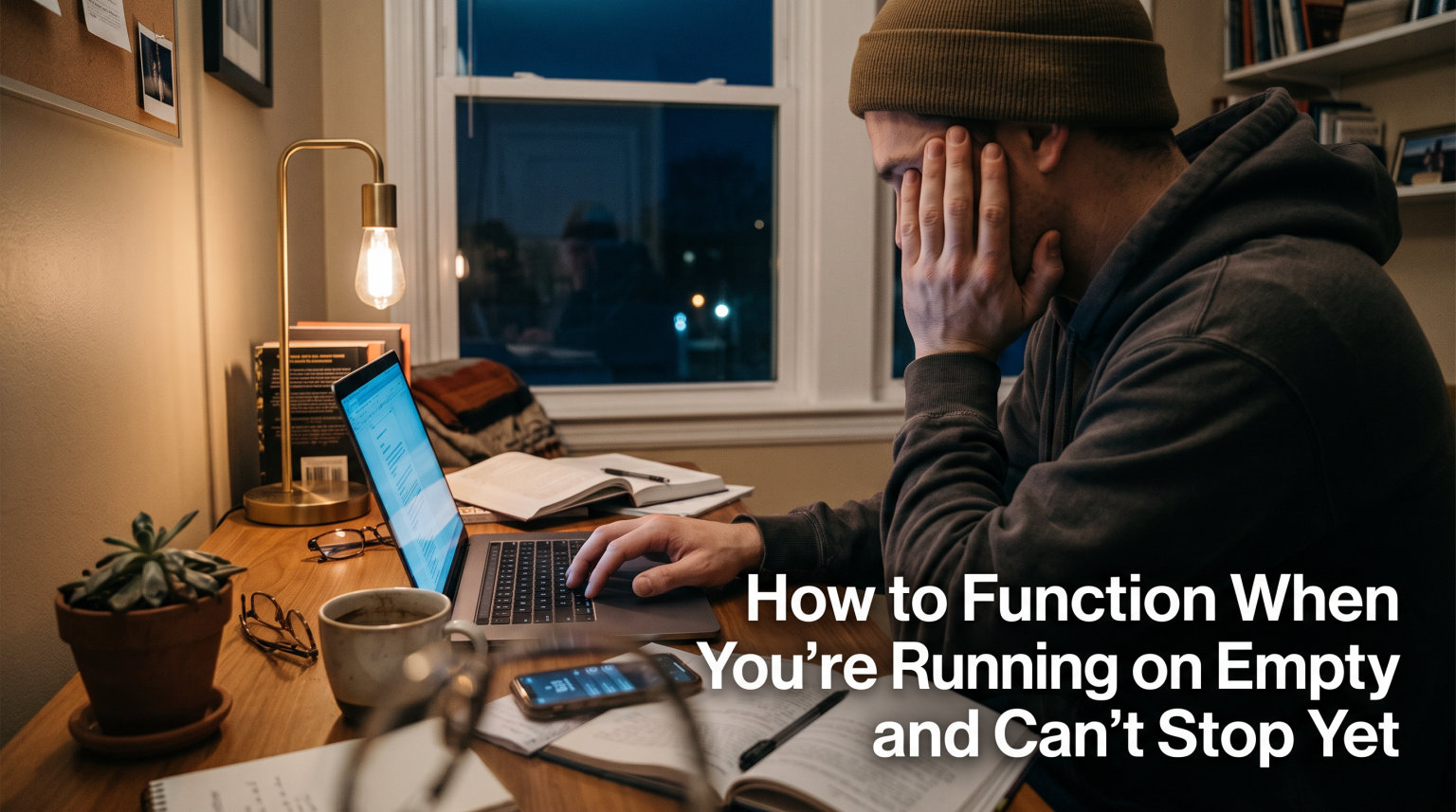
If you’ve ever stared at a screen at 2 a.m. with nothing left to give but still felt unable to stop, I want you to hear this first: you are not lazy, broken, or failing. You are running on empty, and your body is begging you to pay attention. I know because I’ve coached hundreds of people through this exact season, and I’ve lived it myself more times than I care to count.
This article is for the moments when you know you need to rest, but stopping isn’t an option yet. Maybe a deadline is closing, a child needs you, or the bills won’t wait. I’ll show you how to function when you’re running on empty, give you practical same-day strategies, and walk you through what to do when you finally can stop. If you need permission to feel what you’re feeling, consider this it.
Table of Contents
What It Really Means to Be Running on Empty
Running on empty is a state of chronic exhaustion where your nervous system stays in survival mode even after the threat has passed. You feel depleted, foggy, and disconnected, but your body keeps pumping adrenaline like a fire is still coming. Your tank shows zero, but the engine refuses to cut off.
Biologically, your adrenal glands have been pouring out cortisol for so long that they don’t know how to stop. Your sympathetic nervous system (the fight-or-flight branch) is in charge, and your parasympathetic system (the rest-and-digest branch) has been overruled. From the outside, you look like you’re coping. On the inside, you are running on fumes and prayer.
This is not the same as being tired after a long day. It’s deeper. It’s the kind of tired that sleep doesn’t fix, the kind that makes you cry in the parking lot or forget what you were saying mid-sentence. Recognizing this state is the first step toward changing it.
Why You Can’t Stop Even When You Know You Should
If you knew you needed to stop, you would. That’s the part nobody talks about. When you’re running on empty, your brain builds a case for why stopping is dangerous, and it’s usually right about something. Let me break down what I see most often in my coaching practice.
For caregivers, stopping means someone else pays the price. For entrepreneurs, stopping means the business collapses. For parents, stopping means letting the household fall apart. For people-pleasers, stopping means disappointing others. Your nervous system has learned that staying busy is what keeps you safe, and it will fight you to keep you moving.
This is what’s called survival mode, and it’s brilliant at one thing: keeping you alive in the short term. The problem is that it doesn’t know when to clock out. Until you teach it, it will keep treating every email like an emergency and every chore like a life-or-death task. The fact that you can’t stop isn’t a willpower problem. It’s a training problem, and it can be retrained.
7 Signs You’re Running on Empty Right Now
Sometimes we don’t realize how depleted we are until our body sends a louder message. Here are seven signs I walk my clients through when they ask, “Am I just tired, or is this something more?”
- You wake up tired. Even after seven or eight hours, you feel like you never slept.
- Small things set you off. A notification, a question, a slow driver, and you want to scream.
- Your brain feels foggy. You lose words, forget tasks, and reread the same paragraph three times.
- Your body aches. Your neck, shoulders, back, or jaw carry tension all day.
- Joy has gone quiet. Things you used to love feel flat or like a chore to even think about.
- You get sick often. Colds, headaches, stomach issues, or mystery symptoms keep showing up.
- You feel disconnected. You’re going through the motions but feel like you’re watching yourself from far away.
If you nodded at three or more of these, you are not just busy. You are running on empty, and your body is asking for help. The good news is, you can do something about it today, even if you can’t fully stop yet.
7 Things You Can Do Today to Keep Going
You don’t have time for a two-week retreat. You need something that works in the next hour. These are the same strategies I teach my clients when they have to keep functioning while depleted. Pick one, then another, and let the small wins compound.
Step 1: Reset Your Nervous System in 90 Seconds
Place one hand on your chest, one on your belly. Breathe in for four counts, hold for two, exhale for six. Do this eight times. You are manually signaling your parasympathetic system that it is safe to slow down. It won’t fix everything, but it will drop your heart rate and clear the static.
Step 2: Drop One Non-Essential Task
Look at your to-do list and cross off the one thing that won’t matter in a week. Empty the dishwasher tomorrow. Skip the optional meeting. Cancel the favor. You just freed up 30 minutes of decision fatigue, and that’s exactly what you need right now.
Step 3: Fuel Like You Mean It
When you’re running on empty, adrenaline hides your hunger until you crash. Eat a real meal with protein, fat, and complex carbs. Drink a full glass of water. Your brain is 73% water, and even 2% dehydration tanks your focus.
Step 4: Move for Five Minutes, Slowly
Stand up. Walk to the end of the hall. Stretch your arms overhead. Shake out your hands. Gentle movement gets blood flowing to your brain without triggering more cortisol. This is not a workout. It’s a reset button.
Step 5: Tell the Truth Out Loud
Say the sentence, out loud, to another human: “I’m running on empty and I need help.” Text it to a friend. Whisper it to your dog. Post it anonymously. Breaking the silence stops the spinning and invites support in.
Step 6: Lower Your Output, Not Your Standards
You don’t have to perform at 100% today. Done at 70% is still done. Tell yourself, “Good enough for today is good enough.” This isn’t laziness. It’s wisdom. Pushing through at full speed is what got you here.
Step 7: Protect Your Bedtime Like a Meeting with Your Future Self
Set a phone alarm for one hour before bed. After that alarm, screens off, work closed, and no “just one more thing.” Sleep is the only true recovery your body has, and you need it back in the rotation.
How to Stop Running on Empty for Good
The same-day tactics buy you time. Long-term recovery requires deeper changes. Here’s what I recommend building into your life, one small habit at a time.
Set a Daily Energy Floor
Decide on the minimum that must happen for your body to feel safe: seven hours of sleep, two meals without your phone, one walk outside, ten minutes of quiet. Treat these like non-negotiable meetings. Build your day around them, not on top of them.
Build Micro-Boundaries
You don’t have to quit your job or move across the country. Start with one small boundary: no email after 7 p.m., no favors on Sundays, or a silent morning commute. Boundaries are not walls. They’re gates that let the right things in and keep the drain out.
Reconnect With Your Why
Burnout often hides behind a loss of purpose. When you forget why you started, every task feels pointless. Spend ten minutes writing down what you actually want your life to look like in one year. If your current pace is taking you somewhere you don’t want to go, your body already knows.
Schedule Real Recovery Time
Block off a real weekend, a real hour, a real afternoon. Put it in your calendar. Tell people. Defend it. Recovery doesn’t happen in the cracks between tasks. It happens when you dedicate space to it.
Self-Care Fundamentals That Actually Work
Self-care isn’t face masks and bubble baths (though those are fine). Real self-care is what protects your ability to function. There are five areas to cover, and most of my clients are neglecting at least three.
- Physical: Sleep, food, water, movement, sunlight.
- Emotional: Journaling, therapy, crying when you need to, naming your feelings.
- Mental: Boundaries with news, social media, and toxic conversations.
- Social: Time with people who refill you, not just the ones who drain you.
- Spiritual: Whatever reconnects you to something larger: prayer, nature, art, music, awe.
Pick one area. Pick one tiny action. Do it this week. Self-care is a muscle, and it atrophies fast when you stop using it.
When to Seek Help: Signals You Shouldn’t Ignore
Sometimes running on empty is a phase you can climb out of with the right support. Sometimes it’s a deeper signal that needs professional help. If you notice any of the following, please reach out to a licensed therapist or your doctor this week.
- You have thoughts of harming yourself or not wanting to be here.
- You can’t get out of bed for multiple days in a row.
- You’re having panic attacks or frequent breakdowns.
- You’ve been exhausted for more than six months with no improvement.
- You’re using substances to push through or wind down.
None of these are signs of weakness. They are signs of a body that needs more support than self-help can offer. There is no shame in asking for help. There is only the cost of waiting too long.
Frequently Asked Questions
How do I stop running on empty?
Start by acknowledging you’re depleted, not lazy. Drop one non-essential task, take a 90-second breathing reset, fuel your body, and protect your bedtime. Then build a daily energy floor with sleep, food, movement, and quiet. Long-term recovery requires boundaries, purpose, and sometimes professional support.
What should I do when I am running on empty?
Lower the bar for today. Pick one task to drop, eat a real meal, drink water, breathe slowly for two minutes, and tell someone you need help. Do not try to perform at full capacity. Done at 70% is still done, and pushing harder will only delay your recovery.
How do I keep going when I have to keep going?
Use the seven-step same-day protocol: nervous system reset, drop a task, refuel, gentle movement, speak one truth, lower your output, and protect bedtime. These give you short-term stamina without burning the last of your reserves. Treat them as survival tools, not a long-term plan.
What are the 7 signs of burnout?
The seven signs include waking up tired, snapping at small things, brain fog, body aches, loss of joy, frequent illness, and feeling disconnected from your life. If three or more feel familiar, you are likely running on empty and need to act before it gets worse.
Is this burnout or ADHD?
They can look similar but feel different. Burnout usually follows a clear period of overwork and improves with rest. ADHD burnout is chronic, tied to executive function, and rest alone rarely fixes it. If you suspect ADHD, talk to a clinician who understands adult ADHD and burnout together.
How long does it take to recover from running on empty?
It depends on how long you’ve been depleted and what support you have. Some people bounce back in a few weeks with real rest. Others need several months. Recovery is not linear. Give yourself credit for every small step back toward yourself.
You Don’t Have to Earn Rest
I want to leave you with this: rest is not a reward. It is not something you have to earn after you finish the list. Rest is a biological requirement, like breathing. You don’t owe the world your last drop of energy. You owe yourself the grace to stop running on empty and start living again.
Pick one thing from this article and do it today. Then pick another tomorrow. If you need more support, you can always reach out. I’m cheering for you, and I know you can get through this season. If you found this helpful, consider sharing it with someone who needs to hear it too.