
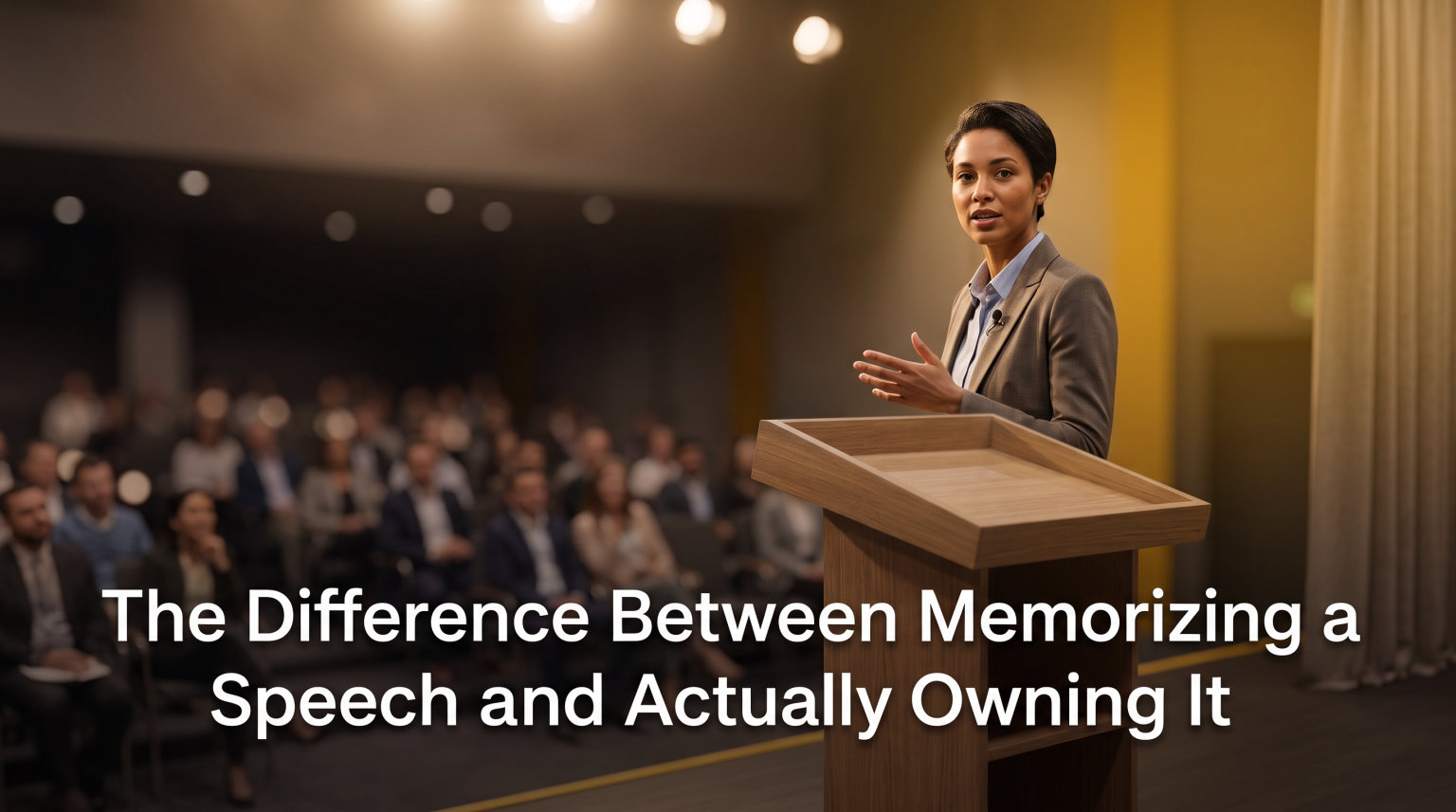
You stand at the podium. The words come out in the right order, exactly as you rehearsed them. Your audience nods politely. Nobody sighs, nobody leaves. And yet something feels completely off. You sound like a recording of yourself, delivering a script you have heard a thousand times. The room is full and you are somehow nowhere to be found.
I have watched this happen with entrepreneurs, team leaders, and first-time keynote speakers across two decades of coaching. The difference between memorizing a speech and actually owning it is not subtle. It shows up in your eye contact, your pauses, your breathing, and the way people lean in or drift out. Memorizing gives you a script. Owning gives you a voice. In 2026, with audiences more distracted than ever, the second one matters more than the first.
This guide walks through what owning a speech really means, why memorization quietly undermines even the most prepared speakers, and the practical steps I have used with clients to help them stop sounding rehearsed and start sounding present.
Table of Contents
Why Memorization Creates Problems for Speakers
Memorization creates problems because it stores your speech as a sequence of words rather than a sequence of ideas. Once your brain locks your talk into a fixed order, every distraction becomes a threat. A phone buzzes in the audience. Someone walks in late. You lose your place, then panic, and the fragile chain of words breaks.
Toastmasters veterans on Reddit and Quora describe this exact failure pattern. One long-time member wrote that memorizing a speech word-for-word is a “recipe to court disaster.” I have seen it happen myself. The speaker hits a stumble, restarts from the top, and the energy drains out of the room in seconds.
There are three predictable problems that show up when you rely on memorization. First, working memory gets overloaded. Your brain is busy retrieving the next line, so it has no bandwidth left for eye contact, vocal variety, or adjusting to your audience. Second, anxiety spikes. Every word you forgot feels like a verdict on your competence. Third, your delivery collapses into a monotone recital. The audience can tell you are not with them, even when they cannot name what is missing.
What It Actually Means to Own Your Speech
Owning a speech means understanding your material so deeply that the right words generate themselves in the moment. You are not pulling words from a file. You are expressing ideas you have already lived with, and the language shows up to carry them. This is what experts call concept mastery, and it is the opposite of rote memorization.
Think about how you explain your favorite hobby to a friend. You do not recite a script. You pick the story, the example, and the wording that fit the moment. You own that material because you have thought about it enough that it has become part of how you speak. A speech you own works the same way.
When you own a speech, your opening still sounds like an opening. Your transitions still connect. Your closing still lands. But the words between can flex with the room. Someone yawns, and you slow down. Someone laughs, and you pause to let it breathe. You are present, not performing.
The Psychological Shift From Reciting to Being Present
The lived experience of owning a speech is nothing like the lived experience of reciting one. During a memorized delivery, your attention is split between the audience in front of you and the script running in your head. You are, in a real sense, in two places at once. Audiences feel that split. They cannot name it, but they register the speaker as “checked out.”
When you own your material, you enter what psychologists call a flow state. Your preparation is invisible because it has been absorbed. Your attention is fully on the people in front of you. You notice a skeptical face and adjust your next example. You feel nervous energy and use it to land a quieter line. This is what natural speech delivery looks like from the inside.
I remember coaching a marketing director who was preparing her biggest keynote yet. She had rehearsed her 30-minute talk more than 40 times. Once she started working from her three core ideas instead of her script, something shifted. She started making small jokes that were not in the notes. She made eye contact with people in the back row. Afterward, three separate attendees told her it felt like the most authentic thing they had heard all year. Nothing about the content changed. Her identity as a speaker did.
How to Move From Memorization to Ownership
Moving from memorization to ownership is a process, not a switch you flip the night before. Here are the five steps I work through with clients who want to stop sounding rehearsed and start connecting with their audience.
Step 1: Build Your Speech Around Three to Five Core Ideas
Strip your speech down to a handful of core ideas. If you cannot summarize your talk in five sentences, you do not yet know your speech well enough to own it. Write those sentences on a single index card. Everything else in your speech should exist to support one of them.
Step 2: Use Retrieval Practice Instead of Repetition
Research on retrieval practice is clear. You remember material far better when you actively pull it from memory than when you reread it. So instead of running the same script 20 times, close your notes and try to explain each core idea out loud from scratch. Each time you get stuck, mark the gap and revisit only that section. This is how internalization happens.
Step 3: Learn the Emotional Sequence, Not Just the Words
Every great speech has an emotional arc. There is a moment of tension, a moment of release, a moment of humor, a moment of gravity. Mark those moments in your outline. When you rehearse, recreate the emotional journey, not the exact wording. If you know where the room should laugh and where it should go quiet, you can recover gracefully even when the precise words shift.
Step 4: Practice Without Your Script
At least half of your rehearsal time should happen without looking at your notes. Stand up, walk around, and teach the material to an imaginary listener. When you cannot remember a section, do not peek. Make it up. The goal is to discover which parts of your speech are owned and which are still held together by the page.
Step 5: Rehearse in Front of Real People
Finally, rehearse your speech in front of at least one human being before the real event. A friend, a teammate, a coach. Then ask them two questions. What did you remember? Where did you feel something? Their answers will tell you whether your speech is landing or leaking.
Signs You Have Successfully Made the Shift
How do you know when you have moved from memorizing to owning? There are three reliable signals to look for. First, you can deliver the speech in different words each time and still hit the same key points. Second, you can field an unexpected question in the middle of your talk and find your footing again. Third, you finish speaking and feel tired from connecting, not exhausted from remembering.
If none of these are true yet, do not panic. Most speakers need at least two real rehearsals before true ownership kicks in. The work is worth it. Going from recitation to presence is the single biggest upgrade any speaker can make in 2026 and beyond.
Frequently Asked Questions
Is it better to memorize a speech?
Memorizing an entire speech word-for-word usually backfires. It overloads working memory, increases anxiety, and leaves no room to adjust to your audience. Owning your material through concept mastery produces more confident, flexible, and authentic delivery.
What did Einstein say about memorizing?
Einstein famously warned that education is not the learning of facts, but the training of the mind to think. The same principle applies to public speaking. Memorizing facts is not the same as owning an idea you can reshape and express in your own words.
How to actually learn instead of memorize?
Learn instead of memorize by using retrieval practice and concept mastery. Reduce your speech to a few core ideas, then explain each idea out loud from memory without your notes. Mark the gaps, revisit only those sections, and rehearse the emotional sequence rather than the exact wording.
What is one of the downsides to memorizing a speech?
The biggest downside is fragility. A memorized speech collapses when you forget a single word, hear an unexpected question, or face any distraction. Speakers who rely on rote memorization often freeze, restart, and lose the room in the process. Ownership, by contrast, is resilient and flexible.
Final Thoughts on Owning Your Speech
The difference between memorizing a speech and actually owning it is the difference between sounding correct and sounding real. Memorization gives you a script to hide behind. Ownership gives you something to stand on. Once you have made the shift, you will not want to go back.
If you are preparing for a talk right now, start with one thing. Take your speech apart until you are left with three core ideas. Then try to teach those ideas out loud, without notes, to a friend. What you find in that conversation is the speech you actually own. Everything else is just rehearsal.
That is the work. And it is the work that turns a script into a voice.