
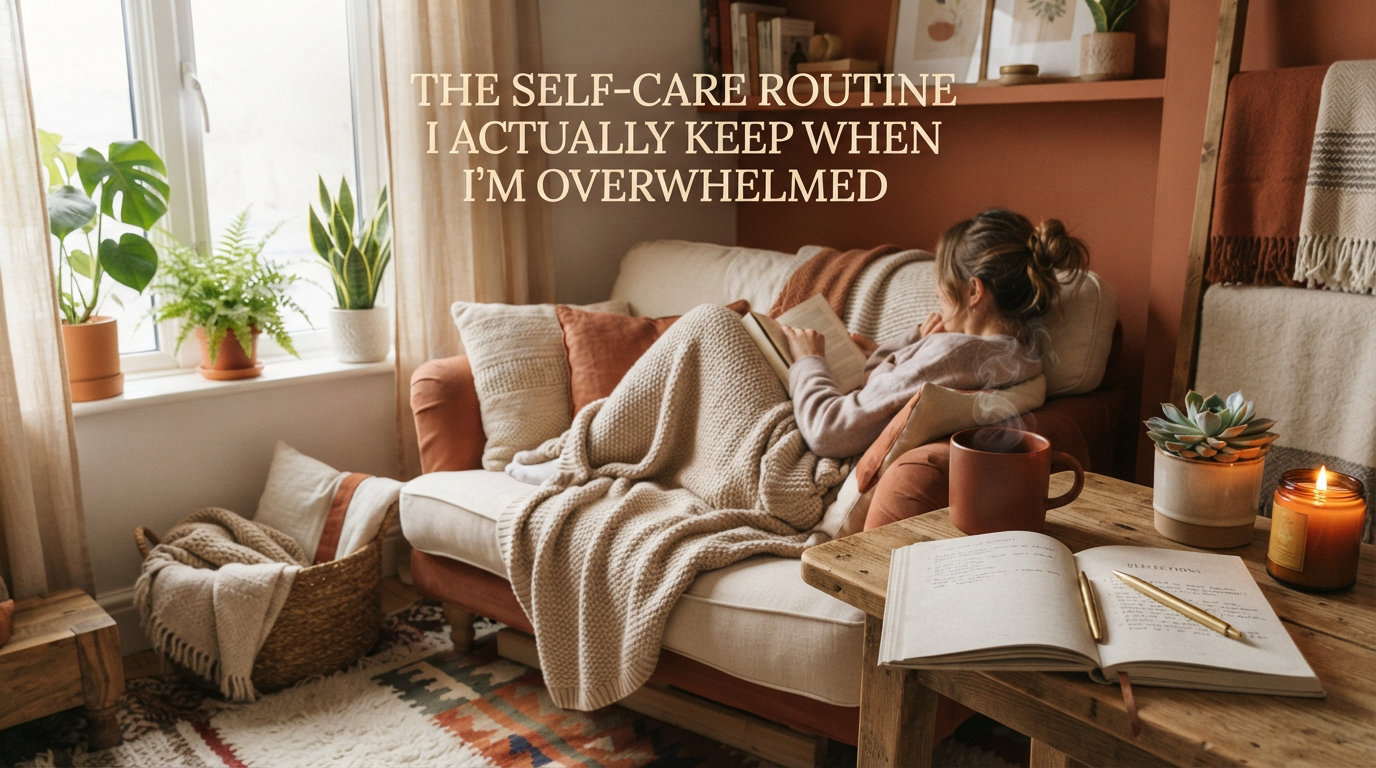
A few years ago, I hit a wall. I was juggling work deadlines, family obligations, and that constant background hum of anxiety that told me I was always one dropped ball away from collapse. I’d read the self-care articles. I’d bought the journals, the candles, the bath bombs. And every time I tried to build a “proper” routine, I’d last about four days before the whole thing collapsed under its own weight.
That’s when I realized something important: most self-care advice is designed for people who already have their lives together. The 10-step morning routines, the hour-long meditation sessions, the perfectly plated meals. When you’re genuinely overwhelmed, that kind of advice doesn’t help. It just becomes one more thing you’re failing at.
What I needed was a self care routine I could actually keep when overwhelmed. Not on my best days. On my worst ones. The days when getting out of bed felt like a victory and a 12-item wellness checklist felt like a personal attack.
In this article, I’m sharing the routine I’ve built and kept for over two years. It’s not glamorous. It’s not Instagram-worthy. But it works because it’s built for real life, especially the messy parts. I’ll also cover the science behind why we get overwhelmed, the 3-3-3 coping rule nobody seems to explain properly, and how to build something sustainable for yourself.
Table of Contents
The Signs You’re Overwhelmed (And Why It Matters)
Overwhelm isn’t just feeling busy. It’s a full-body experience that hijacks your nervous system and makes even small tasks feel impossible. Before we talk about routines, you need to recognize when you’re actually in it.
Here are the signs I’ve learned to watch for in myself: brain fog that makes simple decisions feel monumental, a short fuse where everything irritates me, physical tension in my shoulders and jaw, and that specific exhaustion where sleep doesn’t fix it. You might also notice racing thoughts, trouble concentrating, or the urge to either numb out with your phone or cancel every plan you have.
What’s happening biologically is that your body’s stress response has shifted into overdrive. Your cortisol levels stay elevated, your sympathetic nervous system stays activated, and your brain essentially treats every email notification like a saber-toothed tiger. You’re not lazy or broken. Your nervous system is doing exactly what it evolved to do, just in a context it wasn’t designed for.
This matters because you can’t self-care your way out of overwhelm if you don’t recognize you’re in it. I spent years pushing through, thinking I just needed more discipline. What I actually needed was to notice the signs earlier and respond with less, not more.
The 3-3-3 Rule for Coping: What It Is and Why It Works
You’ve probably seen the 3-3-3 rule mentioned in searches about anxiety and coping skills. It’s one of the most searched questions in this space, yet almost nobody explains it in a way you can actually use. Let me fix that.
The 3-3-3 rule is a simple grounding technique that interrupts the stress response by pulling your attention back to the present moment. It works because anxiety and overwhelm live in the future, in the “what ifs” and the endless to-do lists. Grounding brings you back to right now.
Here’s exactly how to do it:
Step 1: Name 3 things you can see. Look around and say them out loud or in your head. Your coffee mug. The light through the window. The pile of mail you keep meaning to open. Be specific.
Step 2: Name 3 sounds you can hear. The hum of the fridge. Traffic outside. Your own breathing. This engages your auditory processing and pulls you further into your body.
Step 3: Name 3 movements you can make. Wiggle your toes. Roll your shoulders. Clench and release your fists. This is the part most people skip, and it’s the most important because physical movement signals to your nervous system that you’re safe.
I use this technique in the grocery store line, before difficult meetings, and at 2 a.m. when my brain decides to replay every awkward thing I’ve ever said. It takes about 30 seconds, and it works because it gives your brain something concrete to do instead of spiraling. Research on grounding techniques shows they can reduce acute anxiety symptoms by activating the parasympathetic nervous system, which is your body’s natural calming mechanism.
The Self-Care Routine I Actually Keep When I’m Overwhelmed
This is the heart of what I want to share. Not a fantasy routine. The real one I turn to on the days when everything feels like too much.
Morning: The Minimum Viable Start
I used to think mornings required a 90-minute routine of meditation, journaling, stretching, and a green smoothie. On good days, that’s lovely. On overwhelmed days, it’s a setup for failure.
My actual morning self-care comes down to three things: drink a glass of water before anything else, spend two minutes outside (even if it’s just standing on the porch), and eat something before checking my phone. That’s it. No meditation cushion required, no 20-minute yoga flow. Just the basics of being a human animal who needs hydration, daylight, and food.
The reason this works is that it’s so small it feels almost ridiculous to skip. And those three things regulate cortisol (which spikes in the morning), help set your circadian rhythm through daylight exposure, and prevent the blood sugar crash that turns mild stress into full-blown meltdown.
Midday: The Two-Minute Check-In
Somewhere around 2 or 3 p.m., I used to hit a wall. My energy would tank, my patience would thin, and I’d reach for a third coffee that just made me jittery and more anxious.
Now I do a two-minute check-in. I close my laptop, put my feet on the floor, and ask myself one question: “What do I actually need right now?” Sometimes the answer is water. Sometimes it’s a snack. Sometimes it’s stepping outside for fresh air or doing 60 seconds of deep breathing. The point isn’t the specific answer. The point is pausing long enough to ask.
This tiny habit has prevented more afternoon spirals than anything else I’ve tried. It interrupts the autopilot mode where overwhelm thrives and gives me a chance to course-correct before I’m running on empty.
Evening: The Wind-Down That Doesn’t Require Perfection
My evening routine is intentionally forgiving. On good nights, I do a full wind-down: dim the lights, stretch, read a book, maybe journal for five minutes. On overwhelmed nights, I do the bare minimum: brush my teeth, put my phone in another room, and get in bed.
The non-negotiable is phone placement. Charging it across the room instead of next to my bed has done more for my sleep quality than any supplement or sleep hack I’ve tried. Research consistently shows that reducing nighttime phone use improves sleep onset and quality, which directly affects your capacity to handle stress the next day.
I also stopped tracking my sleep. I know that sounds counterintuitive, but for me, the sleep tracker became another source of anxiety. I’d wake up, check my score, and feel stressed about bad numbers before my day even started. Sometimes the most caring thing you can do is remove a data point that’s making you worse.
The 5 C’s of Self-Care Explained
You might have come across the concept of the 5 C’s in your own research. It’s a framework that helps break self-care into approachable categories, and I find it genuinely useful for thinking about what I actually need on any given day.
Care is the physical basics. Eating, sleeping, moving your body, staying hydrated. These aren’t luxuries. They’re the foundation everything else rests on.
Compassion is how you talk to yourself when you’re struggling. Self-compassion means treating yourself with the same kindness you’d offer a friend who’s having a hard time. Research from Dr. Kristin Neff shows self-compassion is strongly linked to lower anxiety and greater resilience.
Connection is relationships and community. Calling a friend, texting someone you miss, even brief social interactions can buffer against stress. Isolation feeds overwhelm.
Coping is your toolkit for hard moments. This is where the 3-3-3 rule lives, along with breathing exercises, journaling, or whatever helps you regulate when things spike.
Consistency is the glue. Small actions done regularly beat big efforts done sporadically every single time. A two-minute check-in every day will serve you better than a two-hour spa day once a quarter.
How to Build a Sustainable Self-Care Routine That Sticks
This is where most self-care advice falls apart. You’re told to build a routine, but not how to build one that survives contact with a bad week. Here’s what I’ve learned after years of trial and error.
Start with exactly one thing. Pick one small action and commit to it for a month. Not seven things. One. Maybe it’s drinking water first thing in the morning. Maybe it’s a five-minute walk after lunch. The goal isn’t to optimize your life. The goal is to prove to yourself that you can keep a promise to yourself.
This advice comes straight from people who’ve been there. One person in a self-care forum put it perfectly: “Pick one small thing, and really commit to doing it for a month.” That’s it. That’s the whole strategy.
Give yourself permission to do less. This was the hardest lesson for me, and I suspect it will be for you too if you’re a high-achiever. Doing less isn’t failing. When you’re overwhelmed, doing less is the strategy. A five-minute walk counts. A glass of water counts. Taking three deep breaths counts.
Know the difference between self-care and self-indulgence. This isn’t about judgment. Both have a place. But self-care is what future-you will thank present-you for. Going to bed early is self-care. Scrolling TikTok until 1 a.m. might feel good in the moment, but it’s not caring for yourself. Sometimes self-care is the boring, unglamorous choice.
Watch out for self-care fatigue. This is a real phenomenon I see discussed constantly in forums. People get overwhelmed by the sheer number of self-care activities they think they should be doing. Meditation, journaling, yoga, meal prep, skincare, gratitude lists. The list becomes its own source of stress.
If your self-care routine is stressing you out, it’s not self-care. Shrink it. Cut it down until it feels almost too easy. Then shrink it a little more. You can always add things back later when you have more capacity.
Common Self-Care Mistakes That Make Overwhelm Worse
In the interest of saving you the same mistakes I made, here are the traps I see people fall into over and over.
Building routines for your best self, not your worst. If your self-care plan only works when you have energy, motivation, and time, it will abandon you exactly when you need it most. Build for the hard days.
Treating self-care as another job. I love how one forum user described this: feeling like self-care is “another job to take care of myself, not skipping meals, sleeping enough, drinking water.” When basic survival starts feeling like a chore, your standards have gotten distorted. Scale way back.
Comparing your routine to others. Someone else’s 6 a.m. cold plunge and journaling session is not your benchmark. Your benchmark is yesterday’s version of you. Are you slightly more resourced than you were last month? That’s progress.
Feeling guilty about not doing “enough.” This one is sneaky. You do some self-care, then immediately feel bad that you didn’t do more. Guilt is the opposite of care. If an activity makes you feel worse, it’s not working, no matter how “healthy” it’s supposed to be.
Ignoring your body’s signals. Pushing through exhaustion, skipping meals because you’re “too busy,” or dismissing that headache for the third day in a row. Your body communicates what it needs. The routine that works is the one that listens.
When Self-Care Isn’t Enough: Knowing When to Get Help
I want to be clear about something. Self-care is powerful, but it’s not a substitute for professional support. There are times when no amount of breathing exercises or morning routines will be enough, and that’s not a personal failure.
Consider reaching out to a therapist or counselor if: your overwhelm lasts for weeks without relief, you’re struggling to function at work or in relationships, you’re experiencing panic attacks, or you’re having thoughts of self-harm. These are signs that your nervous system needs more support than self-care alone can provide.
There is no shame in getting help. In fact, asking for support is one of the most profound acts of self-care there is. Therapy, medication, and professional guidance are tools, not weaknesses. The National Institute of Mental Health and other organizations offer resources to help you find the right support.
FAQs
What is the 3 3 3 rule for coping skills?
The 3-3-3 rule is a grounding technique for anxiety and overwhelm. You name 3 things you can see, 3 sounds you can hear, and 3 movements you can make. This pulls your attention into the present moment and activates your parasympathetic nervous system, which calms the stress response.
How do you take care of yourself when overwhelmed?
When overwhelmed, focus on the basics: drink water, eat something, and get a few minutes of fresh air. Use grounding techniques like the 3-3-3 rule. Avoid adding new tasks to your plate. Permission to do the absolute minimum is key, because small consistent actions matter more than elaborate routines you can’t sustain.
What are the 5 C’s of self-care?
The 5 C’s of self-care are Care (physical basics like food and sleep), Compassion (kindness toward yourself), Connection (relationships and community), Coping (tools for hard moments like grounding and breathing), and Consistency (small regular actions over sporadic big efforts).
How do I manage when I feel constantly overwhelmed?
If overwhelm is constant, start by simplifying your commitments and setting firmer boundaries. Build a bare-minimum routine focused on sleep, hydration, and food. Use grounding techniques in the moment. If overwhelm persists for weeks, interferes with daily functioning, or includes anxiety or panic, reach out to a mental health professional for support.
Why does self-care feel like another chore?
Self-care feels like a chore when your routine is too complex or when you’re holding yourself to unrealistic standards. The solution is to shrink your routine until it feels almost too easy. Pick one small thing and do it consistently. Self-care should reduce stress, not add to it.
Conclusion
The self care routine I actually keep when overwhelmed is not impressive. Water, daylight, food, a two-minute check-in, and a phone that sleeps in another room. That’s the whole thing. It survives bad days because it was built for bad days.
If you take one thing from this article, let it be this: you have permission to start small. Pick one action, commit to it for a month, and let that be enough. Build the routine for the version of you who’s struggling, not the version who has it all figured out. Because that struggling version is the one who needs the care most.