
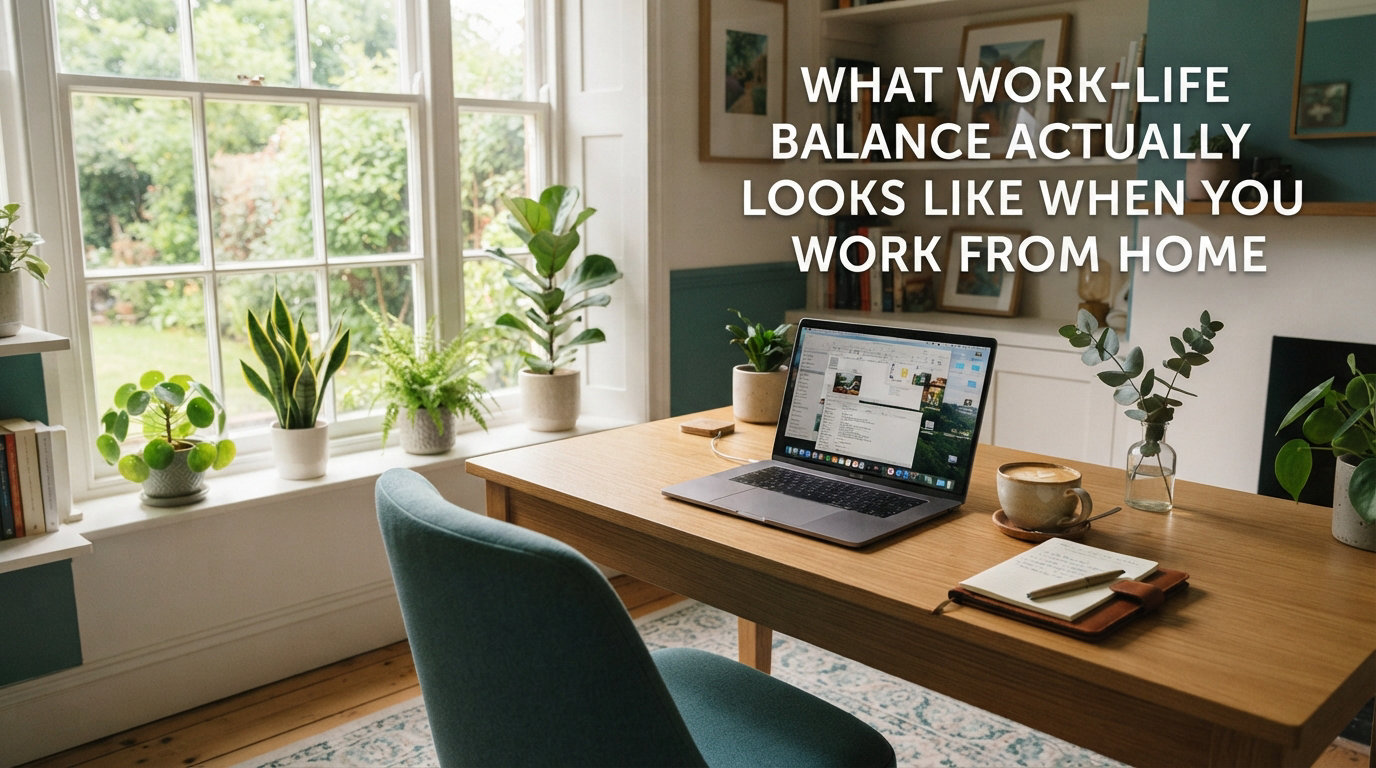
I have been coaching clients through remote work challenges for over a decade, and the same question keeps coming up: what does work-life balance actually look like when your office is also your living room? It is not the Instagram-worthy flat lay of a laptop perched on a tidy desk with a green tea nearby. It is messier, more specific, and far more personal than the corporate pamphlets suggest.
In this guide, I will walk you through exactly what work-life balance looks like when you work from home in 2026. You will get a clear definition, the 8 8 8 rule you can apply today, a real day-in-the-life example, the common mistakes I see daily, and the warning signs that small imbalance is tipping into burnout. By the end, you will have a working picture of balance that fits your actual life, not some idealized version.
Table of Contents
What Work-Life Balance Actually Looks Like When You Work From Home
Work-life balance when working from home means creating clear boundaries between your professional responsibilities and personal life, even though both exist in the same physical space. It is not about splitting time 50/50 or working fewer hours. It is about having predictable, honest separations that protect your energy, focus, and relationships.
Here is what that looks like in practice. You start work at a consistent time, you take actual lunch breaks away from your desk, you close your laptop at a defined hour, and you show up for personal plans the same way you would show up for a meeting. On the inside, you feel like you can fully concentrate during work and fully relax after work. Neither side is constantly leaking into the other.
A balanced remote worker has a dedicated workspace, a morning routine that signals the start of work, an evening shutdown ritual that signals the end, and protected time for meals, movement, and people. They communicate their boundaries clearly to teammates and family. They check email on a schedule, not on reflex. They take real vacations and they do not work through them.
An unbalanced remote worker looks very different. They answer Slack at 10 p.m. They eat lunch over the keyboard. They feel guilty for closing the laptop when there is still work to be done. They cannot remember the last time they took a real break. They have technically flexible hours, but they end up working more than they ever did in an office.
The honest truth is that remote work offers the freedom to design your day, but it also requires much more intentional design than office work ever did. Without a commute, a manager walking by, or coworkers heading out at 5 p.m., the structure has to come from you.
Why Work-Life Balance Matters More When You Work From Home
Work-life balance is harder to maintain at home because the natural boundaries that protect you in a physical office are gone. The drive home, the change of clothes, the walk past a different set of desks, the casual goodbye to a coworker. These small transitions train your brain to switch modes. Remove them and your brain never gets the memo.
The cost of skipping these boundaries is not abstract. Remote workers report higher rates of burnout, longer working hours, and more difficulty disconnecting than their in-office peers. According to multiple 2026 workforce surveys, the average remote worker puts in nearly two extra hours per day, often because the line between work and home has simply dissolved.
The mental health impact is real too. Without intentional separation, work stress seeps into family dinners, sleep, and weekends. Recovery time shrinks. The result is exhaustion that does not respond to a normal night’s sleep. I have seen clients who “love working from home” quietly hate it because they never feel off.
The flip side is just as important. When you build real work-life balance at home, your productivity actually increases. You get sharper focus during work hours, more creative energy, and stronger relationships. You stop bringing Sunday-night dread into Monday morning. The investment in boundaries pays you back in hours of recovered focus and actual rest.
The 8 8 8 Rule Explained
The 8 8 8 rule is a simple framework for splitting your day into three equal parts: 8 hours for work, 8 hours for sleep, and 8 hours for personal time. It was popularized by wellness advocates and quickly caught on because it makes balance feel concrete instead of aspirational.
For remote workers, the 8 8 8 rule works as a daily check. You work an 8-hour block with protected breaks. You sleep 8 hours, ideally on a consistent schedule. You claim 8 hours for everything else: meals, movement, family, hobbies, errands, and the small daily tasks that keep life running.
The key is that the 8 hours of personal time is not “leftover time after work.” It is treated as a protected block, just like a meeting. If your work bleeds into personal time and personal time bleeds into sleep, the rule shows you where the imbalance lives. Most of the remote workers I coach discover their personal time has shrunk to 3 or 4 hours, and their sleep has crept down to 6.
You do not have to hit the rule perfectly. You do have to use it as a mirror. Try tracking your actual hours for one week in 2026 and see how close you get to 8 8 8. Most people are surprised by the gap.
How to Set Clear Work Hours and Boundaries
Set work hours that are realistic for your role and communicate them out loud. If your team is 9 to 5, anchor to that. If your role spans time zones, block your core hours and tell people when you are offline. The hours you choose only matter if everyone else knows them.
Here is the boundary-setting process I walk clients through:
- Pick a start time and an end time you can keep five days a week.
- Block both on your calendar with a label like “Focused Work” or “Off.”
- Set status messages in Slack, Teams, or email that reflect your hours.
- Tell your manager and your team once, then enforce it through behavior, not explanations.
- Build a shutdown ritual: save files, write tomorrow’s top three tasks, close the laptop.
The shutdown ritual is the piece most remote workers skip, and it is the most important. Without it, your brain does not get a clear “off” signal. You keep half-thinking about work during dinner, bath time, and bedtime. The ritual replaces the commute you no longer have.
Boundaries also need to extend to your household. If you share your space with a partner, kids, or roommates, agree on what “I am working” actually means. Knock before entering. Hold the questions until lunch. It is uncomfortable to set up at first, but it prevents the small daily interruptions that shred focus and extend your workday by hours.
Creating a Dedicated Workspace That Signals ‘Work Mode’
A dedicated workspace is the single biggest predictor of work-life balance when working from home. It does not need to be a full room. It can be a corner of a bedroom, a folding table in a closet, or a spot at the kitchen counter that is reserved for work only. What matters is that it is a place, not a posture.
Your brain associates locations with behaviors. When you work from the couch, your brain does not know whether you are relaxing or working. When you work from a specific chair at a specific desk, your brain switches into work mode automatically. That switch is what saves you from carrying work stress home even when you are physically already home.
If space is tight, get creative. A room divider, a bookshelf turned sideways, or even a different colored rug can signal “work zone.” Add one consistent cue, like a small lamp you only turn on during work hours. The cue becomes a trigger for focus.
Keep personal items out of the workspace. Photos of family are fine. Stacks of laundry are not. You want to walk away from your desk at 5 p.m. and feel like you have left work, even if your desk is six feet from your kitchen.
Daily Routines That Separate Work From Personal Life
Routines are what hold your remote work day together. Without them, every decision is a fresh decision, and every decision drains energy. A solid routine carries you through the day on autopilot so you save your decision-making power for actual work.
The morning routine signals the start of work. It does not need to be elaborate. Mine is coffee, ten minutes of movement, a shower, then I sit at my desk and review my top three priorities for the day. Some of my clients take a walk, journal, or make a proper breakfast. The exact content does not matter. What matters is doing the same thing every day so your brain knows work is starting.
The midday reset protects your afternoon. Eat a real lunch, away from your screen. Step outside for five minutes. Move your body. Step away from email for 30 minutes. Midday resets prevent the afternoon slump and the temptation to push through to whatever time feels “done,” which is often very late.
The evening shutdown is your new commute. Save your work, write tomorrow’s priorities, close open tabs, and close the laptop. Then do something that physically transitions you: walk the dog, change clothes, water the plants, make dinner. The physical transition is the signal your brain needs.
Weekends need a routine too. Some remote workers do not work at all on weekends. Others do a small amount on Saturday morning. Pick your pattern and protect it. The days you spend fully in personal mode are the days that refill the energy you spend during the week.
A Real Day in the Life of a Balanced Remote Worker
Let me share a real day from a client I worked with last quarter. Maya is a senior designer at a SaaS company, working fully remote with two kids in elementary school. Here is her balanced day in 2026:
6:30 a.m. Maya wakes up, makes coffee, and does 20 minutes of yoga. Her kids are still asleep. This hour is hers before anyone else needs her.
7:30 a.m. She makes breakfast, gets the kids ready, and walks them to school. The walk is her mental transition into the workday.
8:30 a.m. Maya sits down at her desk in her home office. She closes the door, opens her laptop, and reviews her top three priorities for the day. She does not check email before this.
12:00 p.m. She shuts her laptop, walks to the kitchen, and eats lunch with her partner who also works from home. They do not talk about work. They do not look at their phones.
12:30 p.m. Maya takes a 25-minute walk outside, no podcasts, no phone. Just quiet.
1:00 p.m. Back at her desk for the afternoon block. She has a 90-minute focus block, then a meeting, then another 90-minute focus block.
4:30 p.m. Maya starts her shutdown. She writes tomorrow’s top three tasks, saves files, and closes the laptop. She does not reopen it.
5:00 p.m. She picks up the kids, makes dinner, and is fully present. No email, no Slack, no “let me just check one thing.”
8:30 p.m. Kids are in bed. Maya reads or watches a show with her partner. She does not work, even if she feels like she should.
10:00 p.m. Lights out. Eight hours of sleep, every night.
Maya’s day is not perfect. She occasionally gets pulled into a late meeting. She sometimes skips the walk. But the structure is there, and it is what keeps her feeling balanced when everyone around her is burning out.
Common Mistakes to Avoid When Trying to Balance Work and Home
Most remote workers I coach are making the same handful of mistakes. None of them are obvious. That is what makes them expensive.
Mistake 1: Reinvesting commute time into work. You save 90 minutes by skipping the commute. You spend 90 minutes working. You did not actually gain time. You just moved the boundary.
Mistake 2: Working from the couch or bed. Your brain needs a physical location to associate with work. When the couch is your office, rest loses its meaning and work loses its focus.
Mistake 3: Skipping lunch to get more done. You skip lunch, you work an extra 30 minutes, and you lose two hours of afternoon productivity. The math never works.
Mistake 4: Saying “I am always available.” You will be taken at your word. Set hours and protect them. Availability is not a personality trait.
Mistake 5: Sleeping with your phone in the bedroom. You check email one last time. You see one thing that bothers you. You do not sleep well. Repeat every night.
Mistake 6: Treating weekends like a softer workday. If you work a little on Saturday and a little on Sunday, you never actually rest. Protect at least one full day off every week.
Mistake 7: Telling yourself balance will happen naturally. It will not. Balance is a thing you design, every week, on purpose. Without intention, work expands until it fills every available gap.
Warning Signs You’re Heading Toward Burnout
Burnout does not arrive in one dramatic moment. It creeps in across weeks and months, and you adapt to it so gradually that you do not notice until you are deep in it. Here are the warning signs I tell every remote worker to watch for.
You feel tired even after a full night’s sleep. You dread opening your laptop on Sunday night. You snap at your family over small things. You have stopped taking breaks because they feel like wasted time. You cannot remember the last time you did something for fun. You are productive but you feel empty. You fantasize about quitting, even if you love your job.
If three or more of these describe your current state, you are not tired. You are burning out. The fix is not a vacation. The fix is structural: real boundaries, real rest, and a real conversation with your manager about workload.
I recommend a 30-day reset if you recognize yourself in these signs. Pick one boundary, hold it for 30 days, and see what changes. Most people discover they were not lazy before. They were exhausted.
Frequently Asked Questions About Work-Life Balance When Working From Home
How do I find work-life balance when working from home?
Start by setting clear work hours and telling your team what they are. Create a dedicated workspace, even if it is just a corner of a room. Build a morning routine that signals the start of work and an evening shutdown ritual that signals the end. Take a real lunch away from your screen. Protect time off on weekends. The goal is not perfection — it is consistency. Most remote workers see balance improve within two to three weeks of holding one boundary consistently.
Does working from home actually improve work-life balance?
It can, but only with intentional boundaries. Research in 2026 shows remote workers often report better work-life balance, but they also work longer hours and report higher burnout rates than in-office peers. The flexibility is real, but so is the risk of work expanding into personal time. Work from home improves balance when you protect your time. It worsens balance when you let work fill every gap.
What is the 8 8 8 rule for work-life balance?
The 8 8 8 rule splits your day into three equal parts: 8 hours for work, 8 hours for sleep, and 8 hours for personal time. It is a simple framework for checking whether your day is actually balanced. For remote workers, it is especially useful because it exposes where work is leaking into personal time or sleep. You do not need to hit the rule perfectly. Use it as a weekly mirror to see where your time is actually going.
What are the warning signs of burnout when working from home?
Common WFH burnout signs include feeling exhausted even after sleep, dreading Sunday nights, snapping at family members, skipping breaks, losing interest in hobbies, and feeling productive but empty. If you recognize three or more of these, you are likely not just tired — you are burning out. The fix is structural: real boundaries, real rest, and a real conversation about workload. A vacation helps, but only if you change the underlying pattern.
A Final Word on Building Real Balance at Home
Work-life balance when you work from home is not a destination you arrive at. It is a daily practice, and it looks different for everyone. For some people, it is a tidy home office and a 5 p.m. shutdown. For others, it is a noon dog walk and a hard rule about no email after dinner. The specific shape matters less than the fact that you have one.
If you take one thing from this guide, take this: pick one boundary from the list above and hold it for 30 days. Watch what happens to your energy, your focus, and your evenings. That is what work-life balance actually looks like when you work from home in 2026. It is built, not found.