
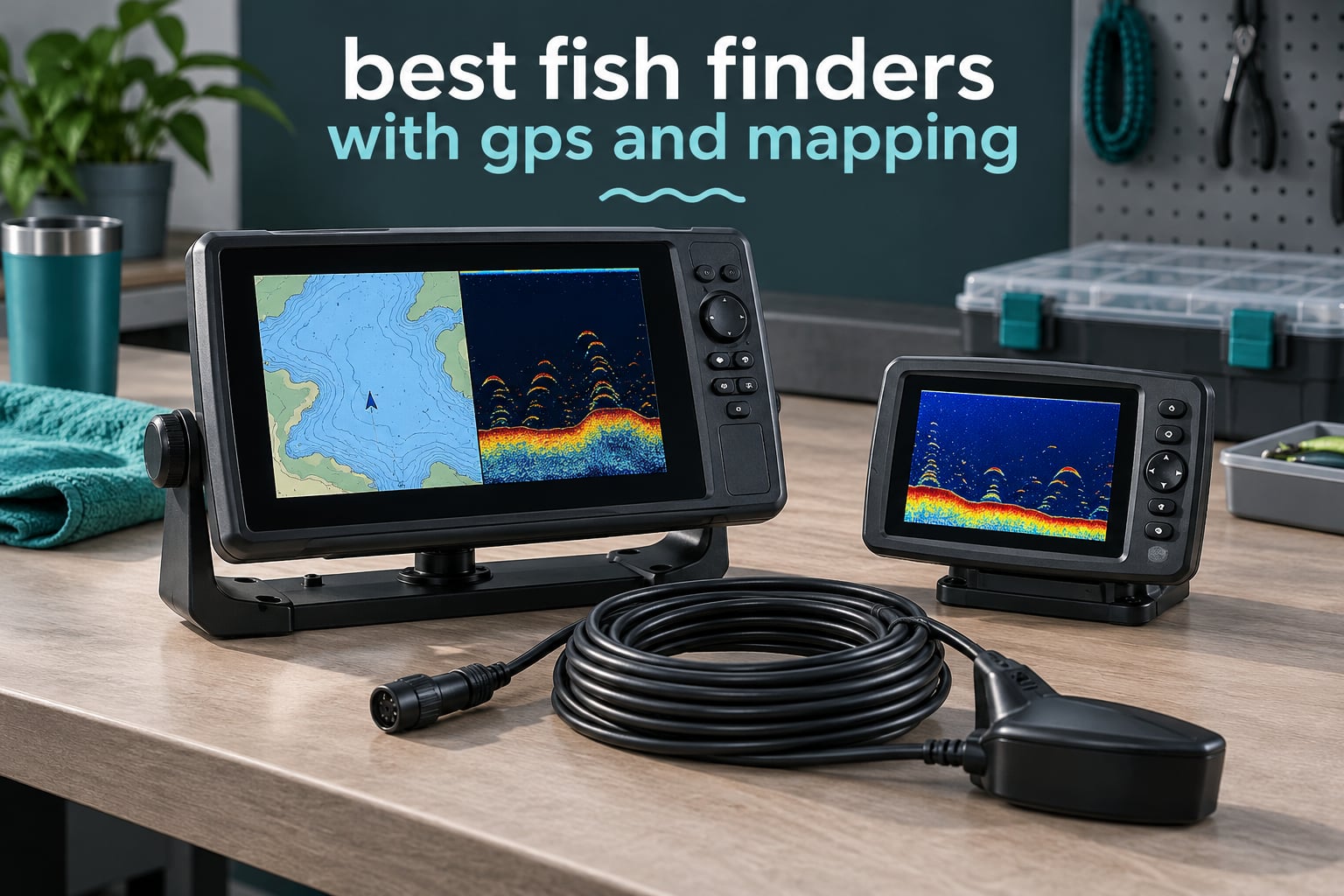
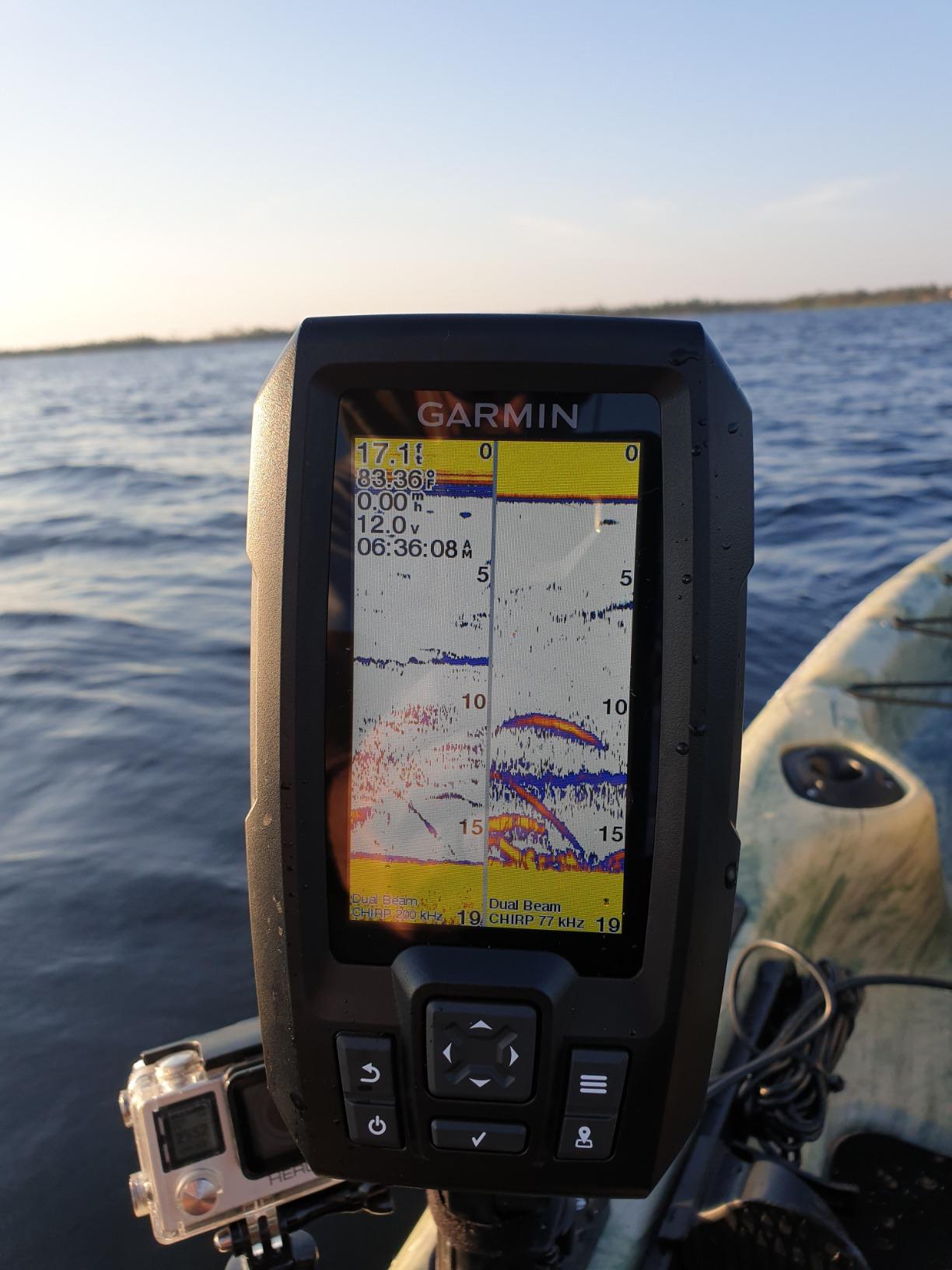
The Garmin Striker 4 with Transducer (model 010-01550-00) is the fish finder we would put in the most boats first, because it comes with the transducer in the box, draws 0.23 amps at 12 volts, and marks waypoints you can navigate back to. Most of the disappointment we see in this category comes down to three questions, and every pick below answers all three before anything else: is the transducer in the box, how big is the screen, and which charts actually cover your water.
We spent weeks reading spec sheets, install guides, and owner threads on r/boating and the bigbendfishing.net forum before choosing these ten. What stood out was how often the same confusion drives returns and regret. A unit with GPS is not the same thing as a unit with usable nautical charts, and a listing titled like a combo can arrive as a head unit with no transducer at all. The single most repeated comment across the fishing forums we read was that the base map many units ship with is “basically useless,” which is a fair description and the reason we added a plain-English section on charts further down.
This roundup covers ten fish finders with GPS and mapping from 3.5 inches to 12 inches, spanning keyed budget units, color units with automated contour mapping, side imaging rigs, live sonar displays, and full networked chartplotters. It covers people fishing from a kayak, a 16-foot jon boat, a center console, and a 30-foot offshore boat, because the right answer changes a lot between them.
We earn a commission when you buy through the links on this page. That never changes the order of the list. Everything below was last checked in 2026, and where the manufacturer and the owner reviews disagree, we say so. If you are outfitting a dock or a cabin at the same time, our guide to automatic fish feeders covers the unattended end of the setup, while this page covers what happens once you are moving.
Table of Contents
Top 3 Picks for the Best Fish Finders with GPS and Mapping in 2026

Garmin Striker 4
- CHIRP plus ClearVu sonar
- Transducer in the box
- 0.23A draw at 12V
- Waypoint GPS map

Garmin Striker Vivid 4cv
- Color display with Vivid palettes
- GT20 CHIRP plus ClearVu transducer
- Quickdraw Contours built in

Lowrance Elite FS 10
- Active Imaging 3-in-1 sonar
- Preloaded C-MAP DISCOVER charts
- 10 inch touchscreen
Those three cover the widest spread of real situations. The Striker 4 wins on value and power draw, the Striker Vivid 4cv adds color and the same Quickdraw mapping, and the Elite FS is the only pick here that pairs a three-in-one sonar transducer with preloaded coastal and inland charting on a 10-inch touchscreen.
Best Fish Finders with GPS and Mapping (October 2026)
| Product | Specifications | Action |
|---|---|---|
| Garmin Striker 4 |
|
Check Latest Price |
 Garmin Striker Plus 4 Garmin Striker Plus 4 |
|
Check Latest Price |
| Garmin Striker Vivid 4cv |
|
Check Latest Price |
 Humminbird Helix 5 Chirp DI G3 Humminbird Helix 5 Chirp DI G3 |
|
Check Latest Price |
 Humminbird Helix 7 G4 Humminbird Helix 7 G4 |
|
Check Latest Price |
 Humminbird XPLORE 10 Humminbird XPLORE 10 |
|
Check Latest Price |
| Lowrance Elite FS 10 |
|
Check Latest Price |
 Lowrance Eagle Eye 9 Lowrance Eagle Eye 9 |
|
Check Latest Price |
 Simrad GO9 XSE Simrad GO9 XSE |
|
Check Latest Price |
 Simrad NSS Evo3S 12 Simrad NSS Evo3S 12 |
|
Check Latest Price |
1. Garmin Striker 4 – Best Overall, Transducer and All
Garmin 010-01550-00 Striker 4 with Transducer, 3.5″ GPS Fishfinder with Chirp
CHIRP plus ClearVu sonar
3.5 inch LCD
0.23A at 12V
IPX7
Pros
- Transducer
- mounts and cable all in the box
- Extremely low 0.23A draw suits a single battery boat
- Readable in full sun with sunglasses
- Depth temperature battery voltage and speed on one screen
Cons
- 3.5 inch screen gets cramped in split view
- Sonar readout can drop out at higher trolling speeds
- Supplied battery leads are thin
The Striker 4 is the reason this category has a reputation for being confusing. Part number 010-01550-00, and the box contains the unit, the transducer, the transom and motor mounts, a tilt and swivel bracket, and the power and data cable. Nothing else to buy before it works. That is the whole pitch, and with 9312 owner reviews averaging 4.6 stars, it is the most proven box on this list by a wide margin.
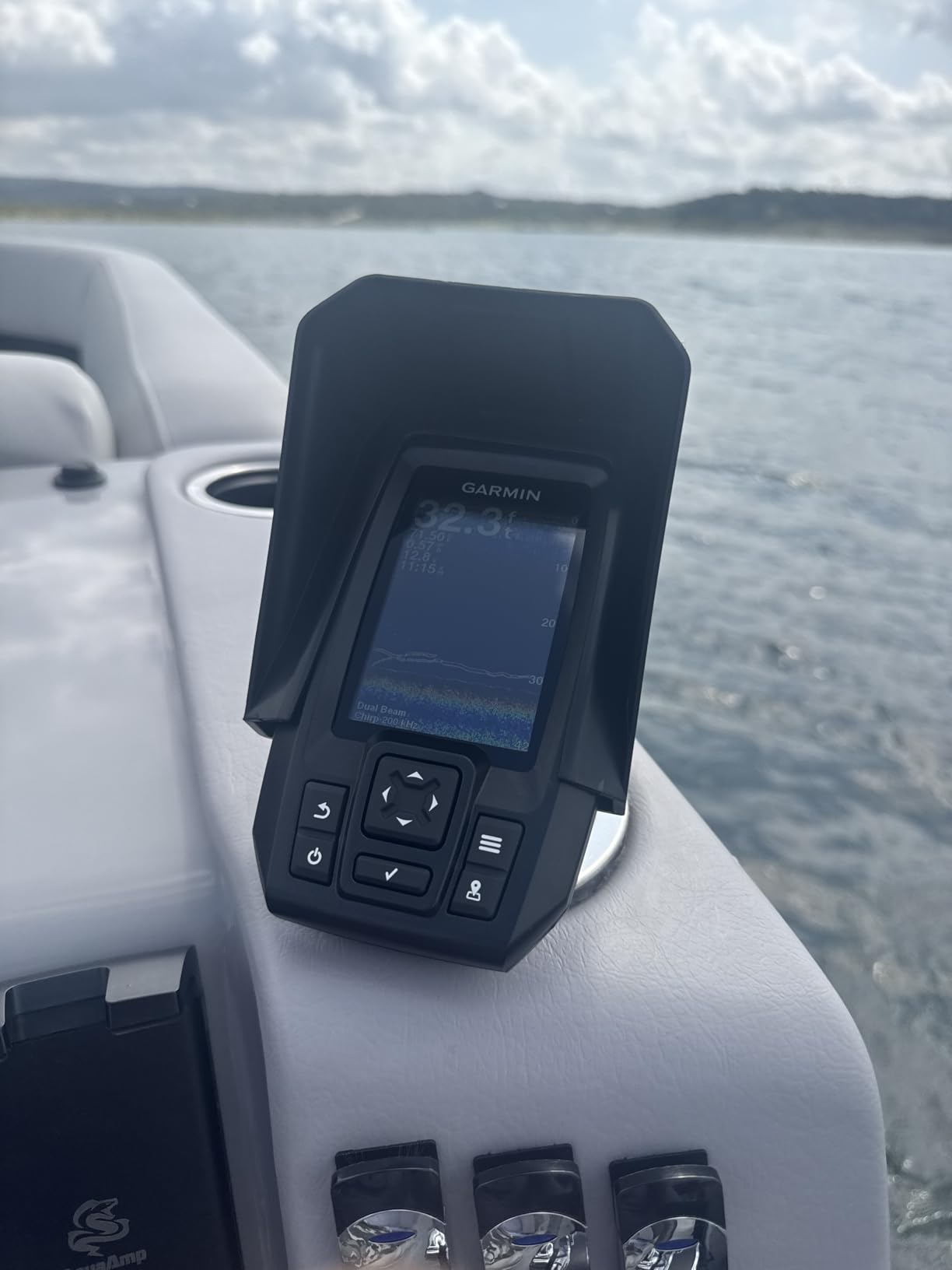
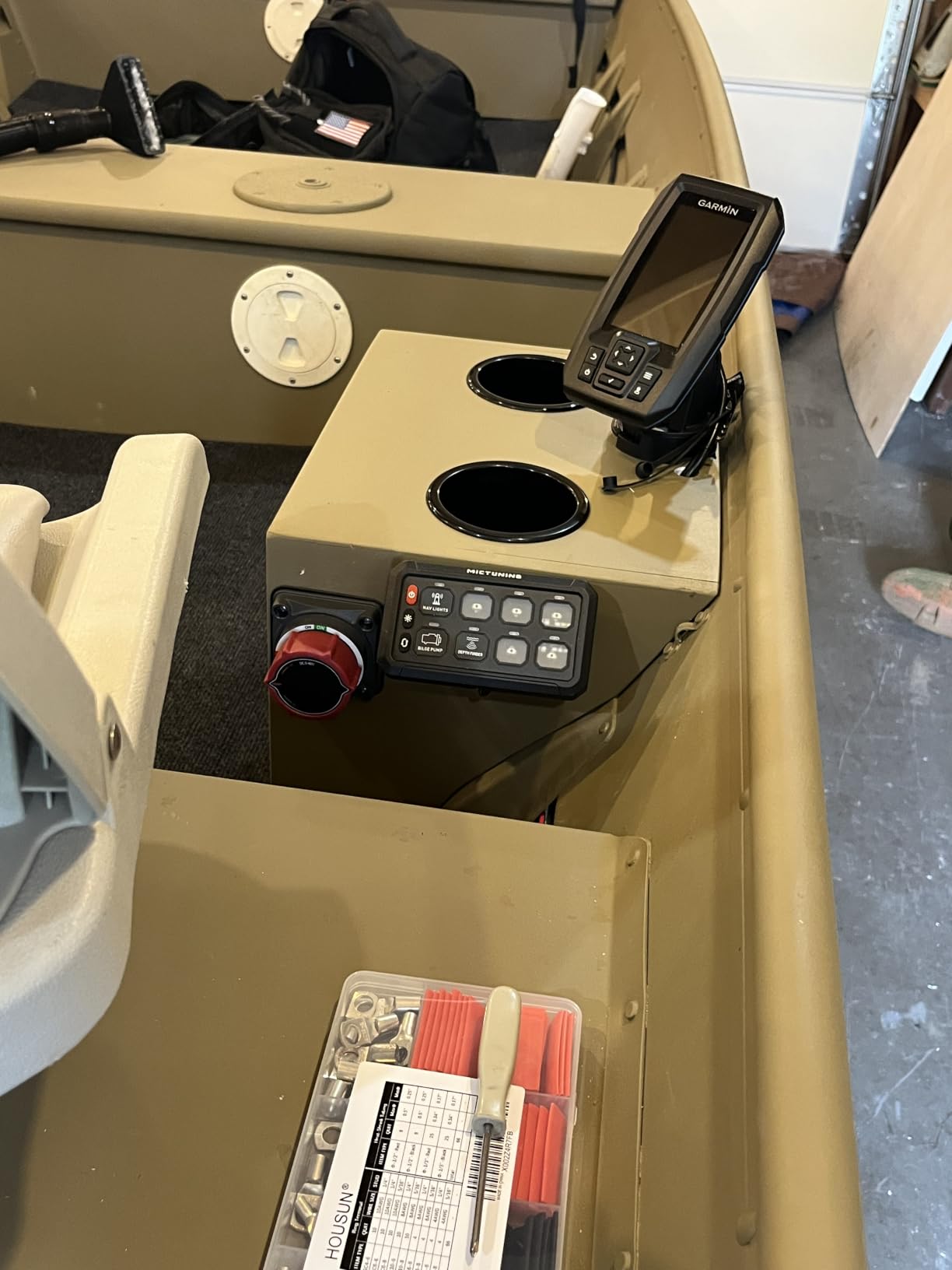
We like it for small boats specifically. The published draw is 0.23 amps at 12V, and owners report running it for days off a small sealed lead acid battery. The display is a 3.5 inch diagonal panel, sunlight readable in testing by owners who fish at midday, and it reports depth, water temperature, battery voltage, boat speed, and bottom contour all on one screen.
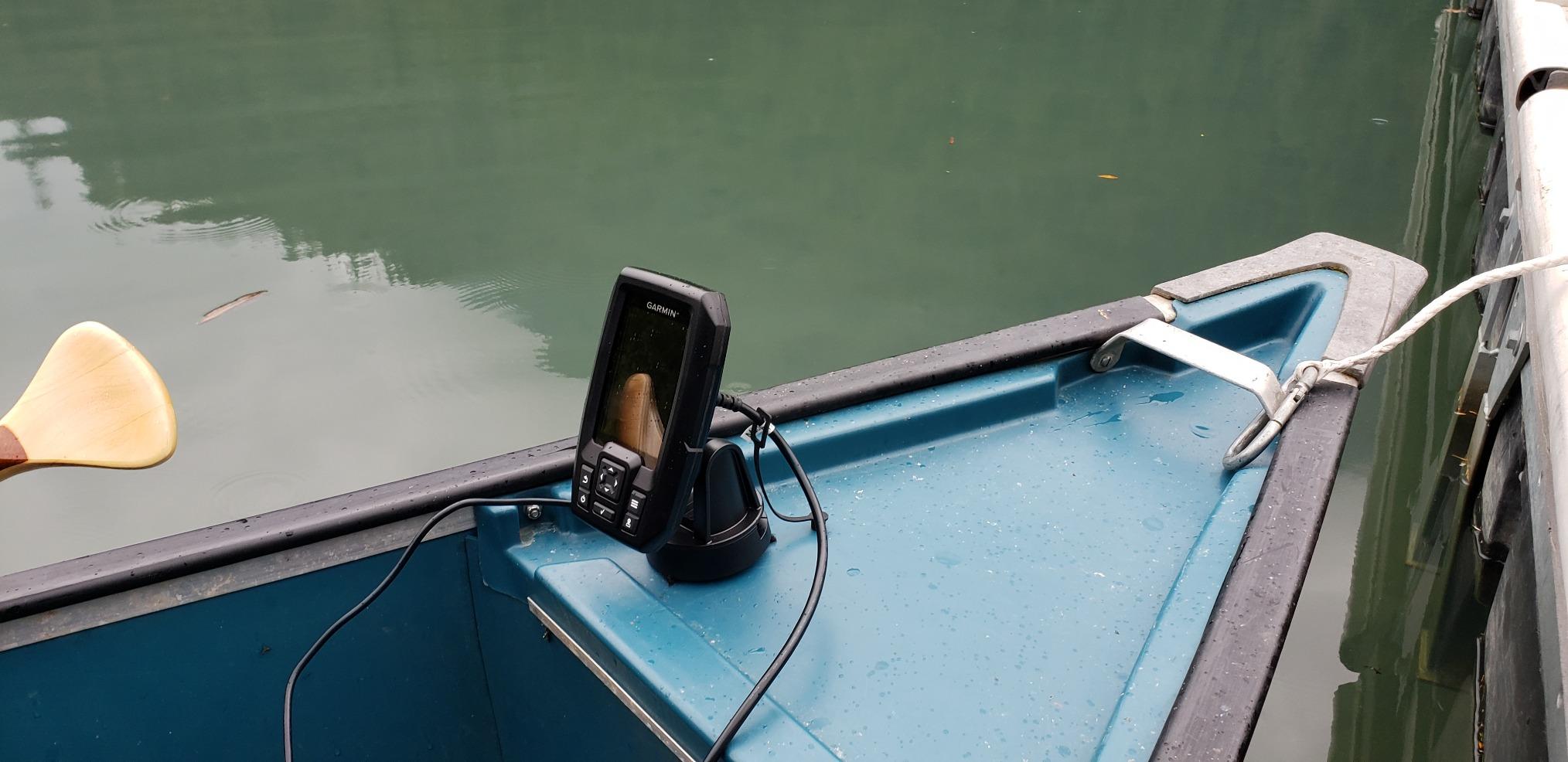
Sonar is CHIRP traditional plus ClearVu scanning, so you get fish arches and a near-photographic look at structure on the same unit. Maximum depth is rated at 1600 feet in freshwater and 750 feet in salt, which covers everything except true offshore work. There is also a built-in flasher for ice fishing and vertical jigging.
The mapping is the weak point, and you should hear it from us rather than find out later. This is a waypoint map, not a chartplotter. You can mark a brush pile, view it, and navigate back to it. You will not get shoreline detail, channel markers, or depth shading unless you add something else.
Who the Striker 4 suits
This is the right unit for a jon boat, a small bass boat, a pontoon with a cramped console, or a kayak with a trolling motor mount. If your whole plan is mark the spot, come back to the spot, it does that job with almost no power draw and no installation headaches. The keyed interface also means you can operate it with wet or gloved hands, which matters more than people expect at 5 a.m.
When to skip the Striker 4
Skip it if you need to see a chart of where you are, or if you run split screen with a map on one side and sonar on the other. At 3.5 inches, that view is unreadable while you are moving, and owners report the sonar readout cutting out at higher trolling speeds. If those two features matter, step up to the 4.3 inch Striker Plus 4 or larger.
2. Garmin Striker Plus 4 – Quickdraw Contours on a Budget
Garmin 010-01870-00 Striker Plus 4 with Dual-Beam transducer
Quickdraw 1-ft contours
4.3 inch QSVGA
Dual-beam transducer
200 W RMS
Pros
- Quickdraw contours for up to 2 million acres of your own mapping
- Sunlight readable 4.3 inch display
- Owners report days of runtime on a 7Ah battery
- Transom and trolling motor mounts included
Cons
- Resolution is less crisp than older Garmin screens
- No battery or power fittings included
- Quickdraw maps cannot be shared on this model
The Striker Plus 4 is the model that introduced most of the internet’s anglers to automated contour mapping. Part number 010-01870-00. The headline feature is Quickdraw, which records 1-foot contours automatically as you run and stores up to 2 million acres of your own mapping on the unit itself. That is genuine charting, produced by your boat, on a display most people assume is too small for it.
Sonar is a Garmin dual-beam transducer with CHIRP traditional at 50, 77, 83, and 200 kHz and 200 W RMS of transmit power, with a maximum measuring depth of 20 meters. The 4.3 inch QSVGA screen is bright in direct sun and splitscreen between chart and sonar comfortably. Owners using it from kayaks, canoes, and on ice rate it very highly for that reason.
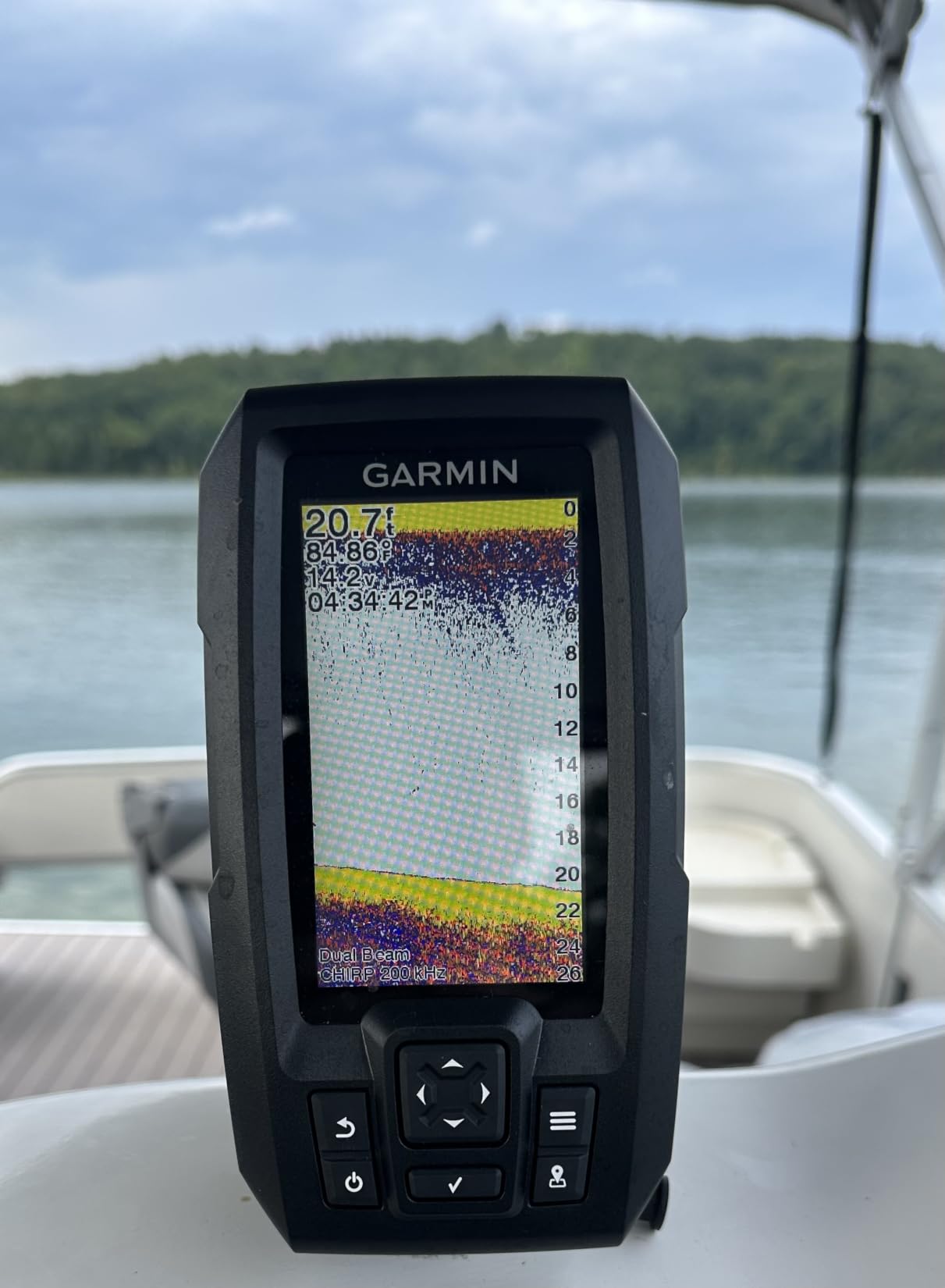
Bluetooth is built in, which is how Quickdraw data moves between units and phones on newer models. On this one, the practical limitation is that Quickdraw maps created here cannot be uploaded or downloaded, so treat the stored contours as a personal lake log rather than a shareable map. It still gets you the fish-holding structure marked in one-foot detail, which is what most anglers are actually after.
Warranty is listed as a Garmin limited warranty with a stated model number rather than a fixed year in the listing data, so confirm the current term with the seller before you rely on it. The box includes the unit, the Garmin dual-beam transducer, transom and trolling motor mounts, the power and data cable, the tilt and swivel mount, and documentation.
Who the Striker Plus 4 suits
Buy this one if you fish the same lake hard enough to want your own contours, and you do not want to spend a large sum on a chartplotter. It also suits anyone moving between a boat and a kayak with the same mapping habit. The 4.3 inch panel is the practical minimum we would consider for splitting chart and sonar.
When to skip the Striker Plus 4
Skip it if you need a real navigational chart, side imaging, or access to a larger body of water. There is no premium chart slot and no imaging beyond CHIRP traditional, so salt and offshore work is out. Note also that no battery or power fittings are included, so budget for a fuse holder and connectors.
3. Garmin Striker Vivid 4cv – Best Color Sonar Value
Garmin Striker Vivid 4cv Fishfinder with Transducer – 4-inch LCD Display – Easy-to-Use Scanning Sonar – Color Palettes, 11.2 Ounces (010-02550-00)
4 inch color LCD
Vivid scanning palettes
GT20 transducer
Quickdraw Contours
Pros
- Color Vivid palettes separate fish from structure clearly
- GT20 transducer gives CHIRP plus ClearVu in one
- Quickdraw Contours included at no extra cost
- Simple tilt and swivel bail mount
Cons
- 4 inch color screen is small for detailed reading
- No side or down imaging at this tier
The Striker Vivid 4cv is the cheapest way to get color scanning sonar, and reviewers consistently give it the highest average rating in our whole Garmin group at 4.7 stars across 1861 reviews. Part number 010-02550-00. The GT20-TM transducer is in the box alongside the power and data cable, tilt and swivel mount, hardware, and documentation.
What color buys you is separation. The Vivid scanning sonar color palettes let you assign fish one color and structure another, which on monochrome units forces you to read the echo shape instead of the hue. Owners who switched from black and white say the difference shows up most on weed lines and drop-offs, where the return is dense and hard to parse by shape alone.
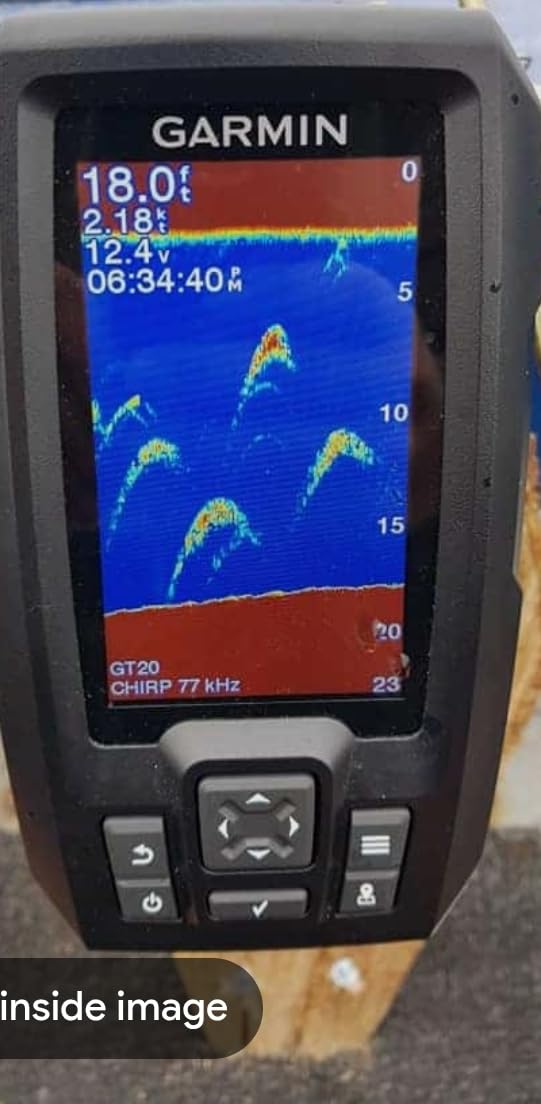
Quickdraw Contours is built in with no separate subscription or accessory, and the same high-sensitivity GPS handles waypoints, routes, and boat speed. Mounting is a bail mount, which is a quick-release style bracket that makes it far easier to stow the unit when you need the windshield down. Warranty is listed at 2 years limited, which is the longest in the Garmin group here.
The same 7 inch and 9 inch variants of this family exist if screen size is your binding constraint, and the electronics are the same generation. The 4 inch version is simply the one that fits a small console and a small budget.
Who the Striker Vivid 4cv suits
This fits anglers who want to see structure clearly without moving up a tier: small-boat bass, panfish, and general lake work where color makes the return easier to read. It also works well as a secondary unit at the helm when someone else handles the big screen at the bow. Most reviewers rate the simplicity of the button interface as a genuine advantage.
When to skip the Striker Vivid 4cv
Skip it if you hunt structure beside the boat rather than under it. There is no side imaging or down imaging here, only CHIRP traditional and ClearVu, so searching wide for a fish holding off a drop-off is not what this does. The color screen is also small enough that a split with any navigation page gets cramped quickly.
4. Humminbird Helix 5 Chirp DI G3 – Best 5-Inch Unit with Down Imaging
Humminbird Helix 5 G3 GPS Fish Finder with Transducer, Dual Spectrum Chirp Sonar & Down Imaging
5 inch color TFT
CHIRP Down Imaging
XNT 9 HW DI T included
Humminbird Basemap
Pros
- Down Imaging catches small fish in shallow water
- Readable color TFT in bright sun
- Accurate GPS tracking with temperature readout
- Transducer handles weeds and debris
Cons
- Fuse and fuse holder not included
- Gimbal bracket is awkward to release
- Down Imaging has a learning curve
The Helix 5 Chirp DI G3 is the first Humminbird on this list that includes a genuine basemap rather than a bare waypoint plotter. Part number 411670-1. The Humminbird Basemap covers more than 10,000 lakes plus the US coastlines, and the unit accepts LakeMaster, CoastMaster, Navionics, and AutoChart Zero Line SD cards if you want more detail.
Sonar is Dual Spectrum CHIRP in Wide and Narrow modes plus CHIRP Down Imaging, which filters visual noise out of the bottom view so small fish show up in shallow water. The XNT 9 HW DI T transom-mount transducer is in the box with the power cable, mounting hardware, and a gimbal bracket. Control is a keypad and softkey layout that works in any weather, wet hands, or gloves.
AutoChart Live records real-time contours with 8 hours of built-in memory, so the unit builds depth data as you fish and stores it for later. Owners who came from premium Lowrance units generally rate this as better value, and the 4.5 star average across 338 reviews reflects that. Down Imaging does carry a real learning curve, which is the most common note in the reviews.
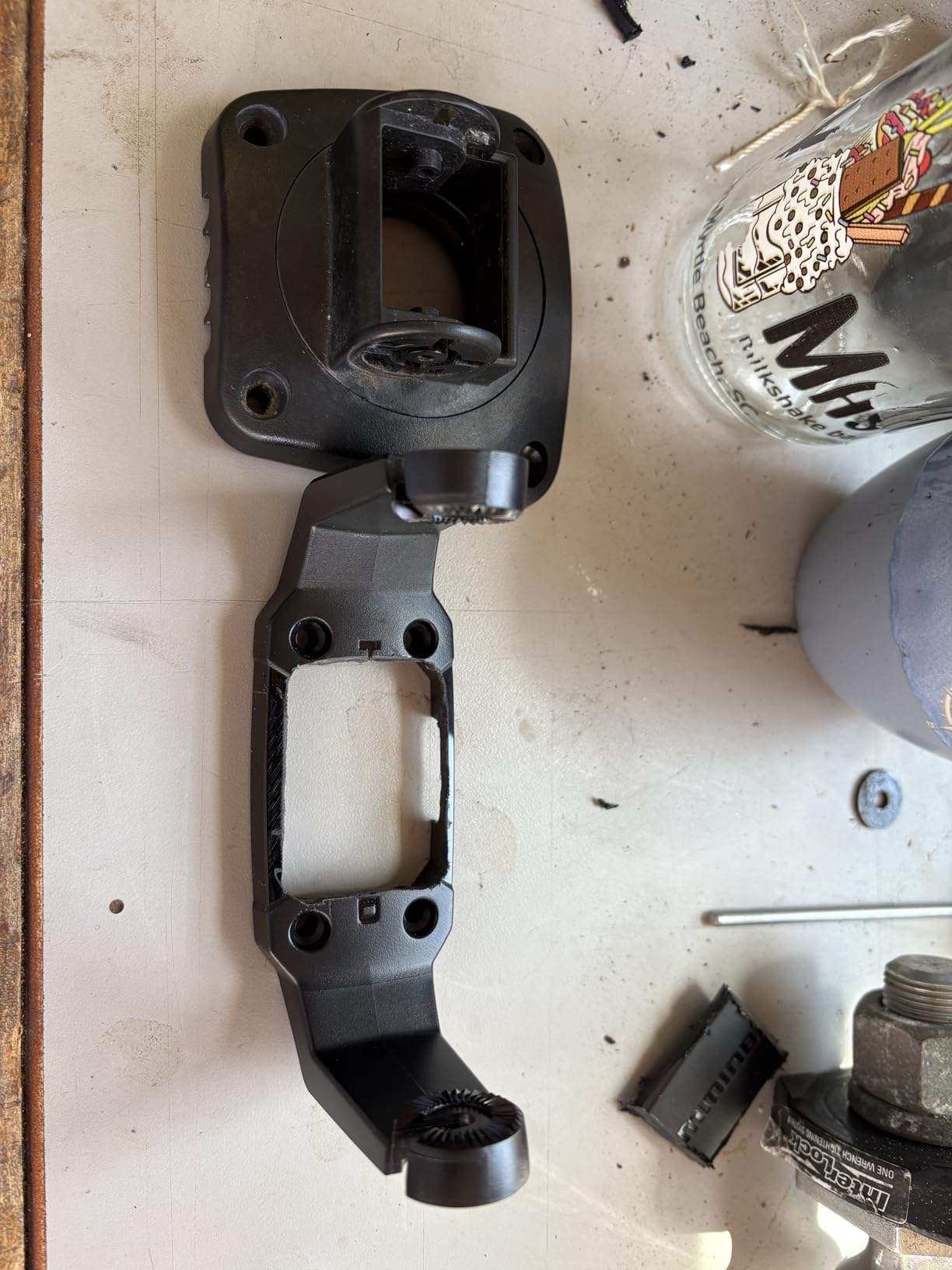
Two practical flags before you buy. The 3-amp fuse and its holder are not included, and the gimbal bracket is reported as awkward to remove, so budget for hardware and allow extra time at the console. Warranty is listed at 1 year manufacturer.
Who the Helix 5 G3 suits
It is the right pick for someone who wants to navigate on something better than waypoint lines but does not need side imaging. Shallow-water and creek fishing benefit from the down view. The keyed controls also make it the easiest unit here to operate on an early start or a rainy day without taking your eyes off the water for long.
When to skip the Helix 5 G3
Skip it if you want to scan the water beside the boat for structure, because down imaging only looks straight down. A five inch screen is also tight if you plan to run side and chart views together. For search-around-the-boat fishing, move up to the 7 inch Helix G4.
5. Humminbird Helix 7 G4 – Best Side Imaging at Mid Tier
Humminbird Helix 7 G4 GPS Fish Finder with Transducer, MEGA Side Imaging
7 inch color TFT
MEGA Side and Down Imaging
XNT 9 HW MSI 150 T included
Basemap
Pros
- MEGA Side Imaging gives a detailed view of structure beside the boat
- Transducer included in the box
- 7 inch screen makes split views readable
- Straightforward keypad control
Cons
- Costs more than entry level finders
- Side imaging takes practice to interpret
- A minority of reviews report units that would not power up
The Helix 7 G4 is the Humminbird to buy if side imaging is the feature you actually want. Part number 411930-1. MEGA Side Imaging covers 125 feet to each side and MEGA Down Imaging looks 125 feet beneath the boat, running on Dual Spectrum CHIRP in Wide and Narrow modes. That side range is what makes it possible to read a channel edge or a weed line while you are on the move.
The box includes the control head, power cable, the XNT 9 HW MSI 150 T transom-mount transducer, mounting hardware, and a gimbal and in-dash mounting kit. The 7 inch color TFT panel is the point at which split-screen navigation and side imaging become readable together, which is the single most repeated practical concern in the fishing forums we read.
Mapping is Humminbird Basemap over 10,000 lakes and US coastlines, with AutoChart Live real-time contour recording and 8 hours of built-in storage. LakeMaster, CoastMaster, Navionics, and AutoChart Zero Line cards all work. Warranty is 1 year manufacturer, and the unit weighs about 2.1 pounds, which is fine for a 7 inch head unit.
Be aware the review sample here is small at 81 reviews. The rating of 4.5 is solid, but a minority of one-star reviews describe units that failed to power up after installation. That pattern shows up on several head units in this category and is usually a wiring or connector issue rather than a defect, but buy from a seller who handles returns without argument.
Who the Helix 7 G4 suits
This is the mid-tier choice for lake and coastal anglers who want to scan structure to both sides of the boat without moving to a touchscreen system. It suits a boat with a normal-sized console where a 7 inch head unit fits without crowding. Owners coming from a smaller unit say the difference in split-screen readability is the biggest upgrade.
When to skip the Helix 7 G4
Skip it if you fish shallow inshore water where side imaging has little room to work, or if your console has no space for a 7 inch unit. It is also not the right unit for a boat that wants full network integration with radar and engine data. Those jobs belong to the XPLORE and Simrad NSS units.
6. Humminbird XPLORE 10 – Best Touchscreen with Full Networking
Humminbird XPLORE 10 GPS Fish Finder with Transducer, MEGA Side Imaging+ & HD Touchscreen
10 inch HD touchscreen
MEGA Side Imaging+ 200 ft
NMEA 2000 and Ethernet
LakeMaster card included
Pros
- Touchscreen and menus are far faster than keypad units
- Sharp bright display readable in direct sun
- Customizable screens and favorites plus on-screen keyboard
- Full NMEA 2000 and Ethernet for multi-device setups
- Responsive customer support
Cons
- Steep learning curve for beginners
- Included coastal card has thin detail in some regions
- Premium charts cost extra
- Older heading sensors will not work on NMEA 2000
The XPLORE 10 is where Humminbird stopped being a keypad brand. Part number 412010-1CHO for the control head. The 10 inch high-definition touchscreen runs MEGA Side Imaging+ at 200 feet per side and MEGA Down Imaging+ to 200 feet, on Dual Spectrum CHIRP sonar. The jump owners describe coming from a Helix is interface speed and screen clarity rather than raw fish finding.
Networking is the other half of the story. NMEA 2000 and Ethernet support One-Boat Network integration, including Minn Kota trolling motor control, and Bluetooth handles anchor control and phone notifications. The available range covers 9, 10, and 12 inch screens with both control-head-only and transducer-included options, so this exact part number is worth reading carefully.
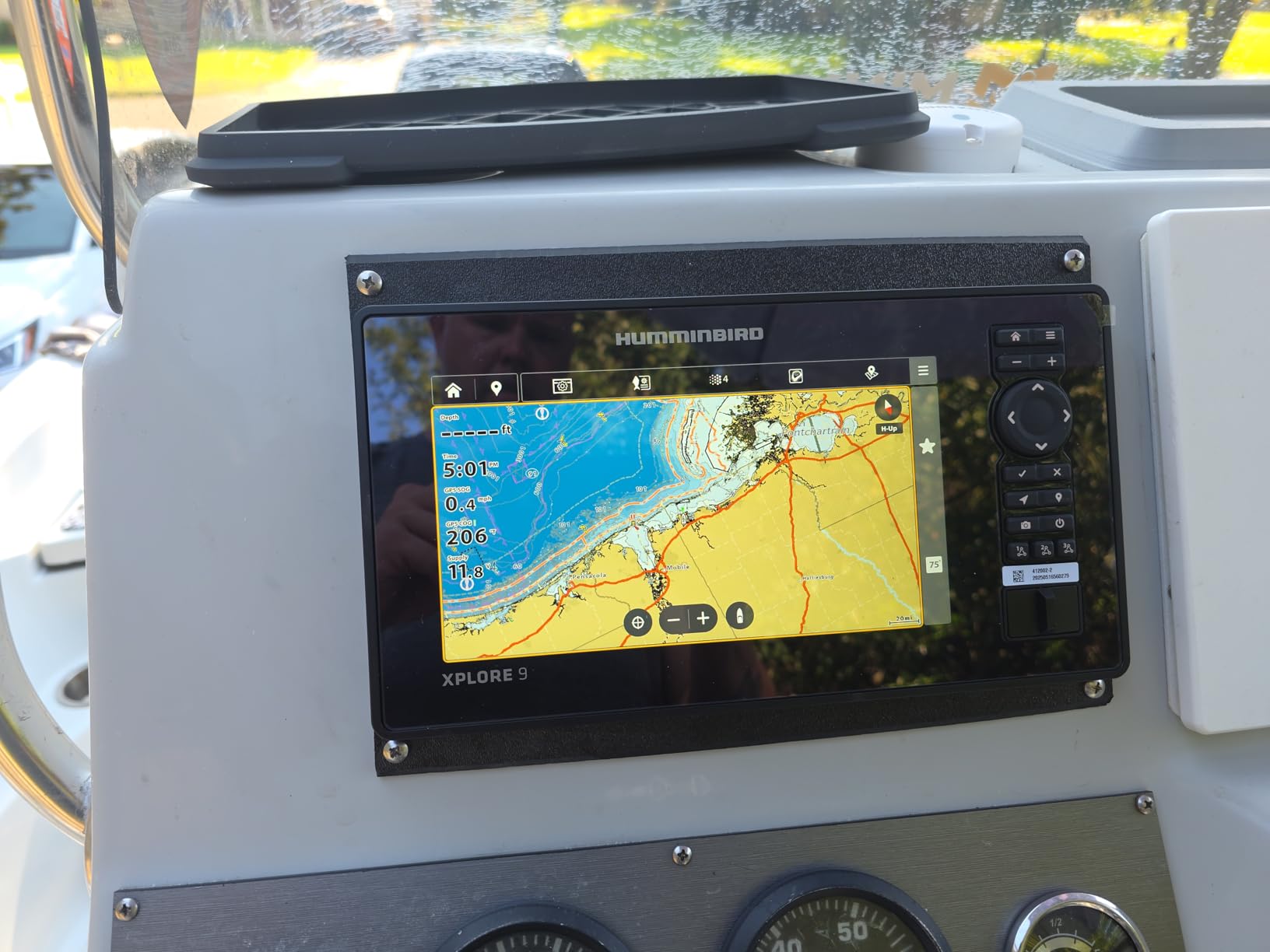
Mapping includes Humminbird Basemap over 10,000 lakes plus an included LakeMaster or CoastMaster VX map card, and AutoChart Live records real-time contours with 8 hours of memory. Reviewers who come from Helix units rate the customizable screens, favorites, and on-screen keyboard as the features they use most. Warranty is three years with registration, the longest in this roundup.
The reservations are consistent across reviews. The learning curve is real even for experienced fish finder owners, the included coastal chart card disappoints people fishing nearshore structure who expected more detail, and the NMEA 2000-only approach will not accept older heading sensors you may already own.
Who the XPLORE 10 suits
It suits a boat being built out as a system rather than a single addition: live well, trolling motor, engine data, radar, and audio all on one network. Owners report the touchscreen speed is the feature that changes daily use, and the bright panel holds up in direct sun. If you fish a lot of nearshore structure, plan on buying a better coastal card.
When to skip the XPLORE 10
Skip it if this is your first fish finder or if your boat has one small console. A 10 inch head unit at 4.8 pounds needs mounting planning, and the interface punishes anyone who does not want to learn it. Also skip it if you need to link older NMEA 0183 sensors you already own.
7. Lowrance Elite FS 10 – Most Versatile with Preloaded C-MAP Charts
Lowrance Elite FS 7 Fish Finder with Active Imaging 3-in-1 Transducer, Preloaded C-MAP Contour+ Charts
10 inch multi-touchscreen
Active Imaging 3-in-1
C-MAP DISCOVER onboard
1000 ft depth
Pros
- One transducer delivers CHIRP SideScan and DownScan with FishReveal
- Large multi-touchscreen with quick touch interaction
- C-MAP DISCOVER charts preloaded for inland coastal and Canadian waters
- Wireless NMEA 2000 and Ethernet for bow to stern displays
Cons
- Touch interface has a learning curve
- Live Sonar needs an extra ActiveTarget module
- Larger screens push the cost into four figures
- Some variants come without a transducer
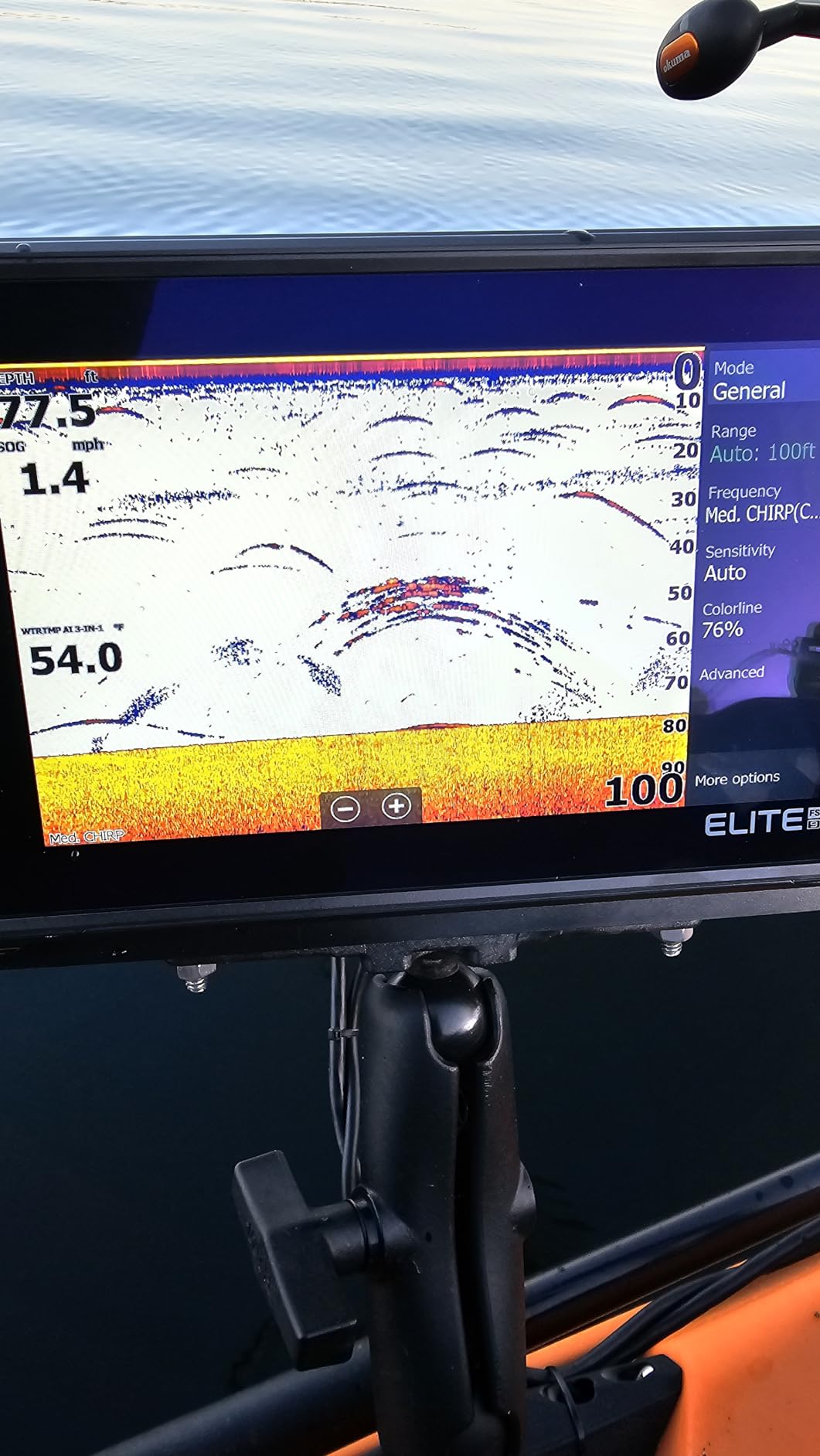
The Elite FS is the most complete single-box answer here for someone who wants navigation and fish finding in one screen with no add-on purchases. Part number 000-16430-001. The 3-in-1 transducer sends CHIRP, SideScan, and DownScan through one element and adds FishReveal to separate targets, and it is included in the box along with the suncover, fuse and fuse holder, corner clip kit, mounting bracket, knobs, and power cable.
Charts are the differentiator. C-MAP DISCOVER onboard coverage for inland, coastal, and Canadian waters is preloaded, so you are not starting from a blank waypoint map. The 10 inch multi-touchscreen handles chart, sonar, and split views in one frame, and reviewers rate the quick touch interaction as responsive. Maximum measuring depth is 1,000 feet.
Connectivity covers wireless, NMEA 2000, and Ethernet, which is what lets you run displays from bow to stern and share waypoints between them. Warranty is 2 years. The unit is offered in 7, 9, 10, and 12 inch sizes and with different transducers or no transducer at all, so confirm that the listing you buy is the HDI, Active Imaging, or head-unit-only version.
Two cautions. Live Sonar is the reason many people look at this unit, and it is not included: ActiveTarget 2 or 2 XL is a separate module. And the reviewers who mark it down most are the ones who expected side imaging and live sonar in the same box for the money.
Who the Elite FS suits
This is the pick for a mid-size center console or sport boat where one screen must do navigation, sonar, and eventually radar. It suits anglers moving between lakes and coastal water who want real charting on day one. It also fits anyone building a two-display boat, because the networking is already there.
When to skip the Elite FS
Skip it if your budget is fixed and you are tempted to add live sonar later, because that module changes the total. Skip it if you fish from a kayak or a very small boat, since the 10 inch head unit is 3.7 pounds of glass on a console. Very small hands and cold fingers will also find the touch interface takes practice.
8. Lowrance Eagle Eye 9 – Best for Live Sonar Without a Separate Module
Lowrance Eagle Eye 9 Live Sonar Fish Finder with C-MAP Discover OnBoard
9 inch IPS display
Live Forward and Live Down
C-MAP microSD included
500 ft depth
Pros
- Live sonar shows fish reacting to a lure with no extra module
- Clear IPS screen readable through polarized sunglasses
- C-MAP charts for US and Canada included
- Low learning curve and uncluttered operation
Cons
- No battery voltage readout
- Not a touchscreen
- Basic transducer mounting hardware
- Thin instruction manual
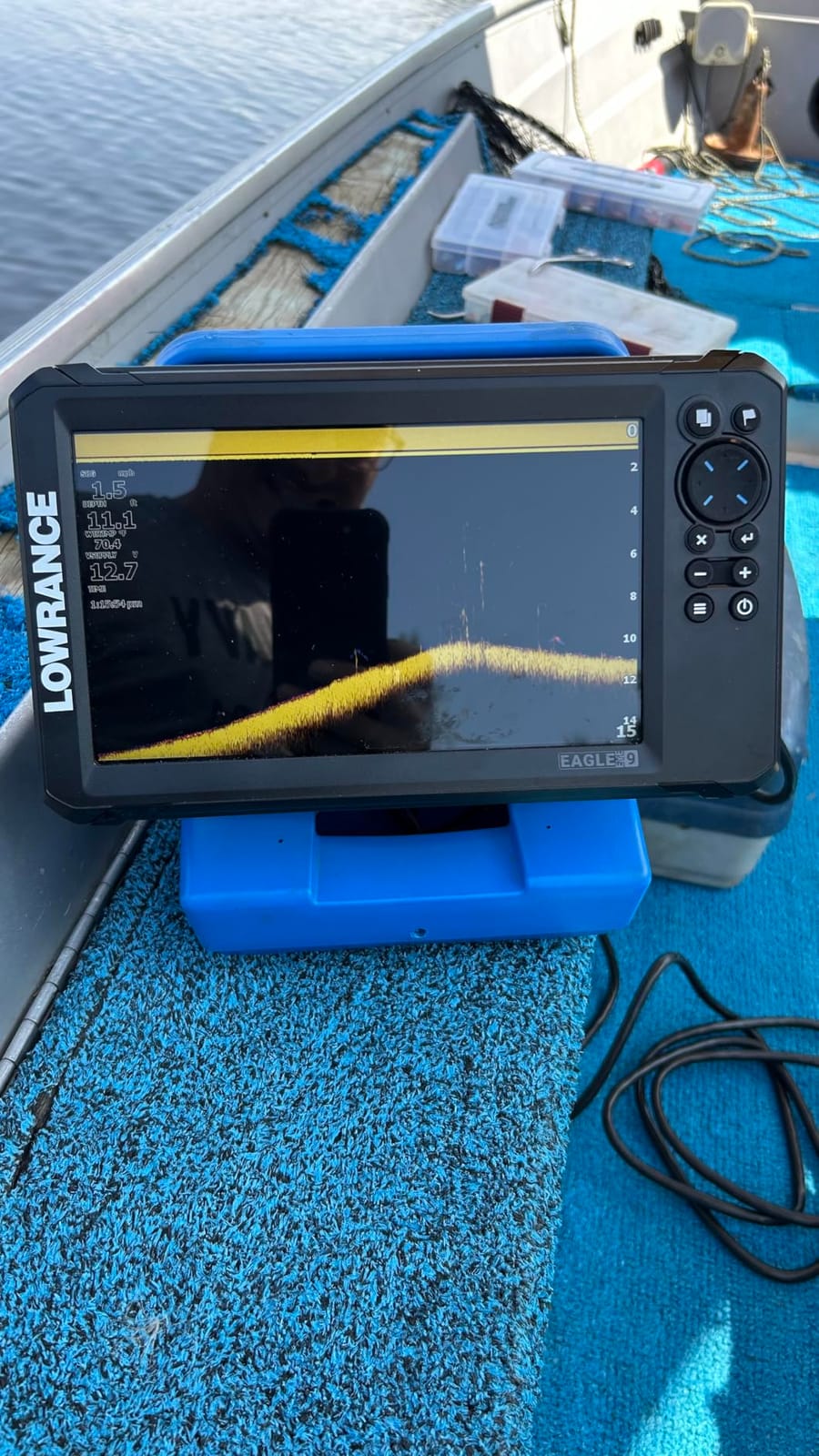
The Eagle Eye 9 is unusual because it puts live sonar in the box rather than treating it as an upgrade. Part number 000-16232-001. The included Eagle Eye transducer feeds four views to the 9 inch IPS display: Live Forward, Live Down, CHIRP, and DownScan with FishReveal. The live transducer connects straight to the display with no extra module, so you can watch a lure get hit in real time.
An IPS panel is worth calling out because it stays visible in direct sunlight and through polarized lenses, which many cheaper transflective screens do not. Maximum measuring depth is 500 feet. An included C-MAP DISCOVER microSD card covers US and Canadian waters, and variants are also offered with C-MAP US Inland charting.
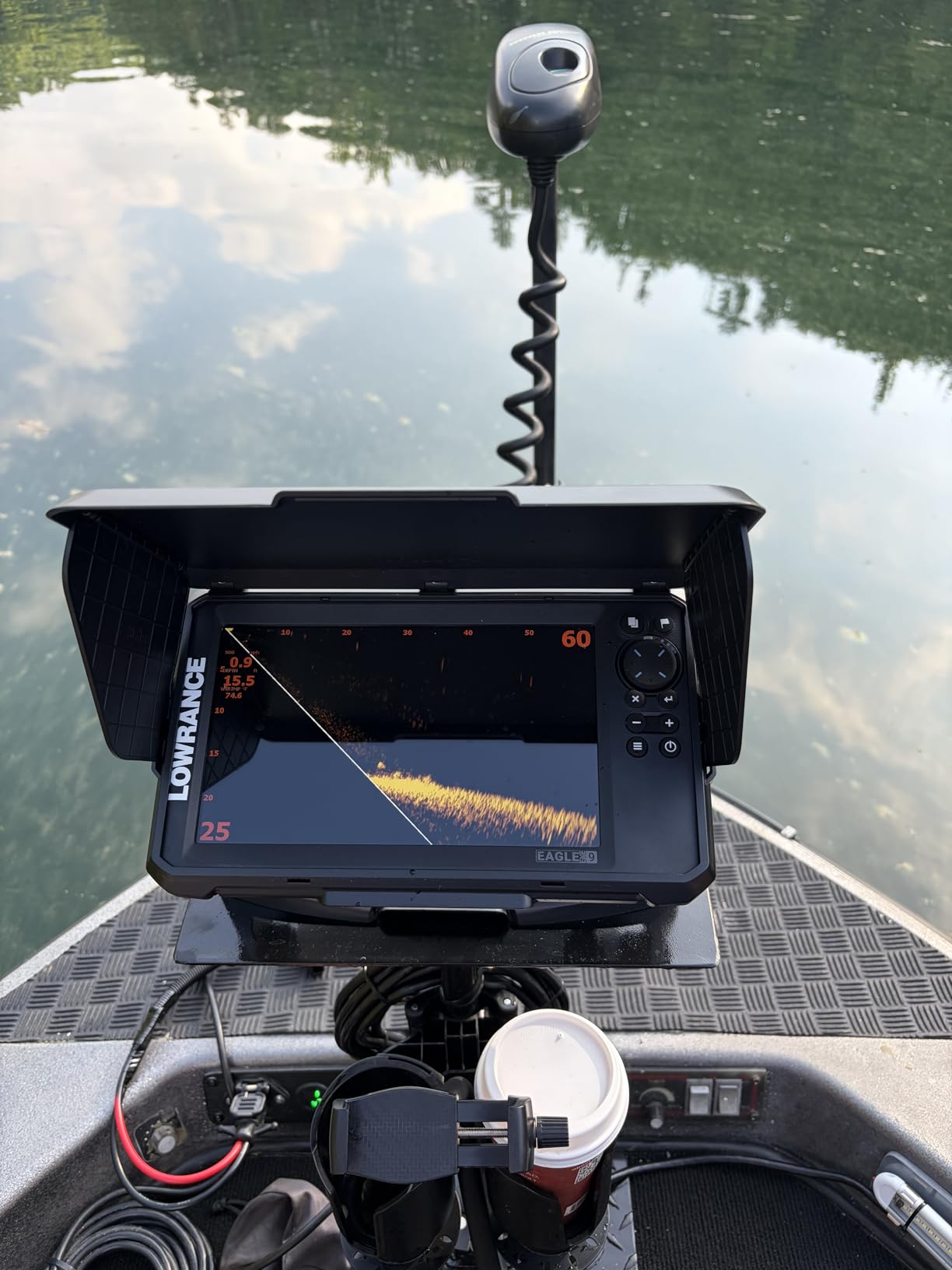
The 4.1 star average across 45 reviews is the lowest in this roundup, and the reasons are specific rather than fatal: no battery voltage readout, no touchscreen, thin documentation, and basic transducer mounting hardware that some owners improvise. A minority of buyers also report units arriving that would not power on, so check the return terms carefully. Owners who keep theirs rate it as an affordable live-scope-style unit with genuinely useful charting included.
One number worth knowing if you run it off a portable battery: reviewers report about 6 hours on a 7Ah battery. Warranty is 2 years.
Who the Eagle Eye 9 suits
It suits anglers who fish structure hard in the water column and want to see strike reactions without buying a separate live sonar module. The low learning curve matters for anyone who does not want to spend a season learning menus. It is also a reasonable way to try live sonar before deciding whether the premium systems are worth it.
When to skip the Eagle Eye 9
Skip it if you want side imaging, since there is no SideScan view on this unit. Skip it if you are building a multi-display boat and need Ethernet and NMEA 2000 depth. Also skip it if you rely on a battery voltage readout to monitor a small boat’s electrical system.
9. Simrad GO9 XSE – Best Chartplotter That Is Also Radar Ready
Simrad GO9 XSE – 9-inch Chartplotter with Active Imaging 3-in-1 Transducer, C-MAP Discover Chart Card
9 inch LED touchscreen
Active Imaging 3-in-1 transducer
C-MAP DISCOVER card
Wi-Fi mirroring
Pros
- Chartplotter sonar and radar-ready hardware in one 9 inch screen
- Active Imaging 3-in-1 transducer with CHIRP SideScan and DownScan
- C-MAP DISCOVER vector charts for US and Canada bundled
- Wi-Fi mirrors the display to phone or tablet
- Suits sportboats center consoles and small cruisers
Cons
- NMEA 2000 only limits older device compatibility
- Touchscreen controls need practice in wet conditions
- Learning curve for sonar and chart setup
The Simrad GO9 XSE is the value route into a networked chartplotter. Part number 000-14840-002. It is a 9 inch LED touchscreen at 480 by 800 resolution that handles GPS, sonar, and radar, and it comes with an Active Imaging 3-in-1 transducer giving you CHIRP, SideScan, and DownScan from one mount.
The included C-MAP DISCOVER card brings vector charts with custom depth shading, tides, and currents across US and Canada. Radar is plug-and-play for Simrad HALO units on a powerboat, which is unusual at this tier, and Wi-Fi display mirroring lets you push the screen to a phone or tablet.
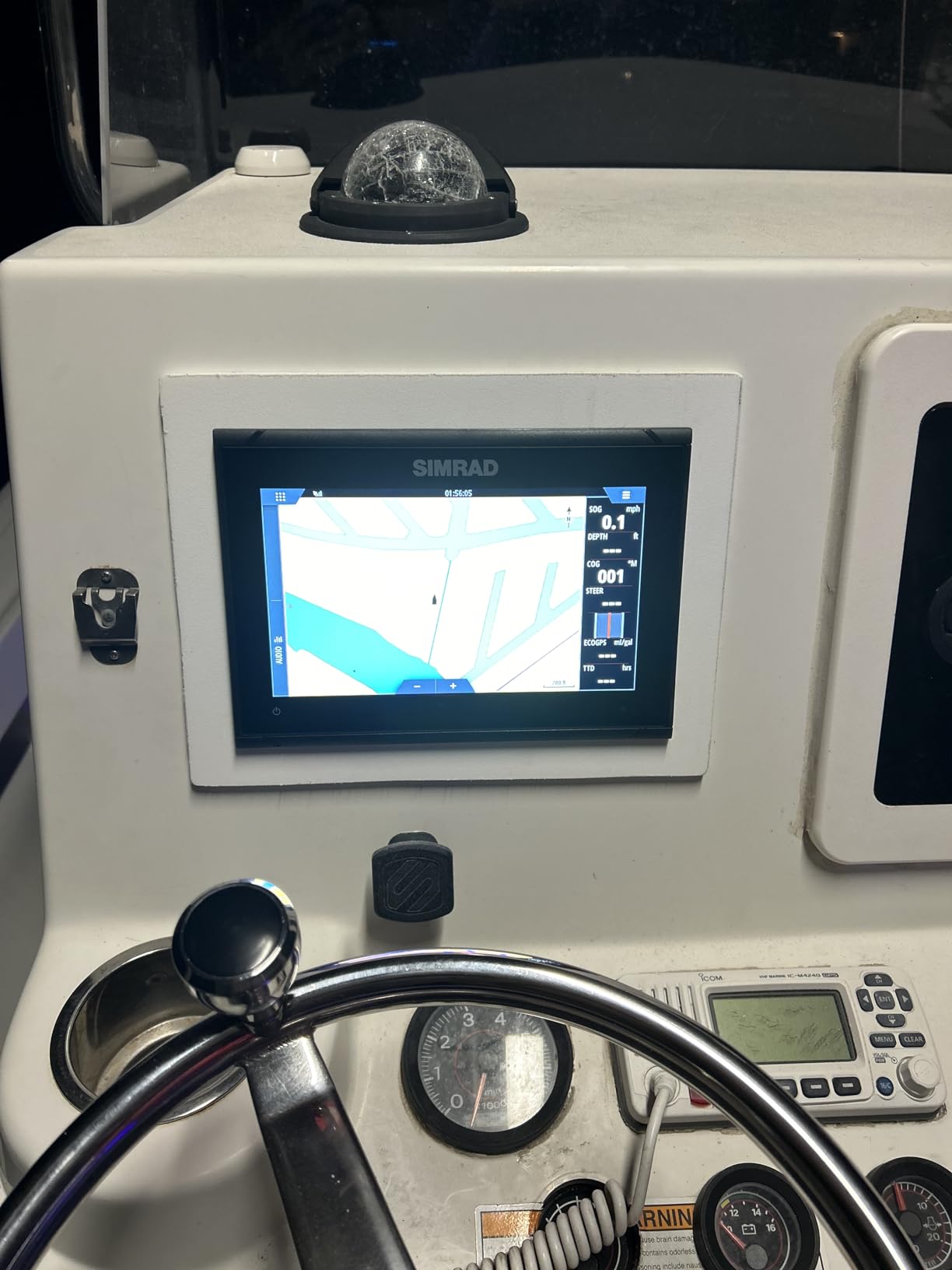
Reviews describe it as a good entry point that does everything without another purchase, with the caveats being a moderate learning curve for sonar and chart settings, touchscreen usability in wet hands, and NMEA 2000-only connectivity that will not talk to older devices. The 4.3 star average across 135 reviews reflects exactly that balance. A 7 inch version and 83/200 or medium and high HDI transducer options also exist.
Who the Simrad GO9 suits
It suits a sportboat, center console, or small cruiser that may add radar later and wants the wiring path open now. Coastal and saltwater anglers get the most out of it because the bundled charting covers US and Canada waters. Display mirroring is a genuine bonus for anyone who wants charts on a phone at the helm.
When to skip the Simrad GO9
Skip it if you already own older NMEA 0183 sensors you want to connect, because this unit is NMEA 2000 only. Skip it if you are on a small console where 9 inches does not fit. It is also not the unit to buy if you want live sonar, which this platform does not offer.
10. Simrad NSS Evo3S 12 – Best for Offshore Navigation
Simrad NSS12 Evo3S Chartplotter and Fishfinder with Preloaded C-MAP US Enhanced Charts, 12 Inch Display, Black, 000-15403-002
12 inch SolarMax IPS
iMX 8 processor
C-MAP US Enhanced
3,000 ft depth
Pros
- Large SolarMax IPS display stays readable in bright conditions
- Fast iMX 8 processor gives smooth transitions
- Hybrid control combines touchscreen keypad and rotary dial
- C-MAP US Enhanced charts preloaded
- Vessel-wide engine fuel and audio integration
Cons
- Most variants are control head only with transducer sold separately
- Premium cost for the 12 inch package
- Large and heavy unit needs careful mounting planning
The NSS Evo3S 12 is the biggest screen in this roundup and the one built for a boat with real instrumentation. Part number 000-15403-002. The 12 inch SolarMax IPS high-definition display runs on an iMX 8 processor, and the hybrid control scheme gives you multi-touch gestures plus a physical keypad and rotary dial, which is the combination most reviewers say solves the wet-hand problem without giving up touch.
Built-in GPS with preloaded C-MAP US Enhanced inland and coastal charts means it works out of the box with no card purchase. It powers Active Imaging sonar, StructureScan 3D, and HALO radar, and vessel-wide integration covers engine and fuel monitoring and audio control. Maximum measuring depth is 3,000 feet, the deepest figure published by any unit here.
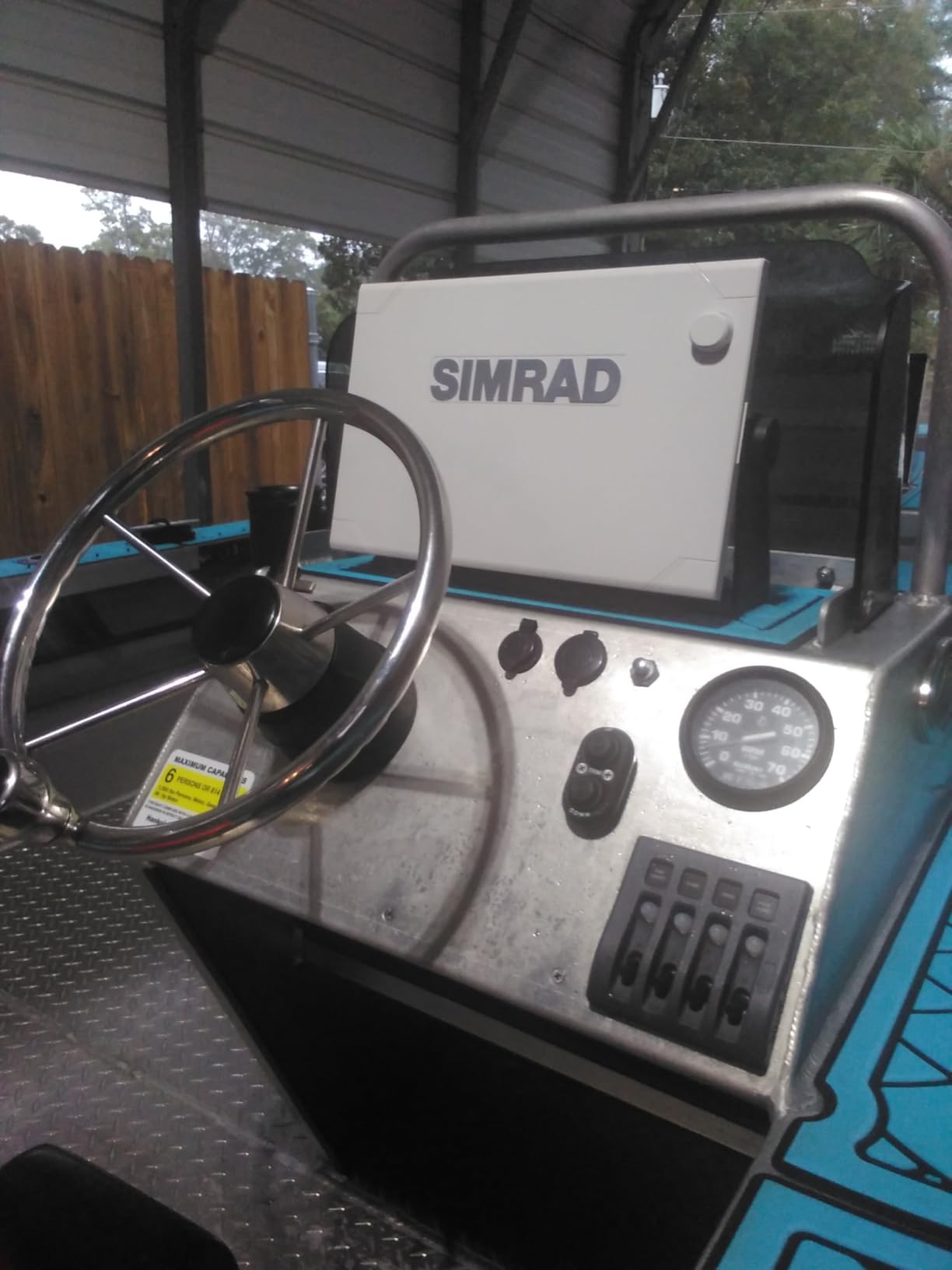
The important catch is in the box list: control head, power cable, sun cover, dash mount kit, and edge bezels. No transducer. Most variants are control-head-only and the sonar hardware is a separate purchase, which is the classic buyer trap people hit when the listing photo looks complete. Owners do note the console planning required, since it weighs 17.5 pounds and needs a real mounting surface. Warranty is 2 years manufacturer, and 9 inch and 16 inch versions exist.
Who the NSS Evo3S 12 suits
It suits a 25 foot and larger boat running offshore or long coastal routes where route planning, engine data, and radar are all part of normal operation. The 3,000 foot depth capability and preloaded enhanced charting are the deciding features for blue water work. Anyone with a hard helm and a proper mounting surface will get on with it well.
When to skip the NSS Evo3S 12
Skip it on any boat with a small console, and skip it if you want a turnkey system, because you will still need to buy a transducer. It is also overkill for freshwater-only fishing on a single lake. If your boat cannot host a 12 inch head unit and separate engine instrumentation, the GO9 covers the same networking ideas at a fraction of the size.
Charts vs GPS: What You Are Actually Buying
This is the confusion behind most of the questions on the forums we read, so it deserves a straight answer. GPS is a receiver. It knows your coordinates. Charts are map data drawn from those coordinates, and they are a separate purchase or a separate card unless the manufacturer says otherwise. A unit with GPS and no chart gives you a dot moving on a blank screen, a trail line, and waypoints you made yourself.
The Garmin Striker 4 and the Striker Plus 4 both ship with GPS waypoint mapping and nothing more. You mark a spot, you can see it as a marker, and you can navigate back to it. That is genuinely useful on a lake you fish, and it is not charting. Quickdraw Contours is the halfway step: the unit records 1-foot depth contours as you run and stores them as your own map, which the Striker Plus 4 and Striker Vivid 4cv both do.
Real charts come from three ecosystems. Humminbird units read LakeMaster and CoastMaster cards, plus Navionics. Lowrance and Simrad units ship with C-MAP DISCOVER onboard or preloaded, with Navionics and LakeMaster options depending on the model. The gotcha that catches people is coverage: a coastal card in a freshwater bundle, or a unit marketed to lake anglers that only carries nearshore coastal detail.
Coastal cards carry the least detail in shallow nearshore structure, which is exactly where inshore anglers fish. Owners of the Humminbird XPLORE point this out directly, and the fix is the same everywhere: buy the card for the water you actually fish, not the water the marketing copy mentions.
How to Choose a Fish Finder with Mapping: Buying Guide
Match screen size to the boat and the way you fish
Seven inch is the practical minimum for split-screen chart plus sonar, and the forums we read are nearly unanimous on that point. Nine inches works well on a center console and lets you co-mingle sonar and navigation views. Ten and twelve inch units belong on boats with a real helm and mounting surface, and they weigh between 3.7 and 17.5 pounds depending on the model.
Below seven inches, treat the screen as a fish finder only. The 3.5 inch Striker 4 and the 4 inch Striker Vivid 4cv are excellent sonar displays and poor navigation screens. Console space, not desire, is what limits unit size for most small-boat owners, so measure before you shop.
Confirm the transducer is in the box, then confirm it matches
Read the listing title for the word transducer or bundle. Head units and combos use nearly identical listings, and a unit that ships without a transducer means a second purchase and a second mounting job. Every pick in this roundup states exactly what is in the box.
It also matters which transducer. A dual-beam or CHIRP traditional transducer covers the basics. A 3-in-1 element gives you CHIRP, SideScan, and DownScan from a single mount, which is why we rate it highly on the Lowrance Elite FS and the Simrad GO9. Mega Side Imaging style units such as the Humminbird Helix 7 G4 and XPLORE need the matching wide-beam element.
Decide the chart ecosystem before you buy the screen
Charts are not interchangeable across brands in the way buyers assume. Choose the ecosystem with your water and your region in mind: C-MAP DISCOVER covers inland, coastal, and Canadian waters, LakeMaster and CoastMaster cover US inland and coastal detail, and Navionics cards work in Humminbird units. Budget for a card as an ongoing cost, not a one-time purchase, because your water coverage will eventually outgrow what ships in the box.
Check power draw and network compatibility on small boats
Small-boat anglers worry about this more than any other spec. The Striker 4 publishes a draw of 0.23 amps at 12V, which is why it and the Striker Plus 4 are popular on single-battery boats, where reviewers report days of runtime and about 6 hours on a 7Ah battery respectively. Larger screens draw considerably more, so if you are running a single battery, size the charging system before you pick the screen.
Networking decides what happens in year two. NMEA 2000 and Ethernet do not interoperate across brands, so a Lowrance or Humminbird trolling motor generally only talks to its own brand. If you already own a trolling motor, an older heading sensor, or an existing head unit, confirm compatibility before ordering. One Angler on the bigbendfishing.net forum described running two separate units for exactly this reason, preferring one brand for sonar and another for GPS.
Forum members also recommend physically handling several units at a marine electronics dealer before buying, because interface speed and button layout matter more in practice than the spec sheet suggests. If you are mounting something on a console or building a bracket, a stud finder helps you locate framing behind a thin panel before you drill.
Frequently Asked Questions
What is the best fish finder and GPS combo?
The Garmin Striker 4 (010-01550-00) is the best all-round choice because it ships with the transducer, transom and motor mounts, power cable, and tilt bracket in the box, and draws only 0.23 amps at 12V. It carries a 4.6 rating across more than 9300 reviews. If you need actual nautical charts rather than waypoints, step up to the Lowrance Elite FS 10 with preloaded C-MAP DISCOVER coverage.
What is the best marine GPS chartplotter for the money?
The Simrad GO9 XSE (000-14840-002) is the strongest value chartplotter in this roundup. It pairs a 9 inch LED touchscreen with an included C-MAP DISCOVER card covering US and Canada, an Active Imaging 3-in-1 transducer for CHIRP, SideScan, and DownScan, Wi-Fi display mirroring, and NMEA 2000. It is also radar ready for Simrad HALO units on a powerboat.
What fish finder brand has the best maps?
It depends on the water, not the brand. C-MAP DISCOVER, bundled with the Simrad GO9 and preloaded on the Lowrance Elite FS, covers inland, coastal, and Canadian waters with vector detail. Humminbird Basemap plus LakeMaster and CoastMaster cards covers more than 10,000 US lakes and the coastlines, and Garmin Quickdraw Contours lets you record your own 1-foot depth map as you fish.
Is Garmin better than Humminbird?
Garmin wins on entry-level simplicity, power draw, and automated contour mapping, and its keyed units are easier to run in bad weather. Humminbird wins on side imaging reach and networking, and it includes real basemaps instead of waypoint-only plotting. Lowrance and Simrad bundle C-MAP charting in the box. Pick the ecosystem that matches the equipment and the water you already fish.
Do I need a separate chart card if my fish finder already has GPS?
Yes, if you want real charts. GPS tells the unit where you are, and the chart draws the shoreline, hazards, depth shading, and tides around you. The Garmin Striker 4 and Striker Plus 4 have GPS but no premium chart capability, so they plot waypoints and Quickdraw contours only. Humminbird, Lowrance, and Simrad units read LakeMaster, CoastMaster, Navionics, or C-MAP cards.
Conclusion
There is no single best fish finder with GPS and mapping, because the transducer, the screen, and the chart coverage are three separate decisions. For most anglers the answer is the Garmin Striker 4, which gives you CHIRP, ClearVu, waypoint navigation, and a 0.23 amp draw in a box that needs nothing added. For color and automated contours on a budget, the Striker Vivid 4cv is the stronger all-round package.
If you navigate more than you mark spots, the decision changes. The Lowrance Elite FS 10 and the Simrad GO9 XSE both ship with C-MAP charting and a three-in-one sonar transducer in the box, and the Humminbird Helix 7 G4 brings MEGA Side Imaging at a mid tier. For a boat being built as a networked system, the Humminbird XPLORE 10 or the Simrad NSS Evo3S 12 is where that path leads.
Before you order anything, confirm three things on the listing: that a transducer is included and which model it is, that the chart bundle covers your water, and that the screen physically fits your console. Those three checks prevent nearly every regret we found in the owner threads. Check current pricing for any of these units before you buy, since the deals move around often.