
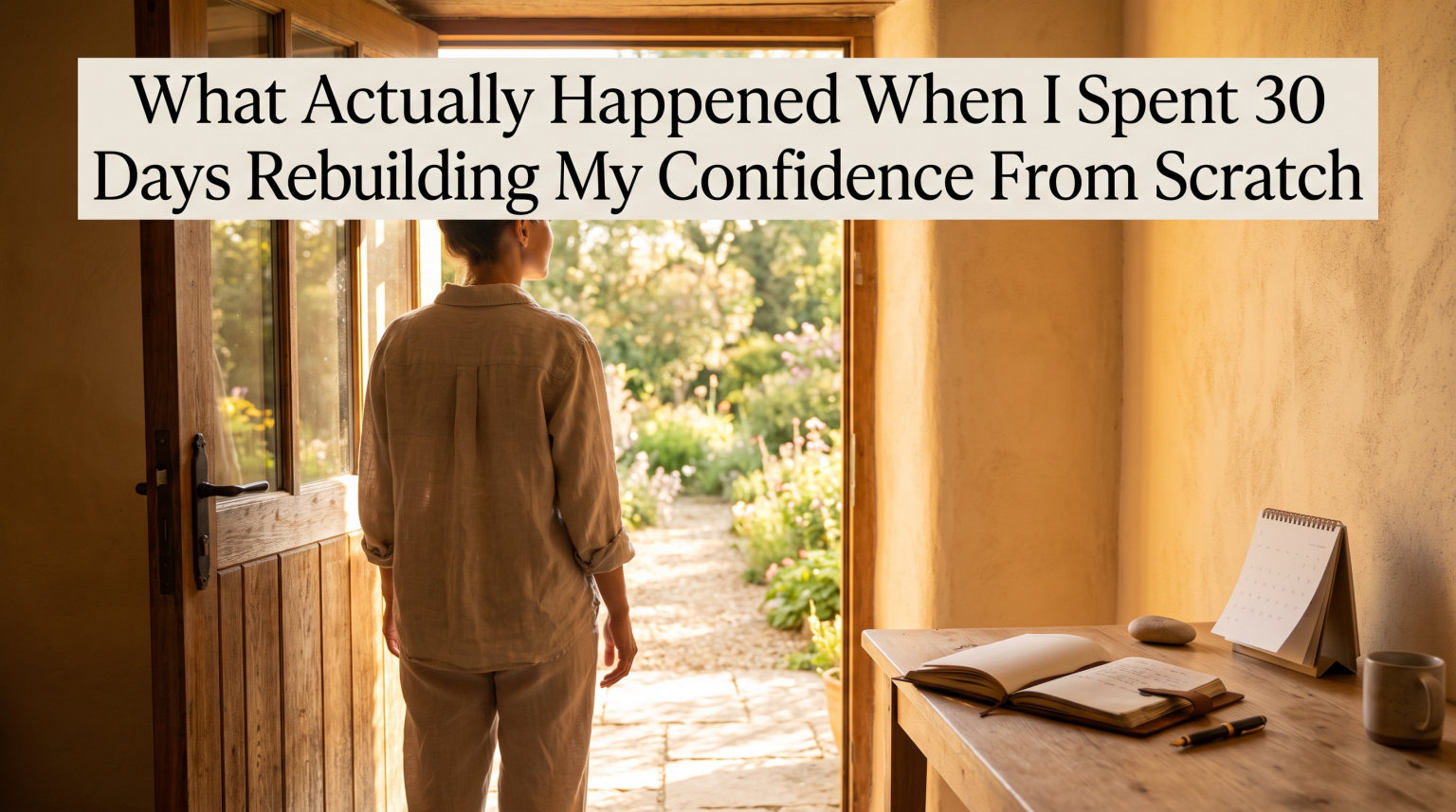
I had spent the better part of six months avoiding my own reflection.
Not literally. I still brushed my teeth and tied my shoes. But somewhere between a career setback, a relationship that fell apart, and a friendship I could not salvage, I had quietly lost faith in myself.
I started saying yes to things I did not want to do. I stopped speaking up in meetings. I cancelled plans with people I loved because the idea of being seen felt unbearable.
One night in May, I caught myself rehearsing a phone call to my own sister. I was thirty-four years old, stuttering through what to say about my weekend, scared she would somehow detect that I had become smaller.
That was the moment I knew I could not keep going like this. So I made a deal with myself: thirty days of rebuilding my confidence from scratch, no shortcuts, no faking it. I would document everything.
What follows is what actually happened when I spent 30 days rebuilding my confidence. Not the polished version. The real one.
Table of Contents
Why I Needed to Rebuild My Confidence From Scratch?
Looking back, my confidence had been eroding for years. It did not crash in one dramatic moment. It crumbled slowly, the way a cliffside does – one storm, one freeze, one too many waves until the ground beneath you is gone.
The root cause of my lack of confidence was not one failure. It was a running commentary I had built up over time, a relentless inner critic that narrated every move I made.
Every small mistake became proof I was not good enough. Every kind word from a friend bounced off what I had already decided about myself.
I want to be honest here. I tried to fix this in the usual ways first.
I bought self-help books. I tried affirmations that felt hollow the moment I said them. I downloaded apps. I even started a gratitude journal I abandoned by day six.
None of it stuck because none of it addressed the actual problem: I did not believe I deserved to feel better about myself.
That realization – that confidence was not a technique problem, but a self-worth problem – became the foundation for everything I did in the next thirty days.
What the 30-Day Confidence Challenge Actually Looked Like
I am not a life coach. I am not a psychologist. I am a regular person who got tired of feeling like a ghost in her own life.
I designed the 30-day challenge myself based on what I had read about behavioral activation, cognitive reframing, and the psychology of small wins.
The structure had four pillars, and I committed to touching each one every single day for thirty days. Some days I did all four. Other days I barely managed one. Both counted.
Pillar 1: Daily action over motivation. Every morning, I did one small thing that scared me. Not a giant leap. A text I had been avoiding. A question I would have normally swallowed. Eye contact with a stranger.
The size did not matter. Doing it while scared was the point.
Pillar 2: Replace the inner critic. Every time I caught myself saying something cruel to myself, I paused and rewrote it. Not into fake positivity – into something accurate.
“I am terrible at my job” became “I made a mistake, and I will learn from it.”
Pillar 3: Move my body. Twenty minutes of movement, every day. Walking counted. So did dancing in my kitchen while the coffee brewed.
The goal was not fitness. The goal was to prove to my nervous system that I could do hard things.
Pillar 4: Document everything. I wrote in a notebook every night. What I did, what I felt, what I noticed. This was the part that changed everything.
Week 1: The Awkward, Cringey First Steps
Week one was brutal in ways I did not expect.
I had imagined confidence building like a movie montage. Inspirational music, glowing montage, montage, suddenly I am a different person.
The reality was much quieter and much more embarrassing. Day three, I sent a LinkedIn message to someone I admired and immediately wanted to throw my phone into the ocean.
Day five, I asked a barista how her day was going and then panicked about whether she thought I was flirting with her.
My inner critic was loud. Louder than I had realized. Every small action came with a running commentary.
Look at you trying to be someone you are not. This is so cringe. Everyone can tell you are performing.
Here is what I learned in week one that I wish I had known on day one: feeling awkward does not mean you are doing it wrong.
It means you are doing it for the first time. Confidence is not the absence of discomfort. It is the willingness to feel discomfort and act anyway.
By the end of week one, my journal entry read: “I do not feel confident yet. I feel like I am wearing a costume. But I am showing up.” That was enough for week one.
Week 2: The Setback I Did Not See Coming
Week two broke me in a way I have to be honest about, because no one talks about this part.
On day eleven, something small happened that knocked me sideways. A friend made an offhand comment about my career pivot. It was not even mean. It was just honest.
And my entire nervous system interpreted it as confirmation of every worst thing I believed about myself. I spent three days in bed.
I want to pause here because this is the part most confidence articles skip. They show you the highlight reel. They never show you the day you crawl back under the covers because someone reminded you of the thing you were already afraid of.
Rebuilding confidence is not a straight line. Anyone who tells you it is has either never tried or is leaving out the hard parts.
On day thirteen, I almost quit. I sat on the edge of my bed with my notebook and thought, this is stupid. I am broken in a way that thirty days cannot fix.
What kept me going, honestly, was the notebook itself. I read back through day one. Day two. Day five.
I had been so focused on how I felt in the moment that I had not seen the small shifts accumulating underneath. There were tiny proof points I had ignored because they did not feel like breakthroughs.
I texted a friend that day and admitted I was struggling. She told me something I now believe is the most underrated advice in personal growth: “Bad confidence days do not erase good confidence days. They are part of the same work.”
I started day fourteen with the smallest possible action. I made my bed. I drank water. I walked for fifteen minutes.
I did not force a breakthrough. I just did not quit.
Week 3: The Tiny Breakthroughs Started Adding Up
Week three is when something shifted. I cannot point to a single moment. It felt more like a thaw.
I noticed I was raising my hand in meetings again. Not every meeting. Not with confidence. But I was speaking up in small ways I had stopped doing months earlier.
I made a joke at dinner with friends and did not immediately regret it. I wore an outfit I would have previously talked myself out of.
The psychology behind this, I now understand, is what researchers call behavioral activation. Each small action sends a signal to your brain that you are capable.
Each signal builds on the last. The compounding is invisible in the moment but unmistakable over weeks.
Day seventeen was the day I realized my inner critic had changed its voice. It was still there, but the volume was lower.
The messages were less cruel. Instead of “you are a fraud,” I heard “you are tired.” Instead of “you will fail,” I heard “this might be hard.”
That shift mattered more than any external accomplishment. The biggest part of rebuilding confidence was not what I did. It was the way I talked to myself while I was doing it.
By day twenty, I had a conversation with someone I had been avoiding for two years. I did not enjoy it. I was nervous the entire time.
But I did not pretend to be someone else, and I did not run away afterward. That felt like a real win.
Week 4: The Day I Realized Something Had Shifted
Week four was quieter than I expected. The intensity dropped. The anxiety softened. The actions that had felt like pulling teeth in week one started to feel, well, almost normal.
On day twenty-six, something happened that I will not forget. I was at a coffee shop and a stranger asked me a question about my laptop bag.
I answered without rehearsing. I made eye contact. I smiled. I walked away thinking, wait, that was easy. That used to be hard.
That was the day I understood what people mean when they say confidence is built, not found.
I had spent years thinking I was missing some essential ingredient. Some people are just confident, I told myself. I was not one of them.
But that was not true. Confidence is a practice. It is built through repetition the way a muscle is built through resistance.
I also noticed the benefits I had not anticipated. I slept better. I argued less with my partner because I was less defensive.
I started saying no to commitments I did not want, which made room for the ones I did. The confidence work spilled into every area of my life in ways I did not plan for.
By day thirty, I was not a different person. I was not suddenly fearless.
I still have an inner critic. I still have days where self-doubt shows up uninvited. But the gap between who I was on day one and who I was on day thirty was real and measurable.
What Actually Changed After 30 Days (The Honest Results)
Let me be specific about what changed, because vague claims are useless.
I went from avoiding eye contact with cashiers to making small talk with strangers without spiraling afterward.
I went from dreading phone calls to making them and moving on.
I went from sleeping nine hours and waking up exhausted to sleeping seven hours and feeling rested.
I started a creative project I had been telling myself I was not good enough to attempt for three years.
What did not change: my inner critic is still there. The fear of rejection is still there. I still have days where imposter syndrome shows up like an unwelcome houseguest.
The difference is that none of these things run my life anymore. They are weather. I am the sky.
The honest truth is that thirty days did not cure me. Nothing will.
But thirty days proved to me that I was not broken in the way I thought I was. I was just out of practice. And practice is something I can do.
If you are wondering how long it actually takes to build up confidence, here is my answer based on this experience: thirty days is enough to change your relationship with yourself in real, lasting ways.
It is not enough to become a finished product. There is no finished product. There is only the practice of showing up for yourself, again and again.
What I Wish I Knew Before Starting This Journey
A few things I wish I had understood from the start.
First, confidence is not about never feeling scared. It is about acting while scared.
I spent so many years waiting to feel ready that I never did anything. Ready is a myth. Started is the only thing that matters.
Second, your inner critic will not leave. It will get quieter. It will become a passenger instead of the driver.
But it will not leave. Stop waiting for the day your self-doubt vanishes. That day is not coming. The day you act anyway is the day that is coming.
Third, consistency matters more than intensity. The days I did the smallest possible version of the challenge counted more than the days I pushed myself to exhaustion.
Showing up tired is showing up. Showing up imperfect is showing up.
Fourth, accountability changed everything. Telling a friend what I was doing meant I could not quietly quit on day eleven.
I did not need a coach or a program. I needed one person who knew what I was attempting and would check in.
Advice If You Want to Try Your Own 30-Day Confidence Rebuild
If you are thinking about doing something similar, here is what I would tell you.
Start smaller than you think you need to. If your action takes courage but does not require a therapist afterward, it is probably the right size.
The goal is repetition, not heroism.
Write things down. Your brain will lie to you about what is happening. Your journal will not.
On the days you think nothing has changed, read back a week. You will see evidence your brain missed.
Tell one person what you are doing. Not for their approval. For their quiet, steady witnessing.
Knowing someone is paying attention makes quitting harder.
Be ruthless about self-compassion. The hardest part of rebuilding confidence is not the actions. It is treating yourself like someone worth being confident about.
That part is the actual work. Everything else is just practice.
And finally, do not wait for the perfect day to start. There is no perfect day. There is only today, and what you choose to do with it.
FAQs
How long does it actually take to rebuild confidence?
Based on my 30-day experience, real change is noticeable within two to four weeks if you are consistent with small daily actions. Lasting confidence, however, is built over months and years. Thirty days proved to me that I was not broken, just out of practice. The real answer is that confidence is rebuilt through ongoing practice, not a one-time fix.
How do I rebuild my confidence after losing it?
Start with one small action each day that scares you slightly. Replace negative self-talk with accurate statements instead of fake positivity. Move your body for at least twenty minutes daily. Document everything in a journal. Tell one trusted person what you are doing so you have accountability. Most importantly, treat yourself with the same compassion you would offer a friend going through the same thing.
What is the root cause of low confidence?
Low confidence usually comes from accumulated self-criticism over time, not from one event. Career setbacks, criticism from people you trust, relationship endings, and an overly active inner critic all contribute. In my case, the root cause was a running narrative I had built about myself that no longer matched who I wanted to be. The good news is that if a narrative was learned, it can be unlearned.
Can you really build confidence in 30 days?
Yes, real and noticeable change is possible in 30 days. You will not become a different person, but you can shift your relationship with yourself in ways that compound. Confidence is a practice built through small, repeated actions. Thirty days is enough to prove to yourself that you are capable. After that, the work continues, but the foundation is in place.
Final Thoughts
That is what actually happened when I spent 30 days rebuilding my confidence from scratch. Some days I hated it. Some days I cried. Some days I felt like I was making it all up. But I showed up. Thirty times. And that turned out to be the whole point.
If you are standing where I stood on day one, scared to begin, I want you to know this: rebuilding your confidence is not about becoming someone new. It is about coming back to yourself.
It is an act of self-respect. And you do not have to wait until you feel ready. You just have to begin. Your thirty days are waiting.