
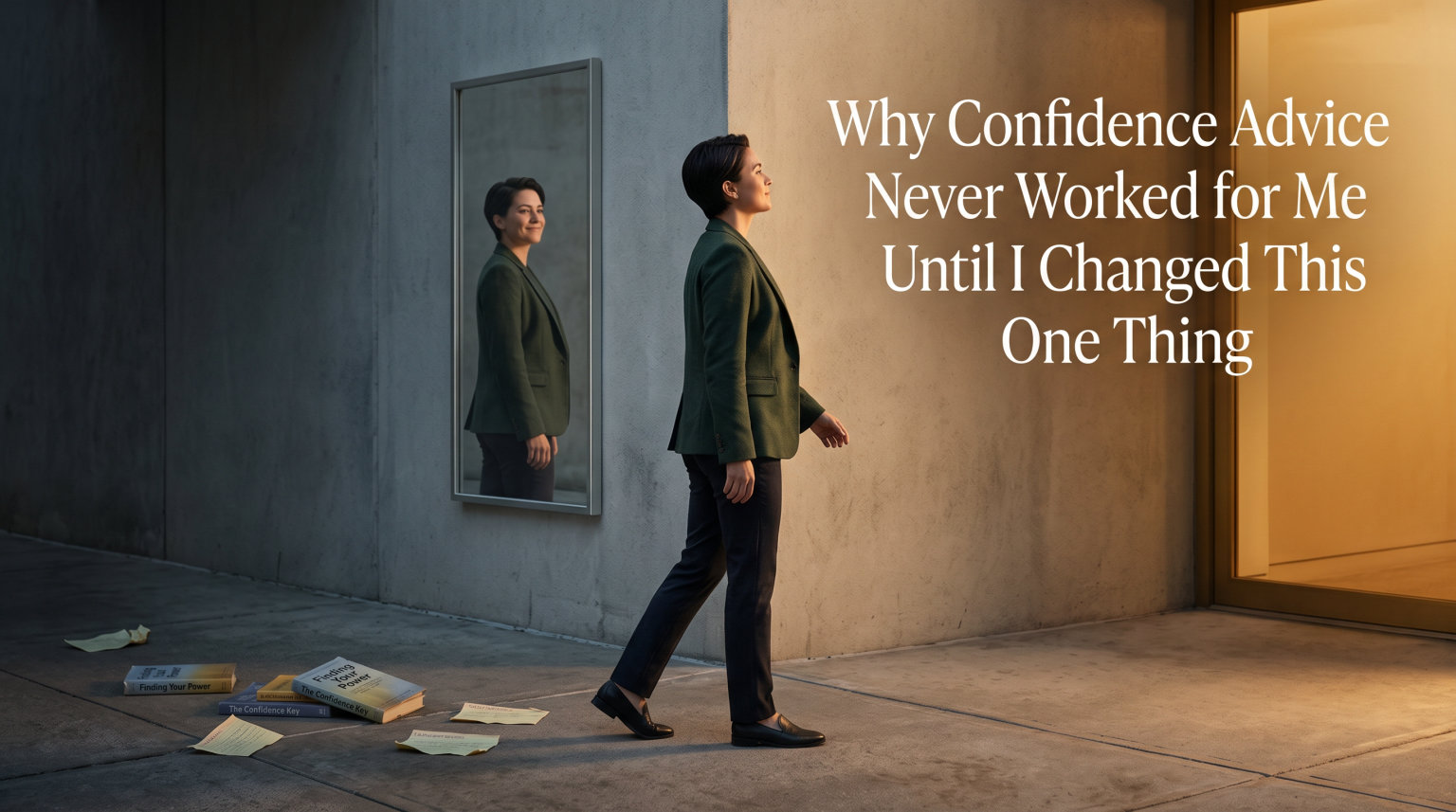
I spent almost a decade collecting confidence advice like trading cards. I read every book, watched every TED talk, and tried every affirmation my friends recommended. And like many of you reading this, I kept asking the same question: why does confidence advice never work for me no matter how hard I try?
It took me eight years, two career collapses, and one very patient mentor to figure out what was actually missing. The advice wasn’t wrong. It was incomplete.
If you have ever felt like confidence advice is written for someone else, this article is for you. I am going to walk you through what I learned, the myths that kept me stuck, and the one shift that finally moved the needle.
Fair warning. I am not going to tell you to wake up at 5am, repeat affirmations, or pretend to be someone you are not.
Table of Contents
Why Standard Confidence Advice Keeps Failing You?
Standard confidence advice fails because it tries to fix the surface while the root stays buried. Most tips assume you have a small confidence problem that a few positive thoughts can patch up.
In reality, most people dealing with real self-doubt are running on deep self-limiting beliefs that were installed years before they ever searched for help.
When I look back at my own journey, I can see exactly why the advice bounced off. I was trying to think confidently while feeling like a fraud.
I was trying to act brave while my nervous system was telling me I was unsafe. No mindset trick was going to override that signal.
What causes a lack of confidence in most adults is not laziness or weakness. It is a stack of unprocessed feedback.
Criticism from a parent, a teacher, a manager, or an ex-partner wires your brain to interpret normal situations as threats. Once that wiring is in place, every piece of advice that starts with “just believe in yourself” feels insulting.
The advice assumes you have a clean foundation to build on. You don’t. You have a foundation covered in old comments, old failures, and old stories.
Until those are addressed, even the best confidence advice will feel like putting a fresh coat of paint on a cracking wall. Here is the part nobody told me.
Confidence is not a feeling you generate. It is a relationship you build with yourself. And just like any relationship, it requires evidence, consistency, and trust over time.
Once I understood that, everything changed. I stopped waiting to feel confident and started building the conditions where confidence could grow.
The 4 Confidence Myths I Believed for Years
Before I found what actually worked, I cycled through the same four myths that most of my clients believed when they first reached out. Let me walk you through each one.
Myth 1: Fake It Till You Make It
I acted confident in meetings for years. I smiled when I was terrified. I said yes to projects I was not qualified for.
On the outside, I looked like I was faking it till I made it. On the inside, I was drowning.
The reason this advice fails is simple. Confidence is not a costume you can wear. It is a felt sense of safety in your own skin.
When you fake it, your body still knows the truth. You burn extra energy performing, and you end up more exhausted than when you started.
I had a client who was a senior leader at a Fortune 500 company. She looked effortlessly confident. Inside, she was having panic attacks before every board meeting.
Myth 2: Just Believe in Yourself
This is the one that hurt the most. “Just believe in yourself” sounds inspiring in a graduation speech.
It is useless when your inner critic has been running commentary for 20 years. Believing in yourself is not a starting point. It is the result of evidence.
Telling a person who has been bullied, betrayed, or fired to “just believe in themselves” is like telling someone in a dark room to “just see the light.”
The light needs to come first. The belief follows the light.
Belief is downstream of behavior. It is the product of what you do consistently, not what you wish for in the moment.
Myth 3: Daily Affirmations Will Rewire Your Brain
I stood in front of my mirror and said “I am confident, I am worthy, I am enough” for eighteen months.
The words felt hollow. The moments I needed them most, they evaporated immediately.
Research from social psychology actually shows that affirmations can backfire when they contradict your existing self-image. Saying “I am confident” when you feel the opposite creates a mental rejection.
Your brain files the affirmation as a lie, which reinforces the original belief. Affirmations only work when they are believable.
The way to make them believable is to first collect evidence that suggests they might be true. Start with smaller statements and build from there.
Myth 4: Take Massive Action Even If You Are Scared
This is the one that kept me stuck the longest. The advice was always “just do it scared.” So I forced myself into networking events, presentations, and cold emails.
Sometimes it worked. Most of the time, I froze, embarrassed myself, and walked away more convinced that I was never going to be confident.
Big leaps without preparation do not build confidence. They build more evidence that you are not ready.
Real confidence is built through small, repeatable wins, not heroic efforts that drain you. The reason heroic efforts fail is that they skip the foundation.
They ask you to perform at a level you have not yet trained for. The result is predictable. You fall short, and you interpret the fall short as proof of your unworthiness.
The One Thing That Changed Everything: How to Build Real Confidence
Here is the shift that changed everything for me. I stopped trying to feel confident and started collecting evidence that I was capable.
Confidence is not a thought. It is a track record. I call this the Evidence Loop.
It works in four simple steps. You do something small that scares you. You do it anyway. You notice you survived.
You remember the next time you are scared. That is it. No affirmations. No performing. No pretending.
Just one small piece of evidence at a time, stored in your body’s memory instead of your mind’s wishlist.
When I started applying this, I did not try to become a different person overnight. I picked one tiny challenge a week.
Each time, I noticed I had survived. Each time, my nervous system relaxed a little more.
Within three months, something shifted. I was not faking it. I was not performing. I was actually starting to trust myself.
That trust is what real confidence feels like. It is quiet, not loud. It is steady, not flashy.
The other half of this shift is internal. I learned to stop outsourcing my worth to other people’s opinions.
Every time I caught myself seeking approval, I asked one question. “If no one ever finds out about this, do I still want to do it?”
When the answer was yes, I knew the motivation was real. When the answer was no, I knew I was chasing approval, not growth.
This is the difference between conditional confidence and unconditional confidence. Conditional confidence depends on outcomes.
Unconditional confidence depends on your own integrity. Once I started operating from unconditional confidence, I stopped flinching when things went wrong.
How to Apply This Confidence Shift in Real Life
Knowing the framework is one thing. Using it under pressure is another.
Here is how I have applied it in the four areas my clients ask about most.
Career Confidence
Most people lose confidence at work because they tie their worth to promotions, praise, or being right.
The Evidence Loop rewires this. Instead of aiming for the big promotion, pick one small professional win each week.
Finish a project ahead of schedule. Master a new skill. Ask for feedback from someone you respect. These small wins become the foundation.
I had a client who felt stuck for three years. We did not touch her career for the first month. We built small evidence in her personal life first.
Once she had evidence of her own capability outside work, her career confidence followed naturally within eight weeks.
The job-loss confidence cycle is one of the most common patterns I see. Someone gets passed over, criticized, or laid off, and they start telling a story about themselves that is not true.
Social Confidence
Social anxiety is not solved by forcing yourself into bigger crowds. It is solved by smaller, safer practice.
Start with one-on-one conversations. Then small groups. Then higher-stakes events.
Each step adds a piece of evidence that you can handle social contact without losing yourself.
I tell my clients to stop trying to be the most interesting person in the room. Just try to be the most present.
Presence builds connection, and connection builds the kind of confidence that does not depend on performance.
The biggest mistake I see in social confidence work is comparing your Chapter 3 to someone else’s Chapter 20. You are seeing their highlight reel.
Relationship Confidence
If your confidence disappears the moment a partner is upset with you, you are running on conditional confidence.
The shift here is learning to hold your own worth separate from someone else’s mood.
The Evidence Loop in this case is about collecting evidence that you can handle conflict without losing yourself. You do this by having one honest conversation a week instead of avoiding it.
Many people confuse neediness with intimacy. They think constantly seeking reassurance is the price of closeness. It is not. It is the opposite.
Real intimacy is built when two people can hold their own ground and still choose each other.
Body Image and Physical Confidence
Body image confidence is not about looking different. It is about treating your body like a partner instead of a project.
The Evidence Loop here is small acts of respect. Eat when you are hungry. Rest when you are tired. Move in ways that feel good, not punishing.
When you treat your body with consistent respect, the evidence stacks up. You start to trust it. You start to feel like an ally of yourself instead of an enemy.
The fitness industry sells confidence as a side effect of looking a certain way. The truth is the opposite. Confidence comes first. Body trust follows.
Your 5-Step Confidence Rebuild Plan
Here is a simple plan you can start this week. Each step is small. Each step is repeatable.
Each step adds another piece of evidence to the bank account of your self-trust.
Step 1: Run a Confidence Audit. For three days, write down every moment you felt small or scared.
Do not judge them. Just notice them. Patterns will appear.
Step 2: Pick One Micro-Challenge. Choose one small thing that scares you slightly. Not a leap. A stretch.
Make sure it is something you can complete in under 10 minutes.
Step 3: Do It and Record the Evidence. Take the action. Then write down what happened. Specifically. “I survived.”
This is the evidence log your brain will use the next time fear shows up.
Step 4: Detach One Win from Approval. Each week, do one thing that nobody will ever know about.
A private act of courage. A skill you learn just for yourself. A boundary you set quietly.
Step 5: Audit Your Inner Circle. Confidence is contagious in both directions.
If the people around you constantly criticize, compete, or compare, your confidence will struggle no matter how hard you work.
Spend more time with people who make you feel like the best version of yourself. Protect your nervous system.
The mistake I see most often is skipping Step 1. People want to jump straight to action. Without understanding the patterns, you are guessing.
Be patient with the timeline. The first month is about awareness. The second month is about small evidence. The third month is where you start to feel the shift.
Frequently Asked Questions
What causes a lack of confidence?
Lack of confidence is usually caused by accumulated negative feedback over time. Criticism from parents, teachers, bullying, repeated failures, or trauma can install self-limiting beliefs that feel like facts. These beliefs are not the truth about you. They are outdated conclusions your nervous system made to keep you safe. Awareness is the first step to changing them.
Why doesn’t confidence advice work for me?
Most confidence advice is designed for people with a small confidence problem. It assumes a clean foundation. If you have deep self-doubt from years of criticism, trauma, or repeated failure, surface-level tips like affirmations or fake-it-till-you-make-it will feel hollow. The advice bounces off because it is not addressing the root cause. Real confidence work starts with collecting evidence that you can handle small challenges, not with positive thinking.
How do I build real confidence that actually lasts?
Real confidence is built through evidence, not affirmations. Use the Evidence Loop. Pick one small action that slightly scares you. Do it. Notice you survived. Write it down. Repeat. Over time, this builds a track record your nervous system can trust. Pair this with detaching your worth from other people’s opinions, and you will move from conditional confidence to unconditional confidence.
What is the difference between conditional and unconditional confidence?
Conditional confidence depends on external outcomes. You feel confident when you win, get praise, or are validated. Unconditional confidence comes from within. It is built on evidence of your own integrity, courage, and capability. Unconditional confidence does not disappear when you fail or when someone disapproves. It is steadier, quieter, and far more sustainable.
How long does it take to build authentic confidence?
It depends on how deep the patterns are, but most people notice meaningful shifts within 8 to 12 weeks of consistent small practice. The key is consistency, not intensity. Five small actions a week, repeated over three months, will build more authentic confidence than one heroic effort followed by burnout. Authentic confidence is a marathon, not a sprint.
A Final Word on Why Confidence Advice Never Worked for Me
Here is what I want you to remember. The reason confidence advice never worked for me, and probably never worked for you, is that I was trying to think my way out of a feeling problem.
Confidence is not a thought. It is the result of a thousand small moments where you proved to yourself that you could handle what life handed you.
Stop waiting until you feel confident to act. Start acting in small, safe ways. Collect the evidence.
The breakthrough is not a moment. It is a hundred quiet moments stacked on top of each other.
If you have been carrying this for years, you do not have to carry it alone. Working with a coach can shortcut the loops you keep getting stuck in.
At Kim Life Coach, I help people who have tried everything finally experience the kind of confidence that does not depend on outcomes. The shift is real. It is possible. And it can start this week.