
For about four years, my nights ended the same way. Lights off, phone up, thumb scrolling through news I could not stop reading. I told myself it was relaxation. My body knew it was not. I would finally put the phone down at 1:14 a.m., my chest tight, my eyes burning, and my mind still racing about something I read two hours earlier.
The calm evening routine I built later did not start as a productivity hack. It started because I was exhausted, anxious, and embarrassed by how little sleep I was getting. In this guide, I want to share exactly what shifted, why a calm evening routine for sleep after years of doomscrolling actually works, and how you can adapt it for your own nights.
Table of Contents
My Four Years of Doomscrolling and the Sleep Problem I Kept Ignoring
I first noticed the pattern back in 2022, during a stretch of bad world news. I told myself I was staying informed. What I was actually doing was opening the same apps, over and over, between 10 p.m. and 1 a.m., chasing a feeling of certainty I never got.
By 2024, the habit was automatic. Brush teeth, get in bed, open phone, scroll until my eyes watered, panic about the time, scroll a little more to calm down. My average sleep dropped to about five and a half hours. I woke up groggy, hit snooze twice, and reached for coffee like a lifeline.
The turning point was small. One Tuesday, I woke up and could not remember a single article I had read the night before. Not one. I had spent roughly three hours feeding my brain content it threw away by morning. That was the moment I knew I had to try something different.
I am not a doctor, and this is not medical advice. I am a coach who works with women on habit change, and what I share here comes from my own journey plus patterns I see with my clients.
What Is Doomscrolling and Why It Hijacks Your Nights
Doomscrolling is the habit of endlessly scrolling through negative news, social media, or content that triggers stress, often late at night when you should be winding down. It is not about curiosity. It is a loop where your brain keeps looking for one more piece of information that will finally make you feel safe or settled.
Doomscrolling and the ADHD Connection
Doomscrolling is often an ADHD thing, especially at night. People with ADHD frequently seek intense stimulation to quiet a busy brain. The phone delivers that stimulation on demand, with no setup, no effort, and no rejection. At night, when your executive function is already tired, the phone becomes the path of least resistance.
The Anxiety-Scroll Loop
Anxiety also fuels this loop. When you feel anxious, your brain wants information, reassurance, and control. Scrolling feels productive, but it usually increases anxiety because the content you are reading is designed to trigger you. The relief never comes, so you keep scrolling.
Evenings make this worse because your willpower is at its lowest. The habits you held together at 9 a.m. start breaking at 10:30 p.m. That is why most people who struggle with late-night scrolling report the same thing. They are not weak. They are tired.
How Nighttime Scrolling Destroys Sleep
Nighttime scrolling affects sleep in two ways at once. The content keeps your nervous system alert, and the screen keeps your brain chemically awake.
Blue Light and Melatonin Suppression
Your phone screen emits blue light that tells your brain it is still daytime. Blue light suppresses melatonin, the hormone that helps you fall asleep. Even thirty minutes of screen time before bed can delay melatonin release by twenty minutes or more, which means you lie there waiting for sleep that does not come.
Cortisol and the Fight-or-Flight Switch
Negative news and stressful social media also raise cortisol, your stress hormone. Cortisol is the chemical that powers fight-or-flight. Sleep requires the opposite, the rest-and-digest state controlled by your parasympathetic nervous system. You cannot be in both states at once.
That is why I would lie in bed with my eyes closed and still feel wired. My body thought I was on alert. My nervous system had no signal that it was safe to power down.
Circadian Rhythm Confusion
Your circadian rhythm is your body’s internal clock. It uses light cues to know when to feel alert and when to feel sleepy. Late-night scrolling sends mixed signals. Bright screen, dark room, stress content, sleepy body. Your rhythm gets confused, and over time, falling asleep gets harder even on nights you do not scroll.
The Calm Evening Routine That Finally Worked for Me
The routine that worked for me is not fancy. It has three parts, takes about forty-five minutes, and runs on the same schedule most nights. Here is the exact sequence.
Step 1: Digital Sunset at 9:30 p.m.
I picked a digital sunset time, 9:30 p.m., and treated it like a meeting I could not miss. At 9:30, the phone goes on the charger in the kitchen, screen down, do-not-disturb on. I still use my watch for the time, which keeps the friction low.
The first week was rough. I picked up the phone by reflex about twelve times a night. By week three, the reflex faded. By week six, I actually looked forward to the quiet.
Step 2: Create a Phone Landing Spot Outside the Bedroom
The single biggest change was the phone landing spot. The idea is simple. Give your phone one home that is not your bed, your nightstand, or your pillow. Mine lives on a small shelf in the kitchen.
Why this works. You remove the option without relying on willpower. When the phone is across the house, you cannot accidentally reach for it. You have to make a decision to go get it, and that decision is what breaks the loop.
Step 3: A 30-Minute Wind-Down Sequence
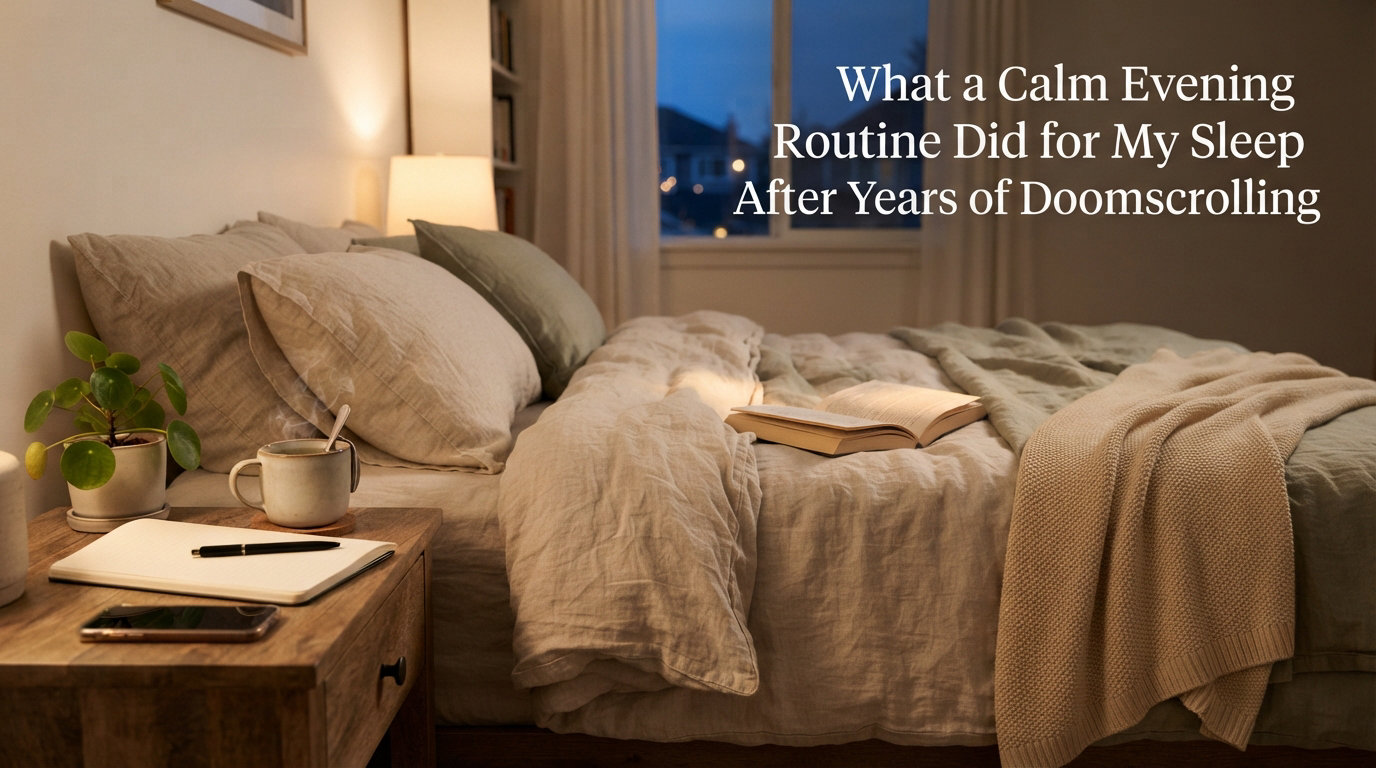
After the phone is away, I run the same wind-down sequence. Dim the lights. Make herbal tea. Stretch for ten minutes. Read a paper book for fifteen minutes. Lights out by 10:30 p.m.
The sequence matters more than the activities. Your brain learns the pattern. After two weeks, dimming the lights started making me yawn automatically. That is a calming cue, and it works because your nervous system is always listening to your habits.
Low-Energy Version for Bad Nights
No one follows a perfect routine every night. There will be nights when you have nothing left. Here is the low-energy version I use on those nights.
The 2-Minute Minimum
On hard nights, I do two things. I plug the phone in outside the bedroom. I change into sleep clothes and get horizontal. That is the entire routine. Two minutes, no shame, done.
This works because the goal is not a perfect evening. The goal is breaking the scroll-in-bed pattern. Even a small break in the loop teaches your brain that bed is for sleep, not for content.
What to Do When You Scrolled Anyway
You will mess up. I scrolled at midnight last Tuesday. When that happens, I close the apps, put the phone down, and do one slow exhale cycle. Four seconds in, seven seconds out, three rounds. Then I get horizontal and let sleep come when it comes.
Strict rules backfire. If you treat one slip as failure, you will quit the routine. If you treat it as a single data point, you stay in the game.
Quick Recovery for the Next Morning
After a bad night, get sunlight in your eyes within thirty minutes of waking. Drink water before coffee. Skip the snooze button. These three moves reset your circadian rhythm faster than you would think.
5 Practical Tips to Stop Doomscrolling Tonight
These are the simplest, highest-leverage moves I teach my clients. Pick one to start.
- Set a 3-3-3 rule for sleep. Three hours before bed, no more work emails. Three hours before bed, no more news. Three hours before bed, screens start dimming.
- Use a focus mode or app blocker. iOS Focus and Android Digital Wellbeing let you schedule downtime. Turn on a bedtime focus at 9 p.m. so only calls from favorites get through.
- Replace, do not just remove. The slot you used to scroll has to be filled with something. Reading, journaling, stretching, even a podcast, anything low-stimulation works.
- Make the phone boring in bed. Remove social apps from your home screen. Keep a book or a Kindle on your pillow instead.
- Track the win. For one week, write down the time you stopped scrolling and how you felt the next morning. The data will convince you faster than any pep talk.
Frequently Asked Questions
How do I stop doomscrolling at night?
Set a digital sunset 30 to 60 minutes before bed, put your phone in a landing spot outside the bedroom, and replace the scrolling slot with a calm wind-down like reading or stretching. The goal is removing the option, not relying on willpower.
What to do in the evening instead of doomscrolling?
Try a calm wind-down like herbal tea, journaling, a warm shower, gentle stretching, or reading a paper book. Pick activities that are low-stimulation and do not require a screen, so your nervous system can shift into rest mode.
Is doomscrolling an ADHD thing?
Yes, doomscrolling is common for people with ADHD. Phones deliver fast stimulation with low effort, which is exactly what an ADHD brain seeks, especially at night when executive function is tired.
How bad is doomscrolling before bed?
Doomscrolling before bed is bad because the blue light suppresses melatonin and the stressful content raises cortisol. Together they keep your nervous system in fight-or-flight mode, making it hard to fall asleep and harder to stay asleep.
How do you sleep fast after doomscrolling?
Close all apps, put the phone in another room, dim the lights, and try slow breathing with longer exhales than inhales. Four seconds in, seven seconds out for three rounds calms your nervous system and signals your body that it is safe to sleep.
The Real Change Was Not the Routine
When I look back, the calm evening routine was not what changed my sleep. What changed was the belief that my nights had to be productive or informative. They do not. They have to be quiet.
If you take one thing from this, take this. Pick a digital sunset tonight. Move your phone to a landing spot outside your bedroom. Read one chapter of a book before you turn out the light. Do that for seven days. That is how a calm evening routine after years of doomscrolling starts. One small, quiet shift at a time.
You will be surprised how much better your mornings feel when your nights finally rest.