
Last Tuesday, a client of mine burst into tears during our session. She had just bombed a work presentation, and the first words out of her mouth were: “I’m such an idiot. I always mess everything up. Why can’t I be normal?” Then she paused, looked up at me, and said, “If my best friend came to me after a presentation flop, I would never, ever say that to her.”
That moment captures something I see every week in my coaching practice. We are endlessly patient with our friends, careful with our words, generous with second chances, and quick to remind them that one rough day does not define them. Then we turn around and speak to ourselves in a way we would never dream of speaking to another human being.
So how do you learn how to talk to yourself like you’d talk to a friend who’s struggling? It is one of the most powerful shifts you can make for your mental health. In this guide, I will walk you through the psychology behind it, the three components of self-compassion, and the exact scripts and exercises I share with my own clients.
Table of Contents
What Self-Compassion Is and Why It Changes Everything
Self-compassion means treating yourself with the same kindness, care, and understanding you would offer a close friend who is hurting. The term was developed by researcher Kristin Neff, who defines it as having three core elements: mindfulness, self-kindness, and a sense of common humanity.
It is not self-pity. It is not letting yourself off the hook. It is not weakness. Decades of research now show that people who practice self-compassion recover faster from failure, experience less anxiety and depression, and report higher emotional resilience than people who rely on self-criticism.
In a 2020 review published in the journal Mindfulness, researchers found that self-compassion interventions significantly reduced symptoms of depression and anxiety while improving life satisfaction. That is the same pattern I see in my own work. The clients who learn to befriend themselves stop spiraling after setbacks. They course-correct faster.
Cleveland Clinic psychologist Natacha Duke puts it well: “People who practice self-compassion are more motivated to improve, not less, because they don’t waste energy beating themselves up.” That one shift, less self-attack and more self-kindness, frees up enormous mental bandwidth.
Why We Treat Our Friends So Much Better Than Ourselves
One of the most fascinating things I have observed in 12 years of coaching is how easily kind, generous, deeply empathetic people turn into tyrants the moment they look in the mirror. The woman who would drive across town to bring her sister soup will call herself “worthless” for burning dinner.
There are three reasons this happens. First, distance creates empathy. When you look at a friend’s pain, your brain’s empathy circuits light up. When you look at your own pain, those same circuits often get hijacked by shame and self-protection.
Second, we are taught that self-criticism is the engine of success. Many of us grew up hearing “you’re your own worst critic” framed as a compliment. We absorbed the message that being hard on ourselves would make us better. The research now says the opposite. Self-criticism correlates with procrastination, perfectionism, and burnout, not excellence.
Third, our inner critic usually sounds like a parent, a coach, or a teacher from our past. The voice in your head telling you that you are not good enough often belongs to someone who was trying (in their own imperfect way) to push you. Recognizing that the critic is an old recording, not a fact, is one of the most freeing shifts you can make.
The Three Components of Self-Compassion You Need to Know
Kristin Neff’s model gives us a clear structure. When you are hurting, run through these three components, in order.
1. Mindfulness: Notice the Pain Without Getting Lost in It
Mindfulness means acknowledging that something hurts. Not suppressing it, not catastrophizing it, just noticing. A simple phrase that works: “This is a moment of suffering.”
Say it out loud when you are stuck. When my client lost her presentation, instead of “I’m an idiot,” she tried: “This is a moment of suffering. Presentations matter to me and this one didn’t go well.” That single sentence stopped the spiral.
2. Self-Kindness: Respond Like a Friend Would
Once you have noticed the pain, the next step is responding to it with warmth. Talk to yourself the way you would talk to your best friend in the same situation. That means no name-calling, no threats, no “you should be better than this.”
Research from 2023 in Self and Identity showed that people who replaced self-critical thoughts with kind self-talk reported a 23 percent drop in stress levels within two weeks. The body cannot tell the difference between kind words spoken inward and kind words spoken aloud.
3. Common Humanity: Remember You Are Not Alone in This
The third component is the one most people skip, and it is often the most powerful. Suffering is part of being human. Your struggle does not make you defective. It makes you human.
When you are tempted to feel uniquely broken, try this reframe: “Other people feel this way too. I am not the only one.” I have watched this single sentence dissolve shame in clients who had carried it for decades. Shame thrives in secrecy. Common humanity is its antidote.
How to Notice Your Inner Critic Before It Runs the Show
You cannot talk to yourself kindly if you do not first notice that you are talking to yourself harshly. The inner critic is sneaky. It often disguises itself as truth, motivation, or “just being realistic.”
Common inner critic phrases to watch for: “You should be over this by now.” “Other people have it worse.” “You’re so sensitive.” “You’ll never change.” If you find yourself saying any of these, that is the critic talking, not the truth.
Pay attention to your body, too. The critic almost always comes with a physical signature: a tight chest, a hot face, a sinking stomach, clenched jaw. When you feel that, pause. Ask yourself: “Is this a friend speaking, or the critic?”
A journaling exercise that helps: for one week, write down every self-critical thought you notice. Just the phrase. Don’t try to fix it yet. Just collect them. By day seven you will see the patterns, and patterns are far easier to change than ambush.
How to Talk to Yourself Like You’d Talk to a Friend: 5 Steps That Work
This is the heart of the work. When you are in the middle of a painful moment, here is the exact sequence I teach my clients. It comes straight from Kristin Neff’s self-compassion break, adapted for everyday use.
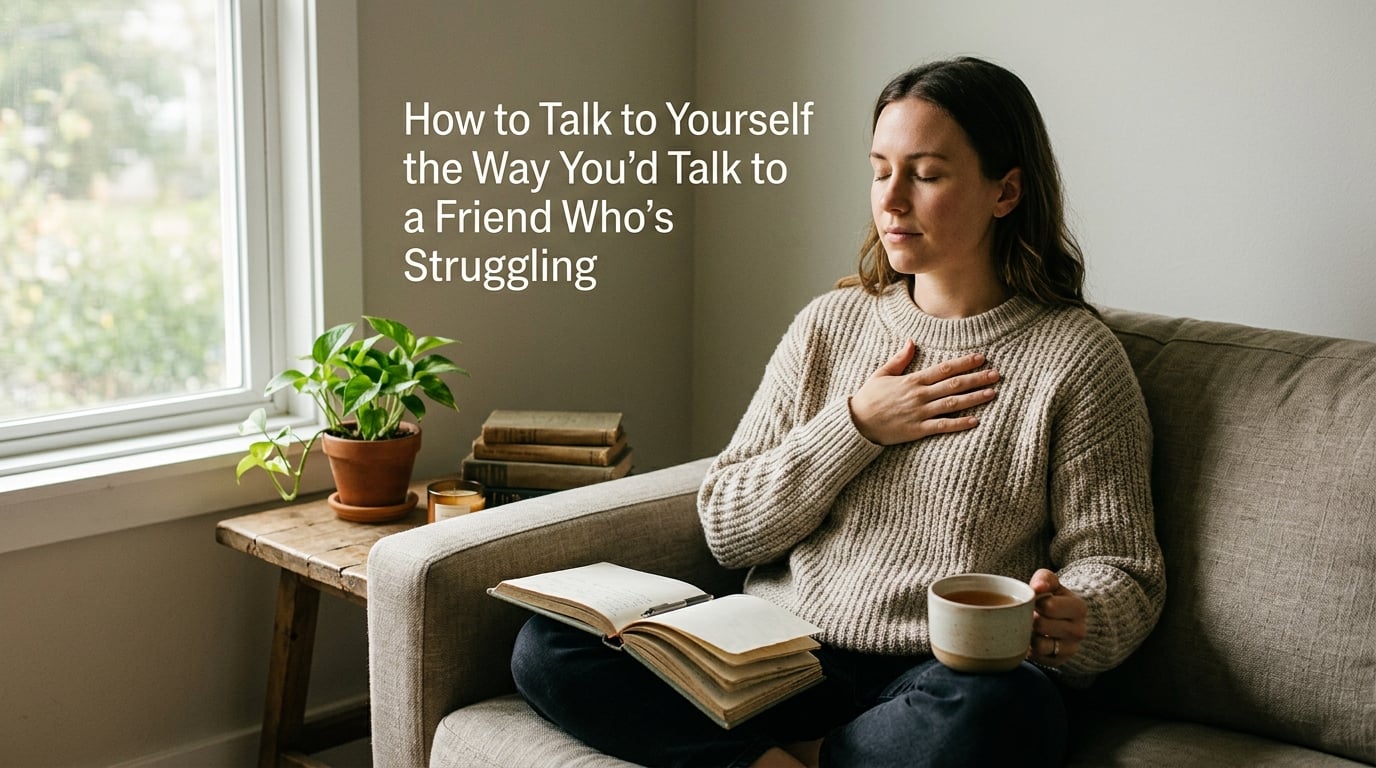
Step 1: Pause and Place a Hand on Your Heart
Physical touch activates the parasympathetic nervous system. It calms you. Place one or both hands gently on your heart or your cheek. That single act signals safety to your body.
Step 2: Name What Is Happening
Say, out loud if you can: “I’m struggling right now.” Naming the pain softens its grip. Neuroscience calls this “affect labeling,” and studies show it reduces the intensity of emotional distress almost immediately.
Step 3: Imagine Your Best Friend in This Exact Situation
Picture them, in vivid detail, sitting across from you with the same problem. Notice what your face does. Notice what your body wants to do. Notice the words forming in your throat.
Step 4: Write or Say What You Would Say to Them
Speak those words out loud or write them down. Then, gently, direct them toward yourself. Use your name. Use second person. The shift in pronoun is small but powerful. You are bridging the gap between how you treat others and how you treat yourself.
Step 5: Repeat Often, Especially on the Hard Days
This is a skill, not a switch. The first month feels awkward. Many of my clients laugh the first time they try it. That is normal. The practice gets easier, and the gap between self-criticism and self-kindness closes over time.
Scripts You Can Use When Self-Criticism Hits Hard
When you are mid-spiral, you do not have time to think up kind things to say. Save these. Use them.
After a mistake or failure: “Of course you’re upset. This matters to you. A mistake here doesn’t erase everything you know. You’re learning.”
During an anxiety spiral: “You’re safe right now. Your body is trying to protect you, and you can thank it. Slow breath in, slow breath out. You’ve handled hard things before.”
When comparing yourself to others: “Their highlight reel is not my measure. I’m walking my own path, and comparison doesn’t move me forward. I can appreciate them and still be enough.”
When feeling unlovable: “I am not my worst moment. I am a whole person, and I am allowed to take up space.”
Print these. Tape them to your mirror. Pull them up on your phone. Have them ready before you need them.
Practical Exercises to Build the Compassion Habit
Knowing the theory is not enough. Self-compassion is a muscle. You have to train it. These three exercises are the ones I assign most often.
Exercise 1: Write a Letter From a Friend
Pick a struggle you are having right now. Then write a letter to yourself, but write it as your most loving friend would write it. Use their voice. Use their kindness. Use their humor.
My client who bombed the presentation wrote a letter from her best friend. It started: “Hey you. Yes, you. The one crying in her car right now. The presentation was rough. You prepared for two weeks. You showed up anyway. I am so proud of you.” She cried again, but this time in a different way.
Read the letter back to yourself, out loud, at least once a week.
Exercise 2: The Mirror Practice
Stand or sit in front of a mirror. Look into your own eyes. Say three kind, true things about yourself. Not affirmations you do not believe. Just true, kind things. “I showed up today.” “I am trying.” “I am learning.”
This exercise feels unbearable the first time. Do it anyway. It is one of the most powerful ways to build the muscle of warm self-relation. Start with 30 seconds. Build up to a full minute.
Exercise 3: The Daily Reframe Log
For 21 days, keep a small notebook. Each evening, write down one moment when you noticed your inner critic. Write down what it said. Then write down what a kind friend would have said instead.
By day 21, your brain will start generating the kind reframe automatically. You will be building the neural pathway for compassionate self-talk.
If you find that self-compassion feels fake, awkward, or impossible at first, you are not broken. You are normal. Many people feel that way. Kristin Neff calls the resistance to self-compassion “backdraft,” and it fades with practice.
FAQs
What is compassionate self-talk?
Compassionate self-talk is the practice of speaking to yourself with the same kindness, understanding, and encouragement you would offer a close friend. It replaces harsh self-criticism with supportive, honest, and gentle internal dialogue.
How do I talk to myself kindly when it feels fake or forced?
Start small and expect awkwardness. Use your name or second person, place a hand on your heart, and try phrases borrowed from how you actually speak to friends. The feeling of authenticity grows with consistent practice, often within 2 to 4 weeks.
Who said u0022Talk to yourself like someone you loveu0022?
The phrase is most often attributed to self-help author Toni Morrison, though variations of the idea appear throughout modern psychology. The principle is central to Kristin Neff’s research on self-compassion.
What is a short quote about self-kindness?
A widely loved line comes from Buddha: u0022You yourself, as much as anybody in the entire universe, deserve your love and affection.u0022 It captures the heart of self-kindness in a single sentence.
How can I help a friend in a difficult situation?
Listen without trying to fix, validate their feelings, ask what they need, follow up the next day, and remind them that struggle is part of being human. Then turn those same gentle questions toward yourself.
Final Thoughts on Becoming Your Own Kind Friend
Learning how to talk to yourself like you’d talk to a friend who is struggling is not a one-time fix. It is a practice, and it gets easier with time. Pick one script. Pick one exercise. Begin there. The way you speak to yourself shapes the way you live, and you deserve a voice on your side.
If you want support building this habit, that is exactly the kind of work I do with my clients. Reach out anytime. You do not have to do this work alone, and you do not have to keep being your own harshest critic.