
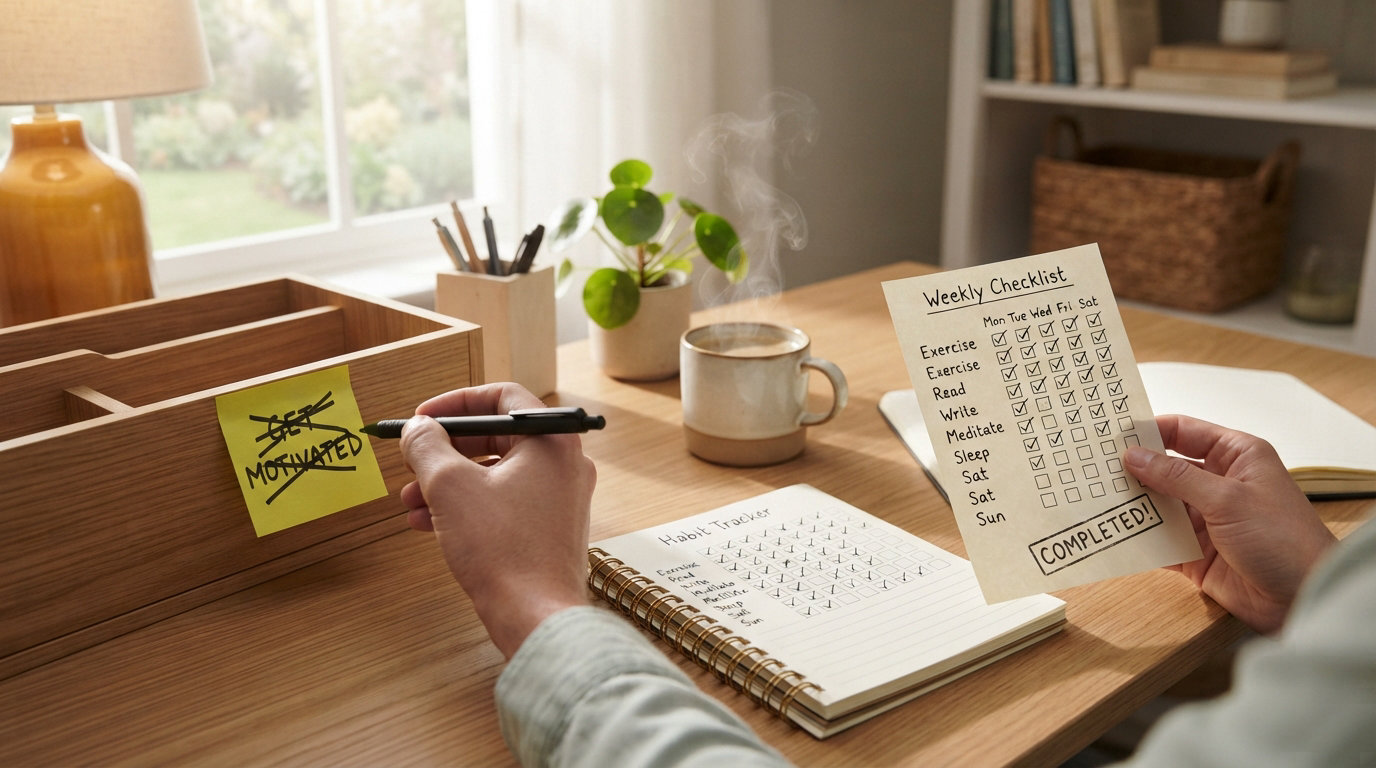
I failed at building habits for years. Every January I would wake up motivated, write out my new routine, and tell myself “this time will be different.” I would buy the planner, download the tracking app, and tell my friends about my new commitment. By February the routine had collapsed. By March I was back to square one, wondering what was wrong with me.
If you have ever started a new habit full of excitement and watched it die a slow death two weeks later, this article is for you. I want to walk you through what I learned about why motivation fails habits, and the system that finally helped me build routines I actually kept. As a life coach, I now see this same pattern in nearly every client I work with during their first three months.
The breakthrough came when I stopped treating motivation as the fuel and started treating it as the weather. You cannot build a fire that depends on sunshine. You also cannot build a daily habit that depends on feeling inspired. Let me show you what to build instead.
Table of Contents
My Personal Story: Five Years of Starting and Stopping
I tried to become a morning person for five years straight. Each attempt started the same way. I would set my alarm for 5:30 a.m., place it across the room, and lie in bed the night before visualizing my new life. I pictured myself writing, exercising, and meditating before the rest of my family woke up.
Day one always felt magical. Day three was still solid. By day eight, I was bargaining with myself. “Just five more minutes.” By day fourteen, I had moved the alarm back to my nightstand. By day twenty-one, the whole project was abandoned and I felt like a failure. I would tell myself that I simply did not have the discipline. I would compare myself to friends who seemed to wake up early without effort and conclude that something was broken in me.
Then I read about the habit loop and realized the problem was never my willpower. The problem was my strategy. I was relying on a feeling to do the work of a system. Once I understood the difference, everything changed. I now wake up at 5:30 a.m. most days without an alarm, and I never “feel motivated” to do it. It just happens. The habit runs on its own wiring.
The same shift happened with my writing habit, my workout routine, and my weekly meal prep. None of them depend on motivation. All of them depend on a structure I built to work even on my worst days. I have now kept each of these habits for over three years, through illness, travel, job changes, and two cross-country moves.
Why Motivation Fails When Building New Habits
Motivation fails habits because motivation is a temporary emotional state, not a reliable engine for behavior. It spikes when something excites us, then fades as novelty wears off. Building a habit on motivation alone is like building a house on a wave. It looks impressive for a moment and then collapses the first time conditions shift.
Here is what I had to accept during my own journey, and what I now teach my coaching clients in our very first session.
Motivation Is a Feeling, Not a System
Feelings come and go. A 2020 study published by the National Institutes of Health found that emotional states fluctuate significantly throughout the day and across contexts. Treating motivation as the foundation of a habit guarantees that the habit will rise and fall with your mood.
When I built my morning routine, I stopped asking “Do I feel like doing this?” and started asking “What time is it? Is it time to do this?” That tiny shift removed the daily negotiation that had been killing my consistency. Decisions drain energy. Removing the decision removed the bottleneck.
You can apply this same logic anywhere. Do not ask whether you feel like going to the gym. Schedule the gym at the same time every day and treat it like a meeting with yourself that cannot be canceled without a real emergency.
Willpower Runs Out Faster Than You Think
Willpower is a limited resource. The concept of ego depletion, though debated in recent years, still captures something true. Every decision you make, every temptation you resist, and every frustration you manage drains the same mental battery. That battery has a real, physical limit over the course of a single day.
If your entire habit depends on willpower, you will eventually hit a low-battery day. And on those days, your brain will reach for the easiest option, which is almost always the old habit you were trying to replace. That is why you find yourself eating takeout at 9 p.m. after a long workday, even though you swore you would cook.
The Excitement Curve Always Drops
Every new habit has what researchers call a “novelty high.” Your brain releases extra dopamine when something feels fresh and exciting. After about two to three weeks, that spike fades. The habit now feels ordinary, and ordinary does not trigger action the way novelty does.
This is why so many people quit between week two and week four. They mistake the disappearance of excitement for the failure of the habit. In reality, the habit has just entered the boring middle, which is where the real work happens. The boring middle is the part where your brain is quietly building the neural pathway. Most people abandon the project just before automaticity arrives.
The Habit Loop: Cue, Routine, Reward
The habit loop is a three-part neurological pattern made of cue, routine, and reward that drives almost every behavior you do automatically. Understanding this loop is the single most important step in learning why motivation fails habits and what to replace it with.
The cue is the trigger that tells your brain to start the behavior. The routine is the behavior itself. The reward is the positive feeling that tells your brain this loop is worth remembering. Over time, the brain encodes this pattern in the basal ganglia, the part of your brain responsible for automatic behaviors. That is when the habit becomes automatic.
This is why your morning coffee, your route to work, and your phone-checking habit happen without conscious thought. The loop has been wired into your brain. Any new habit you want to build needs the same wiring. The difference is that bad habits wire themselves through repetition you never intended, while good habits require you to deliberately engineer the loop until the wiring is strong enough to run on its own.
How Automaticity Develops
Automaticity is the point where a behavior requires no willpower or motivation to perform. Research published in the European Journal of Social Psychology found that automaticity for new behaviors builds over an average of 66 days, not the mythical 21 days often repeated online. The range across participants was 18 to 254 days, depending on the complexity of the behavior.
That number matters. If you expect a habit to feel automatic after three weeks, you will think it failed. If you expect the process to take two to three months, you will give your brain the time it needs to wire the loop. Expectation management is half the battle.
Why Repetition Matters More Than Intensity
Neural pathways strengthen through repetition, not through heroic single efforts. Doing one perfect hour-long workout does almost nothing for your habit. Doing ten minutes every day for sixty days rewires your brain in a way the single workout never could.
This is where most people get the math wrong. They stack intensity in the early days and burn out before repetition has a chance to build automaticity. Consistency is the multiplier. Intensity without consistency is just noise.
Is It ADHD or Lack of Motivation?
Sometimes what looks like a motivation problem is actually an attention or executive function issue, especially if you have ADHD. Knowing the difference matters because the strategies that fix motivation problems are different from the supports that help with ADHD. If you have tried every motivation strategy in this article and still cannot get a habit to stick, this section is for you.
Common signs that the issue is not just motivation include difficulty starting tasks even when you want to do them, losing track of time during activities you enjoy, and struggling to maintain habits despite caring deeply about the outcome. If this sounds familiar, talk to a qualified clinician. ADHD is highly treatable, and the right support can change your relationship with habits entirely.
Even without a diagnosis, executive function challenges are more common than people think. Strategies like external reminders, body doubling, and ultra-small starting points help regardless of whether ADHD is present. Many of my clients who do not have ADHD still benefit from the same scaffolding because modern life overwhelms everyone’s executive function at some point.
Common Reasons Habits Fail to Stick
Most habit failures come down to a small handful of predictable mistakes. Naming them clearly makes them easier to fix. Once you can see your own pattern in the list below, the path forward becomes obvious.
Trying to Change Too Much at Once
When motivation is high, you want to overhaul your entire life. New diet, new workout, new sleep schedule, new journaling practice. Your brain cannot run multiple new loops at the same time. Pick one. Make it stick. Then add the next.
I have watched clients try to overhaul five areas at once and beat themselves up when none of them stuck. When we narrowed the focus to a single habit, three out of five of those same clients built it successfully within two months. Singular focus beats parallel ambition every time.
Ignoring Emotional and Mental Blocks
Some habits fail because there is an unaddressed reason you are avoiding them. I avoided consistent stretching for years because deep down it reminded me of a sports injury I never fully processed. Once I worked through that emotional block, the habit became possible.
Ask yourself honestly whether there is a part of you that does not want the habit to stick. Sometimes that part has a good reason. Sometimes it carries old pain that needs attention before the new behavior can take root.
All-or-Nothing Thinking
If your plan says “workout every day” and you miss a day, the broken-streak effect kicks in. Many people then skip the next day, and the next, until the whole habit is dead. The most resilient habit plans treat a missed day as a normal data point, not a catastrophe.
The best habit builders I know have simply decided in advance that missing is part of the process. They do not negotiate with themselves after a slip. They just do the next small version of the habit as soon as they can.
Strategies That Work When Motivation Disappears
These are the strategies that finally worked for me, and that I now teach to my coaching clients. None of them depend on feeling motivated. All of them depend on the system you build around the behavior you want to repeat.
Start Embarrassingly Small
Pick a version of the habit so small it feels ridiculous. Want to read more? Start with one page a day. Want to exercise? Start with one pushup. Want to meditate? Start with one breath. The point is not the size of the action. The point is the identity and the repetition.
When I started writing daily, I committed to one sentence. Some days I wrote more. Most days I wrote one sentence and closed the laptop. After three months, I was writing a thousand words a day without thinking about it. The habit had become automatic. The tiny start removed every reason to skip the day.
Use Habit Stacking to Anchor New Behaviors
Habit stacking is the practice of attaching a new behavior to an existing habit. The formula is simple. “After I [existing habit], I will [new habit].” For example, after I pour my morning coffee, I will open my journal. After I brush my teeth at night, I will lay out tomorrow’s workout clothes.
This works because the existing habit is already a reliable cue. You are borrowing its automaticity to launch the new behavior. The old habit becomes the trigger for the new one. Over time, the pair becomes a single wired loop.
Design Your Environment for Success
Willpower is unreliable. Environment design is reliable. If you want to eat better, do not keep junk food in the house. If you want to read more, leave a book on your pillow. If you want to write, open your document before you close your laptop at night.
Every friction point you remove is a decision your future tired self does not have to make. Decisions are expensive. Friction-free environments win. The single biggest habit shift I made was getting serious about my physical surroundings, because the surroundings are running my behavior whether I notice it or not.
Build Identity-Based Habits
Identity-based habits focus on who you want to become, not just what you want to do. Instead of “I want to run a marathon,” try “I am a runner.” Instead of “I want to write a book,” try “I am a writer.” Every small action then becomes a vote for the identity.
This shift matters because every action is a vote for the type of person you want to be. Small actions repeated consistently accumulate into identity. When your identity matches the behavior, motivation becomes irrelevant. You do not have to negotiate with yourself about whether you are the kind of person who does the thing. You already are.
Track Progress With a Simple Habit Scorecard
A habit scorecard is a daily record of whether you did the habit. It can be as simple as a notebook with a checkbox for each day. The point is to make your behavior visible to yourself. Visibility creates accountability, and accountability creates consistency. What gets measured tends to get repeated.
Do not let a missed day derail you. Mark it honestly and start fresh the next morning. Streaks are not the goal. Showing up is the goal. The scorecard is just a mirror. Use it to learn about your patterns, not to punish yourself.
Plan for Failure Before It Happens
Every habit will eventually hit a missed day. The question is what you do next. Decide in advance how you will respond. Will you shrink the habit that day? Will you schedule a recovery session tomorrow? Will you text your accountability partner? Will you commit to a two-minute version?
Planning for failure removes the need for in-the-moment decisions, which is exactly when your decision-making is at its worst. A pre-written recovery plan is one of the most underrated habit tools I have ever used.
Frequently Asked Questions
Why do new habits often fail to stick?
New habits often fail because they depend on motivation, which is temporary. Without a clear cue, a small enough starting size, and a stable environment, the behavior never reaches automaticity. Most failed habits collapsed somewhere between week two and week four, when the novelty faded and the underlying system was missing.
Is it ADHD or lack of motivation?
It can be either, and sometimes both. Lack of motivation is usually tied to a temporary emotional dip. ADHD shows up as chronic difficulty starting tasks, sustaining attention, and tracking time, even when the person genuinely cares about the outcome. If motivation strategies alone are not working after several months, consider talking to a clinician about attention-related challenges.
Why does motivation fail?
Motivation fails because it is a feeling tied to dopamine, novelty, and emotional state. These inputs naturally fluctuate, which means any habit built on motivation will rise and fall with them. Habits that last are built on cues, routines, and rewards that work even when motivation does not show up.
How long does it really take to build a habit?
Research from the European Journal of Social Psychology found that automaticity for new behaviors builds over an average of 66 days, with a range of 18 to 254 days depending on the habit. The 21-day myth is not supported by evidence. Plan for two to three months of consistent repetition before expecting the habit to feel automatic.
What are the psychological reasons habits fail to stick?
Psychological reasons habits fail include relying on motivation, attempting too many changes at once, ignoring emotional blocks, all-or-nothing thinking, and failing to design the environment to support the new behavior. Each of these can interrupt the cue-routine-reward loop before automaticity has a chance to develop.
The Real Reason I Stopped Failing
I stopped failing at habits when I finally understood why motivation fails habits. Motivation is a beautiful starting point. It just makes a terrible foundation. The habits that changed my life were the ones I built to work on the days I did not feel motivated. They are small, attached to cues I already had, supported by an environment that made the right action the easy action, and reinforced by an identity I was quietly voting for each time I showed up.
Pick one habit. Make it small enough that failure feels impossible. Attach it to something you already do. Set up your environment so the right action is the easy action. Track it without judgment. Plan for the days you will miss. Then give it sixty days and let your brain do the wiring.
That is the whole system. It is not exciting. It does not feel like a glow-up. It is just consistent, unglamorous repetition of a small action tied to a clear identity. That is what finally worked for me, and it is what works for nearly every client I coach. The day you stop relying on motivation is the day your habits start to last.