
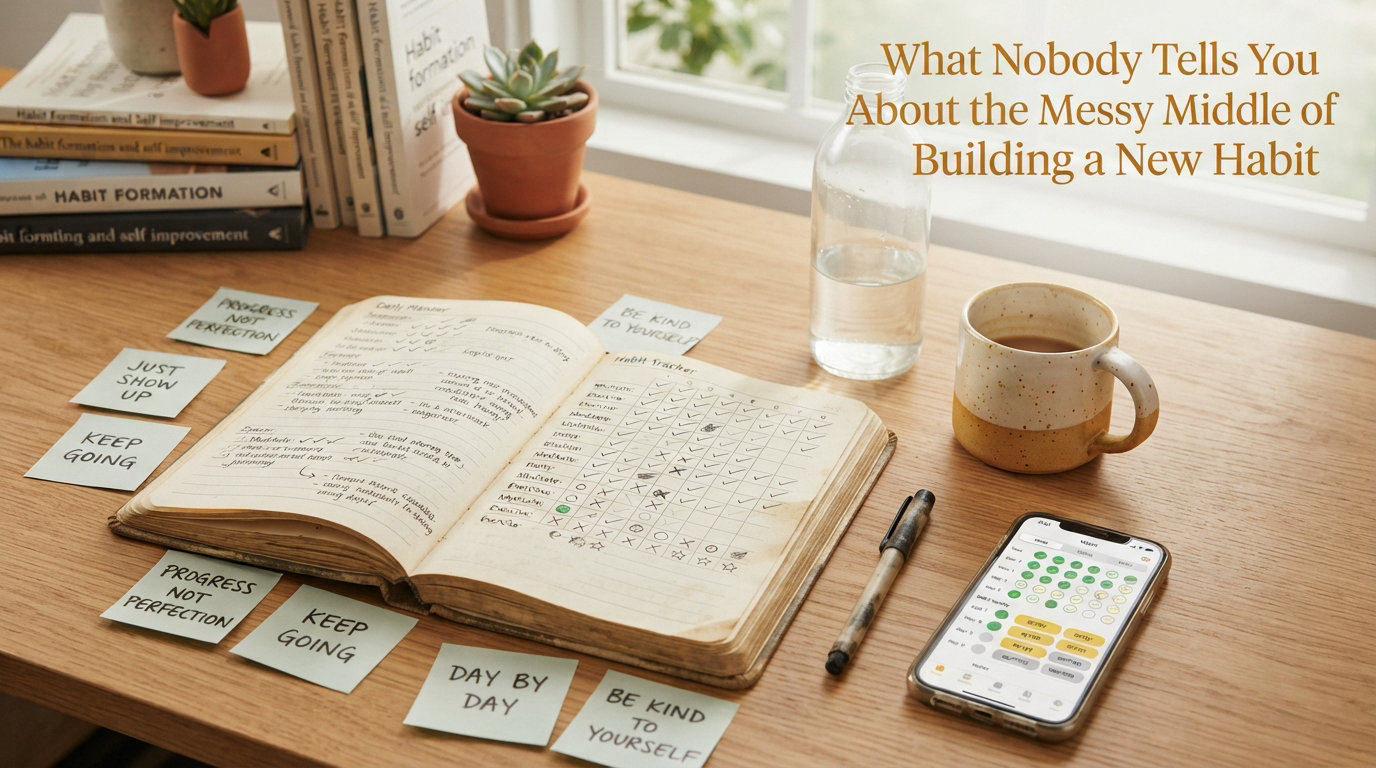
You started strong. Day one felt electric. You told a friend, bought the journal, scheduled the early runs, and poured yourself into the new routine. By day 18 you are staring at that same journal wondering whether you ever cared about this goal at all.
If that sounds familiar, you have arrived at the part of messy middle habit building that derails more plans than any external obstacle ever could. The exciting start gets all the attention. The glorious finish gets all the celebration. The long, uncomfortable stretch in between, where motivation evaporates and doubt moves in, is the part nobody warned you about.
I have watched this exact pattern repeat across hundreds of habit journeys as a coach, and I have lived through it myself more times than I can count. The middle is not a sign you picked the wrong goal or that you lack willpower. It is a predictable, well-documented phase that every meaningful change passes through.
This guide breaks down what the messy middle really is, why your brain is wired to make it feel impossible, how to tell the difference between a normal plateau and a goal that genuinely needs to change, and the practical strategies that actually move you through it.
Table of Contents
What Is the Messy Middle of Habit Building?
The messy middle is the challenging stretch between the excitement of starting a new habit and the satisfaction of seeing it pay off. It is the phase where motivation has dropped, results are not yet visible, and the daily effort feels heavier than it did at the start.
This is the part of the journey captured in Robin Sharma’s widely shared quote: “Change is hard at first, messy in the middle, and gorgeous at the end.” The messy part is not a detour. It is the actual work of change happening in real time.
Almost every popular habit guide focuses on the start (set a goal, make a plan) or the finish (celebrate the win, scale up). The middle gets glossed over because it is unglamorous and hard to package into a single tip. Yet this is exactly where most people quietly quit and assume they failed.
Here is the part nobody tells you: feeling stuck in the middle is not a problem to fix. It is the process working the way it is supposed to.
What Nobody Tells You About the Messy Middle
The standard habit advice skips past the middle because the middle does not fit neatly into motivational language. There is no dopamine hit to celebrate and no final result to point to. There is only showing up, again, when you do not feel like it, for results that have not arrived yet.
What almost no resource explains is the actual machinery behind that discomfort. Once you understand what is happening in your brain and why it feels so hard, the middle stops feeling like a personal flaw and starts feeling like a phase with an exit.
The Brain Science Nobody Explains
Only about one in three habit resources I reviewed touches the brain science, and most do it badly. Here is what is actually happening, because this single piece of knowledge has changed how my clients experience the middle.
When you start a new habit, your prefrontal cortex is doing the work. This is the part of your brain responsible for conscious, deliberate decision-making. It is powerful, but it is also energy-hungry and slow. Every time you choose the salad, lace up the running shoes, or open the study app, your prefrontal cortex has to actively override your old patterns.
The goal of habit formation is to move the behavior out of the prefrontal cortex and into the basal ganglia, the part of the brain that runs automatic behaviors like brushing your teeth. This is where automaticity lives. A habit is not a habit until the basal ganglia is running it with minimal conscious effort.
The messy middle is the transfer phase. The behavior is no longer fully run by your prefrontal cortex (which is exhausted from the early effort) and not yet fully embedded in your basal ganglia. Neither system is fully in charge, and that in-between state feels chaotic, effortful, and unstable.
This is why the middle feels so hard even when you are making progress. Your brain is literally rewiring the neural pathways that will eventually make the behavior automatic. A 2009 study by Phillippa Lally and colleagues at University College London found that habit formation takes anywhere from 18 to 254 days, with an average of 66 days for a new behavior to feel automatic. The middle is the rewiring. There is no shortcut.
Awareness Outpaces Change
One of the cruelest features of the messy middle is that your awareness grows faster than your behavior changes. You know what you should be doing. You can even see yourself not doing it. That gap between knowing and doing is where the shame spiral begins.
I hear this from clients constantly: “I know exactly what I should do, I just don’t do it, so what’s wrong with me?” Nothing is wrong with you. Awareness is a cognitive change, and it happens fast. Behavioral change is neurological, and it happens slowly.
The shame spiral starts when you treat the gap between awareness and action as a character flaw. The moment you reframe it as a normal neurological lag, the shame loses its grip. You are not broken. Your brain is just doing the slow work of catching up to what your mind already knows.
What the Messy Middle Actually Feels Like
Reading about the middle is one thing. Recognizing yourself in it is another. Here are the emotional symptoms my clients describe most often, the same ones that show up over and over in forums and support groups.
1. Motivation flatlines. The initial excitement that powered your first two weeks is gone. You are now relying on discipline alone, and discipline feels thin.
2. Doubt creeps in. You start asking whether the goal was even worth pursuing. Maybe you should have picked something easier. Maybe this is just not your thing.
3. You start comparing. Other people seem further along. Their progress looks linear and effortless while yours feels stuck. Social media makes this worse.
4. You feel like quitting. Not in a dramatic way. In a quiet, rationalizing way. “Maybe I’ll come back to this when life calms down.” Life never calms down.
5. You feel like you are drowning. People in self-improvement communities use words like “stuck in a rut,” “drowning,” and “trapped” to describe this phase. That language is not exaggeration. The feeling is genuinely that heavy.
If you checked every box on this list, you are not failing. You are in the part of habit formation where the work actually happens. The people who eventually make it through are not the ones who never felt this way. They are the ones who kept going while feeling exactly this way.
The Messy Middle vs. the Boring Middle
Most resources treat “messy middle” and “boring middle” as the same thing. They are not, and knowing the difference changes how you handle each one.
The messy middle is emotional. It is loud. It is full of doubt, frustration, and the urge to quit. You are fighting your own brain chemistry as much as you are fighting the habit itself.
The boring middle comes later, after the messiness settles. The behavior is starting to feel routine. There is no longer a daily internal war. But there is also no excitement, no novelty, and often no visible progress. The boring middle is where consistency is quietly built, and it is where most habits actually die a quiet death.
People in the ADHD community talk about this distinction a lot, because a novelty-seeking brain struggles with the boring middle even more than the messy one. The boring middle is not a problem to solve. It is a skill to develop. The actual ability being trained here is not the habit itself but the capacity to keep showing up when nothing feels new.
If you are in the messy middle, your work is emotional regulation and self-talk. If you are in the boring middle, your work is tolerance for repetition. Different phases, different strategies.
7 Strategies to Push Through the Messy Middle of Habit Building
The strategies below are the ones that consistently work for my clients in the messy middle of habit building. None of them rely on motivation, because motivation is exactly what has disappeared by the time you need them.
1. Shrink the habit to a ridiculously small version. When the full habit feels impossible, drop to the minimum viable version. If your goal is a 45-minute workout, the minimum version is putting on your shoes and walking for five minutes. If your goal is writing 1000 words, the minimum is one paragraph. The point is not the small action itself. The point is keeping the neural pathway active on days when the full version would not happen. Consistency on bad days matters more than intensity on good ones.
2. Track inputs, not outcomes. By the middle of habit building, the outcome (weight, income, skill level) is usually invisible. That invisibility feeds the doubt. Shift your tracking to inputs, the actions you control. Did you show up today? Did you do the minimum? Did you log it? Inputs are immediate, measurable, and entirely in your control. Outcomes are lagging indicators that will catch up later if the inputs are right.
3. Use implementation intentions. Decisions made in the moment are the ones that fail in the middle. Pre-decide using an if-then structure: “If it is 6:30am on a weekday, then I am at my desk writing for 30 minutes.” Research on implementation intentions shows they roughly double follow-through rates because they remove the in-the-moment negotiation that drains willpower.
4. Build identity-based habits, not outcome-based ones. Outcome motivation (“I want to lose 20 pounds”) dies fast in the middle because the outcome is not here yet. Identity motivation (“I am the kind of person who trains three times a week”) is self-reinforcing because every session is evidence for the identity. Frame your habit in terms of who you are becoming, not what you are trying to get. The Identity shift is what carries you through the days the outcome cannot.
5. Pre-decide your response to setbacks. Setbacks are not a possibility in the messy middle. They are a certainty. Decide in advance what a missed day means. A good rule: never miss twice. One missed day is life. Two missed days is the start of a new pattern. Pre-deciding this removes the guilt spiral that usually follows a slip, because you already know exactly what you do next.
6. Get one accountability anchor. You do not need a group, an app, or a coach. You need one person, or one system, that knows what you are doing and expects to hear from you. The simple act of telling someone “I am doing this, ask me on Friday” raises the cost of quitting. Isolation is what makes the middle feel personal. Anchoring it to another person makes it shared.
7. Reconnect with the original reason, in writing. The reason you started is usually emotional and specific. By the middle, you have forgotten it, and the goal has become a chore. Write down why this matters, in one sentence, on a sticky note where you will see it daily. The original reason does not need to be profound. It needs to be yours.
When to Persist and When to Pivot
One of the most asked questions in forums, and the one almost no resource answers, is how to tell the difference between a normal messy middle and a goal that genuinely needs to change. Quitting in the middle because it is hard is one mistake. Persisting through a middle that is the wrong middle is another.
Here is the framework I use with clients. It is not perfect, but it removes most of the guesswork.
Persist when:
- The goal still aligns with your core values, even though the method feels wrong.
- You are showing up inconsistently, but the direction is correct.
- The hard feelings are about the effort, not the destination.
- You can identify the specific obstacle (fatigue, scheduling, skill gap) and it has a fix.
Pivot when:
- The goal itself no longer reflects who you want to be.
- You are persisting out of sunk-cost fear, not genuine desire.
- The method is clearly broken (wrong tool, wrong environment, wrong timeline) but the goal is right.
- Your body or mental health is paying a price the goal cannot justify.
Notice the difference. Persisting means staying with the goal and adjusting the approach. Pivoting means changing the approach, the timeline, or sometimes the goal itself. Neither is failure. Both are intelligent responses to new information.
The mistake is treating the messy middle as a single decision: keep going or give up. The real question is sharper: is the goal still right, and if so, what needs to change about how I am pursuing it?
Failure as Data, Not as Identity
The single most damaging story you can tell yourself in the messy middle is “I failed, therefore I am a failure.” That sentence collapses a single event into a permanent identity, and once the identity sets in, the habit is over.
No competitor resource I reviewed makes this distinction explicitly, which is why it is worth its own section. Failure-as-data treats every missed day, every slip, and every bad week as information. What triggered it? What time of day? What was the cue? Each slip is a data point that helps you redesign the habit for the conditions of your actual life, not the idealized version of it.
Failure-as-identity does the opposite. It uses the slip as proof that you are the kind of person who cannot change. This is the story the shame spiral is built on, and it is almost always false. People who eventually build lasting habits are not people who never slipped. They are people who treated each slip as feedback and kept adjusting.
The shift in self-talk is small but decisive. Instead of “I missed again, I am so undisciplined,” try “I missed again, what does that tell me about how this habit is set up?” One sentence closes the door. The other opens it.
Frequently Asked Questions
What is the messy middle in the context of pursuing a goal?
The messy middle is the difficult phase between the excitement of starting a goal and the satisfaction of seeing results, where motivation drops, progress feels invisible, and doubt increases even though you are still putting in the effort.
What is the 3 3 3 rule for habits?
The 3-3-3 rule is a simple habit framework that means committing to your new habit for 3 days, then 3 weeks, then 3 months. Each stage builds on the last and breaks a long, intimidating commitment into smaller, achievable checkpoints that help carry you through the messy middle.
What part of the brain is linked to forming habits?
Habit formation involves transferring behavior from the prefrontal cortex, which handles conscious effort and decision-making, to the basal ganglia, which handles automatic behavior. The messy middle is the transfer phase, when neither system is fully in charge and the habit feels unstable.
How to get through the messy middle?
To get through the messy middle, shrink the habit to a minimum version on hard days, track inputs instead of outcomes, use if-then implementation intentions, build identity-based motivation, pre-decide your response to setbacks (never miss twice), anchor to one accountability partner, and reconnect in writing with the original reason you started.
How long does it take to form a new habit?
Research by Phillippa Lally and colleagues found that forming a new habit takes anywhere from 18 to 254 days, with an average of 66 days for a behavior to feel automatic. The wide range reflects how complex the habit is and how consistent you are during the messy middle.
You Are Not Behind, You Are In It
If you take one thing from this guide, let it be this: the messy middle of habit building is not a sign you are doing it wrong. It is the sign you are doing it. The doubt, the flat motivation, the comparing, the urge to quit, these are the terrain, not the weather.
Your brain is rewiring. Your awareness has outpaced your behavior, and the gap between them is exactly where the shame tries to take root. Catch that gap, reframe it, and keep showing up at the minimum version on the days the full version is not available.
Keep a record this week of one input per day, reconnect in writing with the reason you started, and tell one person what you are working on. The middle ends. It always does. The only question is whether you are still in the habit when it does.