
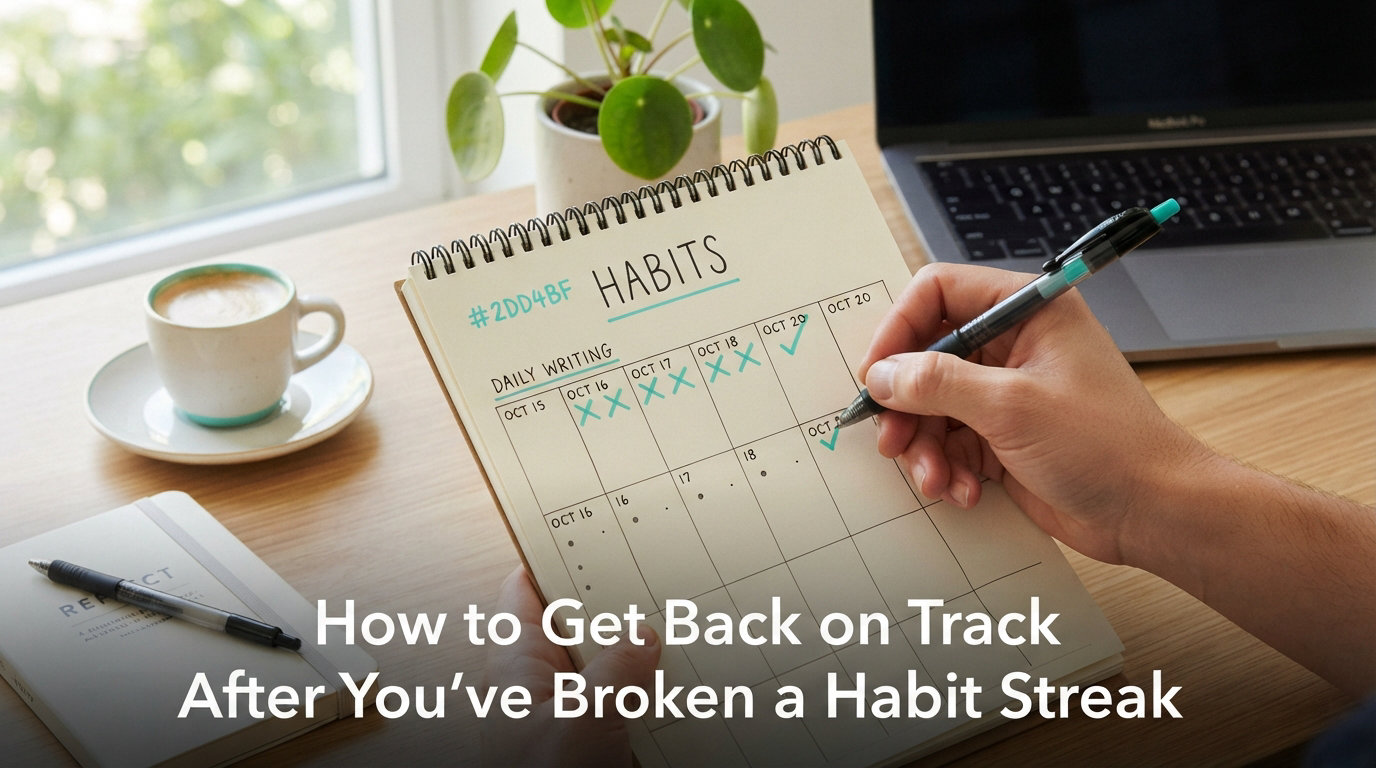
You had a 47-day meditation streak going. You felt proud, consistent, unstoppable. Then Thursday happened. A late meeting ran long, your kid got sick, and by the time you collapsed into bed, your daily streak was gone.
If you are wondering how to get back on track after breaking a habit streak, you are in the right place. That sinking feeling of seeing a broken streak is something nearly everyone who tracks habits has experienced.
Here is the good news. One missed day does not erase weeks of progress. Your neural pathways are still there, slightly weakened but far from gone. The real danger is not the slip itself but what you do next.
In this guide, I will walk you through exactly what happens in your brain when a streak breaks, seven proven strategies to recover quickly, and how to build a habit system that survives the inevitable bad day.
Table of Contents
The Psychology of Habit Streaks: Why Breaking One Feels So Bad
Streaks work because they tap into your brain’s dopamine reward system. Every time you check off a day, you get a small hit of satisfaction that reinforces the behavior. This is the same mechanism behind why streak-based apps like Duolingo and habit trackers are so effective at keeping you engaged.
When you break a streak, that reward loop suddenly vanishes. Your brain registers the loss, and a phenomenon behavioral economists call loss aversion kicks in. Losing something you already had feels roughly twice as painful as gaining something new feels good.
This pain opens the door to what psychologists call the “what-the-hell effect.” Once the streak is broken, your brain says, “Well, I already ruined it, so what does one more day matter?” That single thought has sabotaged more habits than any external obstacle ever could.
But here is what most people misunderstand about broken streaks. Your neural pathways do not reset to zero after one missed day. Research from University College London shows that missing a single day has almost no measurable impact on habit formation. The pathways you built over weeks of consistency are still there, waiting to be reactivated.
The damage only compounds when you let one slip turn into a week, then a month. The break itself is not the problem. Your response to it is everything.
How to Get Back on Track After You’ve Broken a Habit Streak
The fastest way to get back on track after a broken habit streak is to act quickly, skip the shame, and resume your routine within 24 hours. Here are seven strategies that work, based on behavioral psychology research and real-world experience.
1. Skip the Shame and Practice Self-Compassion First
Beating yourself up after a broken streak is the most common response, and it is also the most counterproductive one. Research from Dr. Kristin Neff at the University of Texas shows that self-criticism actually decreases motivation and increases the likelihood of giving up entirely.
Instead, treat yourself the way you would treat a friend who missed a day. You would not tell your best friend they are a failure for skipping one workout. You would say, “No big deal, just go tomorrow.”
Self-compassion is not about making excuses. It is about keeping your emotional energy intact so you actually have the fuel to restart. Shame drains that fuel. Self-forgiveness preserves it.
2. Use the 24-Hour Reset Rule
The 24-Hour Reset Rule is simple. When you break a streak, your only goal is to resume the habit within 24 hours. Not next Monday. Not at the start of next month. Within one single day.
This matters because the longer the gap between your last successful day and your restart, the harder it becomes. A one-day break is a speed bump. A one-week break starts to feel like starting over. A one-month break essentially is starting over.
I have used this rule personally with my writing habit. The days I restarted within 24 hours, I barely felt the interruption. The times I told myself “I’ll start fresh next week,” I often lost the habit entirely for months.
3. Identify What Triggered Your Slip
Most streak breaks are not random. They follow a pattern, and identifying that pattern is the difference between a one-time slip and a recurring cycle. Ask yourself three questions. What was happening right before the slip? What emotion were you feeling? What specific obstacle got in the way?
Common triggers include schedule disruptions like travel, illness, or work deadlines. Emotional triggers like stress, exhaustion, or conflict also play a major role. Environmental triggers, such as being in a different location or losing access to your usual cue, can derail even strong habits.
Once you identify the trigger, you can build a specific contingency plan. If travel breaks your morning workout habit, your plan might be a 10-minute hotel room routine. If exhaustion kills your reading habit, you shift it to the morning instead of before bed. The trigger is data, not a character flaw.
4. Resume Immediately and Skip the Make-Up Days
One of the biggest mistakes people make after a broken streak is trying to compensate. You missed two days of meditation, so you try to meditate for three times as long to “catch up.” This sounds logical, but it backfires almost every time.
Make-up days create an artificially high barrier to re-entry. Suddenly resuming your habit feels like a massive effort instead of a simple return to normal. You procrastinate, the gap widens, and before long you have abandoned the habit altogether.
The fix is to return to your original baseline. If your habit was 20 minutes of reading, do 20 minutes. Not 40, not 60. The goal is consistency, not compensation. Show up at your normal level and let momentum rebuild naturally.
5. Apply the Two-Day Rule
The Two-Day Rule is a powerful safeguard against the slippery slope of abandoned habits. The rule states simply that you never miss two days in a row. One miss is a slip. Two misses starts a new pattern of inactivity.
This rule works because it gives you permission to be imperfect while still maintaining a hard boundary. You can miss a day guilt-free, knowing that the only requirement is to show up tomorrow. The pressure is manageable, and the standard is clear.
Many people I have worked with find this rule far more sustainable than a strict daily streak. It removes the all-or-nothing pressure that makes streaks so fragile while still keeping you accountable to regular practice.
6. Shift to Identity-Based Recovery
When your streak breaks, it is easy to feel like you have lost your identity as “someone who exercises” or “someone who meditates.” But identity is not determined by a single missed day. It is determined by what you do consistently over time.
Identity-based habits, a concept popularized by James Clear in Atomic Habits, focus on who you want to be rather than what you want to achieve. A runner does not stop being a runner because they skipped a day. They simply run again tomorrow.
After a broken streak, reconnect with your identity. Say to yourself, “I am someone who shows up for this habit.” Then act on it that same day. The identity reinforces the action, and the action reinforces the identity.
7. Switch to Percentage-Based Tracking
Streak tracking has a built-in flaw. One missed day resets everything to zero, which creates a devastating psychological blow. Percentage-based tracking solves this problem by measuring your overall consistency instead of your current run of consecutive days.
Instead of counting a 30-day streak, you track that you completed your habit 28 out of the last 30 days. That is a 93% success rate. Missing a day drops you from 93% to 90%, a small dip that barely registers emotionally.
Reddit communities like r/Habits and r/getdisciplined consistently report that users who switch to percentage tracking abandon habits far less often than those who use streak counters. You can track this simply by marking a calendar, or by choosing a habit app that supports percentage or “lives” mechanics rather than rigid streaks.
Building Long-Term Habit Resilience
Getting back on track once is great. Building a system that survives future breaks is even better. Habit resilience means designing your routine so that slips are expected, absorbed, and recovered from automatically.
Start by building forgiveness mechanisms into your system from day one. Give yourself a set number of “free passes” each month, similar to how Duolingo offers streak freezes for missed days. Knowing you have a safety net reduces the anxiety that makes streaks so fragile.
Plan for common life disruptions before they happen. Travel, illness, family emergencies, and work crunches will happen. Write down a minimum viable version of each habit for low-energy days. A full workout might become five stretches. Thirty minutes of reading might become five pages. The goal is to keep the identity alive even when circumstances are not ideal.
Find an accountability partner who knows your habit goals. Sharing a broken streak with someone who responds with encouragement rather than judgment makes recovery dramatically easier. Research consistently shows that social accountability is one of the strongest predictors of long-term habit success.
Finally, consider using the 3-3-3 rule to structure your habits. Pick three habits, commit to doing them for three weeks, and track three key metrics. This framework keeps your focus manageable and prevents the overwhelm that often leads to burnout and streak abandonment.
FAQs
What is the 3 3 3 rule for habits?
The 3-3-3 rule means choosing three habits to focus on, practicing them for three weeks, and tracking three key metrics to measure progress. It keeps your habit system simple and prevents the overwhelm that leads to abandoning your routine.
How long does it take to rewire your brain from bad habits?
Research from University College London found that it takes an average of 66 days to form a new habit, with a range of 18 to 254 days depending on complexity. Breaking an old pattern follows a similar timeline, but missing one day has almost no effect on the neural pathways you have already built.
What are the hardest habits to quit?
The hardest habits to break are those tied to strong dopamine rewards and deep emotional triggers. Smoking, excessive social media use, nail-biting, emotional eating, and procrastination rank among the most difficult because they activate the brain’s reward center and are often linked to stress relief.
What is the 21 90 rule for habits?
The 21-90 rule suggests it takes 21 days to build a new habit and 90 days to turn it into a permanent lifestyle change. While the exact timeline varies by person and habit complexity, this rule provides a useful framework for setting realistic expectations during habit formation and recovery.
Conclusion
Breaking a habit streak is not a failure. It is a normal, expected part of any behavior change process. What separates people who recover from those who quit is simple. They practice self-compassion, restart within 24 hours, and treat the slip as data rather than evidence of incompetence.
When you learn how to get back on track after breaking a habit streak, you are really building the most important skill of all. Resilience. The ability to stumble and keep going is worth more than any unbroken streak could ever be.
Your next step is simple. Pick one strategy from this list and use it today. Then come back tomorrow and do it again.