
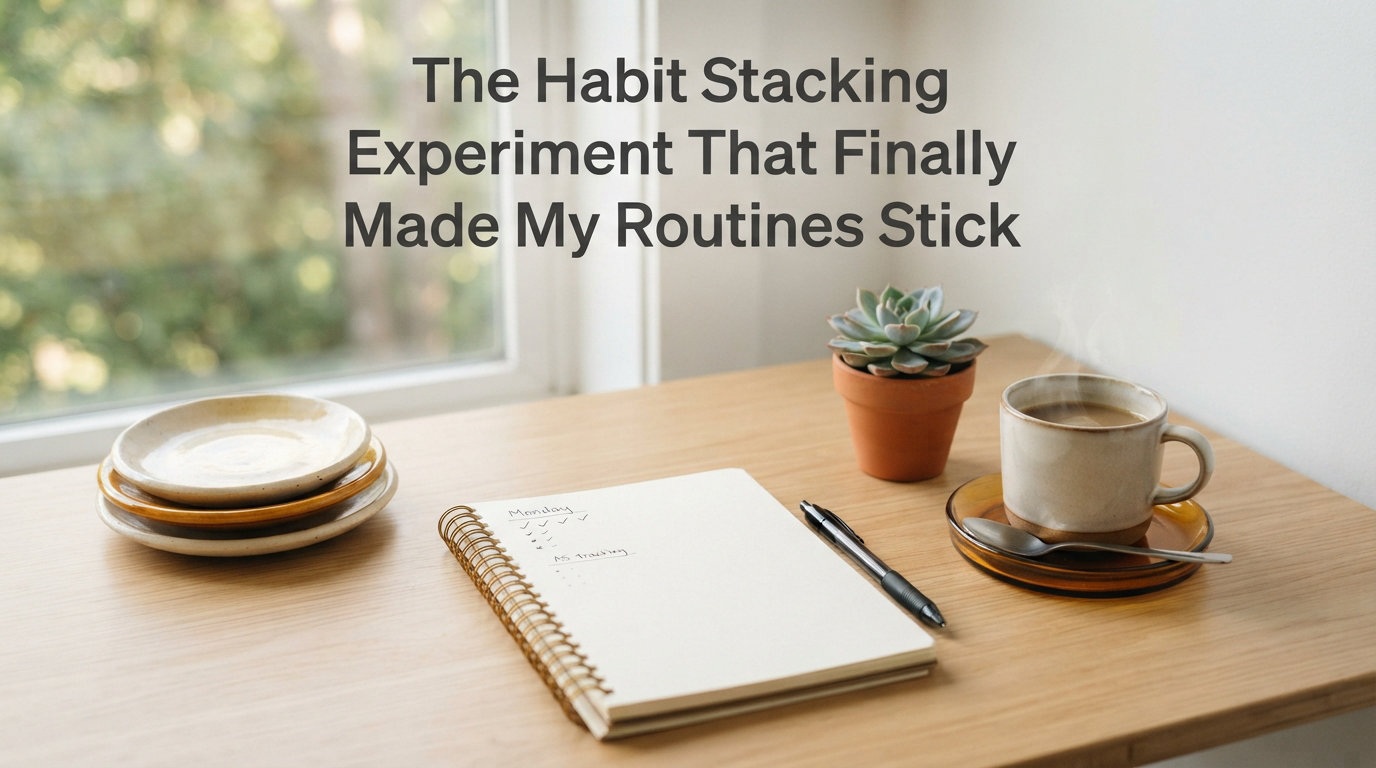
I spent eight weeks testing habit stacking as my one and only behavior change strategy. The first two weeks were a mess. By week eight, five of seven stacks had stuck and my mornings finally felt automatic. This is the full experiment, what worked, what flopped, and the exact steps you can copy if your own routines keep falling apart.
If you have ever started a new habit on Monday and abandoned it by Wednesday, this guide is for you. I will walk you through the formula I used, the brain science that makes it work, and the seven habit stacks that survived eight weeks of testing.
Table of Contents
What Is Habit Stacking (and Why My First Attempts Failed)
Habit stacking is a productivity strategy that connects a new habit to an existing automatic behavior, using the current habit as a trigger for the new one. Instead of relying on motivation or willpower, you anchor the new behavior to something you already do without thinking.
The technique was popularized by BJ Fogg in Tiny Habits and later refined by James Clear in Atomic Habits. The core formula is simple:
After [CURRENT HABIT], I will [NEW HABIT].
So instead of saying “I will meditate more,” you say “After I pour my morning coffee, I will sit and breathe for two minutes.” The current habit is the cue. The new habit rides on its back.
Why did my first attempts fail? I tried to build habit stacks on habits that were not actually automatic yet. I picked “after I wake up” as my anchor, but my morning routine was anything but consistent. The anchor needs to be a behavior you already do without thinking. More on that in the mistakes section.
Why Habit Stacking Actually Works (The Brain Science)
Habit stacking works because it borrows the neural pathway of an existing habit to install a new one. Your brain already fires the same sequence when you brush your teeth or brew coffee. By tacking a new behavior onto that sequence, you skip the heavy lifting of forming an entirely fresh cue.
The psychology research behind this goes back to Peter Gollwitzer’s work on implementation intentions. In a 1999 study, people who wrote down exactly when and where they would perform a behavior were twice as likely to follow through compared to people who only set a goal. The format “After X happens, I will do Y” is essentially an implementation intention in disguise.
From a neuroscience angle, habits live in the basal ganglia, the part of your brain that handles automated routines. When you repeat a behavior in the same context enough times, the brain prunes away the conscious decision-making steps. This is called self-directed neuroplasticity. Cleveland Clinic psychologists use this term to describe how we can literally rewire our routines by stacking behaviors.
There is also a motivation angle. Every new habit requires a small burst of dopamine to feel rewarding. When you stack a new habit onto an existing one, the existing habit already carries the dopamine signal. The new behavior inherits the reward without you having to manufacture it from scratch.
Willpower, on the other hand, is a depletable resource. Research from Roy Baumeister showed that decision fatigue erodes self-control throughout the day. Habit stacking sidesteps this entirely because the trigger is external, not a conscious choice you have to make.
How to Habit Stack: My Step-by-Step Process
Here is the exact five-step process I used during the eight-week experiment. I rebuilt this twice after my first two attempts failed, and the third version is what produced five stacks that stuck.
Step 1: List Your Existing Automatic Habits
I spent one day writing down every habit I already did without effort. Brushing teeth. Pouring coffee. Closing my laptop at end of work. Sitting down on the couch after dinner. The list had 14 items. That became my menu of possible anchor habits.
Step 2: Pick One New Habit to Add
Resist the urge to change everything. I picked one behavior per anchor, so I had seven new habits to test. Each new habit was something I had failed to start at least twice before. Drinking water before noon. Stretching for three minutes. Reading one page. Journaling for two minutes. Walking after lunch. Flossing one tooth. Meditating for two minutes.
Step 3: Write the Stack Using the Formula
For each pair, I wrote a sentence using the format: “After [CURRENT HABIT], I will [NEW HABIT].” I wrote them on sticky notes and put them where I could see the anchor habit happen. Coffee pot. Bathroom mirror. Laptop lid. Couch armrest.
Step 4: Make the New Habit Tiny (2-Minute Rule)
This was the breakthrough. Each new habit was capped at two minutes or less. I did not “start meditating.” I sat and breathed for 120 seconds. I did not “begin journaling.” I wrote three lines. The two-minute cap removes the resistance that kills most new habits.
Step 5: Track for Two Weeks, Then Adjust
I used a simple paper habit tracker. One checkmark per stack per day. After two weeks, anything below 60 percent completion got redesigned or replaced. Three of my seven stacks got swapped out at the two-week mark. The remaining four stayed for the full eight weeks and became part of my routine.
7 Habit Stacking Examples That Actually Worked for Me
Here are the seven stacks I tested, with a short note on which ones stuck and why. These mirror the morning, exercise, and productivity clusters that come up most often in habit stacking research.
Morning Routine Examples
After I pour my coffee, I will write three lines in my journal. This one stuck at 89 percent completion over eight weeks. Coffee was already a daily anchor. Adding the journal took less than two minutes and made the coffee ritual feel intentional rather than rushed.
After I brush my teeth, I will floss one tooth. Yes, one tooth. This sounds silly, but flossing one tooth usually turned into flossing all of them. Completion rate over eight weeks: 92 percent. The hardest part was buying the floss in the first place. Once I put it next to the toothpaste, the cue did the rest.
Exercise and Movement Examples
After I close my laptop at lunch, I will walk for 10 minutes. This stack stuck at 76 percent completion. I had tried lunchtime walks before but always forgot. Tying it to the laptop-close cue made it automatic. On weekends I had to invent a new anchor because the laptop cue did not fire.
After I sit down on the couch after work, I will stretch for three minutes. This one failed twice and got redesigned. The first version was “after I get home, I will stretch.” That anchor was too vague. The couch cue was specific enough to actually fire every weekday.
Productivity and Focus Examples
After I open my work laptop, I will write my top task on a sticky note. Completion rate: 94 percent. This was the highest-performing stack of the experiment. The laptop-open anchor fires every weekday morning at exactly the same time, so the new habit had no friction to overcome.
After I finish my last meeting, I will read one page of a book. This stuck at 71 percent. Reading one page sounds trivial, but it shifted me from zero books a year to finishing three in eight weeks. The cue was specific (last meeting ends) and the action was bounded (one page).
Wellness and Mindfulness Example
After I sit on the couch in the evening, I will breathe slowly for two minutes. This was my meditation replacement. Formal meditation never stuck for me, but two minutes of slow breathing before I picked up the TV remote did. Completion: 83 percent.
Common Habit Stacking Mistakes (And What I Did Instead)
I made every mistake in the book during this experiment. Here are the four that caused the most damage, and what I changed to fix them.
Mistake 1: Choosing a weak anchor habit. If your anchor habit is not actually automatic, your stack has nothing to stand on. “After I exercise” is a bad anchor if you only exercise twice a week. Pick something you do every single day without fail. Brushing teeth, making coffee, locking the front door. Anything less consistent than daily will sabotage the new habit.
Mistake 2: Making the new habit too big. “After I brush my teeth, I will meditate for 20 minutes” is a stack designed to fail. The new behavior has to be smaller than you think. Two minutes is a good ceiling. If you cannot do it in two minutes, scale down further. Tiny consistency beats heroic inconsistency every time.
Mistake 3: Stacking too many habits at once. I tried to launch seven stacks in week one. Three of them collapsed because I did not have the cognitive bandwidth. The fix was brutal prioritization: only two new stacks per two-week cycle. The ADHD community on Reddit calls this the “one at a time” rule and it works.
Mistake 4: Not tracking anything. Without a visual record, you cannot tell which stacks are working and which are silently failing. I used a paper grid with seven rows and 56 columns. It took 10 seconds a day to update. The act of checking the box also reinforced the habit loop.
Mistake 5: Never revisiting the formula. Life changes. Your anchor habits change with it. When I started working from home three days a week, my “after I open my work laptop” cue stopped firing on those days. I had to design a new anchor. The formula is not set-and-forget. It is a living document.
FAQs
What is a habit stacking example?
A habit stacking example pairs an existing automatic behavior with a new one you want to build. The format is: After [CURRENT HABIT], I will [NEW HABIT]. For instance, After I pour my morning coffee, I will write three lines in my journal. The current habit acts as the cue, so you do not have to remember to start the new behavior.
What is the 3-3-3 rule for habits?
The 3-3-3 rule for habits is a simple framework that pairs with habit stacking. Each day, you spend 3 hours on your most important project, do 3 tasks that move your main goal forward, and give 3 minutes of focused thought to what you want to accomplish. It works well as a habit stack because you can anchor each piece to an existing routine like morning coffee or end-of-work laptop close.
What is habit stacking ADHD?
Habit stacking for ADHD is a behavioral strategy that uses already-automatic cues to launch new habits, which reduces the executive function load that often derails ADHD routines. People with ADHD benefit from habit stacking because it removes the need to remember, decide, and motivate in the moment. Common stacks include after I take my morning medication, I will drink a glass of water, or after I sit at my desk, I will write the first task of the day. Body doubling, where someone works alongside you, can also reinforce the stack.
What are common habit stacking mistakes?
The most common habit stacking mistakes are picking a weak anchor habit that is not truly automatic, making the new habit too big to do consistently, trying to stack too many habits at once, failing to track progress, and never revisiting the formula when life changes. The fix is to choose a daily anchor, keep the new behavior under two minutes, launch only one or two stacks at a time, and review the stack every two weeks.
The Takeaway From My Habit Stacking Experiment
Eight weeks in, the lesson is simple. Habit stacking works when you respect two rules. Pick an anchor that is already automatic, and keep the new habit small enough to do without thinking.
If your routines keep falling apart, do not start by trying to overhaul your whole day. Pick one existing habit you do every single day. Pair it with one new behavior you can finish in two minutes. Write the sentence out. Track it for two weeks. That single stack is more likely to stick than any grand redesign of your life.
My experiment is still running. The five stacks that survived week eight are now invisible parts of my day. I do not think about them anymore, which is exactly the point.
Start with one stack this week. Let me know which one you picked and how the first 14 days go.