
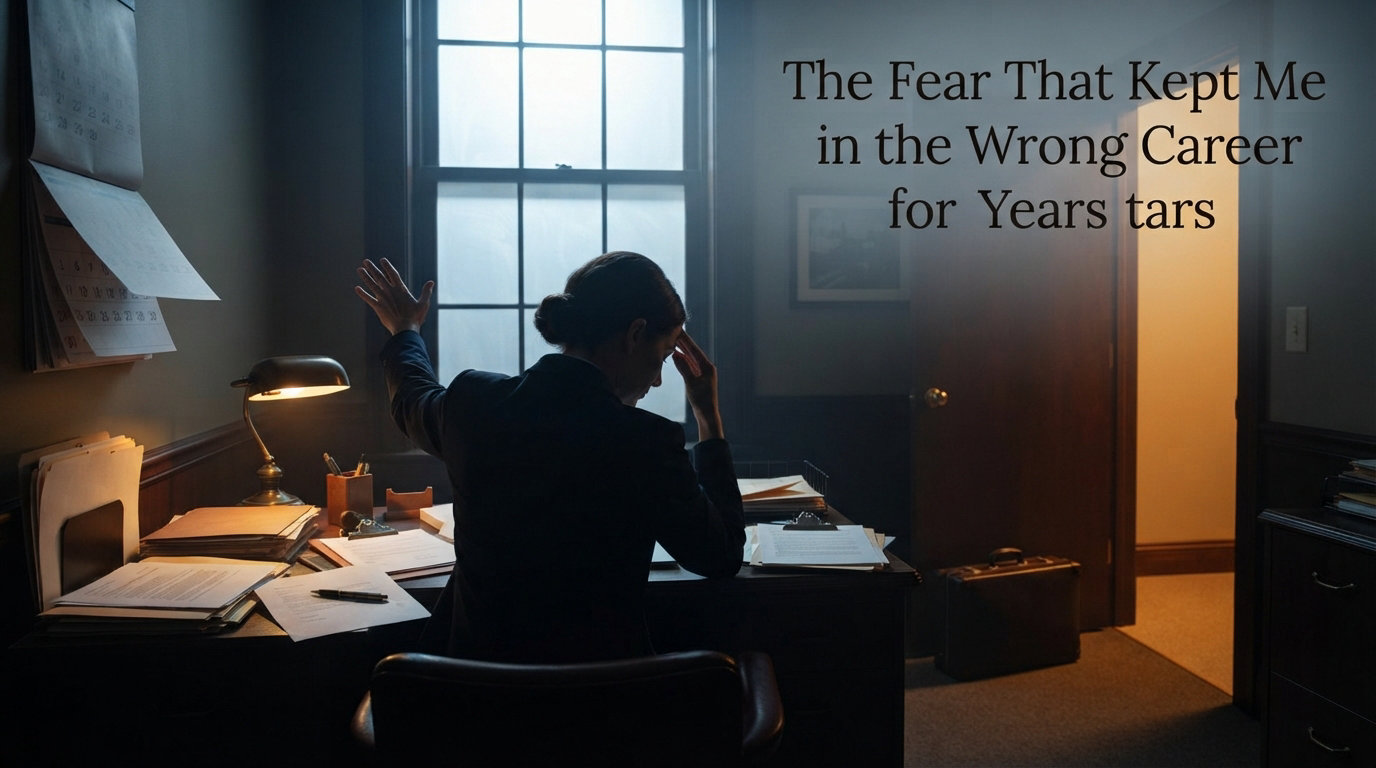
It started as a low hum. Nothing dramatic, no cinematic breakdown in a bathroom stall or tearful confession to a mentor. Just a quiet, persistent vibration in the back of my mind every Sunday evening that said, this is not right. I ignored it. For ten years.
That hum grew louder over time, but I had gotten remarkably good at drowning it out. I told myself I was being practical. I told myself everyone felt this way about their job. I told myself the discomfort would pass once I got the next promotion, the next raise, the next impressive title.
None of that happened. The fear that kept me in the wrong career for ten years was not the fear of failure. It was the fear of admitting I had already failed. The fear of starting over. The fear of watching everyone I graduated with pull ahead while I rebuilt from scratch in my thirties.
If you are reading this, I suspect you know that hum. You may be living with it right now, telling yourself the same stories I told myself for a decade. This article is for you. I want to share what those ten years taught me about fear, why we stay stuck, and how to finally move through it.
Table of Contents
The Fear That Kept Me in the Wrong Career for Ten Years
I want to tell you about the decade I lost. Not to wallow in it, but because I think my story might sound uncomfortably familiar to you.
I graduated into a field that looked great on paper. My family was proud. My friends were impressed. The starting salary made people raise their eyebrows at dinner parties. And for the first year, maybe two, I mistook relief for passion. I was just so relieved to have a job, to have a plan, to have an answer when people asked what I did.
But by year three, the cracks were showing. I dreaded Mondays. I spent meetings mentally calculating how many hours until I could leave. I started getting headaches on Sunday nights that mysteriously vanished by Friday afternoon.
By year five, I was in full emotional hiding. I had constructed an elaborate performance of someone who loved their career. I volunteered for projects I did not care about. I said yes to networking events that made me feel hollow. I posted carefully curated updates about my professional achievements on social media. Meanwhile, inside, I was running on empty.
By year seven, I started having what I now recognize as panic episodes. I would sit in my car in the parking lot before work, gripping the steering wheel, unable to move. I told myself it was just stress. I told myself everyone felt this way.
Here is the part that still frustrates me when I look back: I knew. Deep down, I knew by year two that I was in the wrong career. But knowing was terrifying, because knowing meant I had to do something about it. And doing something meant admitting that I had spent years going in the wrong direction.
That admission felt like a kind of death. I had tied my entire identity to this career. My sense of self, my social standing, my answer to every cocktail party question. Who was I without it?
The breaking point came in year ten. A colleague I respected pulled me aside after a meeting and said, simply, “You don’t belong here. You know that, right?” It was the kindest, most devastating thing anyone had ever said to me. I went home and cried for two hours. And then, for the first time in a decade, I stopped running from the hum and started listening to it.
Recognizing the Signs You Are in the Wrong Career
The hardest part of being stuck in the wrong career is that the signs are everywhere, but they are easy to rationalize away. We are masterful at explaining our own misery to ourselves.
Here are the signs I ignored, and the ones I now hear from almost every coaching client who walks through my door:
1. The Sunday night dread is a constant. Everyone has an occasional bad week. But if Sunday evenings feel like a slow-rolling panic attack that lifts the moment you clock out on Friday, your body is trying to tell you something. Listen to it.
2. You perform your job instead of living it. When you are in the right career, work feels like an extension of who you are. When you are in the wrong one, work feels like a character you play. You put on a costume every morning and take it off every evening.
3. Your accomplishments feel hollow. You land the promotion, get the raise, hit the target, and the satisfaction lasts about forty-eight hours. Then the emptiness returns. External achievements cannot fill an internal misalignment.
4. You are jealous of people in completely unrelated fields. If you find yourself envious of a friend who is a teacher, a baker, or a park ranger, and you cannot stop thinking about how their life looks, pay attention. Envy is a compass pointing toward what you actually want.
5. You have stopped imagining your future in this field. When someone asks where you see yourself in five years, you go blank. You cannot picture it. Or worse, the picture fills you with dread.
6. Your body is breaking down. Chronic headaches, digestive issues, insomnia, teeth grinding, unexplained exhaustion. The body keeps the score when the mind refuses to listen. I spent five years treating physical symptoms that were actually career symptoms.
If three or more of these signs resonate with you, you are likely not in a rough patch. You are in the wrong place. And that is not a failure. It is information.
The Four Fears That Keep You Stuck
When I finally admitted I needed to change careers, I expected to feel relief. Instead, I felt something worse than the discontent: raw, paralyzing fear. Through my own experience and years of coaching others through the same transition, I have identified four distinct fears that trap people in careers they have outgrown.
Fear of Financial Ruin
This is the big one. The fear that if you leave your current career, you will not be able to pay your mortgage, support your family, or maintain the life you have built. This fear is real and valid. But it is also negotiable.
Most people assume a career change means an immediate pay cut to zero. In reality, career transitions happen in phases. You can build skills, test new paths, and create income bridges while still employed. The all-or-nothing mindset is the fear talking, not reality.
Fear of Judgment
What will your parents think? Your friends? Your former classmates? Your LinkedIn connections? This fear is enormously powerful because it taps into our deepest need for belonging and social approval.
I spent years staying in a career I hated because I could not bear the thought of people whispering about my “failure.” Here is what I learned: people are far too preoccupied with their own lives to scrutinize yours. And the few who do judge you are not people whose opinions should shape your future.
Fear of Starting Over
You have invested ten years in this career. Ten years of skills, relationships, credentials, and momentum. Walking away feels like setting all of that on fire.
But here is the reframe that changed everything for me: you are not starting over from zero. You are starting over from experience. Every skill you have built, every challenge you have navigated, every professional relationship you have formed comes with you. You are not erasing a decade. You are redirecting it.
Fear of Choosing Wrong Again
This one keeps people frozen more than any other. What if I change careers and the new one is just as bad? It is a paralyzing question because it feels unanswerable.
But it is answerable. The reason I chose the wrong career the first time was that I chose with fear, not clarity. I picked what felt safe, impressive, and expected. If you choose your next career with self-awareness instead of fear, you are already operating from a fundamentally different place. The same person does not make the same mistake twice when they have done the inner work.
When Fear Is Actually Trying to Tell You Something
We treat fear as the enemy of career change. We think we need to conquer it, silence it, push through it. But what if fear is not your enemy at all?
Your brain is wired for survival, and survival means predictability. When you consider leaving a known career for an unknown one, your amygdala, the ancient threat-detection center in your brain, sounds an alarm. It does not know the difference between a career change and a predator. It just knows something familiar is ending and something unfamiliar is beginning.
This is why career change fear feels so physical. Your heart races. Your stomach tightens. Your thoughts spiral. Your body is responding to a perceived threat, even though no actual danger exists.
But here is the part most people miss: that same fear response is proof that something matters to you. We do not feel fear about things we do not care about. The intensity of your career change fear is directly proportional to how much this decision matters to your authentic self.
I now believe fear is a compass. It points not toward danger, but toward significance. The things that scare us most about career change, losing our identity, disappointing others, risking financial security, are the things most tied to our deepest values. Fear is not telling you to stop. It is telling you that you are on the edge of something real.
So instead of trying to eliminate fear, try listening to it. Ask what it is protecting. Ask whether the thing it is protecting, your comfort, your image, your safety, is actually serving you anymore.
How to Move Forward Despite the Fear
I will not pretend there is a shortcut. Moving through career change fear is uncomfortable, nonlinear work. But there are practical steps that make it manageable. These are the steps I took, and the steps I now walk clients through every day.
Step 1: Stop trying to figure everything out at once. The biggest trap is believing you need a complete plan before you can take any action. You do not. You need one small step. That might mean reading a book about a field that interests you, taking a weekend workshop, or having one honest conversation with someone in a different industry.
Step 2: Run experiments, not commitments. Fear thrives on permanence. It tells you that every decision is irreversible. Counter that by running low-stakes experiments. Volunteer in a new field. Take on a side project. Shadow someone for a day. You are not committing to a new career. You are gathering data.
Step 3: Build a financial bridge. Address the money fear head-on. Start saving aggressively. Research the earning potential in fields that interest you. Talk to a financial advisor about what a transition would actually require. When you turn a vague, terrifying financial unknown into specific numbers, the fear shrinks.
Step 4: Talk to people who have done it. I cannot overstate the power of hearing someone else say, “I was where you are, and I made it through.” Find people who have changed careers in their thirties, forties, even fifties. Their stories will do more to calm your fear than any article or book.
Step 5: Work with a coach or counselor. Career change is not just a professional decision. It is an identity shift. Having someone trained to help you navigate that shift is invaluable. I waited far too long to seek support. Do not make my mistake.
Step 6: Give yourself permission to grieve. Leaving a career, even a wrong one, means mourning the version of yourself you were going to be. That grief is normal. Acknowledging it creates the emotional space to build something new.
Step 7: Redefine success on your own terms. The reason I stayed stuck for so long was that I was measuring success by external standards: salary, title, prestige. When I started measuring it by alignment, energy, and fulfillment, the right path became obvious.
Seven Questions to Ask Before You Make the Leap
Before you make any dramatic move, take time to sit with these questions. Write your answers down. Do not rush.
1. If money were not a factor, what would I do tomorrow morning?
2. What am I most afraid of losing if I change careers, and is that thing actually as important as I think it is?
3. Who am I trying to impress by staying, and are those people worth a decade of my life?
4. What have I always been curious about but never allowed myself to explore?
5. When have I felt most alive, energized, and engaged in my life, and what was I doing?
6. What is the actual worst-case scenario if I change careers, and how likely is it really?
7. If I do nothing and stay in this career for another ten years, how will I feel on the last day?
That last question is the one that broke me open. When I imagined myself at the end of another decade in the wrong career, the answer was immediate and clear: I would feel regret so deep it would change the shape of my life. That single image gave me more courage than any motivational speech ever could.
FAQs
What to do if you feel like you’re in the wrong career?
Start by acknowledging the feeling without judgment. Then take small, low-risk steps: identify what specifically feels wrong, explore fields that genuinely interest you, talk to people who have changed careers, and consider working with a career coach. Do not try to solve everything at once. The goal is to move from stuck to curious.
What is career dysmorphia?
Career dysmorphia is a term used to describe a distorted perception of your own professional situation, where you either overestimate how trapped you are or underestimate your transferable skills. It causes you to see your career as worse or more permanent than it actually is, making change feel impossible when it is not.
What age is mid career crisis?
A mid-career crisis typically occurs between ages 35 and 50, when professionals reassess their career direction, values, and life goals. However, career dissatisfaction and the desire for change can happen at any age. The feelings are valid regardless of where you are in your timeline.
What is the most common career regret?
The most common career regret is staying in a job or field too long out of fear. People rarely regret taking a chance on something they cared about. They regret the years spent ignoring their own discontent, waiting for things to improve on their own, and prioritizing other people’s expectations over their own fulfillment.
You Do Not Have to Wait Ten Years
I spent a decade in the wrong career, and I cannot give that time back. But I can tell you what I learned from it. The fear that kept me stuck was not protecting me. It was costing me. Every year I waited, the fear grew louder and the stakes felt higher.
The fear that kept me in the wrong career for ten years was not really about the future. It was about the past. I was afraid of admitting that the path I had chosen, defended, and built my identity around was the wrong one. That admission felt like failure. In reality, it was the beginning of everything changing for the better.
If you are sitting with that hum right now, that quiet voice telling you this is not right, please do not do what I did. Do not wait ten years. Do not wait for a breaking point or a kind colleague to tell you what you already know.
The fear will not go away before you act. It goes away because you act. Every small step you take, every conversation, every experiment, every honest answer to those seven questions, shrinks the fear a little more.
You are not starting over from nothing. You are starting over from experience, from self-awareness, and from the hard-won knowledge that you deserve work that feels like yours. The decade you have ahead of you can look completely different from the one behind you.
That is not a dream. It is a decision. And you can make it today.