
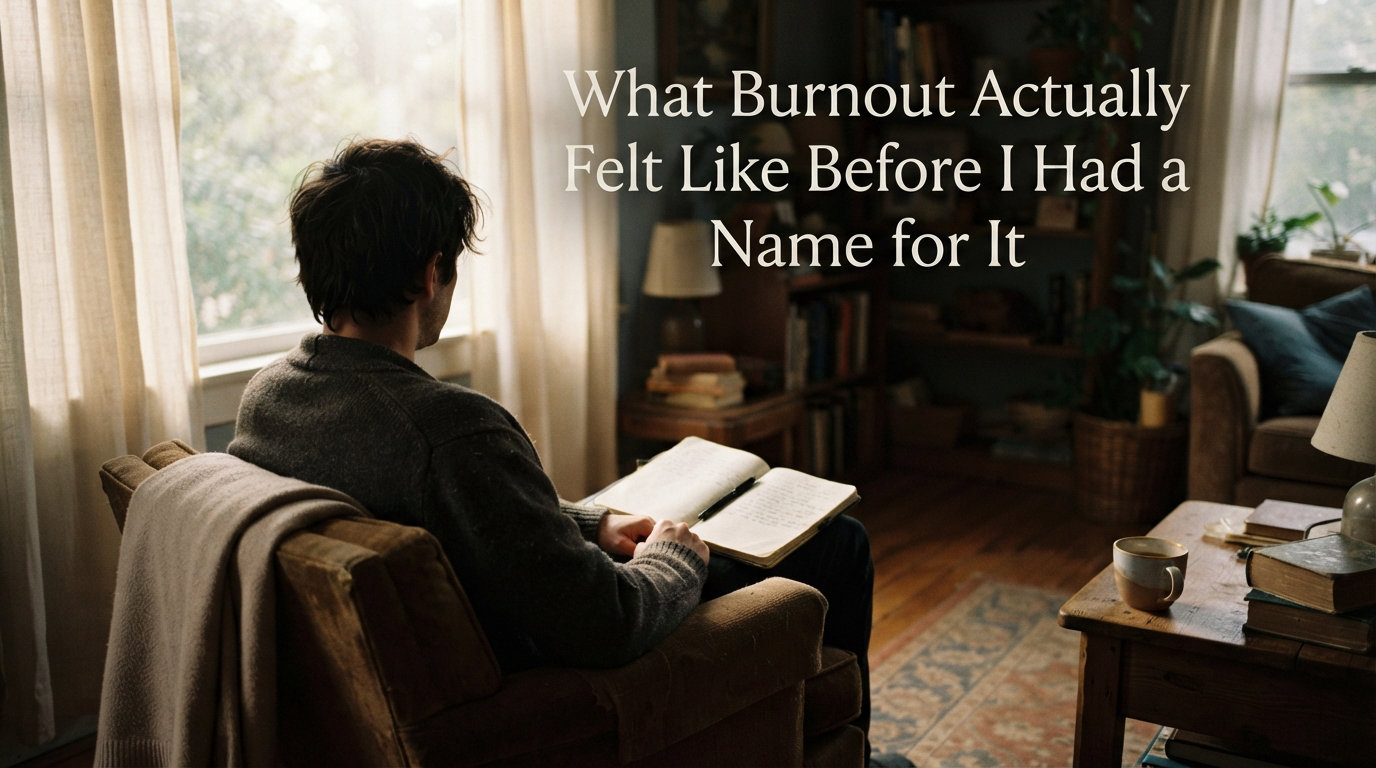
I remember standing at the kitchen counter one Tuesday, holding a mug of coffee that had gone cold in my hand, and thinking, something is wrong with me.
I had slept nine hours the night before. I had eaten breakfast. I had no reason to feel as though I had been emptied out from the inside.
And yet there I was, staring at the toaster, unable to remember why I had walked into the room.
That moment came years before I had a name for what burnout actually felt like. Before I knew the word, before anyone said it to me, before I gave myself permission to use it. This is the story of that in-between space, when something was clearly happening and I had no map for it.
If you are here because something feels off and you cannot name it, I wrote this for you.
Table of Contents
The Confusion Came Before the Word
The confusion came before I ever called it burnout.
For a long stretch, I thought I was simply tired. The kind of tired that an early night would fix, the kind that a weekend would cure, the kind that everyone my age seemed to be carrying around in their tote bags next to their water bottles.
But the tiredness never left. It just changed shape.
I was in my late thirties, running a business, raising kids, holding a marriage, trying to be the friend who always showed up. I said yes to most things. I was proud of how much I could carry. I wore my busyness like a soft scarf, draped loosely, never too tight.
What I did not see then was that I had stopped sleeping deeply years earlier. My body had quietly downshifted into a kind of survival mode, and I had mistaken the hum of that survival mode for personality.
I was the woman who pushed through. I was the one who answered emails at midnight. I was the one who planned the trip, ran the meeting, and remembered everyone’s birthdays. I thought this was strength. It was not strength. It was the early warning system of burnout, and I was ignoring every single signal.
What I called it instead
I called it a lot of things before I called it burnout.
I called it being out of shape. I called it a busy season. I called it perimenopause. I called it low iron. I called it a long winter.
Each label gave me a small story I could live inside, a tidy little box I could put my exhaustion into. None of those boxes held the thing for very long.
Looking back, the labels were a kind of protection. As long as it was just tiredness, it had an easy fix. As long as it was hormones, it was normal. As long as it was stress, I could muscle through. The minute I gave it a real name, I would have to do something about it, and I was not ready to do something about it.
What Burnout Actually Felt Like in My Body
What burnout actually felt like, in my body, was a heaviness I had never felt before.
It was not the heaviness after a long hike or a hard workout. It was a heaviness that lived underneath my muscles, in the places you cannot stretch. My legs felt like wet sand when I climbed the stairs. My arms felt too heavy to lift my own hair into a ponytail.
And yet I could not rest.
That was the part I could not explain to anyone. I was exhausted in a way that made sleep feel impossible. I would lie in bed at night with a body begging for rest and a brain that would not stop running inventory.
Emails I had not answered. Conversations I had replayed. A grocery list I had forgotten. A small, sour dread that sat behind my sternum like a stone I could not cough up.
Here is what burnout physically felt like for me, before I had a name for it:
Exhaustion that sleep never fixed. I could sleep ten hours and wake up feeling like I had been hit by a quiet truck.
A body that felt both wired and tired. Adrenaline without anywhere to go. Restless but depleted.
Recurring headaches and a tight jaw. I clenched my teeth in my sleep for the first time in my life.
A gut that was always off. Bloating, nausea, a low hum of digestive discomfort that no test could explain.
Getting sick more often. Colds that lingered, a sinus infection that came back twice, a slow leak of immunity.
A racing heart for no reason. Sitting in a parked car, suddenly feeling like I had just sprinted.
These were not the symptoms of a dramatic collapse. That is what I want to be clear about. I did not faint in a boardroom. I did not end up in the emergency room. My burnout crept in like a tide, not like a wave.
And because it was slow, it was easy to miss.
The Emotional Fog I Couldn’t Name
The emotional fog was even harder to name than the physical one.
I had always been a person with feelings I could find. Happy, sad, frustrated, excited. They were usually waiting for me, organized on a shelf I could reach.
But somewhere in those years, the shelf went blank.
I remember opening a gift at my own birthday and feeling nothing. Not polite-nothing. Not grateful-with-reservation. Genuinely nothing, like the feeling part of my brain had been quietly unplugged.
I cried at commercials. I felt irritated by the sound of my own family laughing. I would get into the car after dropping the kids off and just sit there for ten minutes, unable to remember which direction to drive.
Here is what the emotional side of burnout felt like before I knew it had a name:
A flat, grey numbness. Not sadness exactly. Just a low hum of nothing.
Dread about ordinary things. Sunday evenings felt like the night before a funeral.
Cynicism toward work I used to love. A slow, creeping contempt I did not recognize in myself.
Withdrawal from people I cared about. Cancelling plans, then feeling relieved, then feeling worse.
A sense of performing my life rather than living it. Smiling on cue. Asking the right questions. Going through the motions.
Forgetfulness and brain fog. Losing words mid-sentence, walking into rooms without knowing why.
I called this being depleted. I called this being introverted. I called this the cost of being a grown-up.
I did not call it burnout, because burnout was something that happened to other people. Burnout was the colleague who cried in the parking lot. Burnout was the friend who took a medical leave. Burnout was not me, driving home from the school pickup, blinker on, numb as a stone.
That was my first mistake. I had a picture of what burnout was supposed to look like, and I did not match it.
The Moment I Finally Saw It
The moment I finally saw it was not dramatic either.
It was a Tuesday morning, of course it was. I was sitting at my desk, a to-do list in front of me, a warm mug beside me, and I realized I did not care if I ever sent another email again.
Not in a rebellious way. Not in a burn-my-laptop way. In a quiet, eerie, almost surprised way. I looked at the list, and there was simply no person inside me who wanted to do any of it.
I closed the laptop. I put on shoes. I drove to a park I had not been to in years, and I sat on a bench for an hour and a half doing absolutely nothing.
And in that nothing, a small, clear thought arrived.
You have not been tired for a long time. You have been burned out.
It was the first time the word felt real to me. It was the first time I had given myself permission to use a word that big for what was happening inside my own life.
I had been waiting, I realize now, for some dramatic event to give me permission. A breakdown, a diagnosis, a friend to point at me with concern. None of those came. What came was a quiet bench, an empty afternoon, and a voice inside me that finally got loud enough to be heard.
Why it took so long to recognize
Looking back, I understand why it took so long to name my burnout.
I was raised, like many of us, on the gospel of pushing through. The belief that rest is something you earn, that struggle is a sign of virtue, that the body is a tool you can override with enough coffee and discipline.
I was also a high achiever by identity, not just by habit. My self-image had quietly fused to my productivity. If I could not do all the things, who was I?
That identity crisis is, I think, the quiet reason so many of us do not name our burnout when it first shows up. Admitting burnout feels like admitting we are not the person we thought we were. And for some of us, that is scarier than the exhaustion itself.
If Any of This Sounds Familiar, You Are Not Alone
If any of this sounds familiar, you are not alone in this.
I have heard versions of this story from hundreds of women in my office, in my DMs, in the back pews of conferences. The details change. The age, the job, the kids or no kids, the city, the bank account. The shape of the experience is almost identical.
A woman who still showed up to every meeting. A teacher who loved her students but could not remember why. A new mother who felt guilty for wanting a single hour alone. A founder who could not explain why the business she built felt like a cage.
The slow, creeping kind of burnout rarely makes a good headline. It does not collapse dramatically. It does not announce itself. It just keeps adding weight, one invisible stone at a time, until you wake up and cannot remember what lightness felt like.
Here is the part I want to say out loud, in case no one has said it to you recently.
You are not lazy. You are not weak. You are not failing at being a grown-up.
Your body has been sending you a steady stream of polite letters for months, maybe years. The heaviness, the fog, the dread, the cancelled plans, the Sunday-night pit in your stomach. Those were not personality flaws. They were data.
You are allowed to listen to that data now.
What Burnout Before I Had a Name Taught Me
What burnout, before I had a name for it, taught me was this: not every important signal comes with flashing lights.
The lesson was not that I should have pushed harder, or rested sooner, or quit my job, or meditated more. The lesson was that I had been asking the wrong question. I had been asking how do I get through this, when I should have been asking what is this trying to tell me.
It taught me that exhaustion is information. That numbness is information. That dread on a Sunday night is information.
It taught me that I did not have to match a dramatic story to give myself permission to slow down. Quiet burnout is still burnout.
And it taught me that having a name for something is its own kind of relief. The relief is not in the label. The relief is in the recognition. The relief is in suddenly knowing that there are other people who have felt this exact heaviness in this exact chest and have come out the other side of it.
If you are in the fog right now, I want you to know that the fog lifts. Not all at once. Not on a schedule. But it does lift.
And you do not have to wait until you collapse to start taking yourself seriously.
FAQs
What does burnout actually feel like?
Burnout feels like a heaviness that sleep cannot fix, a wired-but-tired body, a foggy brain, emotional numbness, and a low dread about ordinary things. It is quieter than most people expect, and it often creeps in rather than crashes down.
How do you know if you are nearing burnout?
You are nearing burnout if rest no longer feels restful, if you dread Sundays, if you feel cynical about work you once loved, if you are withdrawing from people you care about, or if you feel like you are performing your life rather than living it. Persistent exhaustion that sleep does not fix is one of the earliest signals.
What is the first stage of burnout?
The first stage of burnout is usually chronic exhaustion that does not improve with rest, combined with a growing sense of detachment from the work or people that used to energize you. It shows up as irritability, dread, brain fog, and a quiet loss of enthusiasm long before any dramatic collapse.
How do you get out of burnout?
Getting out of burnout usually requires slowing down long enough to hear what your body and emotions have been trying to say. That often means rest, boundaries, support, and giving yourself permission to do less. Recovery is rarely fast, and there is no single method that works for everyone.
Why did I not recognize my burnout sooner?
Most people do not recognize their burnout sooner because they expect burnout to look dramatic, when it usually arrives as a slow, creeping heaviness. Many high-achievers also confuse pushing through with strength, and quietly fuse their identity to their productivity, which makes slowing down feel impossible.