
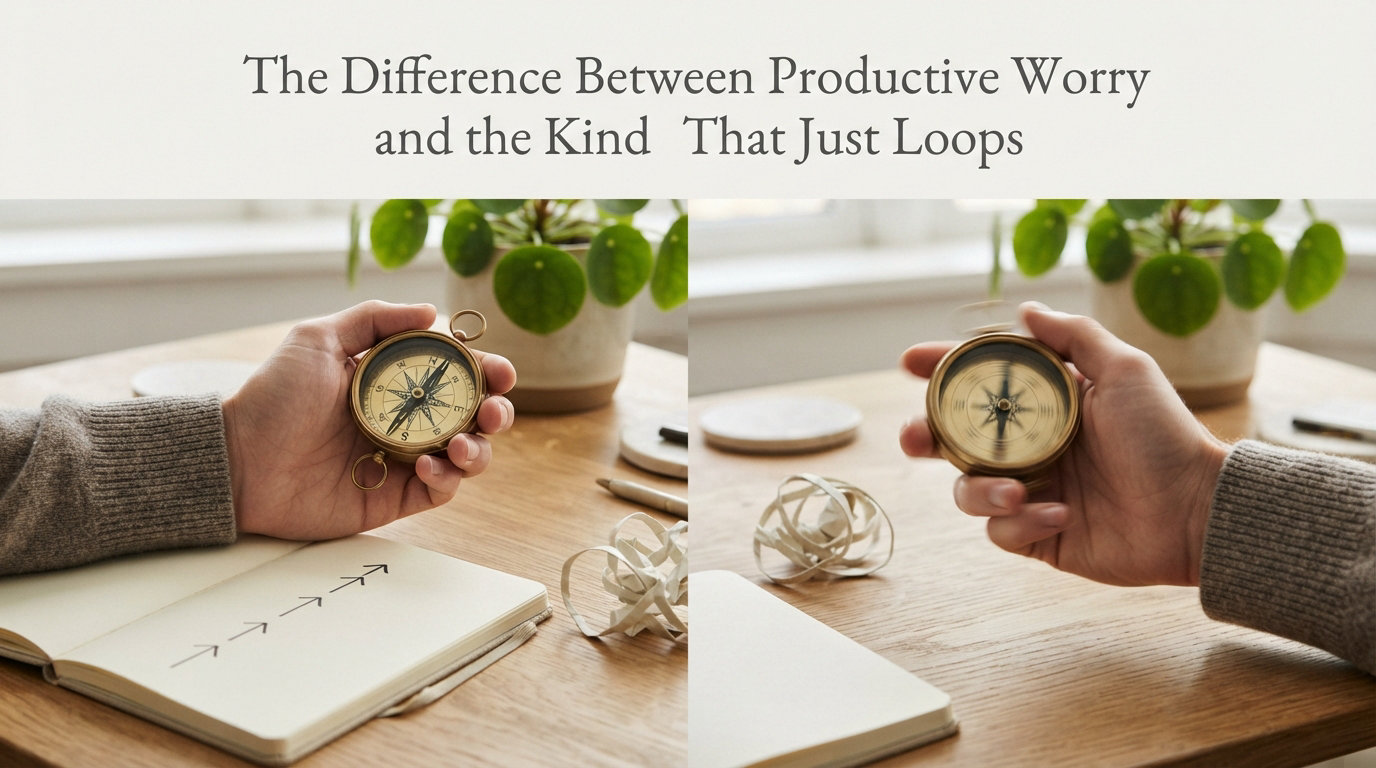
If you have ever spent an hour worrying about a problem and walked away feeling like you accomplished something, only to realize nothing actually changed, you are not alone. I have been there more times than I can count. The frustration of feeling like your mental effort produced zero results is one of the most common experiences people bring to coaching.
Here is the truth most people miss: not all worry is the same. Understanding the difference between productive worry vs. unproductive worry changes everything about how you handle anxiety. Productive worry moves you toward action and resolution. Unproductive worry spins in circles, draining your energy without ever reaching a conclusion.
In this guide, I will walk you through exactly how to tell which type of worry you are dealing with in any given moment. You will learn the one sorting question that separates helpful concern from an endless loop, why your brain gets stuck repeating the same anxious thoughts, and seven practical strategies to break free when worry has you trapped. I will also cover when worry is signaling that it is time to seek professional support.
By the end, you will have a clear mental framework you can use the next time your mind starts spinning. No more lying awake wondering whether your worry is doing anything useful.
Table of Contents
What Is Productive Worry? (And Why It Actually Helps)
Productive worry is a focused, time-limited form of concern that leads to a specific action you can take today. It narrows your attention to a real problem, triggers problem-solving, and then stops once you have a plan. Think of it as your brain’s early warning system working exactly as it should.
The key word is actionable. Productive worry always points toward something you can do. It does not spiral into hypothetical futures or catastrophize about outcomes you cannot control. It identifies a threat, motivates you to prepare, and quiets down once you have taken steps.
Here are three concrete examples of what productive worry looks like in everyday life:
You worry about an upcoming presentation. So you spend 30 minutes outlining your slides, practice once out loud, and pick your outfit the night before. The worry drove preparation, then faded.
You notice a persistent symptom and worry about your health. So you call your doctor, schedule an appointment, and write down your questions. The worry prompted a specific, time-bound action.
You worry about an unexpected bill. So you sit down, review your budget, identify two expenses to cut, and set up a payment plan. The worry channeled into a concrete financial response.
Notice the pattern. In each case, the worry had a clear beginning, pointed to something you could actually do, and ended once you acted. That is what makes it productive. It serves a function, performs that function, and then steps aside.
Research on constructive worry shows that this type of concern actually improves performance and outcomes. People who worry productively about presentations tend to prepare better. People who worry productively about their health tend to catch problems earlier. The worry is working for them, not against them.
What Is Unproductive Worry? (The Kind That Just Loops)
Unproductive worry is a repetitive, generalized form of concern that cycles through your mind without leading to resolution or action. It feels like thinking, but it never produces a decision. Instead of narrowing toward a solution, it expands outward, pulling in more scenarios, more what-ifs, and more catastrophic possibilities.
This is the kind of worry that just loops. You revisit the same concern 20 times and feel no closer to an answer. Each cycle adds a new layer of anxiety without adding any new information. The worry feeds on itself, growing louder and more insistent even as it accomplishes nothing.
Here are three examples of what unproductive worry looks like:
You worry about getting sick while traveling next month. You cannot control whether you catch a virus three weeks from now, but you spend hours imagining the worst scenarios. No action is taken because no action is available. The loop continues.
You replay a conversation from yesterday, worried you said something wrong. The conversation is over. You cannot change it. But your mind rehashes every word, searching for evidence of a mistake you cannot undo.
You worry about the economy, climate change, or global events. These are real concerns, but they are too large and too distant for any individual action to resolve. The worry cycles endlessly because there is no endpoint.
The hallmark of unproductive worry is that it feels urgent but offers no path forward. It demands your attention like a fire alarm that will not stop ringing, even after you have checked every room and confirmed there is no fire.
People in anxiety support communities describe this experience vividly. They talk about feeling “trapped” in a worry loop, spending hours in mental effort that produces no resolution. One of the most common refrains is that worrying feels productive but is not actually helping. That gap between the feeling of doing something and the reality of doing nothing is what makes unproductive worry so exhausting.
The Sorting Question: Can I Do Something About This Today?
The single most powerful tool for distinguishing productive worry vs. unproductive worry is one question: “Can I do something about this today?”
If the answer is yes, your worry is pointing toward action. Write down the specific step you can take, take it, and let the worry go. If the answer is no, your worry is unproductive in this moment. No amount of mental cycling will change the outcome.
Here is how to use this sorting question as a simple three-step process:
Step 1: Name the worry. Say it out loud or write it down. “I am worried about my friend being angry at me.”
Step 2: Ask the sorting question. “Can I do something about this today?” Be honest. If you can call your friend and ask, the answer is yes. If you already left a message and are waiting for a reply, the answer is no, not right now.
Step 3: Act or release. If yes, identify one specific action and do it. If no, acknowledge that the worry cannot help you today and redirect your attention. You can revisit the concern tomorrow if circumstances change.
This framework is simple, but it works because it forces a decision. Worry thrives on vagueness and open-endedness. The sorting question cuts through that vagueness with a clear yes or no. There is no middle ground where worry gets to keep spinning.
I have used this question with dozens of clients, and the most common reaction is surprise at how quickly it works. People who have been caught in a worry loop for hours often resolve it in under a minute once they apply the sorting question honestly.
Productive Worry vs. Unproductive Worry: Side-by-Side Comparison
Sometimes seeing the differences laid out clearly makes the distinction click. Here is a direct comparison of the two types of worry across their most important characteristics.
| Characteristic | Productive Worry | Unproductive Worry |
|---|---|---|
| Focus | Specific and concrete | Generalized and vague |
| Time Orientation | Present-centered on “what is” | Future-focused on “what if” |
| Outcome | Leads to a plan or action | Leads to more worry |
| Duration | Time-limited, ends with action | Open-ended, cycles endlessly |
| Control | Focuses on what you can control | Fixates on what you cannot |
| Feeling Afterward | Relief, clarity, readiness | Exhaustion, more anxiety, no resolution |
| Direction | Moves toward a solution | Moves in circles |
If you scan the left column and find your current worry matches more items on the right than the left, you are in an unproductive loop. That is not a character flaw or a sign of weakness. It is a pattern your brain fell into, and patterns can be changed.
Why Worry Becomes a Loop (and Will Not Let Go)
Understanding why your brain gets stuck changes how you relate to the experience. Worry loops are not a personal failing. They are the result of a well-documented neurological pattern called the habit loop.
Every habit loop has three parts: a trigger, a behavior, and a reward. With worry, the trigger is usually an uncertain or threatening situation. The behavior is the repetitive thinking itself. And the reward is deceptively subtle. Your brain interprets the mental effort as “doing something” about the threat, which provides a brief sense of control or preparedness.
That tiny reward is what keeps the loop running. Even though the worry does not solve anything, the brain gets just enough of a payoff to repeat the behavior. Over time, the neural pathway gets stronger, and the worry loop becomes the default response to stress. This is the same mechanism behind any habit, from nail-biting to scrolling your phone.
The brain region most involved here is the default mode network, specifically an area called the posterior cingulate cortex. When this network is overactive, your mind tends to loop on self-referential, repetitive thoughts. Research by neuroscientists including Dr. Judson Brewer has shown that people with chronic anxiety show heightened activity in this region. The more you worry, the more this pathway strengthens, and the harder it becomes to stop.
It is also important to distinguish worry from rumination, since the two often overlap but move in different directions. Worry is repetitive negative thinking about future threats. It asks “what if?” and projects into scenarios that have not happened. Rumination is repetitive negative thinking about past events. It asks “why did this happen?” and replays situations you cannot change.
Both operate on the same underlying habit loop mechanism, but worry faces forward while rumination looks backward. Many people do both, caught between regretting the past and fearing the future, with no attention left for the present moment.
Then there is meta-worry, which is worry about worrying. You start feeling anxious about the fact that you cannot stop worrying. Maybe you tell yourself that all this worry is damaging your health, or that something is wrong with you for not being able to let it go. Meta-worry creates a double loop, where the worry about worry triggers more worry, which triggers more meta-worry. It is exhausting and it is incredibly common.
The good news is that because worry loops are habits, they can be interrupted and replaced. The same neuroplasticity that built the loop can build a new one. That is what the strategies in the next section are designed to do.
7 Signs Your Worry Has Crossed Into Unproductive Territory
Sometimes you know immediately that your worry is looping. Other times, the shift happens gradually, and you do not realize you are stuck until you have been spinning for an hour. Here are seven clear signs that your worry has crossed the line from productive to unproductive:
You have had the same worry before with no new information. If you are thinking the same thought for the fifth time and have not learned anything new since the first time, you are looping.
You cannot identify a specific action that would help. When you try to name the next step and draw a blank, the worry is not pointing toward a solution.
The worry expands rather than narrows. Productive worry focuses. Unproductive worry multiplies, pulling in new scenarios and cascading into a full what-if spiral.
You feel worse, not better, after thinking about it. Productive worry ends with relief or a plan. Unproductive worry ends with more tension and no clarity.
The worry is about something outside your control. If you cannot influence the outcome through any action available to you, the worry is spinning in place.
It is interfering with sleep, work, or relationships. When worry starts costing you function in daily life, it has moved beyond the productive range.
You are worrying about your worry. Meta-worry is a strong signal that the original concern has become an unproductive loop feeding on itself.
If you nodded along to three or more of these, your worry is likely stuck in a loop. The strategies below will help you break it.
Breaking the Loop: 7 Practical Strategies That Actually Work
You do not have to just live with worry loops. The following strategies are drawn from cognitive behavioral therapy, mindfulness-based approaches, and real-world techniques that people in anxiety communities report as genuinely helpful. Try several and keep the ones that work for you.
1. Use the 3-3-3 Rule for Immediate Grounding
The 3-3-3 rule is a simple grounding technique that interrupts the worry loop by pulling your attention into the present moment. Name three things you can see, three sounds you can hear, and move three parts of your body. That is it.
This works because worry lives in the future, in hypothetical scenarios that have not occurred. Grounding forces your brain into the present, where those future threats do not exist. The physical movement component, even something as small as wiggling your toes, engages your body and breaks the mental pattern. Many people find this technique especially helpful for stopping a worry spiral in the moment, before it builds momentum.
2. Try the 6:30 PM Worry Rule
The 6:30 PM rule is a structured approach to containing worry rather than fighting it. Pick a specific time, such as 6:30 PM, and designate it as your official worry window. For 15 minutes, you write down every worry on your mind. When the window closes, you close the notebook and move on with your evening.
If a worry surfaces outside the window, you acknowledge it and tell yourself you will address it at 6:30 PM tomorrow. This works because it does not demand that you stop worrying, which often backfires. Instead, it gives worry a designated place and time, preventing it from spilling into every hour of your day. Over time, many people find their worries become less urgent when they know they will be heard at the scheduled time.
3. Write It Down and Sort It
Get a piece of paper and write your worry at the top. Then apply the sorting question: “Can I do something about this today?” Draw two columns. In the left column, list every action you could take. In the right column, list everything about this situation that is outside your control.
This exercise makes the distinction concrete. When you see your uncontrollable factors written down, it becomes easier to release them. And when you see your actionable items, you can pick one and do it. Many of my clients are surprised by how short the action column is compared to the control column when they actually write it out.
4. Name the Loop to Break It
When you catch yourself in a worry spiral, say to yourself, “This is a worry loop.” Not “I am worried about X” but specifically, “My brain is running a worry loop right now.” This labeling technique comes from mindfulness research and has been shown to reduce activity in the amygdala, the brain’s alarm center.
By naming the pattern rather than engaging with its content, you step outside it. You are no longer inside the worry. You are observing it. That shift in perspective, even for a few seconds, can be enough to break the loop’s momentum and give you space to redirect your attention.
5. Schedule a Physical Pattern Interrupt
Physical movement is one of the fastest ways to interrupt a mental loop. When worry has you stuck, do something that engages your body fully. Take a brisk 10-minute walk. Do 20 jumping jacks. Splash cold water on your face. Hold an ice cube for 30 seconds.
The intensity of the physical sensation forces your brain to shift resources away from the default mode network, where worry loops live, and toward processing the immediate sensory input. This is not avoidance. It is a reset. Once the loop is broken, you can return to the concern with a clearer mind and decide whether any productive action is available.
6. Replace the Loop With a Bigger, Better Offer
Dr. Judson Brewer’s research on habit change emphasizes that you cannot simply delete a habit. You have to replace it with something more rewarding. The worry loop persists because it offers a small payoff, the illusion of control. To replace it, you need what Brewer calls a “bigger, better offer.”
Curiosity is one of the best replacements. When you catch yourself worrying, shift to genuine curiosity about the present moment. What does your body feel like right now? What sounds are in the room? Curiosity feels good, it is inherently rewarding, and it naturally pulls your attention to the present. Over time, the brain learns that curiosity feels better than worry, and the habit begins to shift.
7. Address Morning Rumination Specifically
Morning rumination is one of the most common and least addressed forms of unproductive worry. You wake up, and before you are even out of bed, your mind starts replaying yesterday’s mistakes or projecting today’s anxieties. Forum communities are full of people asking how to stop this pattern.
The most effective approach is to have a morning routine that engages your attention immediately. Do not lie in bed once you are awake, because the worry loop thrives in that half-awake, unstructured space. Get up within five minutes. Do something that requires focus: a brief workout, a guided meditation, reading something engaging, or writing down three things you are looking forward to today. The goal is to give your brain something to do before the worry loop has a chance to start running.
When Worry Is Telling You to Get Professional Help
Worry becomes a clinical concern when it is persistent, intense, and interfering with your daily functioning. If you have been experiencing excessive worry most days for six months or more, and it is affecting your sleep, work, relationships, or physical health, it may be time to talk to a professional.
This is especially relevant if your worry feels uncontrollable, if it spans many different areas of your life rather than focusing on one specific concern, or if you are experiencing physical symptoms like muscle tension, fatigue, irritability, or difficulty concentrating. These are common signs of generalized anxiety disorder, a condition that responds well to treatment.
Reaching out for help is not a sign that you have failed to manage your worry on your own. It is a sign that you recognize worry is running a loop your willpower alone cannot break. Therapists trained in cognitive behavioral therapy can help you identify and change the thought patterns driving chronic worry, often in a relatively short period of time. You deserve support, and effective help is available.
FAQs
What are looping thoughts a symptom of?
Looping thoughts, also called perseverative thinking, are a common symptom of anxiety disorders, generalized anxiety disorder, obsessive-compulsive disorder, depression, and chronic stress. They can also occur during periods of acute stress or after a traumatic experience. Looping thoughts are essentially the worry habit loop running on repeat. While everyone experiences occasional looping thoughts, persistent and distressing loops that interfere with daily life may signal an underlying condition worth discussing with a mental health professional.
What is the difference between worry and rumination?
Worry is repetitive negative thinking about future threats. It asks ‘what if?’ and projects into hypothetical scenarios that have not happened yet. Rumination is repetitive negative thinking about past events. It asks ‘why did this happen?’ and replays situations you cannot change. Both run on the same underlying habit loop in the brain, but worry faces forward while rumination looks backward. Many people experience both simultaneously.
What is the 3-3-3 rule of anxiety?
The 3-3-3 rule is a grounding technique for interrupting anxiety and worry loops. You name three things you can see, identify three sounds you can hear, and move three parts of your body. This pulls your attention out of future-focused worry and into the present moment, engaging your senses and body to break the mental spiral. It takes under a minute and can be done anywhere.
What is the 6:30 PM rule to stop worrying?
The 6:30 PM rule involves scheduling a fixed 15-minute window each day as your designated worry time. During this window, you write down every worry on your mind. Outside the window, when a worry surfaces, you acknowledge it and tell yourself you will address it at the next scheduled time. This contains worry to a specific time and place rather than letting it spread throughout your day.
How do I stop ruminating past mistakes?
To stop ruminating on past mistakes, first recognize that rumination is a habit loop, not a productive thinking process. Then use pattern interrupts: name the loop by saying ‘I am ruminating,’ shift to a physical activity, or practice the 3-3-3 grounding rule. Ask yourself what you learned from the mistake and whether there is any action you can take today to make amends or do better next time. If the answer is no further action, practice self-compassion and redirect your attention to the present.
Conclusion: Your Worry Can Work for You
The difference between productive worry vs. unproductive worry comes down to one question: can you do something about it today? Productive worry answers yes, points you toward action, and then steps aside. Unproductive worry answers no but refuses to leave, looping endlessly through scenarios you cannot control.
Your next step is simple. The next time you notice yourself worrying, pause and ask the sorting question. If you can act, act. If you cannot, try one of the seven strategies above to break the loop. You do not have to fight worry. You just have to learn when it is helping and when it is spinning.
Worry is a habit, and habits can change. Start with one technique this week and see what shifts. You might be surprised how quickly your mind responds when you give it a better option.