
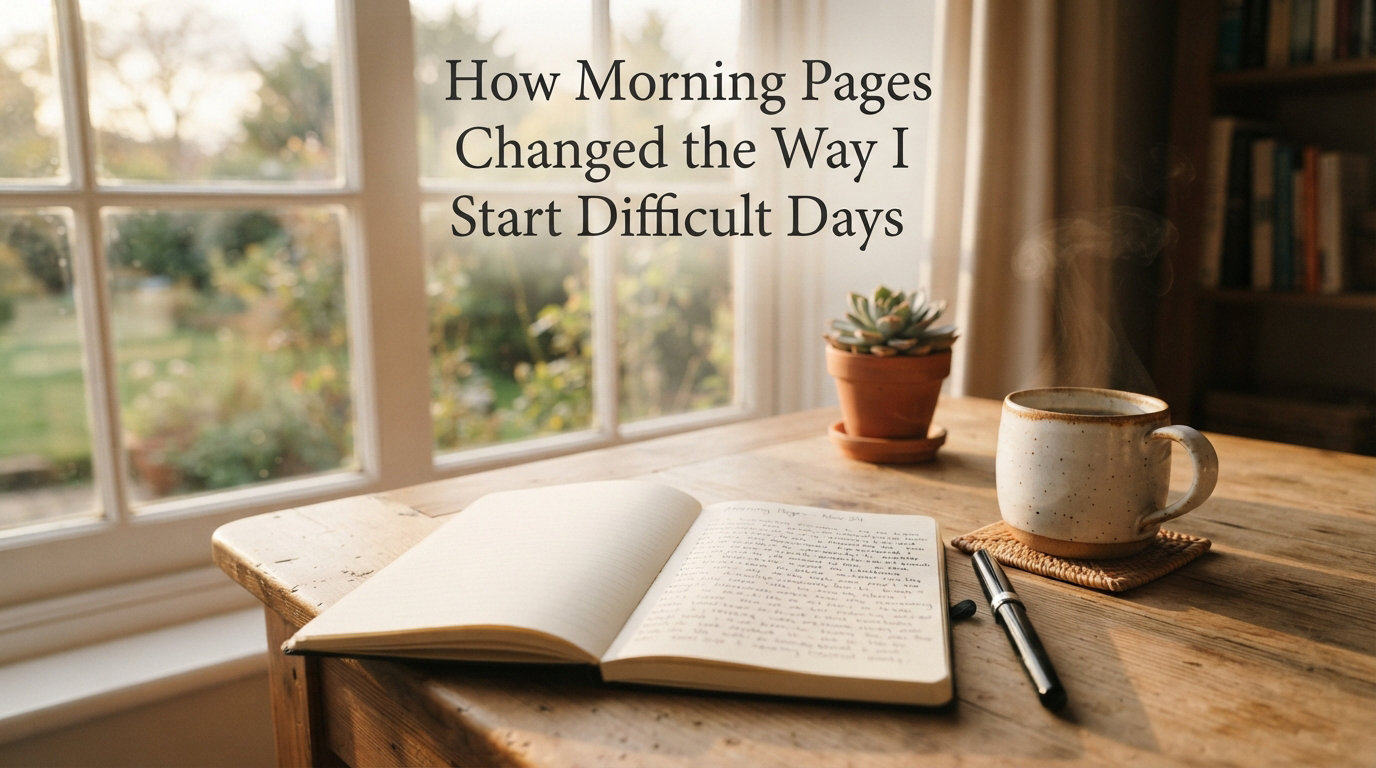
Some mornings hit harder than others. You wake up with a weight on your chest before your feet even touch the floor. Maybe it’s a conversation you’re dreading, a deadline that feels impossible, or just a low-grade anxiety you can’t quite name.
I used to start those days the same way most people do. I’d grab my phone, scroll through notifications, and let the outside world flood in before I’d even had a sip of water. By the time I was dressed, my mind was already racing with everyone else’s priorities.
Then I discovered Morning Pages, and everything about how I handle difficult days shifted. Not overnight. Not magically. But in a way that actually stuck.
In this article, I’ll walk you through what Morning Pages are, how they changed my relationship with hard mornings, and how you can use them to face difficult days with more clarity and less dread.
Table of Contents
What Are Morning Pages?
Morning Pages are three pages of longhand, stream-of-consciousness writing done first thing each morning. You write whatever comes to mind without filtering, editing, or judging it.
The practice comes from Julia Cameron’s book The Artist’s Way, first published in 1992. Cameron designed Morning Pages as a daily tool for creative recovery, but the benefits extend far beyond creativity.
The concept is simple. You fill three standard letter-size pages with whatever is in your head when you wake up. Worries, dreams you half-remember, complaints about your alarm clock, fragments of songs stuck in your brain. All of it goes on the page.
There’s no structure. No prompts. No goal other than getting the thoughts out of your skull and onto paper. Cameron calls this a “brain dump,” and that’s exactly what it feels like.
What makes Morning Pages different from regular journaling is the absence of reflection. You’re not analyzing your feelings or documenting your day. You’re simply clearing the mental clutter before your day begins.
My Transformation: Before and After Morning Pages
I’ll be honest. When a friend first told me about Morning Pages, I was skeptical. I wasn’t a writer. I didn’t keep a diary as a kid. The idea of filling three pages every single morning sounded tedious and pretentious.
But I was also desperate. I’d been going through a stretch where difficult mornings were becoming the norm. Work stress had bled into my personal life. I’d wake up already behind, already anxious, already bracing for impact.
My mornings looked like chaos. I’d hit snooze three times, check my email in bed, and immediately feel my stomach clench at whatever had landed in my inbox overnight. I was reactive from the moment I opened my eyes.
The First Week Was Awful
I started Morning Pages on a Monday in 2026, and I almost quit by Wednesday. Sitting down with a blank notebook felt confrontational. The silence made my anxiety louder, not quieter.
On day one, I wrote the same sentence fifteen times: “I don’t know what to write.” On day two, I filled two pages complaining about my job. On day three, I wrote about a dream I’d had and how it reminded me of something I’d been avoiding.
By day four, something shifted. I noticed I’d been carrying a specific worry for days without ever naming it. Writing it down didn’t fix the problem, but it stopped running in the background like a program draining my battery.
What Changed After a Month
After about four weeks, I noticed a pattern. On mornings when I did my pages, I felt more grounded before I started my day. Not happy, necessarily. But steady.
The biggest change was how I handled the first stressful moment of the day. Before Morning Pages, a difficult email could derail my entire morning. After I’d been writing for a month, I could read the same email and think, “Okay, I’ll deal with that at ten.”
That gap between feeling something and reacting to it was new. Morning Pages hadn’t made my problems disappear. They’d given me a buffer.
The Difficult Day That Convinced Me
I remember the specific morning that sold me on the practice. I had a meeting that day I’d been dreading for two weeks. I was certain it would go badly.
I sat down with my notebook and wrote furiously for three pages. I wrote out every worst-case scenario. I wrote the things I was afraid to say out loud. I wrote about how small and unprepared I felt.
When I closed the notebook, something had changed. The fear was still there, but it had lost its grip. I’d already lived through the worst version of the morning on paper. The actual meeting felt almost anticlimactic by comparison.
That’s when I understood what Morning Pages could do for difficult days. They weren’t about positivity or gratitude. They were about giving your fears a place to land before they could hijack your day.
How Morning Pages Help on Difficult Days
Morning Pages work differently on hard days than on ordinary ones. When everything is fine, the pages clear mental cobwebs and boost creativity. When you’re facing something genuinely difficult, they become a tool for emotional regulation.
They Get You to Neutral
One of the most common things I hear from people who practice Morning Pages is that the pages help them reach a neutral starting point. You don’t need to feel great. You just need to not feel like you’re drowning.
Writing three pages of raw thought moves you from overwhelmed to functional. It’s like opening a pressure valve. The anxiety doesn’t vanish, but it drops from a roar to something you can actually work with.
They Surface What’s Actually Bothering You
On difficult mornings, you often feel terrible without knowing exactly why. There’s a general dread, a heaviness, a sense that something is wrong. But the specifics stay buried.
Morning Pages have a way of excavating those specifics. When you write without filtering, the real concern almost always surfaces. You might start writing about traffic and end up on a conversation from three days ago that’s been eating at you.
Once the actual problem is on paper, you can deal with it. While it stays buried, it controls you.
What to Do When Your Pages Feel Depressing
This is the concern I hear most often, and I want to address it directly because it’s real. Some mornings, your pages will be dark. You’ll write three pages of hopelessness, anger, or grief.
That can feel alarming. You might wonder if writing negative thoughts is reinforcing them.
Here’s what I’ve learned. Those dark pages are not a sign that Morning Pages are hurting you. They’re a sign that those thoughts were already there, running beneath the surface. Writing them down doesn’t create them. It reveals them.
If your pages feel overwhelmingly negative for several days in a row, that’s valuable information. It might be telling you something needs to change in your life, or that you’d benefit from talking to a therapist. Morning Pages don’t replace professional support. They can, however, help you notice when you need it.
One technique that helps on heavy days is what I call the “pivot.” After two pages of dumping everything difficult, use the third page to write one thing you can actually do today. Not a silver lining. Just one small action that’s within your control.
How to Start Morning Pages (Even If You’re Not a Morning Person)
The biggest barrier people face is the word “morning.” If you’re not a morning person, the idea of waking up early to write sounds like punishment.
Here’s the good news. The exact time matters less than the principle. Morning Pages work because they’re the first thing you do, not because they happen at dawn.
The Only Rules That Actually Matter
Here’s how to start, keeping it as simple as possible:
Step 1. Get a notebook and a pen. Nothing fancy required. A cheap spiral notebook and a ballpoint pen work perfectly. The goal is low friction.
Step 2. Write three pages by hand. Longhand matters here. Typing is faster, but the slower pace of handwriting is part of what makes the practice effective. It forces your brain to slow down to the speed of your pen.
Step 3. Do it first thing, whatever “first thing” means for you. Before email, before social media, before the news. If your first waking moment is 10 AM because you work nights, that’s your morning.
Step 4. Don’t reread. Don’t edit. Don’t judge what you wrote. Close the notebook and move on with your day.
Adapting the Practice If You Hate Mornings
If waking up fifteen minutes earlier feels impossible, try a different entry point. Some people do their pages with their morning coffee at the kitchen table. Others write during their commute on the train.
The key is to write before you’ve consumed other people’s words. Before you’ve read the news, checked social media, or opened your inbox. That window, whenever it falls in your day, is when the pages work best.
If three pages feels like too much, start with one. The three-page guideline is a target, not a law. What matters is that you show up and write something. Consistency beats volume every time.
One more tip for non-morning people. Write before you’re fully awake. Some of the most honest pages I’ve written happened when I was barely conscious. The inner critic, the part of you that judges and filters, hasn’t fully booted up yet. Take advantage of that.
What to Write in Your Morning Pages
The short answer is anything. The longer answer is that what comes out will surprise you.
On ordinary days, your pages might be mundane. Grocery lists, complaints about the weather, replaying a conversation from yesterday. That’s normal. The brain dump is doing its job even when the content feels boring.
On difficult days, your pages might get raw. You might write about fears, frustrations, and things you’d never say out loud. That’s where the real work happens.
If you get stuck and genuinely don’t know what to write, write that. “I don’t know what to write and this feels stupid” is a perfectly valid sentence to fill a page with. Often, the act of writing your resistance loosens something, and the real thoughts start flowing.
Don’t worry about being a good writer. Morning Pages are not for an audience. Nobody will ever read them, including you if you choose not to reread. This is the one space where you can be completely unfiltered, completely honest, and completely messy.
FAQs
What are Morning Pages and how do they work?
Morning Pages are three pages of longhand, stream-of-consciousness writing done first thing in the morning. You write continuously without stopping, editing, or judging what comes out. The goal is to empty your mind of whatever thoughts, worries, or mental clutter are present when you wake up, so you can start your day with a clearer head.
How do you write Morning Pages?
Sit down with a notebook and pen as soon as you wake up. Write three pages by hand without stopping, editing, or rereading. Write whatever comes to mind, even if it is repetitive or boring. Do not check your phone or email first. The practice takes about 20 to 30 minutes.
Why are Morning Pages important?
Morning Pages clear mental clutter, quiet the inner critic, reduce anxiety, and create space for clarity and creativity throughout the day. On difficult days specifically, they help you process heavy emotions before they hijack your morning, moving you from overwhelmed to functional.
What should you journal about in Morning Pages?
Write whatever is in your head. Worries, dreams, complaints, to-do lists, random thoughts, fears, or frustrations. There is no prompt and no right answer. If you do not know what to write, write that. The point is to dump everything onto the page without filtering.
Should you reread what you wrote in Morning Pages?
Julia Cameron recommends not rereading your pages for at least the first eight weeks. The purpose is to write freely without worrying about what you produced. Over time, some people do reread occasionally to spot patterns, but many choose never to. Rereading is optional and entirely up to you.
Final Thoughts
Morning Pages didn’t make my difficult days disappear. They gave me a way to face them without being swallowed by them first thing in the morning.
The practice works because it’s simple. Three pages, a pen, and whatever is in your head. No app, no subscription, no fifteen-step system. Just you and a blank page, clearing the debris before the day begins.
If you’re facing a difficult stretch right now, try it for one week. Grab any notebook you already own, set your alarm fifteen minutes earlier, and write three pages tomorrow morning. Don’t worry about doing it perfectly. Just write.
The version of you that starts the day with a clear mind handles hard things differently than the one who starts already overwhelmed. Morning Pages are how I found that out, and I think you might too.