
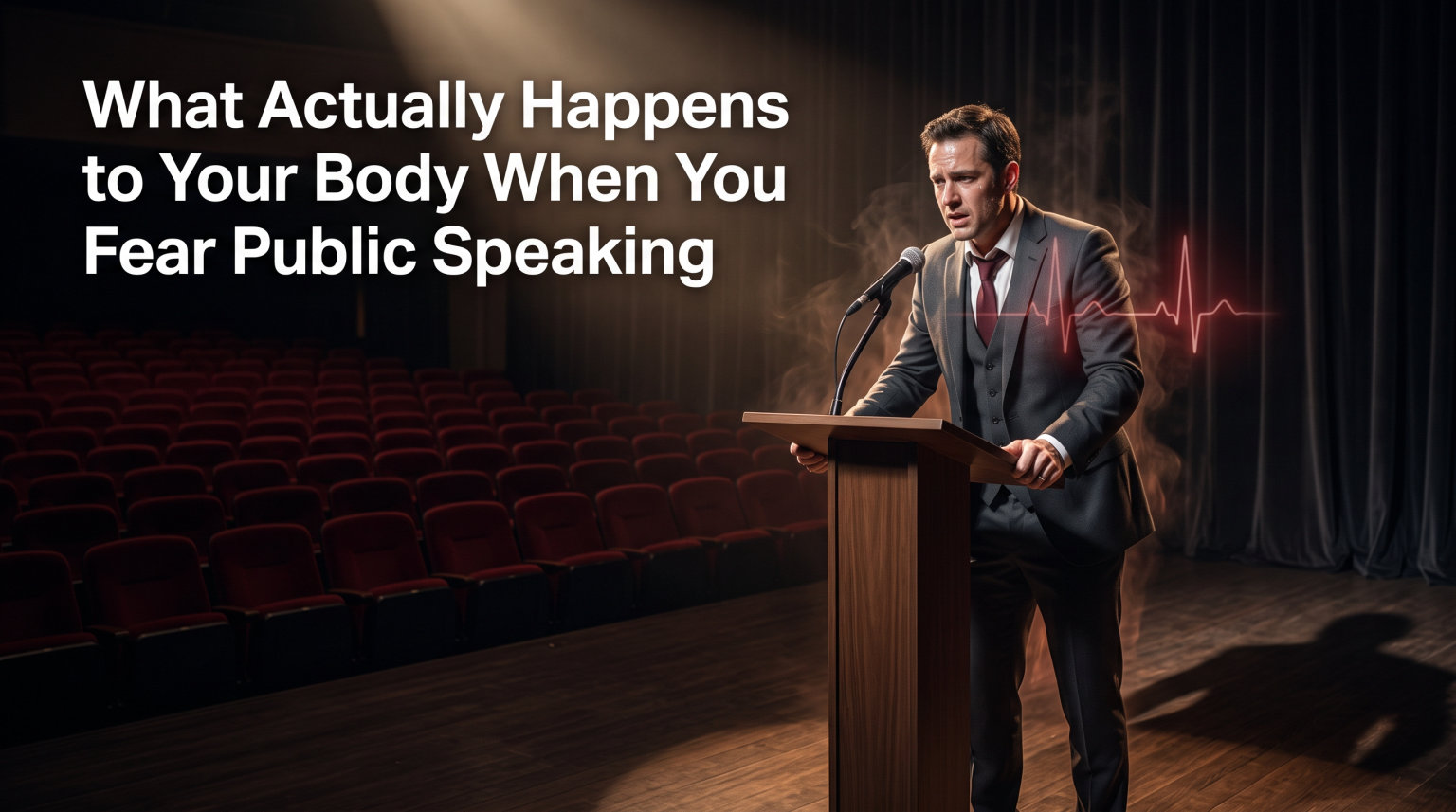
Your palms are sweating. Your heart is pounding so hard you can feel it in your throat. Your mouth goes dry, your voice shakes, and your mind goes completely blank the moment you stand up to speak.
If this sounds familiar, you are far from alone. Public speaking anxiety affects roughly 40% of the population, making it one of the most common fears people experience in their daily lives.
I have worked with many clients who describe the same cascade of physical symptoms before stepping on stage or into a meeting room. They want to understand what happens to your body when you fear public speaking, because understanding the biology behind the fear makes it far less terrifying and far more manageable.
In this guide, I will break down exactly what happens to your body when you fear public speaking, system by system. We will trace the response from the moment your brain perceives a threat to the minutes after you sit back down. I will also share practical techniques to calm your body before and during your next presentation.
This is current science explained simply, so you can stop fighting your body’s natural reactions and start working with them.
Table of Contents
What Happens to Your Body When You Fear Public Speaking: The Short Answer
When you fear public speaking, your brain perceives the audience as a threat and activates the fight-or-flight response. This causes your amygdala to signal your adrenal glands, flooding your body with adrenaline and cortisol. Your heart races, your breathing quickens, your muscles tense, your digestion slows, and your prefrontal cortex partially shuts down.
These reactions are not a sign of weakness. They are the exact same survival mechanisms that kept our ancestors alive when facing physical predators. Your body genuinely cannot tell the difference between a hungry lion and a room full of colleagues watching you present quarterly numbers.
Roughly 75% of people experience some level of speech anxiety, ranging from mild butterflies to debilitating panic. The good news is that every one of these physical responses is well understood, predictable, and manageable once you know what is driving them.
The Fight-or-Flight Response: Why Your Body Reacts to Public Speaking
Every physical symptom you feel before speaking traces back to one survival system: the fight-or-flight response.
When you stand up to speak, your brain assesses the situation and decides there is a potential threat. It does not matter that the threat is social rather than physical. The amygdala, a small almond-shaped structure deep in your brain, processes this perceived danger in milliseconds, well before your conscious mind can talk you out of it.
The amygdala immediately sends distress signals to your hypothalamus, which activates your sympathetic nervous system. This is the branch of your autonomic nervous system responsible for revving you up and preparing your body for action. Within seconds, nerve pathways signal your adrenal glands sitting atop your kidneys to release a surge of adrenaline, also called epinephrine, directly into your bloodstream.
This is an ancient evolutionary response. For our prehistoric ancestors, being judged or rejected by the group literally meant death, because a lone human could not survive alone in the wild. Your brain still treats social evaluation as a life-or-death situation, even though your next presentation carries no real physical danger.
Adrenaline hits fast, within two to three seconds. Cortisol, the secondary stress hormone, follows over the next several minutes to sustain the response as long as the perceived threat remains. Together, these hormones reshape how every system in your body operates for the duration of your speech.
How Each Body System Responds to Public Speaking Fear
Most explanations of stage fright stop at the surface level of feeling nervous. But what actually happens to your body when you fear public speaking is far more specific and measurable. Each major body system reacts in a predictable, documented way.
Your Cardiovascular System: Why Your Heart Races
Adrenaline forces your heart to pump faster and harder than normal. Your heart rate can jump from a resting 70 beats per minute to over 120 beats per minute in a matter of seconds. Your blood pressure rises as blood vessels constrict, pushing blood aggressively toward your large muscle groups to prepare you to fight or run.
This is why you feel your heart pounding in your chest, and sometimes in your throat or ears. Your body is deliberately prioritizing blood flow to your arms and legs over your digestive organs. The effect is powerful, and many people mistake it for a medical emergency the first time they experience it at full intensity.
Your Respiratory System: Why You Cannot Catch Your Breath
Your breathing becomes rapid and shallow as your bronchial tubes dilate to pull in more oxygen. This is your body preparing your muscles for intense physical exertion.
The problem is that you are standing still behind a podium, not sprinting from danger. Rapid, shallow breathing means you are taking in more oxygen than your body needs and blowing off too much carbon dioxide. This imbalance causes lightheadedness, tingling in your fingers and lips, and a suffocating feeling that you cannot get a full breath, even though your lungs are working perfectly fine.
This is one of the most frightening symptoms because it genuinely feels like suffocation. Simply understanding that your body is over-oxygenating can reduce the panic significantly.
Your Nervous and Endocrine Systems: Adrenaline and Cortisol at Work
Think of your sympathetic nervous system as the gas pedal and your parasympathetic nervous system as the brake. During public speaking fear, the gas pedal is pressed flat to the floor.
Adrenaline arrives first, within seconds. It sharpens your focus, dilates your pupils to take in more visual information, and triggers the sweating that so many speakers dread. Cortisol follows minutes later, keeping your blood sugar elevated and your tissues on high alert for sustained action.
The stress hormone cascade affects your brain directly. Elevated cortisol impairs the function of your hippocampus, the region responsible for memory formation and retrieval. It also suppresses your prefrontal cortex, responsible for logical thinking and language. This hormonal flood is the biological reason your thoughts get jumbled and your memory fails you mid-sentence.
Your Digestive System: Where Butterflies Come From
When fight-or-flight activates, your body diverts blood away from your digestive tract and redirects it toward your muscles. Digestion essentially shuts down on the spot.
This causes the sensation commonly called butterflies in your stomach. What you are actually feeling is reduced blood flow to your gut combined with increased stomach acid production. For some people this leads to nausea, a hollow pit sensation, or an urgent need to use the bathroom right before speaking.
Your salivary glands also slow their output dramatically, which is why your mouth goes dry and your voice cracks. Dry mouth is one of the most frustrating symptoms for speakers because it makes articulation difficult and draws attention to the very thing you are trying to hide.
Your Muscular System: Why You Shake and Tremble
Adrenaline primes every muscle in your body for explosive movement. But since you are standing relatively still, that prepared energy has nowhere to go. The result is involuntary trembling that you cannot simply will away.
Your hands shake. Your knees feel weak and unreliable. Your jaw may clench tightly. Your voice quivers because the small muscles controlling your vocal cords are also tense and over-stimulated. Some speakers notice their hands and legs visibly shaking, which creates a vicious cycle of self-consciousness that feeds the anxiety further.
Muscle tension also causes stiffness in your neck and shoulders, contributing to the overall feeling of being physically trapped and uncomfortable in your own body while all eyes are fixed on you.
The Brain Freeze: Why You Forget Words When Nervous
The brain freeze is one of the most distressing symptoms of public speaking anxiety. You practiced your material. You knew it cold. Then you stand up, and suddenly you cannot remember a single word of what you prepared.
This happens because cortisol and adrenaline suppress activity in your prefrontal cortex, the brain region responsible for working memory, logical reasoning, and language retrieval. Your brain prioritizes immediate physical survival over recall and complex thought.
At the same time, your amygdala is highly active, scanning for threats and amplifying your emotional responses. The combination means you are physically less able to access your memory while simultaneously more emotionally reactive to the awkwardness of the situation.
Online communities are full of people describing this exact experience: getting choked up, going blank mid-sentence, and feeling trapped on stage with nowhere to go. The key insight is that brain freeze is not a character flaw or a sign you did not prepare enough. It is a measurable neurochemical event that happens to almost everyone under sufficient social pressure.
The more you understand this mechanism, the more you can forgive yourself for it and use simple recovery strategies, like pausing for a sip of water, when it happens.
Timeline: What Your Body Experiences Before, During, and After a Speech
One thing missing from most guides on this topic is a clear timeline. Here is what typically happens to your body at each stage, from the days before your presentation to the hour after you finish.
Days before: Anticipatory anxiety builds gradually. Your baseline cortisol levels are mildly elevated. You may experience trouble sleeping, irritability, and a low-level but persistent sense of dread. Your body is already beginning to prime itself for the perceived threat.
Hours before: Adrenaline starts to circulate at low levels. Your resting heart rate increases slightly. You may feel restless, notice butterflies forming, and find your appetite disappearing entirely. This is typically when dry mouth and frequent bathroom trips begin.
Minutes before: Full fight-or-flight activation kicks in. Your heart rate spikes, breathing becomes shallow, palms sweat heavily, and your hands or voice may start trembling visibly. Your prefrontal cortex is already partially suppressed, which is why last-minute cramming feels frustratingly ineffective.
The first 30 seconds of speaking: This is peak physical intensity. Every symptom reaches its maximum simultaneously. Your body is fully convinced you are in physical danger.
One to three minutes in: If you keep speaking and keep breathing, symptoms usually begin to subside on their own. Your parasympathetic nervous system starts to engage, slowly bringing your body back toward baseline. This is exactly why experienced speakers say the opening is always the hardest part.
After you sit down: Adrenaline drops quickly, but cortisol remains elevated for another 20 to 60 minutes. You may feel physically exhausted, shaky, or experience an emotional crash. Many people also feel a powerful wave of relief and even exhilaration once the threat has passed.
Normal Nervousness vs. Public Speaking Anxiety Disorder
Almost everyone feels some degree of nerves before speaking in front of a group. But there is a meaningful difference between normal nervousness and glossophobia that crosses into anxiety disorder territory.
Normal nervousness feels like butterflies, a slightly elevated heart rate, and a brief surge of adrenaline that fades within the first minute or two of speaking. It may be uncomfortable, but it does not prevent you from functioning or delivering your message.
Glossophobia, or clinical public speaking anxiety, looks very different. It involves intense dread that begins days or even weeks in advance. Physical symptoms are severe and often include visible shaking, full panic attacks, hyperventilation, and an overwhelming urge to flee the room. People at this level frequently avoid speaking situations entirely, turning down promotions, skipping classes, or restructuring their careers around the fear.
Roughly 10 to 15 percent of people with public speaking fear fall into this more severe category. If your fear is actively disrupting your life, career advancement, or education, it may qualify as a form of social anxiety disorder. Professional support from a therapist, particularly one trained in cognitive behavioral therapy, can make a significant and lasting difference.
There is no shame in seeking help. Some individuals find that beta-blockers, prescribed by a doctor, effectively manage the physical symptoms of performance anxiety when practice and breathing techniques alone are not enough.
How to Calm Your Body Before and During Public Speaking
You cannot simply think your way out of a full fight-or-flight response once it has started. But you can use specific, proven techniques to signal your body that it is safe and bring your nervous system back under control.
Immediate Techniques (Use Right Before You Speak)
Diaphragmatic breathing is the single most effective in-the-moment tool available to you. Breathe in slowly through your nose for four counts, letting your belly expand outward rather than your chest rising. Then exhale through your mouth for six counts. Longer exhales directly activate your parasympathetic nervous system, which counteracts adrenaline. Do this for two full minutes before you step up to speak.
Progressive muscle release helps discharge the physical tension that adrenaline builds up. Clench your fists tightly for five seconds, then release completely. Repeat with your shoulders, your jaw, and your toes. This deliberate tension-and-release cycle sends a signal to your nervous system that the threat has passed.
Ground yourself physically in the room. Feel your feet flat on the floor. Hold something solid like the edge of a podium or a marker. Sensory grounding pulls your brain out of the threat spiral and anchors it back in the present moment.
The Role of the Vagus Nerve
The vagus nerve is the main communication highway of your parasympathetic nervous system, and it functions as your body’s built-in brake pedal for anxiety.
When stimulated, the vagus nerve slows your heart rate, deepens your breathing naturally, and signals calm throughout your entire body. You can activate it through slow exhalation, humming quietly, splashing cold water on your face, or gentle massage along the sides of your neck. Some experienced speakers hum softly backstage to stimulate the vagus nerve and bring their heart rate down before walking on.
This is the actual science behind why deep breathing works. It is not a placebo or wishful thinking. You are directly stimulating a major cranial nerve that controls your body’s relaxation response at a physiological level.
Long-Term Strategies
Gradual exposure is the most powerful long-term solution for public speaking fear. Every time you speak and survive the experience, your brain updates its threat assessment. This is why Toastmasters, improv classes, and repeated voluntary practice work so effectively. You are literally rewiring your amygdala’s response through safe, controlled, incremental exposure over time.
Thorough preparation reduces uncertainty, which reduces perceived threat at the neurological level. But here is the catch: perfectionism actually increases anxiety. Aim to know your material well enough to recover from a stumble gracefully, not to deliver a flawless, word-perfect performance.
Reframe your physical symptoms as excitement rather than fear. The physiological response of excitement and anxiety is nearly identical, and research shows that telling yourself you are excited measurably improves performance compared to trying to force yourself to feel calm.
If self-help strategies are not producing results, cognitive behavioral therapy remains the gold-standard treatment for public speaking anxiety. A trained therapist can help you identify and restructure the specific thought patterns that trigger your fear response in the first place.
FAQs
Does fear of public speaking ever go away?
For most people, the fear significantly decreases with repeated exposure and practice, though mild nervousness may always be present. Complete elimination is rare, but the intense physical symptoms become manageable and often fade into a mild energy that actually helps your performance. Severe glossophobia may require cognitive behavioral therapy or professional support to overcome fully.
What is the root cause of fear of public speaking?
The root cause is an evolutionary survival mechanism. Your brain interprets social judgment and rejection as a life-threatening situation because, for early humans, group rejection meant death. The amygdala activates the fight-or-flight response, flooding your body with adrenaline and cortisol. Past negative experiences, perfectionism, and fear of embarrassment also reinforce this response over time.
Is fear of public speaking a mental disorder?
Mild to moderate fear of public speaking is completely normal and is not a mental disorder. However, when the fear is severe enough to cause avoidance, panic attacks, and significant disruption to your career or daily life, it may qualify as a specific phobia or a form of social anxiety disorder. A mental health professional can provide an accurate diagnosis and treatment plan.
What is the number one worst habit for anxiety?
Avoidance is the single worst habit for anxiety of any kind, including public speaking fear. Every time you avoid a speaking opportunity, you reinforce your brain’s belief that the situation is genuinely dangerous. This makes the fear stronger over time. The most effective way to break this cycle is through gradual, controlled exposure to speaking situations.
Why do I shake when presenting?
Shaking during presentations is caused by adrenaline flooding your muscles and preparing them for explosive physical action like fighting or running. Since you are standing still, that energy has no outlet and releases as involuntary trembling in your hands, legs, and voice. Slow diaphragmatic breathing and progressive muscle release before speaking can reduce this significantly.
How do I calm my body before speaking?
The fastest way to calm your body is slow diaphragmatic breathing with extended exhales, which activates your vagus nerve and parasympathetic nervous system. Breathe in for four counts and out for six counts for two minutes. Progressive muscle release, grounding your feet on the floor, and reframing symptoms as excitement also help bring your heart rate and tension down.
Conclusion
Understanding what happens to your body when you fear public speaking transforms the entire experience from something terrifying and unpredictable into something you can name, explain, and manage. Your racing heart, dry mouth, shaking hands, and blank moments are not signs of failure or personal weakness. They are ancient survival mechanisms doing exactly what they evolved to do.
The more you practice, breathe deliberately, and expose yourself to speaking situations, the more your body learns that an audience is not a predator. Start small, use the techniques in this guide, and give yourself grace along the way.