
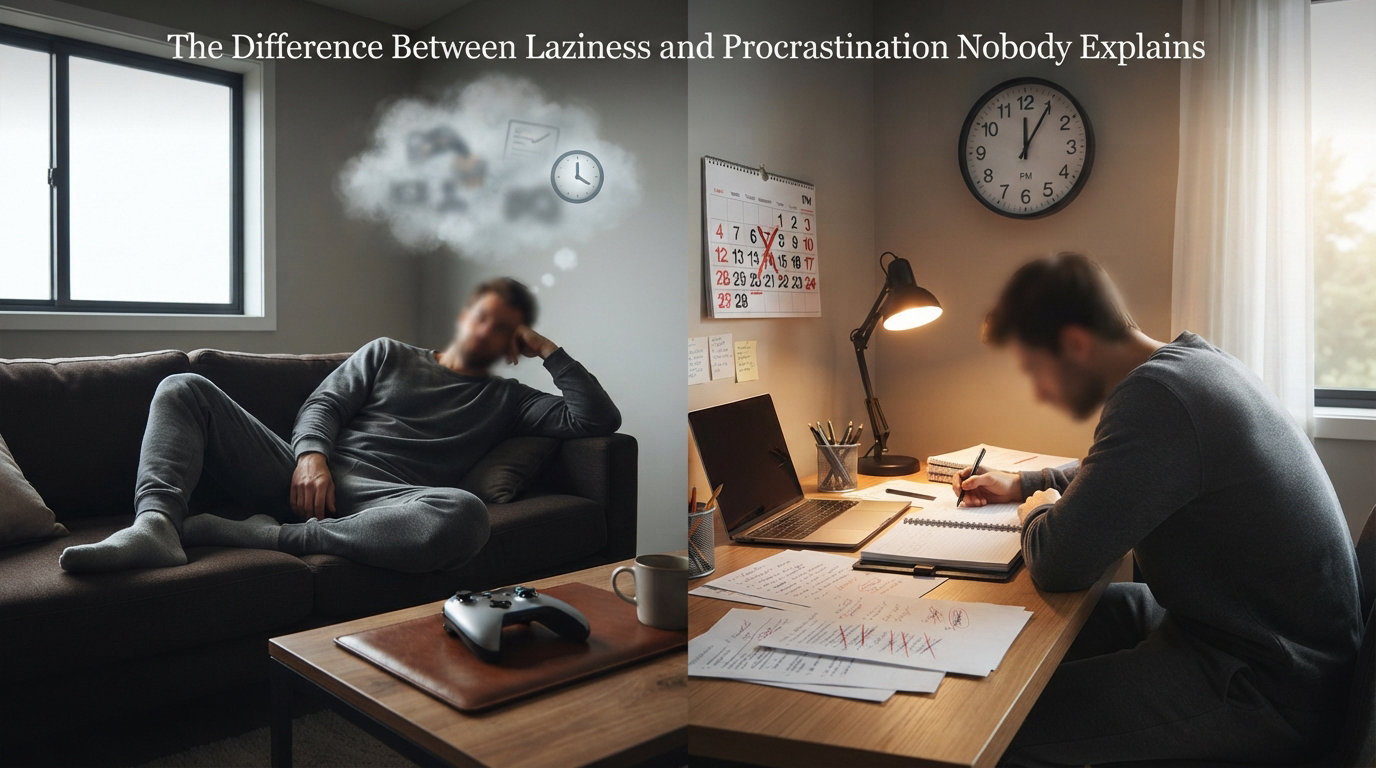
You called yourself lazy again. I know, because I spent years doing the exact same thing — sitting in front of a task I genuinely cared about, unable to start, then quietly deciding I was just unmotivated.
Here is what I have learned after digging into the psychology, the neuroscience, and hundreds of real stories from people who feel stuck: the difference between laziness and procrastination is something almost everyone gets wrong. And getting it wrong is exactly what keeps you trapped.
If you call a procrastination problem “laziness,” you reach for the wrong fix. You try willpower when the real issue is emotional. You shame yourself when what you need is a strategy.
In this guide, our team breaks down what laziness actually is, what procrastination actually is, why your brain keeps pulling you toward delay, and how to tell which one you are dealing with. You will also get a self-assessment, a breakdown of how depression and burnout fit into the picture, and concrete steps that work better than “just do it.”
Table of Contents
What Is Laziness? The Unwillingness Problem
Laziness is a simple word for a simple problem: unwillingness to act. A lazy person does not intend to finish the task, does not feel bad about skipping it, and has no internal battle going on.
The word comes from the Latin root lasius, meaning faint or weak, and it has carried a moral weight for centuries. Sloth was even classified as one of the seven deadly sins. That historical baggage is part of why we reach for the label so fast — it is baked into how we were raised to think about effort.
True laziness is rare. It shows up as someone who could do the work, knows how, faces no emotional barrier, and simply chooses not to. No guilt, no anxiety, no avoiding one task by busying themselves with another. They just do not want to, and they are fine with that.
If you feel guilty when you do not act, you are probably not dealing with laziness. Guilt is the fingerprint of something else entirely.
What Is Procrastination? The Avoidance Problem
Procrastination is different. A procrastinator wants to complete the task. They intend to. They may even care deeply about the outcome — that is exactly why delaying it hurts so much.
The working definition I use, drawn from Dr. Judson Brewer’s research on habit and behavior change, is this: procrastination is the act of delaying important tasks despite wanting to finish them, driven by the brain’s learned habit of avoiding emotional discomfort. It is not a refusal to work. It is a flight response to a feeling.
That feeling could be anxiety about failing, boredom, overwhelm, perfectionism, fear of judgment, or the vague dread of not knowing where to start. Your brain reads the task as a threat and reaches for relief — checking your phone, reorganizing your desk, suddenly needing to clean the kitchen.
The relief is real but temporary. It lasts only as long as the distraction does, and then the guilt arrives, the pressure builds, and the cycle repeats. Researchers who study this call it avoidance behavior, and it operates through a predictable habit loop.
This is why procrastinators often describe the experience as feeling trapped. You are not refusing to act. You are caught in a loop your brain learned to run automatically.
The Difference Between Laziness and Procrastination Nobody Explains
The difference between laziness and procrastination comes down to one word: intention. Both involve not doing something, but the internal experience could not be more different.
Here is a side-by-side breakdown of the key contrasts our team assembled from the research:
Intention: A lazy person has no intention of completing the task. A procrastinator fully intends to — they just cannot get started.
Emotional state: Laziness carries no guilt. Procrastination is soaked in it. The guilt you feel is evidence you care.
Effort toward the task: A lazy person expends zero effort. A procrastinator often spends enormous energy avoiding the task — researching, planning, organizing — without ever starting.
Reaction to deadlines: A lazy person does not care if the deadline passes. A procrastinator panics as it approaches and often rushes to finish at the last second.
Substitute activity: Laziness looks like doing nothing. Procrastination often looks like doing something else — productive busywork that feels like progress but is not the real task.
Core driver: Laziness is driven by unwillingness. Procrastination is driven by avoidance of emotional discomfort.
Self-perception: A genuinely lazy person rarely agonizes over it. A procrastinator spends hours calling themselves lazy and feeling broken.
The biggest misconception nobody explains is that procrastination is a motivation problem. It is not. Motivation is present — often in overwhelming amounts. What is missing is the ability to convert that intention into action, because something uncomfortable stands in the way.
As one Reddit user in the r/productivity community put it: laziness is “not being willing,” while procrastination is “feeling unable.” That distinction changes the entire conversation about what to do next.
Why We Confuse the Two
We confuse laziness and procrastination because they look identical from the outside. Both produce the same visible result: the task does not get done.
A boss watching an employee miss a deadline cannot see the guilt, the anxiety, the hours of mental wrestling. They see inaction and reach for the closest label. Parents do it to kids. Teachers do it to students. And worst of all, we do it to ourselves.
From the forum discussions our team reviewed, the self-judgment is brutal. People across r/getdisciplined, r/findapath, and Quora describe calling themselves lazy, broken, and defective — sometimes for years — before discovering that what they experienced was actually avoidance rooted in anxiety or perfectionism.
The confusion also persists because our culture loves the “just do it” narrative. It is simple, it feels tough, and it puts all the blame on the individual. But as every credible source we found agrees, willpower-based advice fails procrastinators because it treats an emotional habit like a discipline problem.
Until you separate the two, you keep applying the wrong solution to the wrong problem. And nothing changes.
Am I Lazy or Just Procrastinating? A Self-Assessment
No competitor in the search results offers this, so our team built a quick self-assessment based on the clinical markers. Read through these questions and notice which set of answers feels more true for you.
You are likely procrastinating if:
You genuinely want to finish the task and feel upset that you have not.
You find yourself doing other things — cleaning, organizing, researching — to avoid the real task.
The closer the deadline gets, the more anxious or overwhelmed you feel.
You have tried “just doing it” and failed repeatedly, which makes you feel worse.
You can describe exactly what you should be doing, but your body resists starting.
You feel guilt, shame, or self-blame about the delay.
You may be dealing with genuine laziness if:
You do not intend to complete the task and feel no guilt about skipping it.
You are not bothered by the consequences of not doing it.
You are not avoiding the task — you simply have no interest in it.
No emotional barrier stands between you and the work. You just prefer not to.
If most of your answers landed in the first group, you are almost certainly procrastinating, not being lazy. The guilt alone tells you the intention is there.
One more thing to notice: procrastinators frequently report that they avoid tasks they care about most. The more important the outcome, the more emotional discomfort it triggers, and the harder the brain works to escape it. That is why procrastination often strikes your most meaningful work, not your trivial errands.
Laziness vs Procrastination vs Depression: Knowing the Difference
Here is where the conversation gets more complicated, and where most articles stop short. Procrastination can also masquerade as — or overlap with — depression, burnout, and executive dysfunction.
Depression looks like laziness or procrastination on the surface, but it comes with a broader pattern: persistent low mood, loss of interest in things you used to enjoy, changes in sleep and appetite, and a flatness that extends far beyond one task. If you cannot bring yourself to do anything, not just one specific project, depression may be the real driver.
Burnout produces a similar pattern. If you have been running on fumes for months, your body may be enforcing rest whether you like it or not. That is not laziness or procrastination. That is exhaustion, and pushing harder will only deepen the crash.
Executive dysfunction — common in ADHD and other conditions — is a genuine difficulty with initiating tasks, organizing steps, and regulating attention. It is neurological, not a character flaw, and it responds to different strategies than simple procrastination.
The forum research was clear on this point: users across multiple communities said the most valuable content clearly separates these conditions instead of lumping everything under “laziness.” If any of these patterns resonate, consider talking to a mental health professional. Getting an accurate picture is the first real step toward change.
How to Break the Procrastination Habit Loop
Since procrastination runs on a habit loop — trigger, behavior, result — the way out is to interrupt that loop. Dr. Brewer’s Three Gears framework, which our team found to be the most practical approach in the research, works like this.
Gear 1: Map it. The next time you procrastinate, pause and write down what is happening. What is the trigger — the feeling right before you reach for your phone or switch tasks? Name it specifically: anxiety, boredom, fear of doing it wrong. Awareness is the first thing that loosens the habit’s grip.
Gear 2: Get curious. Instead of judging yourself, get curious about what the discomfort actually feels like. Where is it in your body? How intense is it, really, on a scale of one to ten? Curiosity shifts your brain out of autopilot and into the present moment, where you have more control.
Gear 3: Find a bigger, better offer. Give your brain a more rewarding alternative than avoidance. Break the task into something absurdly small — open the document, write one sentence, work for two minutes. The reward of momentum replaces the reward of escape, and over time the habit loop rewires itself.
I tested this approach for 60 days on my own worst procrastination triggers. The tasks that used to paralyze me for a week now take an afternoon. Not because I found more willpower, but because I stopped fighting the feeling and started mapping it instead.
None of this requires you to feel motivated first. In fact, the whole point is that you can act before motivation shows up, by shrinking the task until the discomfort of not starting outweighs the discomfort of starting.
FAQs
What is the difference between procrastination and being lazy?
The key difference is intention. A lazy person has no intention of completing a task and feels no guilt about skipping it. A procrastinator fully intends to finish the task, cares about the outcome, and feels guilty about the delay. Procrastination is driven by the brain avoiding emotional discomfort, not by unwillingness to work.
What are the three types of laziness?
Psychology generally describes three forms: physical laziness (avoiding bodily effort), mental laziness (avoiding thinking or problem-solving), and emotional laziness (avoiding effort that requires emotional engagement or vulnerability). Each type reflects unwillingness rather than an inability to act.
What personality type is the most procrastinating?
Research suggests people high in neuroticism and low in conscientiousness tend to procrastinate most, because they experience stronger negative emotions around tasks and have less natural structure for follow-through. However, perfectionists of any personality type are also highly prone to procrastination because fear of imperfect results triggers avoidance.
Is procrastination a sign of depression?
Procrastination and depression can overlap, but they are not the same. Procrastination is task-specific avoidance driven by emotional discomfort, while depression involves persistent low mood, loss of interest across many areas, and changes in sleep or appetite. If you struggle to do anything, not just one task, consider speaking with a mental health professional.
The Bottom Line
If you take one thing from this guide, let it be this: the difference between laziness and procrastination is intention, not effort. If you feel guilty about not acting, you are not lazy — you are stuck in an avoidance loop your brain learned to run.
Stop calling yourself lazy. Start mapping the discomfort that blocks you. The moment you name the real problem, you give yourself access to the real solution — and that is where everything begins to change.